





The CIA was watching China watch its psychics.
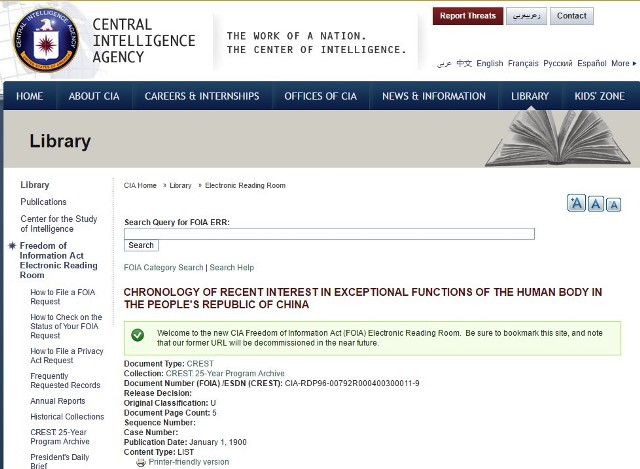
The document catalogued as CIA-RDP96-00792R000400300011-9 in the Agency’s declassified reading room is titled Chronology of Recent Interest in the Exceptional Functions of the Human Body in the People’s Republic of China and was produced by the CIA’s own research monitoring program tracking Chinese military interest in what the document calls exceptional human body functions, the Chinese institutional vocabulary for what American researchers called psi phenomena and what the Soviet program called biocommunication.
The document records an institutional trajectory: in 1979, Chinese scientists began publishing research on children with claimed exceptional abilities including the ability to read text sealed in containers without opening them. By 1981, more than a hundred research centers had been established across China specifically to study these abilities, staffed by more than a hundred formally trained academics. By 1982, the Chinese Academy of Sciences had organized a public hearing in Beijing attended by more than four thousand university professors to evaluate the evidence.
This is not the trajectory of a fringe research interest. This is the trajectory of a major scientific establishment responding to evidence it could not dismiss and resources it could not ignore.
The American research program, covered in this library’s Stargate piece, was running simultaneously. The Soviet program, whose existence was the primary motivation for American investment in the field, had been running since the 1960s. Three nuclear powers with the best available scientific talent and classified research budgets were all conducting parallel investigations of the same claimed human capabilities at the same time.
Whether the convergence reflects three separate establishments discovering genuine phenomena, three separate establishments falling for the same collective delusion, or three separate establishments monitoring each other’s research and investing to avoid falling behind in a capability race regardless of their private assessments of its validity, is the question that the multi-national institutional record raises.
Zhang Baosheng and the Sealed Container Research
The research subject whose findings the CIA reports covered most extensively is Zhang Baosheng, a Chinese man born in 1958 whose claimed abilities were investigated by Chinese military and academic researchers from the early 1980s through his formal incorporation into the People’s Liberation Army’s PSI research team in 1984.

The experimental protocol developed to test Zhang Baosheng’s claimed telekinetic abilities appears in the CIA monitoring reports with sufficient technical detail to evaluate the evidentiary quality of the findings.
The experimental protocol for the sealed container research used glass test tubes sealed with rubber stoppers and confirmed airtight before the experiment. Small objects were placed inside, including paper squares with printed characters, metal staples, and in some trials, live insects. Zhang Baosheng was positioned at a distance from the tubes and asked to cause the contents to move or exit the tubes without physical contact with the containers.
The recorded results, observed and noted by multiple researchers simultaneously using video recording from multiple angles, included the movement of paper squares within the sealed tubes, the exit of paper squares from sealed tubes whose seals showed no subsequent damage or alteration, the movement of metal staples within and out of sealed tubes, and the movement of live insects within and out of sealed tubes, with the insects surviving the process intact.
The protocol’s design, sealed containers, multiple simultaneous observers, video recording, and unpredictable objects like live insects, describes what a rigorous test would look like. Whether Zhang Baosheng’s actual performances met that standard needs a direct answer rather than an open question, because the historical record on Zhang specifically is considerably worse for the psychokinesis claim than this framing suggests. Zhang became one of the most extensively investigated and most extensively discredited figures of China’s qigong era. He was exposed by the Committee for the Scientific Investigation of Claims of the Paranormal in 1988, and subsequent investigation found that his most famous feats, including spoon-bending and reproducing effects similar to sealed-container object movement, were explainable through conventional sleight of hand. Crucially, accounts of his actual performance conditions describe him frequently leaving the room unattended during demonstrations, the opposite of the controlled, continuously observed conditions described here, and being accompanied by an entourage that provided distraction and false confirmation that a trick had succeeded even when it had not. He grew increasingly discredited through the 1990s as this pattern became clear to Chinese researchers themselves.
This does not mean the CIA’s monitoring reports are fabricated, they accurately record what Chinese military researchers believed and reported at the time, but it means Zhang Baosheng specifically should not be presented as the strongest evidentiary case here. The gap between what rigorous sealed-container protocols would require and what Zhang’s actual performance conditions are documented to have involved is exactly the gap that later exposed his work as conjuring rather than psychokinesis.
A second CIA document, CIA-RDP96-00792R000300390001-2, describes a separate protocol using a wooden cabinet as a sealed container rather than a glass test tube. The cabinet, described as 120 by 180 centimeters with a depth of 60 centimeters, had its door sealed before the experiment. Zhang Baosheng was reported to remove target objects from inside the closed cabinet and replace them elsewhere inside the cabinet without opening the door or producing damage to the cabinet.
Given the credibility problems specific to Zhang Baosheng detailed above, the cabinet protocol findings should be read with real skepticism rather than as an implication about the nature of spatial barriers themselves.
The CIA report’s own language for this conclusion is carefully non-committal: it records the observed findings without asserting their mechanism. The report is an intelligence product designed to record what the Chinese researchers found and what capabilities the Chinese military believed it was developing, not to make independent claims about the physics of consciousness.
The Institutional Convergence
The American Stargate program covered in this library’s dedicated piece was initiated in 1972 as a direct response to CIA intelligence about Soviet investment in psychic research. The institutional logic was straightforward: if the Soviet Union was investing classified resources in a phenomenon, the United States needed to know whether that phenomenon was real and what its military applications might be. The investment was risk management against a potential capability gap rather than a scientific conviction that the phenomenon existed.
The Chinese program recorded in the CIA monitoring reports shows the same institutional logic operating in a third national context: Chinese military investment in exceptional human body functions research was driven by the same combination of genuine scientific evidence that the researchers could not dismiss and strategic concern about potential military applications that policymakers could not ignore.
The Soviet program, the most extensively recorded of the three through both defector reports and CIA monitoring, included research programs at several Moscow-area institutes, with the most extensively recorded being the work at the Moscow Institute of Control Problems and the research on Nina Kulagina, the Russian woman whose claimed telekinetic abilities were studied by Soviet military researchers and captured in film footage that has been analyzed by multiple independent researchers.
The Kulagina films show objects moving on a table surface away from her hands without physical contact, under controlled conditions designed to eliminate obvious fraud mechanisms. The films have been analyzed by researchers who concluded that conventional fraud mechanisms, including hidden threads or electromagnets, were inconsistent with the observed object movements’ characteristics. They have also been dismissed by skeptics who argued that the experimental controls were insufficient to rule out sophisticated fraud.
Whether the Soviet, Chinese, and American programs were all investigating the same real phenomenon, all falling for sophisticated fraud by their research subjects, or some complex combination in which some subjects were genuine, some fraudulent, and the institutional machinery had insufficient methodological tools to reliably distinguish between them, is the question that the multi-national convergence makes more pressing than any single national program alone.
The probability that three separate military establishments with access to the best available scientific talent and the motivation to detect fraud would all simultaneously invest in a phenomenon that had no genuine effect is lower than the probability that any one of them would do so independently. Whether that probability is low enough to establish the phenomenon’s reality is the statistical question that the multi-national institutional record raises without resolving.
The Physics Problem
The source’s quote, attributed to a participant in the research tradition rather than to a named physicist in the available record, raises the physics problem that the psychokinesis findings most directly pose.
If physical objects can be moved through sealed containers without contact and without damage to the container, the physics of spatial barriers and material penetration as understood by quantum mechanics and classical mechanics is inadequate to account for the observation. This is not a minor anomaly. It is the violation of a principle, the impenetrability of matter, that is foundational to every engineering calculation and every chemistry experiment conducted in the history of science.
Whether the violation is genuine or apparent depends on the experimental quality. If the sealed container research protocols were genuinely fraud-proof and the observations are accurately reported, the physics implication is that either the standard model of matter and space is incomplete in a real and practically significant way, or there is a mechanism involving known physics, potentially quantum tunneling at macroscopic scales, that the standard treatments of quantum mechanics rule out but that has not been definitively excluded by experiment at the relevant scales.
Quantum tunneling is a recorded quantum mechanical phenomenon in which particles penetrate potential barriers that classical mechanics forbids. At the atomic and molecular scale, quantum tunneling is not only real but essential to numerous well established phenomena including nuclear fusion in stars, the operation of tunnel diodes in electronics, and the scanning tunneling microscope’s imaging capability. At macroscopic scales, quantum tunneling’s probability decreases exponentially with the object’s mass and the barrier width, becoming effectively zero for objects visible to the naked eye under any reasonable physical parameters.

Whether the Chinese sealed container research findings, if accurate, reflect macroscopic quantum tunneling at a probability that standard quantum mechanics predicts is effectively zero, or reflect a mechanism that quantum mechanics does not currently include, or reflect experimental error and fraud, is the physics question that the findings raise without resolving.
The CIA reports do not claim to answer this question. They record what the Chinese military researchers reported finding and what the Chinese military believed they were developing. Whether that belief was correct is the question that the documents raise and that the physics community has declined to engage with at the level of experimental resources that would be required to resolve it.
What Three Programs Established
The American Stargate program’s twenty-three-year history produced the most extensively recorded and independently reviewed body of psychic research evidence in any national program’s record. The congressional review conducted by the American Institutes for Research in 1995, which led to Stargate’s declassification and termination, is more divided than it is usually presented as being, and the library’s standard requires representing that division rather than the cleaner version. The review was authored jointly by statistician Jessica Utts and psychologist Ray Hyman, and the two reached genuinely different conclusions in the same official report. Utts concluded the statistical effect was real, consistent across laboratories, and not explicable as a methodological artifact. Hyman, reviewing the same data, did not dispute that the effect sizes were statistically consistent, but argued the apparent hits were better explained by vague, general reporting matched to targets through subjective validation than by a genuine paranormal effect, and that independent replication outside the small circle of labs that had produced the strongest results was still lacking. What both authors agreed on, and what actually drove the program’s termination, is that even if some effect were real, the intelligence remote viewing produced was too vague and inconsistent to be operationally useful.
The combination of Utts’s finding that the statistical effect was genuine, Hyman’s dispute of that interpretation, and both authors’ agreement that the operational usefulness was insufficient, is what the mainstream scientific community has treated as license to set the phenomenon aside: without a clear scientific consensus and without practical utility, there was little institutional pressure to pursue it further. Whether this institutional response is scientifically adequate, or whether an effect that one half of an official review found statistically real constitutes an unresolved scientific problem regardless of its practical utility, is the question that the institutional history raises.
The Chinese program’s findings, recorded in the CIA monitoring reports, represent an independent evidentiary base that the Western scientific community has essentially ignored because the research was conducted in China during the Cultural Revolution’s aftermath and was not published in Western peer-reviewed journals. Whether the methodological quality of the Chinese research is sufficient to treat its findings as independent corroboration of the American and Soviet results depends on the experimental details that the CIA monitoring documents partially preserve.

The Soviet program’s recorded findings, including the Kulagina films and the extensive institute-based research described in defector reports and CIA analysis, represent a third independent body of evidence from a research tradition with both the motivation to detect fraud and the institutional resources to do so.
Three programs, three countries, three decades, three independent bodies of evidence pointing at the same category of claimed human capability.
The phenomenon’s reality or non-reality has not been resolved by the available evidence. What the available evidence has established is that three of the most capable and most motivated institutional research programs in twentieth-century history all found sufficient evidence to sustain decades of serious investment.
Whatever they were investigating was real enough to keep three military powers looking. That same institutional seriousness, without independent public verification, characterizes the current UAP disclosure debate.