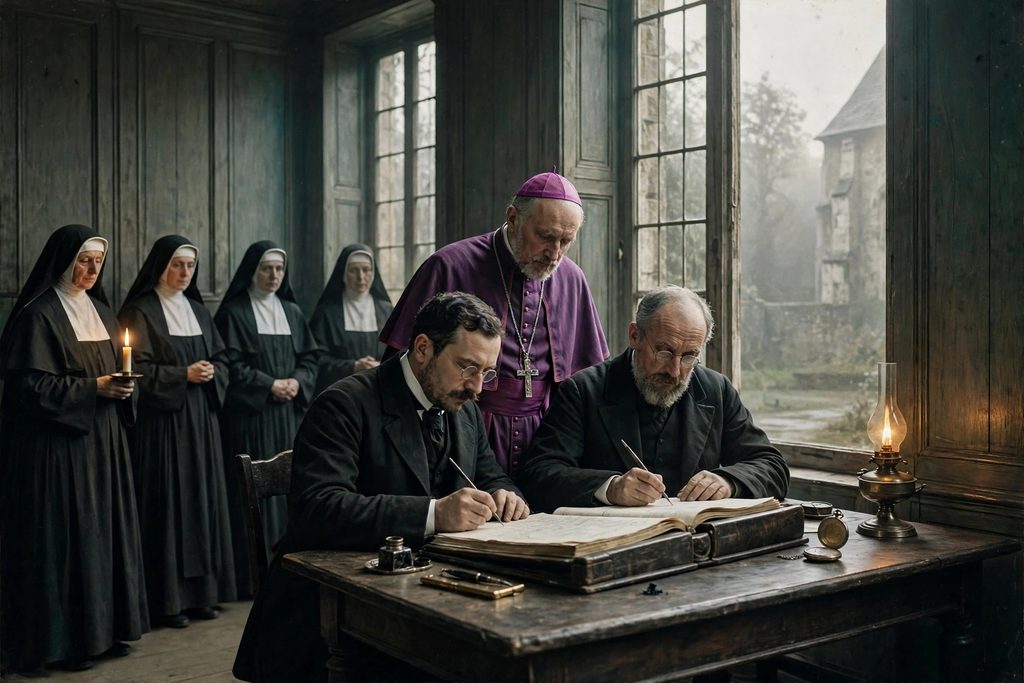
On 22 September 1909, in the convent of Saint-Gildard at Nevers, a small group gathered around a grave that had been closed for thirty years. The bishop was there, with members of a church tribunal, two doctors and the sisters of the community. They had come to identify the body of Sister Marie-Bernard, who had died in the convent infirmary on 16 April 1879 at the age of 35. The world knew her as Bernadette Soubirous, the miller’s daughter who had seen the Virgin in a grotto at Lourdes.
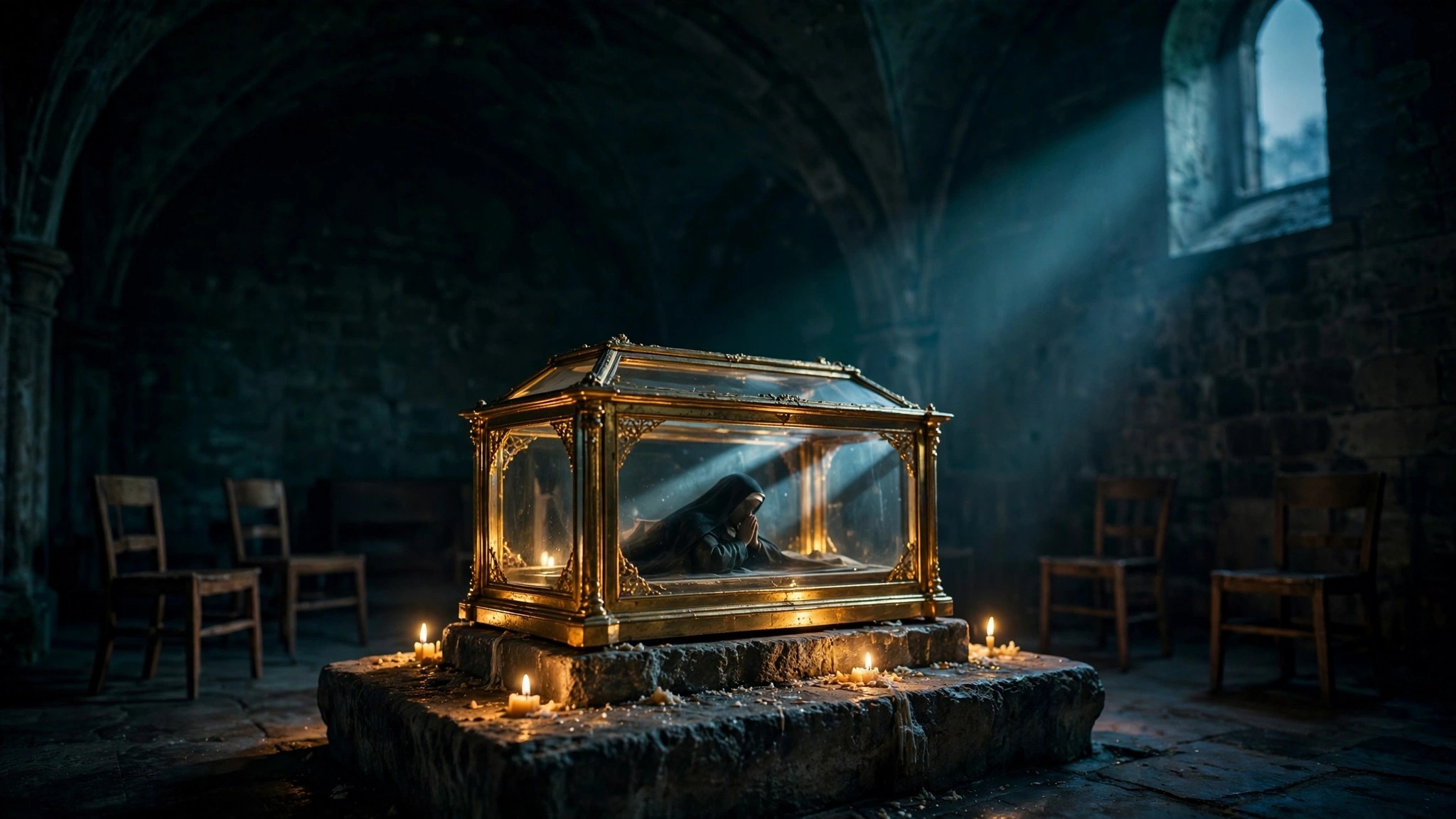
When the coffin was opened, there was no smell. The doctors found the body whole. The habit was damp, the rosary in her hands had rusted, but her skin was intact and the shape of her face could still be seen. The sisters washed the body, dressed it in a new habit and sealed it into a new double coffin. Ten years later it was opened again, and in 1925 a third time. By then she had been beatified, and her body was placed in a shrine of glass and gold in the convent chapel, where it lies today.
Tens of thousands of people come every year to look at her, a small woman asleep with her hands folded, apparently untouched by nearly a century and a half. She is the most famous of the incorruptibles, the bodies of holy men and women said to have resisted the decay that waits for everyone else. Their stories cross religions, from the convents of France to a Buddhist monastery in Siberia, and they remain among the strangest records that faith and medicine have ever kept side by side.
Three Openings at Nevers
The reports of the three exhumations survive, and they are more interesting than the legend. In 1909 the examining doctors, Jourdan and David, recorded a body in remarkable condition with no odour of decay. Even the Catholic account of the event, published by the broadcaster EWTN, notes that the preservation was “not a ’miracle’ in the strictest sense.”
In April 1919 two other doctors, Talon and Comte, examined the body separately and filed matching reports. It was now, they wrote, “practically mummified,” and patches of mildew and a layer of salts had formed on the skin, probably a result of the washing ten years earlier. In April 1925 the same two doctors returned, and Dr. Comte removed relics to send to Rome and to Lourdes, among them fragments of two ribs, both kneecaps, muscle from the thighs, and pieces of the diaphragm and liver. He wrote that the body was intact and the skeleton complete, and he noted the liver in particular, which he found soft and almost normal in consistency, in an unexpectedly good state after forty-six years.
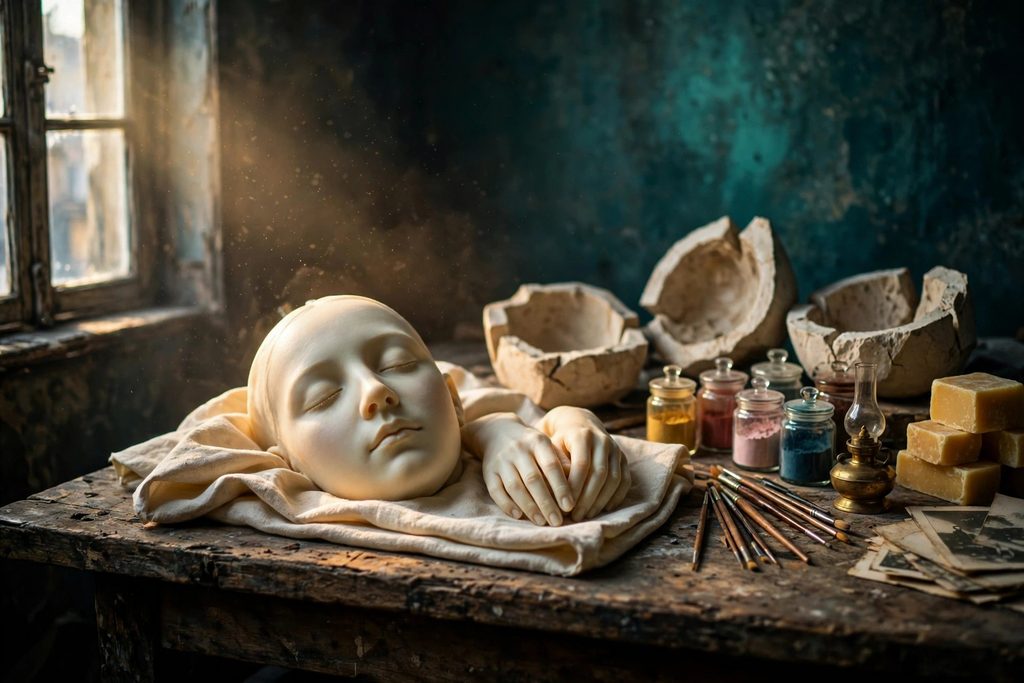
Then came a detail that rarely makes it into the stories. The face had darkened and the eyes and nose had sunk. Fearing that its appearance would make “an unpleasant impression on the public,” the authorities had the Paris firm of Pierre Imans, makers of fine wax figures, prepare light wax masks of the face and hands from moulds and photographs. A sculptor fitted them in July 1925. What pilgrims see at Nevers is Bernadette’s preserved body, wrapped in bandages, with her face and hands made of wax.
None of that makes the case ordinary. A body buried in a damp grave for thirty years should not have emerged with its skin and organs present, and three separate examinations found that it had. The mystery of Nevers is real enough without the mask, and harder to see with it.
The Church’s Own Caution
For centuries the Catholic Church treated an incorrupt body as a sign of holiness, and at one time it counted incorruptibility among the miracles that could support a cause for canonisation. That practice has long since ended. Today incorruptibility is not required for sainthood and is not accepted as a miracle in the process. Bodies that were embalmed are not considered incorrupt at all. Monsignor Robert Sarno, a longtime official of the Vatican’s office for the causes of saints, has been blunt about it, attributing slow decay to environmental conditions and to what science now knows about decomposition.
The Church’s caution has grown with each modern opening. When the body of Padre Pio, the Capuchin friar who died in 1968, was exhumed in 2008, officials described it as in “fair condition.” The face was too decomposed to display, so a London company that makes lifelike museum figures produced a silicone mask. When the tomb of the young Italian Carlo Acutis was opened, the Bishop of Assisi said the body “was found in the normal state of transformation typical of the cadaveric condition” and that a silicone reconstruction had been used on the face. The body of Pope John XXIII, found intact when it was exhumed in 2001, had been embalmed and sealed in a triple coffin with little oxygen.
What Preserves a Body
Decomposition is not a single process. It is a contest between the body’s own enzymes, the bacteria within it, the insects and microbes around it, and the conditions of the grave. Change the conditions and the contest changes.
Dry, cold or salty conditions can halt decay altogether and leave a mummy, the skin drawn tight over bone. Damp, cool, airless graves can produce something stranger. Fat in the body slowly turns into adipocere, a pale, waxy, soap-like substance that can hold the shape of a face and limbs for decades or centuries. Sealed lead or zinc coffins, lime, clay soils and cold crypts all slow decay. And through much of European history the bodies of important people, saints included, were embalmed, sometimes with aromatic resins and salts, sometimes with methods that were later forgotten.
That last point has surprised researchers more than once. Saint Margaret of Cortona, who died in 1297, was long venerated as incorrupt, until examination showed that she had been embalmed at her devotees’ request, a fact lost over the centuries. Italian paleopathologists, among them Ezio Fulcheri at the University of Genoa, have spent decades studying the bodies of saints and found every kind of preservation, natural mummification, deliberate embalming, later restoration and the wear of repeated handling and display.
Yet not every case dissolves under study. Scientists who examined Saint Zita of Lucca, a household servant who died in the thirteenth century, found no sign of human intervention in her preservation. The American writer Joan Carroll Cruz, whose 1977 book The Incorruptibles catalogued 102 cases, argued that many bodies lacked the rigidity of mummies, that most came from orders that forbade embalming, and that some were found in conditions that should have destroyed them, such as Saint Charbel Makhlouf of Lebanon, whose body was reported floating in mud in a flooded grave. Her book is a work of devotion, not of forensic science, but the cases she gathered still wait for a full scientific accounting.
Two of the oldest stories show why. In 1599, during restoration work at the church of Santa Cecilia in Trastevere in Rome, the coffin of Saint Cecilia, a martyr of the early Church, was opened in the presence of witnesses, who reported her body lying on its side as if asleep, more than a thousand years after her death. The young sculptor Stefano Maderno carved her in marble exactly as he was told she lay, her face turned away, and the statue still rests beneath the altar. No one today can examine what the witnesses saw.
The second lies in Goa, on the west coast of India. Saint Francis Xavier, the Jesuit missionary, died in 1552 on the island of Shangchuan off the coast of China, and his body was buried in quicklime, which was used to speed the destruction of flesh. When it was dug up months later to be carried to India, it was reported to be fresh. Devotion took its toll. A pilgrim is said to have bitten off one of his toes in 1554, and in 1614 his right arm was removed and sent to Rome. Today what remains of him lies in a silver casket in the Basilica of Bom Jesus, brought down for public veneration roughly once a decade, dark, dried and much diminished, but still drawing hundreds of thousands of pilgrims.
Beyond the Catholic World
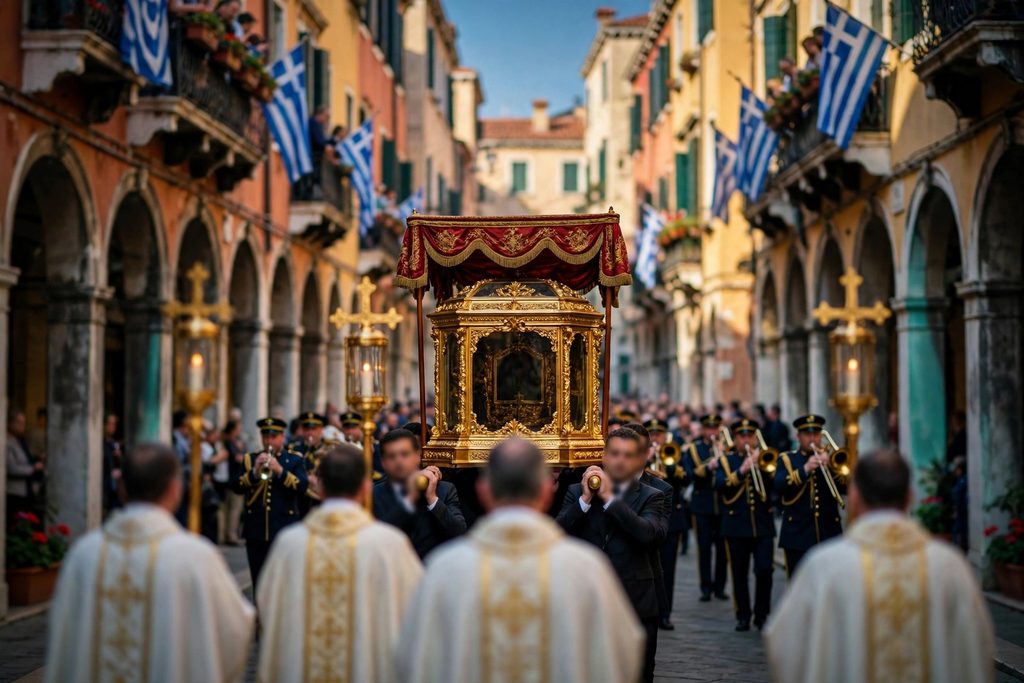
The incorruptibles are not only Catholic. In Orthodox Christianity the relics of saints have been venerated for well over a thousand years, and the tradition draws its own careful line between natural mummification and true incorruption. In Greece the most beloved of them lies on Corfu. Saint Spyridon, a fourth-century bishop from Cyprus, rests in his church in Corfu town, and several times a year his body is carried through the streets in procession, upright in a glass-fronted casket, as the island gives thanks for deliverance from plague and siege.
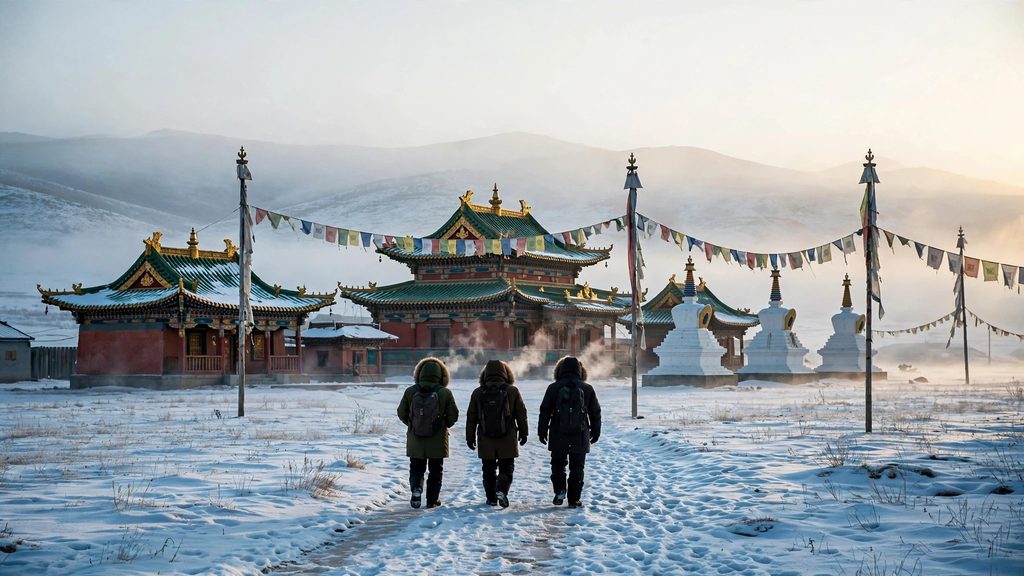
The most extraordinary case outside Christianity is in Siberia. Dashi-Dorzho Itigilov was the Pandito Khambo Lama, head of the Buddhists of the Russian Empire, appointed in 1911, and he took part in the celebrations of the Romanov dynasty’s three hundredth anniversary in 1913. In 1927, at the age of 75, he sat down in the lotus position, asked his students to meditate with him, and died. As his testament instructed, he was buried seated, in a pine box. Accounts say the body was packed in salt.
His followers secretly opened the grave in 1955 and again in 1973, hiding their findings from Soviet authorities, and reported both times that the body showed no signs of decay. On 11 September 2002 the monks exhumed him formally and carried him to the Ivolginsky monastery near Ulan-Ude, where he sits behind glass and is shown to pilgrims on a few days each year, his eyes and nose sunken, his body slumped slightly forward.
That November the forensic expert Viktor Zvyagin, of Russia’s Federal Centre of Forensic Medicine, examined the body and took samples of hair, skin and nails for analysis in Moscow. He told reporters that the body was in the condition of someone who had died about 36 hours before. He also said that preserved bodies he had encountered were usually the result of mummification or extreme environmental conditions, and that this case was “something different, and for me, incomprehensible.” His findings were reported through interviews and press accounts rather than a full published study, and the dry, salt-packed burial in Siberian ground offers natural explanations that have never been fully tested. To his followers, Itigilov has not died at all, but rests in a deep meditative state from which he will one day return.
Buddhism has another tradition that shows what deliberate preparation can achieve. In the mountains of Yamagata in Japan, Shingon monks known as sokushinbutsu spent years on a severe diet of nuts, bark and roots, sometimes drinking a tea made from the sap of the lacquer tree, before entering a sealed underground chamber to meditate until death. Some of their bodies emerged mummified years later and are still venerated. Their preservation was the result of an intention carried out with terrible discipline over a lifetime.
The Angel Question
This page began its life as a review of a book about angels. In 1993 the French journalist Pierre Jovanovic published an inquiry into guardian angels, gathering accounts of people who said a protective presence had saved them from accidents and of patients who described a being of light during near-death experiences. The old version of this file tried to join the two subjects, arguing that the people whose bodies resisted decay were those who had lived in closest contact with angelic beings, and that their contact had somehow changed their flesh.
The idea has a poetic logic, but the record does not support it. Bernadette saw a vision she described as a young lady, not an angel, and her face blackened in the grave. Padre Pio, who spoke for fifty years of conversations with his guardian angel, needed a silicone mask in 2008. Saint Zita was a servant known for her charity, not for visions. Itigilov’s tradition has no angels. The connection between contact and preservation exists mainly because the same institution investigated both, and recorded both in the files of the same people.
The near-death experience is a serious subject in its own right. Raymond Moody popularised the “being of light” in 1975. In 2001 the Dutch cardiologist Pim van Lommel reported in The Lancet that 62 of 344 cardiac arrest survivors, about 18 percent, described a near-death experience. The AWARE studies led by Sam Parnia have since tried to test whether awareness can continue during cardiac arrest, and in 2023 they reported signs of organised brain activity in some patients during resuscitation, as late as an hour into CPR. What these experiences are remains one of the most debated questions in medicine. They are explored on their own terms elsewhere in the archive, in our file on the Greek underworld and its judges of the dead, and they need no help from the incorruptibles.
Why the Incorruptibles Still Matter
Seen whole, the incorruptibles form a spectrum. At one end are bodies that were embalmed, restored and fitted with wax or silicone, and whose fame outran their condition. At the other are a handful of cases, Bernadette’s organs after forty-six years, Zita without embalming, Itigilov in his Siberian grave, where natural explanations are plausible but have never been fully demonstrated, because the bodies are relics and are rarely examined with the full tools of forensic science.
Human beings have always read meaning into how the dead endure. The same instinct runs through the stories of Akita’s weeping statue and of the preserved dead of the Caucasus at Chegem, and in the oldest religions humans built. A body that will not decay looks like a promise, that what was good in a person was too strong for death to unmake. The pathologist sees soil, temperature, fat and salt. The pilgrim sees a sign. At Nevers, both are looking at the same small figure behind the glass.
The Verdict | Disputed
The incorruptible bodies exist, and their preservation has been recorded by doctors over more than a century. Many cases owe their condition to embalming, burial conditions or restoration, and the most famous faces on display are wax and silicone. A few cases remain unexplained in detail, because the bodies have never been studied with modern forensic methods. The claim that their preservation was caused by contact with angels or by spiritual states has no support. Whether any of them escaped decay by means beyond nature is a question on which the Church itself now declines to rule. The verdict is Disputed.
For how this verdict sits beside the rest of the archive, see the Verdict Index.