Eternal Branches and Why We Can’t Die – The Quantum Immortality That Haunts Every Shadow of Death

19 Min Read

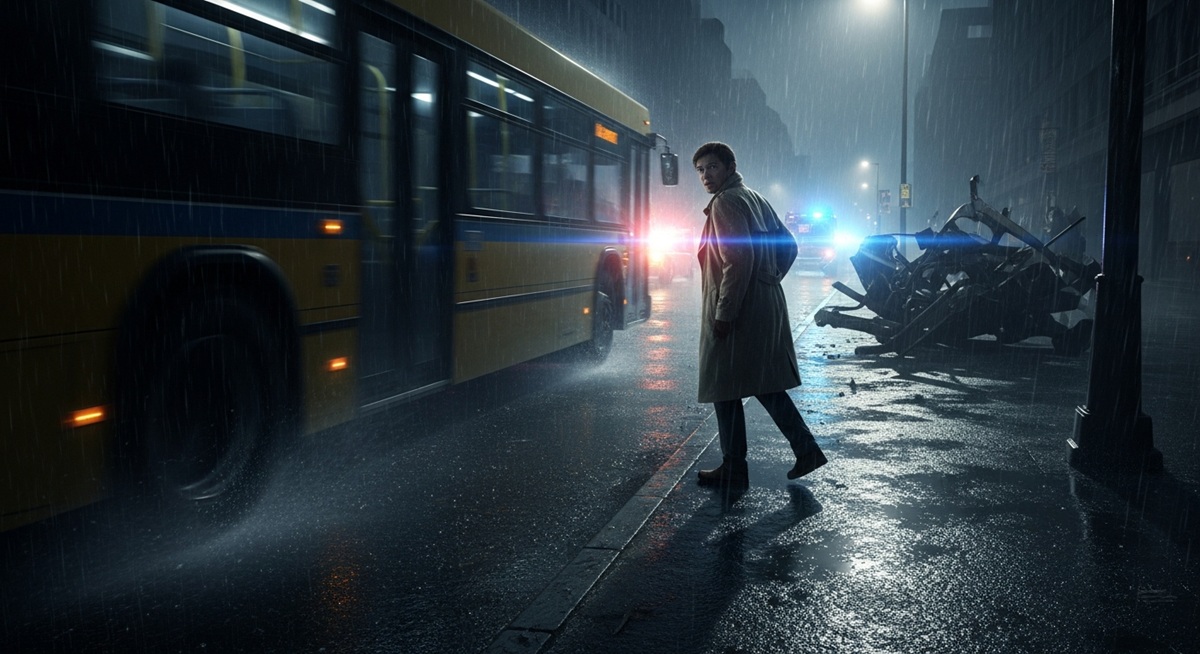
In the dim flicker of a rain-slicked streetlight, a figure steps off the curb just as the world erupts into chaos. Tires screech like the wail of forgotten ghosts, metal twists in a symphony of near-annihilation, and for a split second, the boundary between existence and oblivion blurs into nothingness. The impact never lands. The bus hurtles past, a phantom in the downpour, leaving only the echo of a heart pounding against ribs that refuse to shatter. Was it luck? Divine intervention from some indifferent cosmos? Or something far stranger—a silent decree from the multiverse itself, ensuring that this thread of awareness endures, weaving onward through the labyrinth of what-ifs?

This is the enigma of quantum immortality, a concept that doesn’t promise resurrection but whispers that death, in its cruel finality, might be nothing more than an illusion for the observer who persists. It’s a idea born from the cold precision of equations, yet it drapes the fabric of reality in shadows of the uncanny, inviting us to question whether the self we cling to is truly fragile, or an eternal wanderer in branching infinities.

Shadows in the Quantum Veil

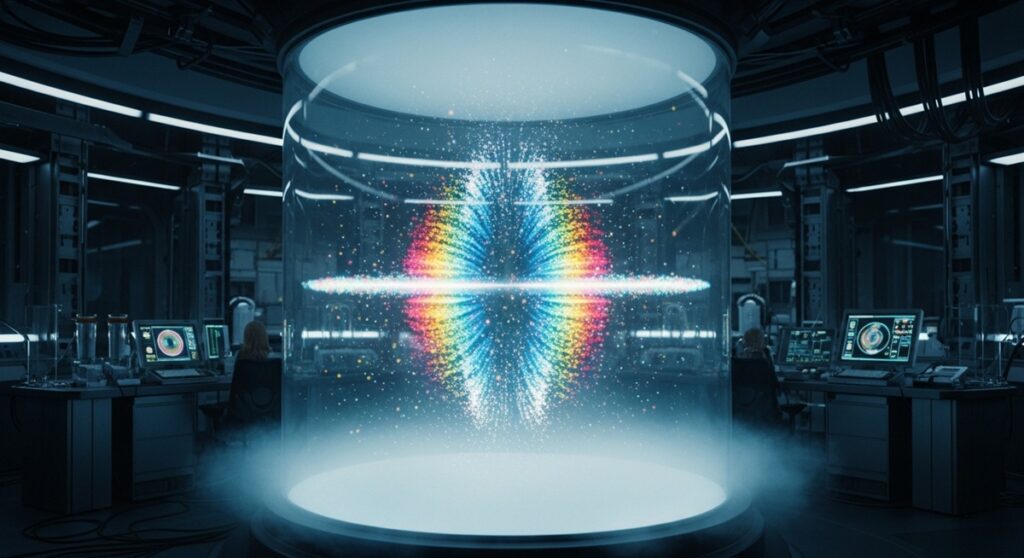
Beneath the surface of our everyday world, where coffee steams in mugs and deadlines loom like storm clouds—lies a realm governed by rules that defy the tidy logic of cause and effect. Quantum mechanics, that arcane architecture of the subatomic, reveals a universe not of solid certainties but of shimmering possibilities. Picture the double-slit experiment, a deceptively simple setup that has haunted physicists since the early 20th century. Fire electrons at a barrier pierced by two narrow openings, and instead of drilling straight through like obedient bullets, they dance. They interfere with themselves, etching patterns on the far wall as if each particle has splintered into a wave, slipping through both slits simultaneously, only to recombine in a schematic of probability.

- Signal Intercept -
quantum immortality the uncanny illusion 1

This isn’t parlor trickery; it’s the essence of superposition, where entities exist in multiple states at once until the act of observation forces a reckoning. A single electron, that fleeting speck of matter, embodies every potential path until the moment of measurement collapses the wave function into one stark outcome. And here’s the vertigo-inducing twist | this weirdness isn’t confined to the infinitesimally small. Massive molecules, chains of thousands of atoms, have been coaxed into exhibiting the same wave-like behavior in laboratories, hinting that the quantum strangeness permeates upward, threading through the very air we breathe, the cells that pulse in our veins. Decoherence, that subtle thief of wonder, is what masks it all, the relentless chatter of environmental interactions that smears the delicate interference, rendering our macro-world into the illusion of solidity we navigate daily.

Yet in the quiet spaces between particles, the implications simmer. If reality at its core is a symphony of overlapping potentials, then every choice, every quantum fluctuation, births not a single path but a fractal explosion of them. This is etched into the mathematics of the Schrödinger equation, which charts the evolution of these probabilistic waves with elegant inevitability. Heisenberg’s uncertainty principle adds its own layer of cosmic mischief, declaring that precision in one aspect—position, say—demands vagueness in another, momentum. It’s not a flaw in our tools but a fundamental decree | the universe abhors absolute knowledge, preferring the haze of the indeterminate. In this veiled domain, the seeds of quantum immortality take root, suggesting that what we call “reality” is but one sliver of a vast, unseen mosaic.

The Forked Paths of Reality

At the heart of quantum immortality pulses the many-worlds interpretation, a theory proposed by Hugh Everett in 1957 that upends the orthodox tale of quantum collapse. In the Copenhagen interpretation, dominant for decades, the universe plays a game of chance | the wave function, that ghostly ledger of all possibilities, endures until scrutiny intervenes. Then, with a dramatic flourish, it snaps into a single state—the particle lands here, not there; the die rolls a six, not a one. It’s as if the cosmos, caught in the headlights of observation, freezes in embarrassment, selecting one reality from the ether.

quantum immortality the uncanny illusion 2

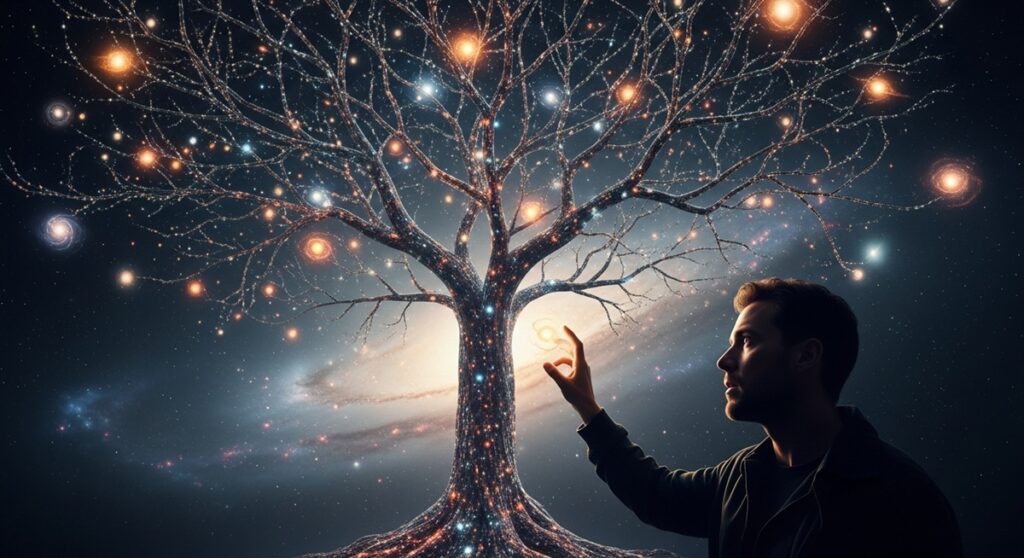
Everett, a young physicist weary of such anthropocentric sleight-of-hand, offered a bolder vision. No collapse occurs, he argued. Every outcome unfolds, not in sequence but in parallel, splintering the universal wave function into an ever-branching tree of worlds. You, reading these words, perceive only your branch, the one where the coffee didn’t scald your tongue or the email arrived on time. But in the adjoining limbs of the multiverse, alternatives bloom unchecked | the scalded tongue, the delayed message, the paths untaken. This isn’t poetic fancy; it’s a rigorously mathematical framework, sidestepping the measurement problem by positing that all worlds are equally real, equally governed by the same deterministic laws. The branching isn’t random chaos but a precise unfolding, hidden from view by the veil of locality.

Everett’s Radical Vision

Everett’s idea arrived like a thunderclap in a storm of postwar quantum debates, challenging the priesthood of physics with its unflinching materialism. Why invoke a special role for observers, he asked, when the equations themselves suffice? The wave function evolves unitarily, without interruption, birthing infinities from every quantum fork. Critics dismissed it as extravagant—why multiply universes by the trillions when one will do? Yet in the decades since, the many-worlds interpretation has clawed its way into respectability. Proponents like David Deutsch and Sean Carroll champion it as the cleanest resolution to quantum paradoxes, free from the ad-hoc mysticism of collapse. Decoherence, once a foe, now serves as an ally, explaining why branches rarely tangle | interactions with the environment entangle systems, rendering parallel worlds effectively isolated, their inhabitants blind to the others.

In this framework, quantum immortality emerges as a stark corollary. If every possibility manifests, then for any event teetering on the edge of lethality—a heart faltering mid-beat, a fall from a precipice—there exists a branch where survival prevails. Consciousness, that elusive spark, doesn’t defy death; it simply adheres to the branches where continuity persists. The theory doesn’t resurrect the fallen but ensures the observer’s thread never snaps entirely. It’s a cold comfort, laced with dystopian undertones | an eternity of near-misses, where the weight of accumulated survivals might erode the soul long before the body yields.

- Signal Intercept -

Whispers of the Undying Mind

Consider the physicist Max Tegmark, a mind sharpened on the whetstone of cosmology, who once found himself ensnared in a vehicular ballet of doom. Tires locked on black ice, the world tilted into slow-motion apocalypse, and in that suspended breath, Tegmark glimpsed the abyss. The car spun, grazed disaster, and righted itself, a miracle of physics or fate? Years later, reflecting on that brush with oblivion, he couldn’t shake the shadow of the multiverse. In some branches, the spin ended in crumpled metal and silence; in this one, he emerged unscathed, pondering the implications over a desk cluttered with equations.

Tegmark’s encounter is a personal echo of the theory’s core. Quantum immortality posits that subjective experience— the relentless “I” that awakens each dawn—tracks the lifeline of persistence. Rooted in the observer’s role within quantum mechanics, it suggests consciousness isn’t a passive passenger but an active filter, manifesting only in worlds compatible with its endurance. This ties into deeper riddles | Is the brain a quantum organ? Theories like those of Roger Penrose and Stuart Hameroff speculate that microtubules within neurons exploit superposition for computation, enabling the non-algorithmic leaps of thought. Evidence remains scant—quantum effects in warm, wet biology decohere swiftly—but the possibility lingers, a specter in the neural fog.

Envision it | your thoughts as fragile waves, branching at every synaptic fork, some extinguishing in the dark, others flickering onward. In the multiverse’s grand archive, every version of you endures in some ledger, but the “you” that reads this sentence is the survivor, the one who dodged the bullet—or the bus, or the aneurysm. It’s not immortality as elixir or afterlife, but as inexorable selection | the cosmos, in its infinite sprawl, conspires to keep the witness alive, if only to bear the burden of endless tomorrows.

The Eternal Observer

quantum immortality the uncanny illusion 3

No parable captures this spectral dance quite like Schrödinger’s cat, that infamous feline boxed with poison and peril. Seal the container with a radioactive trigger poised to release death, and quantum logic decrees the cat exists in limbo—alive and dead, superimposed until the lid lifts. Open it, and reality resolves | a purr or a corpse. But in the many-worlds lens, no such violence occurs. The box divides the world | one branch cradles a living cat, purring against your hand; another mourns its still form. You, the observer, split too, one version stroking fur, the other burying regret.

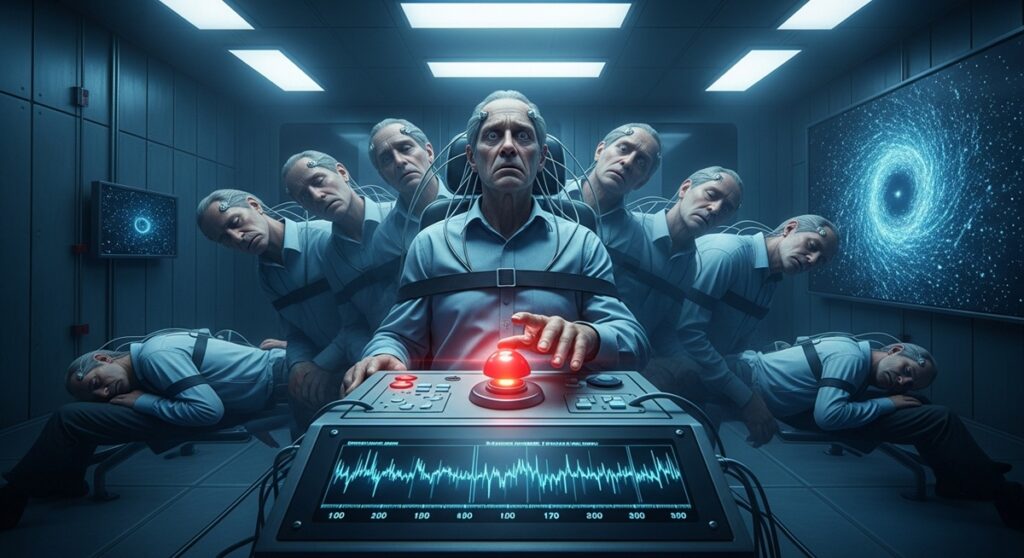
Erwin Schrödinger meant it as satire, a jab at quantum absurdity, but it endures as a gateway to immortality’s whisper. Extend the thought | replace the cat with a human heart, the poison with a firing squad. Tegmark refined this into his quantum suicide apparatus—a device with escalating lethality, coin-flip chances of oblivion at each pull. In half the branches, demise claims you swiftly; in the survivors, the odds compound, yet experience marches on. You pull the trigger once, twice, a dozen times, always emerging into the live round’s shadow. To the outside world, you’re long gone; subjectively, you’re the undying gambler, consciousness leaping the chasm to the next safe shore.

This isn’t heroism or hubris—it’s the inexorable logic of infinity. In a multiverse without end, rarity becomes inevitability | no matter how improbable the survival, some branch harbors it, and that’s the one your awareness claims. The dystopian chill seeps in here, though. What of the aged shell, racked by decay, clinging to a threadbare existence in the last viable world? Quantum immortality offers no mercy, only prolongation—a spectral vigil in a reality stripped bare.

Fractured Selves | The Pillars of Immortality

For quantum immortality to hold its ground amid the philosophical tempests, it demands assent to three precarious pillars, each a battlefield of intellect and intuition. First, the many-worlds interpretation must reign supreme, its branching infinities not mere conjecture but the true topology of existence. Detractors decry the ontological excess—untold universes for every quantum hiccup—but proponents counter with elegance | it resolves paradoxes without invoking untestable collapses, aligning seamlessly with relativity’s block-universe sprawl.

- Signal Intercept -
quantum immortality the uncanny illusion 4

Second, consciousness must entwine with quantum states, not as emergent classical byproduct but as a rider on the wave function’s crest. This flirts with panpsychism’s fringes, where mind permeates matter, or Penrose’s orchestrated objective reduction, positing gravity-induced collapses that birth awareness. Skeptics balk— the brain’s thermal noise should drown quantum coherence—yet anomalies persist | avian navigation via entangled radicals, photosynthetic efficiency defying entropy. If mind rides the quantum tide, then its continuity across branches isn’t metaphor but mechanism.

Third, and most elusive, the self must preserve continuity through the forks—a thread of identity weaving the splinters. Philosophers like Derek Parfit probe this with teletransportation thought experiments | are you the same “you” after atomic disassembly and reassembly? In the multiverse, branches diverge gradually, identities overlapping like fading echoes, but the illusion of unity holds. Challenge any pillar, and the edifice crumbles; uphold them, and immortality gleams, unfalsifiable and thus immune to empirical daggers. It’s a fortress of logic, impervious yet isolated, taunting us with truths we can neither grasp nor discard.

Echoes from the Void | Criticisms and Shadows

Quantum immortality drifts in the penumbra of science, revered by some as provocative elegance, dismissed by others as intellectual quicksand. Critics, from David Albert to Sabine Hossenfelder, brand it a parlor game—untestable, unfalsifiable, a siren song luring minds from verifiable frontiers. How to probe a hypothesis that thrives on the observer’s survival bias? Propose an experiment, and in the branches where it succeeds, you’re there to applaud; in the failures, silence reigns. It mocks Popperian rigor, existing in the realm of gedanken, those ethereal what-ifs that illuminate without illuminating.

Yet the many-worlds foundation gains traction, bolstered by quantum computing’s triumphs | qubits juggling superpositions, algorithms sifting parallel computations. If machines harness branching realities, why not minds? The theory’s charm lies in its austerity, no special pleading for consciousness, no hidden variables, just the raw churn of the wave function. Still, shadows loom | does it erode free will, rendering choices illusory echoes? Or exalt it, multiplying agency across infinities?

Historical Hauntings

Gaze backward, and the multiverse’s fingerprints smudge history’s pages. The Cuban Missile Crisis of 1962 | submarines teetering on launch codes, a single twitch away from nuclear Armageddon. We inhabit the branch of restraint, diplomats’ whispers averting the blaze. But in adjacent worlds, missiles arc skyward, cities vaporize in thermonuclear dawn. Our survival isn’t providence but selection, the consciousness that ponders this text excludes the ash-choked voids. Similarly, every pandemic dodged, every asteroid swerve, carves our timeline as the improbable survivor. It’s a haunting symmetry | the past, too, branches, and we tread the path of the living, ghosts of the dead haunting unseen realms.

Beyond the Veil | What It Means for the Mortal Coil

quantum immortality the uncanny illusion 5

Quantum immortality doesn’t hawk eternal youth or paradisiacal afterlives; it’s a subtler venom, promising not bliss but boundless endurance. In each moment’s quantum lottery, awareness claims the winning ticket, perpetuating the self through frailties that would fell lesser threads. Imagine the toll | a body crumbling under entropy’s siege, mind intact in the sole branch where synapses fire on. It’s dystopian immortality, a solitary march through desolation, where joy’s peaks sharpen against despair’s valleys. Philosophers like Nick Bostrom extend this to simulation arguments—perhaps we’re already in such a curated reality, pruned of dead ends.

- Signal Intercept -

For the collective, it refracts mortality’s mirror | grief for the departed becomes echo of branches unlived, empathy a bridge to parallel pains. Ethically, it tempts recklessness—why fear the fall if survival awaits?—yet tempers with the subjective horror of accumulated scars. Science views it askance, a spark for papers on quantum Darwinism, where classicality emerges from quantum noise. Yet in the quiet, it stirs deeper currents | What defines the “I” if selves proliferate endlessly? Is death’s sting dulled, or amplified by infinities of loss?

Lingering in the Branches

As the multiverse’s branches sway in unseen winds, quantum immortality leaves us suspended—not in terror, but in a profound, uneasy awe. It doesn’t solve the riddle of existence but reframes it, casting the self as an indomitable navigator through probabilistic seas. In the hush of midnight doubts, it beckons | What near-misses have you already outlived, what futures flicker just beyond the veil? The equations offer no solace, only the stark beauty of persistence amid chaos. Perhaps the true mystery isn’t survival’s guarantee, but the fragile wonder of awareness itself— a fleeting light refusing extinction, illuminating shadows we may never cross. Dare to peer into those forks, and the world unfolds not as cage, but as labyrinthine invitation, where every breath defies the void.

Share This Article
Leave a Comment