



The sound arrived before anyone knew what had made it.
On the morning of August 27, 1883, police sergeant James Cummins on the island of Rodrigues, near Mauritius in the Indian Ocean, heard what he described as the distant roar of heavy guns from the eastward. He logged it in the official record. The sound he heard had traveled 4,800 kilometers from the Sunda Strait between Java and Sumatra, where the island of Krakatoa was tearing itself apart.
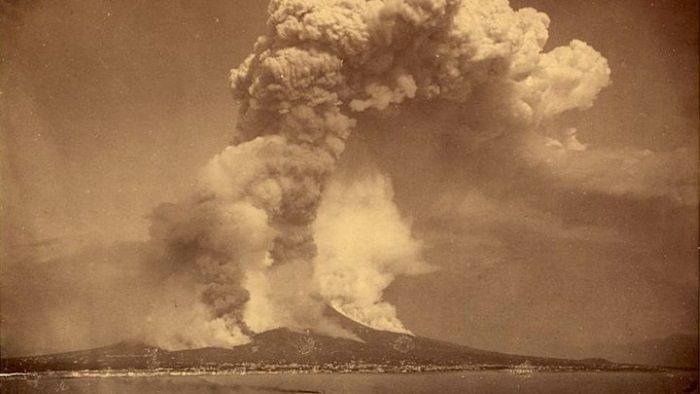
No explosion in recorded human history has been heard from a greater distance. The Krakatoa detonations of August 27, 1883 were heard from the Australian continent to the east and from the island of Rodriguez to the west, across an arc of approximately 8 percent of Earth’s surface. Barometric pressure fluctuations produced by the eruption were detected by weather stations around the world and were recorded as the atmospheric shock wave passed, seven times, as it circumnavigated the globe.
The eruption’s energy has been estimated at approximately 200 megatons of TNT equivalent, approximately 13,000 times the yield of the Hiroshima atomic bomb. The eruption column reached approximately 80 kilometers into the atmosphere, penetrating the stratosphere and injecting an estimated 20 cubic kilometers of volcanic material into the upper atmosphere. The caldera collapse that ended the eruption sequence dropped the northern two-thirds of Krakatoa island into the sea, producing tsunamis that reached 30 meters in height and swept the coastlines of Java and Sumatra.
The death toll was 36,417 recorded individuals, the majority killed by the tsunamis rather than by the eruption itself. The towns of Merak, Teluk Betung, and Ketimbang were destroyed completely. Ships in the Sunda Strait were washed kilometers inland.
What happened in the following months is the element of the Krakatoa story that connects most directly to the civilizational catastrophe framework this library covers across its Prophecy and Cyclical Time cluster.
The Year Without Normal Sunsets
The 20 cubic kilometers of volcanic material that the 1883 eruption injected into the stratosphere did not fall back to Earth quickly. Stratospheric aerosols, primarily sulfur dioxide gas converted to sulfate aerosol particles, distribute globally through stratospheric circulation and remain suspended for months to years before settling. The 1883 eruption injected enough material to produce measurable atmospheric effects around the world for approximately two years.
The most immediately visible effect was the global sunset colors. Beginning in September 1883 and continuing through 1884, observers around the world reported extraordinary sunset and sunrise colors: deep reds, purples, and greens that differed dramatically from the normal palette of atmospheric scattering. The British journal Nature published a systematic compilation of these reports from observers in England, Europe, North America, and Asia, whose descriptions allow the stratospheric aerosol distribution to be reconstructed.
The atmospheric optical effects were not simply beautiful. They were the visible signature of the physical process whose thermal consequences were simultaneously developing. The stratospheric aerosol layer that produces the anomalous colors also reflects incoming solar radiation back into space before it can warm the surface, producing a measurable global cooling.
The global temperature record for 1884, reconstructed from historical weather station data, shows a decrease of approximately 1.2 degrees Celsius from the pre-eruption baseline. This temperature decrease persisted for approximately five years before returning to the pre-eruption level. The cooling produced measurable agricultural effects: crop yields decreased in Northern Hemisphere agricultural regions in 1884 and 1885, contributing to food price increases recorded in the economic records of the period.
The temperature sensitivity that the 1883 Krakatoa data establishes is the evidence that connects the modern instrumental record to the historical and paleoclimatological record of volcanic-induced cooling that the 536 CE piece covers for the most extreme case in the historical record.
The 536 CE Comparison
The 536 CE solar disappearance piece in this library covers what the historian Procopius and the climatologist Michael McCormick identified as the worst decade to be alive in the past 2,300 years: a catastrophic period of atmospheric dimming beginning in 536 CE that produced crop failures, famine, pandemic disease, and civilizational collapse across the Northern Hemisphere.
The mechanism that the 536 CE piece covers, volcanic eruption injecting sufficient material into the stratosphere to reduce solar radiation reaching the surface by a measurable fraction for years, is the same mechanism that the 1883 Krakatoa eruption demonstrated in the modern instrumental period with precise measurement.
The difference between the 1883 Krakatoan event and the 536 CE event is scale. Krakatoa injected approximately 20 cubic kilometers of material into the stratosphere. The eruption or eruptions responsible for the 536 CE dimming are estimated to have injected several times this amount, producing an atmospheric effect severe enough to reduce summer temperatures in Northern Europe by 1.5 to 2.5 degrees Celsius for more than a decade.
The comparison is instructive: a 1.2-degree cooling from 20 cubic kilometers produced the global sunset effects, the recorded crop yield reductions, and the measurable five-year temperature depression of 1883-1888. A 2-degree cooling from a proportionally larger injection produced the decade-long dimming that McCormick and his colleagues established as sufficient to end the Roman Empire’s remnant eastern structure and catalyze the Justinianic Plague.
The scale difference between Krakatoa 1883 and the 536 CE event is the evidence for why the 1883 event was catastrophic locally and globally significant but not civilizationally terminal, while the 536 CE event was sufficient to end the world as it had been known.
The Munch Connection and What It Reveals
Edvard Munch’s The Scream, one of the most reproduced images in the history of Western art, was painted in 1893 and is based on an experience Munch recorded in his journal in January 1892.
His journal entry describes walking with friends at sunset when the sky turned blood red. He wrote: I felt an infinite scream passing through nature. The sky color that Munch described, blood red with streaks of yellow and orange, matches the recorded Krakatoa sunset colors that observers recorded in Norway and Northern Europe in 1883-1884.
Whether Munch’s experience in January 1892 reflected residual atmospheric effects from the 1883 eruption, which persisted in diminished form for several years, or reflected a local meteorological phenomenon, is a question that the timing, approximately ten years after the eruption, makes less certain than the popular account typically acknowledges. A stronger case connects Munch’s experience to the eruption of Raikoke in the Kuril Islands in 1892 and the eruption of Awu in Indonesia in 1892, which together produced recorded sunset anomalies in Northern Europe in the winter of 1892-1893.
Whether Munch was recording Krakatoa’s legacy, Raikoke and Awu’s immediate effects, or a combination, is less important than what his experience and his painting reveal: the experience of a volcanic sunset, the sky turned red and alive with a quality that felt wrong and overwhelming, produced an artistic response that has remained the defining image of modern anxiety for more than a century.
The ancient traditions that describe the sky turning wrong colors before catastrophic events, recorded in the prophetic and cyclical time traditions across this library, may be preserving exactly the experience that Munch recorded in his journal and painted in 1893: the visible atmospheric signal of a volcanic event whose full consequences had not yet arrived.
Anak Krakatau and the Inheritance
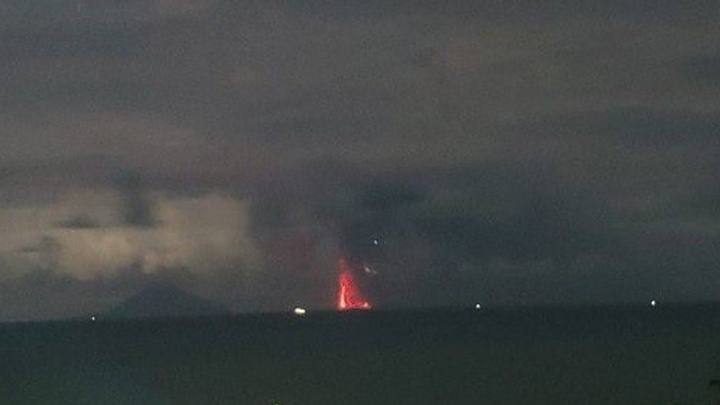
The Anak Krakatau, which means Child of Krakatoa in Indonesian, emerged from the submarine caldera of the 1883 eruption in 1927. For almost a century, it has been building itself on the same geological structure that destroyed its predecessor.
The 2018 partial collapse of the Anak Krakatau’s southwestern flank, which entered the sea and generated the December 22, 2018 tsunami that killed 439 people on the Javanese coast without any seismic warning, is the event that established the mechanism by which the current volcano poses its primary threat.
The flank collapse mechanism is distinct from the 1883 mechanism, which was driven by a phreatomagmatic explosion in the magma chamber. The 2018 event showed that the Anak Krakatau can generate lethal tsunamis through gravitational collapse of its growing flanks without the atmospheric explosion that made the 1883 event globally audible.
Whether the Anak Krakatau will eventually produce an eruption comparable to the 1883 event depends on how much volcanic material it accumulates before the next major eruptive cycle and whether the conditions of the 1883 event, the collapse of a larger volcanic structure with a magma system of comparable volume, are reproduced.
Volcanologists note that the Anak Krakatau is building on the same magmatic system that powered the 1883 event and that the Sunda Strait’s geological setting, at the intersection of the Indo-Australian and Eurasian plates, provides the same fundamental energy source that drove the 1883 eruption.
Whether this geological inheritance means the Anak Krakatau will eventually replicate its predecessor’s scale is not established. Whether the 1883 scale eruption occurred once in the Krakatoa structure’s geological history or has occurred multiple times across the geological record is the question whose answer would provide the best estimate of the future recurrence probability.
What the 1883 Record Establishes
The 1883 Krakatoa eruption is the best-instrumented large volcanic event in the historical record. Its physical parameters, energy, injection volume, atmospheric distribution, pressure wave propagation, and temperature effects, were measured by the instrumental networks of the late nineteenth century in sufficient detail to provide the physical baseline for understanding how volcanic events produce global effects.
The correspondences between the 1883 instrumental record and the historical accounts of the 536 CE event, the 1257 Samalas eruption whose ice core signature is the largest volcanic sulfate deposit of the last 2,000 years, and the 1815 Tambora eruption whose Year Without a Summer produced crop failures across the Northern Hemisphere, establish the mechanism through which volcanic events at sufficient scale produce the civilizational catastrophes recorded in the historical and prophetic record.
The 1883 Krakatoan event was catastrophic locally: 36,000 dead, hundreds of towns destroyed, the Sunda Strait reshaped. It was globally significant: temperatures dropped, sunsets turned blood red around the world, atmospheric shock waves circled the globe seven times. It was not civilizationally terminal: the injection volume was sufficient to produce measurable effects but not sufficient to produce the decade-long dimming that the 536 CE event’s scale generated.
The scale at which a volcanic event transitions from catastrophic to civilizationally terminal appears in the paleoclimatological record and the 1883 event’s precise measurement provides the physical benchmark.
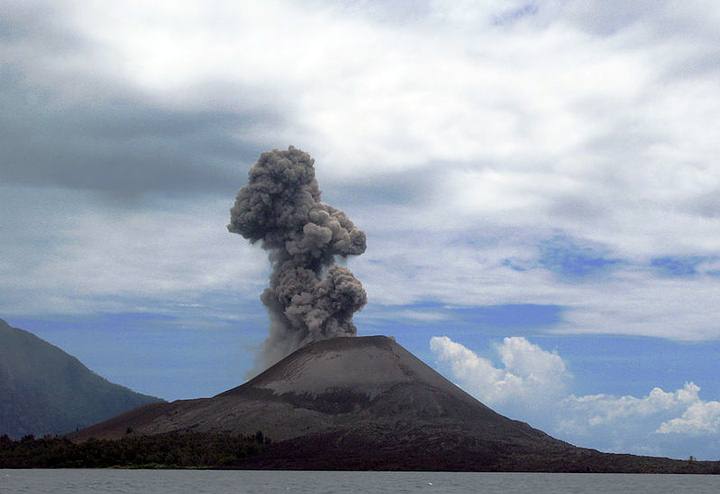
Anak Krakatau is growing in the same location. The geological structure that produced 200 megatons in 1883 is being rebuilt by the same processes.
The sound of 1883 was heard 4,800 kilometers away. Sergeant Cummins logged it in the record on Rodrigues Island and thought he was hearing distant guns.
He was right that something was firing. He was wrong about the range.