



What if reality is not what it appears to be? Not a physical world governed by permanent laws. Not a universe that exists independently of any mind. Not even a creation with a creator who fully understands what has been made. What if everything that exists, the stars, the oceans, every thought that has ever occurred to anyone, is only a dream? And what if the thing dreaming it is insane?
That is the nightmare at the center of one of the most disturbing ideas ever produced by cosmic horror. It has a name. Azathoth. And the strange part is not that H. P. Lovecraft invented him. The strange part is how easily the idea echoes questions that appeared centuries earlier in Gnostic religion, philosophy, and mystical traditions, and how modern physics still hasn’t settled the deeper question of what reality ultimately is.
None of that proves Azathoth exists. But it creates a disturbing intellectual pattern. Because sometimes the oldest nightmares are not frightening because they predict the future. They’re frightening because they ask questions humanity still cannot answer.
The Blind Idiot God
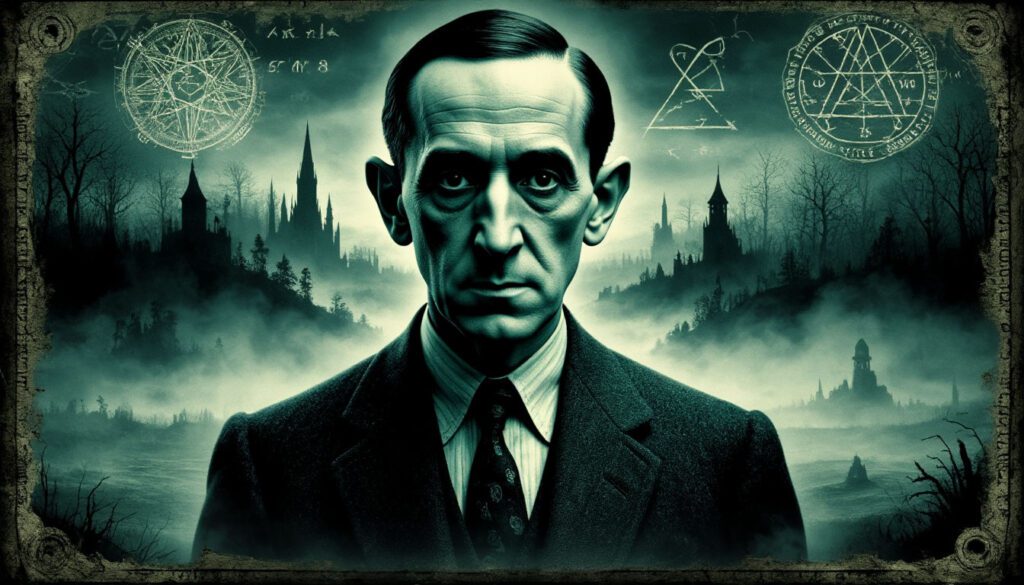
Howard Phillips Lovecraft did not populate his universe with ordinary monsters. His horror was larger than that. His creatures did not simply hide in forests or ancient ruins waiting to attack human beings. They belonged to realities so vast that humanity itself became almost irrelevant. The universe wasn’t designed for anyone. It didn’t necessarily care that anything existed. And the things moving through it might not even recognize humanity as something worth noticing.
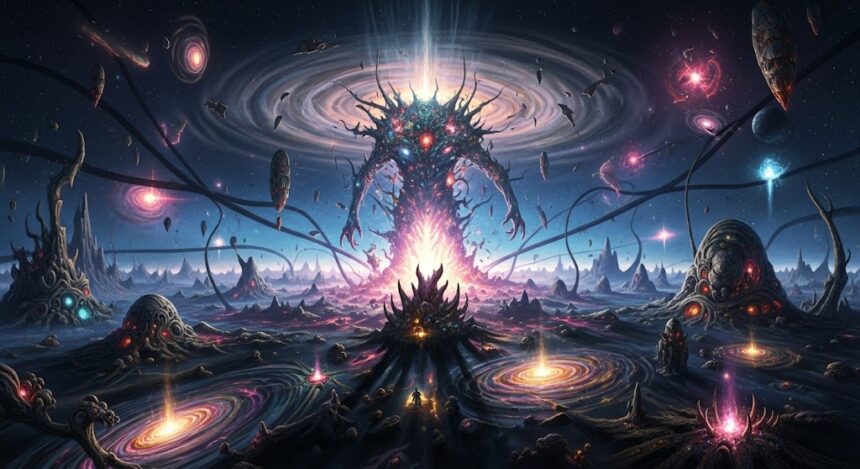
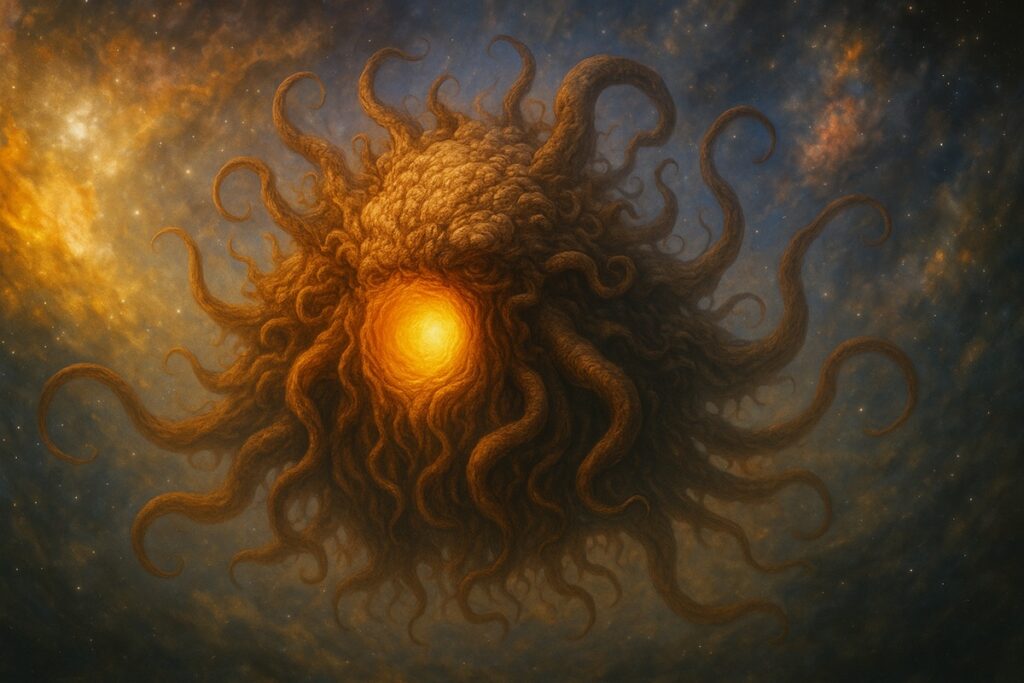
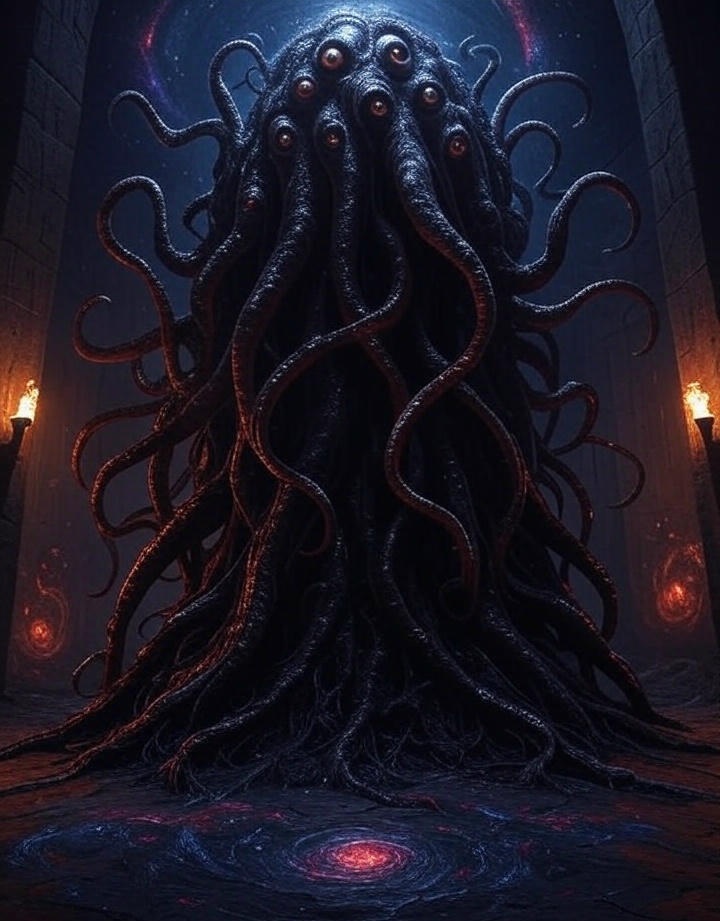
Among those entities stands the most disturbing of them all: Azathoth. Lovecraft described him as the Blind Idiot God, a being associated with nuclear chaos and primordial disorder, existing at the center of a reality that does not behave according to human ideas of purpose, morality, or meaning. He isn’t a god of love. He isn’t a god of judgment. He isn’t even really a ruler. There is nothing comforting about him. The nightmare is that the universe might not have a ruler at all. It might have a dreamer. And the dreamer might not know that it is dreaming.
Lovecraft Didn’t Believe in Any of This
This creates the first paradox. Lovecraft was not secretly a mystic. He was an atheist and materialist whose surviving letters make his rejection of conventional religion unmistakably clear. He did not present Azathoth as something he had encountered. He invented him. His cosmic horror emerged from what he called cosmicism: the idea that humanity is insignificant within an immense, indifferent universe.
So Azathoth was fiction. But fiction can sometimes express a philosophical possibility more vividly than philosophy can. And that’s where the story becomes strange. Because Lovecraft’s nightmare, an unknowable reality whose apparent order may conceal something fundamentally incomprehensible, didn’t begin with Lovecraft. Long before Cthulhu. Long before Arkham. Long before Azathoth. There were people describing a universe that was not what it appeared to be. And some of them believed the creator itself was blind.
The Ancient God Who Didn’t Know He Was God
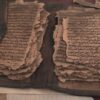
In 1945, an Egyptian farmer discovered a sealed jar near Nag Hammadi. Inside were thirteen leather-bound codices containing more than fifty ancient texts associated with Gnostic traditions. Among them was the Apocryphon of John. And within that strange cosmology appears one of the most unsettling figures in ancient religious literature: Yaldabaoth.
The Gnostic universe was radically different from the one taught by orthodox Christianity. The material world was not necessarily a perfect creation. It could be a prison. A deception. A flawed imitation of a higher reality. And its creator, the demiurge, was not the supreme divine source. He was ignorant. He believed himself to be the highest god because he did not know that something existed above him.
In this mythology, the being responsible for the visible universe is therefore not necessarily evil in the conventional sense. He is something arguably more disturbing. He doesn’t understand what he is. He mistakes his limited reality for the whole of reality. And that is where the resemblance to Azathoth becomes impossible to ignore.
Not because the Gnostics secretly worshipped a Lovecraftian god. They obviously did not. The traditions are separated by nearly two thousand years and belong to completely different intellectual worlds. But they independently entertain a remarkably similar nightmare: what if the apparent order of reality is produced by something that doesn’t understand reality itself?
The Dreamer Beneath the World
This is where mythology begins bleeding into philosophy. George Berkeley famously argued that existence is inseparable from perception. Leibniz imagined reality as composed of non-physical substances, or monads. Hegel described reality through the development of the Absolute Mind. Advaita Vedanta presents Brahman as ultimate reality and the phenomenal world as maya, appearance or illusion.
These traditions are not interchangeable. They do not all say the same thing. They certainly do not secretly describe Azathoth. But they converge on a question that refuses to disappear: is consciousness fundamental, or is consciousness something produced by matter? That question remains alive. And once it is taken seriously, the floor beneath ordinary reality becomes considerably less solid.
Then Physics Made the Question Worse
Quantum mechanics does not prove that reality is a cosmic dream. It does not prove that consciousness creates the universe. It does not prove Azathoth. But it did something almost as useful to a cosmic-horror writer: it destroyed the comforting simplicity of classical reality.
Quantum systems exhibit superposition. Measurements affect physical systems. The behavior of matter at microscopic scales cannot be described using the ordinary intuitions developed for everyday objects. And physicists themselves disagree about what the mathematics ultimately means. Copenhagen. Many-worlds. Pilot-wave theory. Other interpretations. They can reproduce the same experimental results while offering radically different pictures of what reality is doing underneath.
The experiments are real. The disagreement about their ultimate meaning is real. The philosophical question remains open. And that distinction matters, because the fact that quantum mechanics is strange does not establish a consciousness-created universe. But it does carry a humbling reminder: the universe does not owe human intuitions any obedience.
The Planck Problem
Max Planck once stated: “I regard consciousness as fundamental. I regard matter as derivative from consciousness.” Unlike many famous quotations attributed to physicists online, this statement has a traceable primary source, a January 25, 1931 interview in the London newspaper The Observer, conducted by science writer J. W. N. Sullivan and published on page 17.
But there is an important distinction. Planck was expressing a philosophical position. He was not presenting experimental evidence that the universe is literally a dream. That difference matters. There are serious contemporary philosophers, including Bernardo Kastrup and Philip Goff, who explore consciousness-first interpretations of reality. There are also serious philosophers and scientists who reject those interpretations in favor of physicalism. The debate is alive. It isn’t settled. And that uncertainty creates the perfect opening for the oldest question in this entire story: what if consciousness isn’t something the universe produces? What if consciousness is what the universe is made of?
The Dreamer Problem
Suppose, for a moment, that consciousness really is fundamental. Suppose there is a consciousness vastly larger than any individual human mind. Not a human consciousness multiplied by a thousand, but something so immense that an entire universe could exist inside its experience without it possessing anything resembling individuality as humans understand it. A galaxy would be a thought. A civilization would be a pattern. A human life would be a flicker.
Under that premise, what is called physical reality would simply be the stable structure of its dream. This is where Azathoth becomes more than a fictional monster. He becomes a metaphor for a terrifying possibility: that existence does not require intention. The universe may be ordered without being designed. Complexity may emerge without intelligence. Meaning may exist only because conscious beings create it. And beneath all of it there may be nothing resembling a mind at all. Only chaos. Only process. Only existence happening for no reason whatsoever. That is cosmic horror stripped of its tentacles.
The Gnostics Had an Answer
The Gnostics believed there was a way out. If the visible world was a prison, then the answer was not to become better at living inside the prison. It was to wake up. Gnosis, knowledge, was not simply collecting information. It was recognition: the realization that the identity a person takes to be themselves might not be the deepest layer of what is actually there. That idea survives, in different forms, through mystical traditions and modern philosophical discussions of consciousness. And it produces an extraordinary inversion. Perhaps the point was never to discover more about the dream. Perhaps the point was to discover who, or what, was dreaming.
The Observer Problem
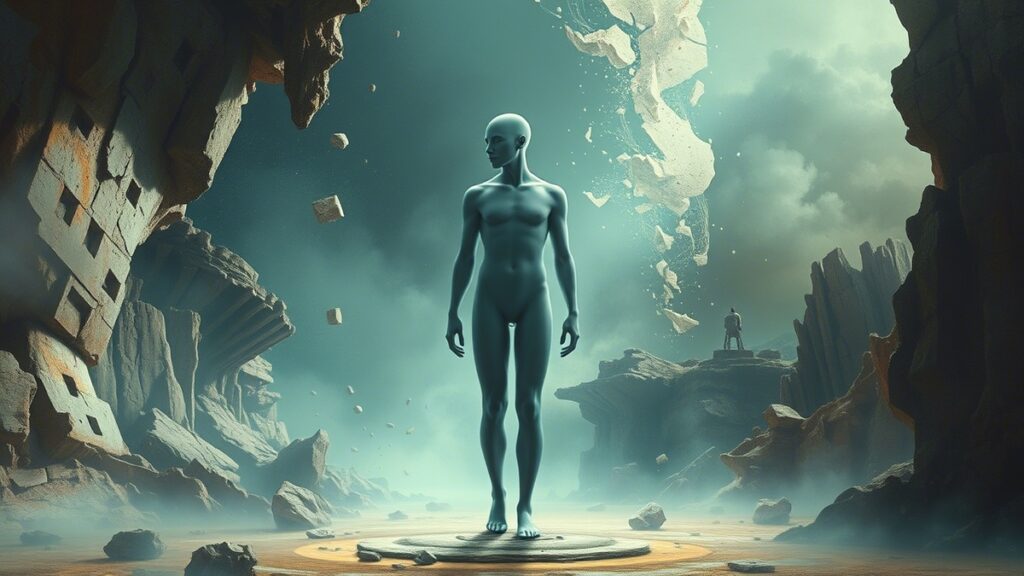
The question becomes stranger when observation itself enters the picture. There is the world being observed, and there is the consciousness doing the observing. But what, exactly, is that observer? Contemplative and philosophical traditions have circled this question for centuries: a thought can be watched as it arises, an emotion can be noticed as it forms, a memory can be observed taking shape. And yet the thing doing the watching resists being pinned down the same way. It doesn’t prove that reality is a simulation. It doesn’t prove that a cosmic intelligence is dreaming the universe. But it exposes something much stranger: the observer can itself become an object of observation, and once that happens, the line between the one experiencing reality and the reality being experienced becomes difficult to draw cleanly.
What Quantum Mechanics Actually Says
This is where the mythology has to stop and the evidence has to begin.
Quantum mechanics gives experimentally confirmed phenomena such as superposition and measurement effects. It does not establish that consciousness creates reality. It does not establish that the universe exists inside a mind. And it certainly doesn’t identify that mind as Azathoth. Those are philosophical and imaginative extrapolations.
The scientific question remains open in a much narrower and more interesting sense: what is reality fundamentally made of, and why does conscious experience exist within it at all? Physics has extraordinarily successful mathematical descriptions of what matter does. It has not produced a universally accepted answer to why subjective experience exists. That unresolved gap is real. Everything placed inside it afterward is interpretation.
So… Does the God of Madness Exist?
Probably not in the literal sense. There is no evidence that a Lovecraftian entity called Azathoth sits at the center of the universe dreaming existence into being.
But that’s almost beside the point. Because Azathoth was never frightening merely because he was a monster. He was frightening because he represented a possibility: that there is no intelligence behind existence, that the universe has no moral architecture, no intended destination, no guarantee of meaning, no cosmic parent watching from above. And perhaps the most disturbing possibility of all, that consciousness itself is not the universe’s explanation. It is merely another thing the universe somehow produced. Or perhaps consciousness really is fundamental. Perhaps matter is secondary. Perhaps reality is stranger than either materialism or mysticism currently allows anyone to imagine. No one knows. And that is where the horror lives.
The Last Door
The Gnostics called the visible world an illusion. Lovecraft imagined an indifferent cosmos populated by entities beyond human comprehension. Philosophers have argued for centuries over whether mind or matter is fundamental. Modern physics has shown that reality at its deepest levels behaves nothing like the world human senses evolved to navigate.
These traditions are not secretly proving one another. They shouldn’t be collapsed into a single theory. But they keep returning to the same abyss: what if the reality experienced by conscious beings is not the ultimate reality?
Maybe Azathoth is nothing more than a fictional creation of an atheist writer. Maybe Yaldabaoth is nothing more than an ancient theological myth. Maybe consciousness is simply an emergent property of enormously complicated brains. Maybe quantum mechanics will eventually fit neatly into a completely physical description of the universe. Maybe.
But there is one fact none of those possibilities makes disappear: consciousness exists, reality is being experienced, and no one yet knows exactly what consciousness is, why it exists, or why there is a universe for it to occur within in the first place.
So perhaps the oldest cosmic-horror question isn’t “Does the God of Madness exist?” Perhaps it is something stranger: is the universe the dream, and consciousness the dreamer? Or is consciousness itself the dream, produced by something too vast, and too indifferent, to ever notice that it was dreaming at all?