

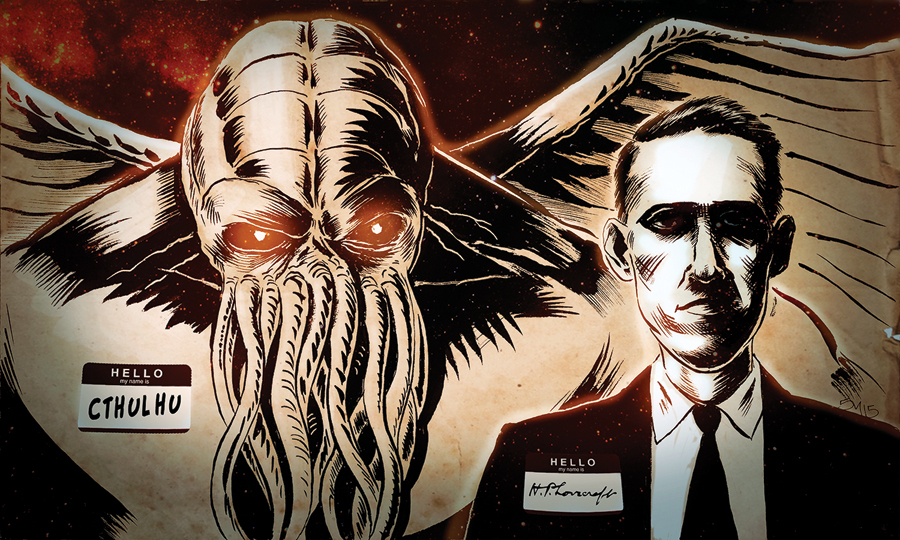
Howard Phillips Lovecraft insisted that the gods of his fiction were inventions. Cthulhu, Nyarlathotep, Azathoth, Shub-Niggurath, the Necronomicon, the cyclopean ruins, the ancient civilizations beneath the surface of the world, none of them were presented by Lovecraft as recovered history. He was an atheist, a materialist, and, by his own account, a writer constructing cosmic horror from imagination, nightmares, mythology, and the anxieties of his age.
And yet something genuinely strange happened after his death. Occultists who knew perfectly well that Lovecraft had invented his mythology began incorporating that mythology into actual magical systems. Kenneth Grant built Lovecraftian imagery into his Typhonian interpretation of Thelema. Michael Aquino and others associated with the Church of Satan adapted Cthulhu material for ritual use. Chaos magicians subsequently treated fictional entities as potentially useful symbolic constructs without requiring them to possess objective, supernatural existence.
The result is stranger than the familiar claim that Lovecraft was secretly a prophet. The more interesting phenomenon is what happens when a fictional universe becomes an operational reality for people who inhabit it, when characters become names, names become symbols, symbols become ritual objects, and ritual objects begin acquiring independent cultural lives of their own.
The Materialist at the Center of the Myth
Lovecraft’s own position is the first fact that has to remain intact. His surviving correspondence presents a writer deeply committed to materialism and profoundly skeptical of supernatural explanations. He rejected the idea that occult systems provided access to a hidden metaphysical order. The universe of his fiction was not secretly his theology. It was an imaginative construction built around a far more disturbing proposition: that the universe might be vast, indifferent, and fundamentally hostile to the human desire for meaning.
But Lovecraft also repeatedly described the importance of dreams to his creative process. His nightmares supplied images, settings, creatures, and situations that could later be transformed into fiction. That fact does not establish communication with an external intelligence. It does establish something more psychologically interesting: the mythology entered his writing through a channel he himself regarded as mysterious, involuntary, and unusually vivid.
That distinction matters. A dream can feel discovered rather than invented without having been transmitted from somewhere outside the brain. A writer can experience an image as arriving fully formed without that image being an archaeological memory or supernatural communication. Lovecraft therefore presents the first paradox of the entire story: the man who created one of modern culture’s most elaborate supernatural cosmologies did not believe in the supernatural mechanism his later interpreters sometimes attributed to him.
When Fiction Crossed the Ritual Boundary
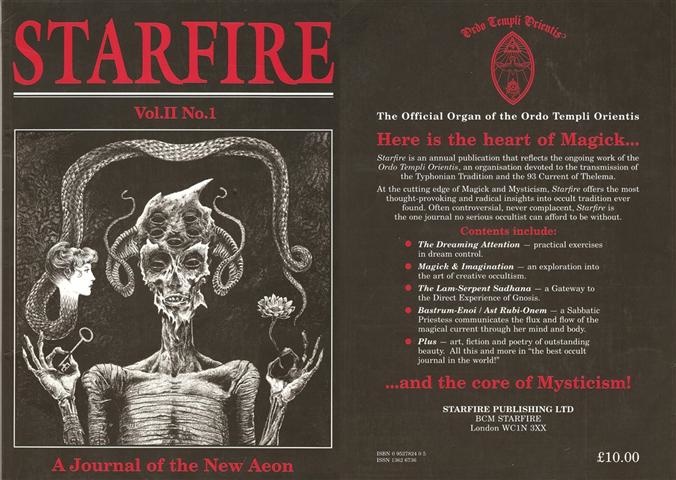
This is where the story stops being a question about Lovecraft’s private beliefs and becomes a history of what other people did with his inventions. Kenneth Grant occupies a central place in that transformation. A British ceremonial magician associated with Aleister Crowley’s Thelemic tradition, Grant eventually developed the Typhonian current and produced a large body of writing connecting Crowleyan concepts with tantra, Qabalah, extraterrestrial imagery, and Lovecraft’s mythology.
Grant’s interpretation did not require the claim that Lovecraft consciously possessed secret occult knowledge. The more radical proposition was symbolic: that Lovecraft’s fictional vocabulary could describe, or at least provide a useful imaginative language for, experiences and concepts already present within occult practice. That creates an unusual reversal. Lovecraft invented entities to make the supernatural frightening. Grant took those inventions and made them usable as occult symbols. The direction of influence therefore runs from fiction into ritual, rather than from an occult reality into fiction.
Whether such rituals produce supernatural effects is a separate question. Historically, however, the transformation itself is not speculative. The fictional mythology entered a living magical tradition.
The Cthulhu Egregore
This is where the concept of the egregore becomes useful, not as proof that Cthulhu objectively exists, but as a way of describing how a fictional construct can acquire a life of its own inside a community. In occult terminology, an egregore is generally understood as a thought-form or collective entity generated and sustained by the attention, belief, emotion, and ritual activity of a group. The concept belongs to occult discourse. It is not an empirically established category of supernatural being.
But something observable can happen without accepting the metaphysical claim. Cthulhu has accumulated decades of illustrations, novels, games, rituals, performances, academic studies, tattoos, statues, role-playing campaigns, websites, films, music, occult texts, and private devotional practices. Millions of people have encountered the symbol. Thousands have elaborated it. Entire communities have assigned it meanings Lovecraft never intended.
In that cultural sense, Cthulhu has become more than the character Lovecraft wrote in 1926. The original fictional entity has been surrounded by an expanding human-made network of interpretation. Every new representation becomes another layer of the mythology. Every ritual adds another association. Every game, painting, novel, ceremony, and conversation gives the symbol another opportunity to reproduce itself.
Calling that process an egregore is an occult interpretation of a phenomenon that can also be described through entirely secular concepts: memetics, cultural transmission, collective symbolism, participatory mythology, and the self-reinforcing dynamics of belief.
The Church of Satan and the Ritualization of Cthulhu
The process became even more explicit in the orbit of Anton LaVey’s Church of Satan. LaVey founded the organization in San Francisco in 1966. Michael Aquino, who later became an important figure within the movement, was among those who worked directly with Lovecraftian material, and Cthulhu-themed ceremonies appeared in The Satanic Rituals, published in 1972. The important point is not whether these ceremonies summoned an objectively existing Great Old One. There is no empirical evidence establishing that they did.
The important point is that a fictional mythology had crossed a boundary that fiction ordinarily does not cross. Cthulhu was no longer merely something a reader encountered in a magazine. The name could become part of a ceremony. The imagery could become ritual architecture. The fictional language could become an instrument for deliberately producing fear, altered attention, theatrical intensity, or symbolic identification.
The distinction between fiction and ritual had not disappeared. It had become the subject of the ritual.
Chaos Magick and the Power of a Fiction Everyone Knows Is Fiction
The later development of Chaos Magick makes the paradox even sharper. One of the movement’s defining ideas is that belief can be treated instrumentally: a practitioner may adopt a symbolic system for a particular operation without necessarily accepting its cosmology as literal objective truth. Under that framework, the fact that Lovecraft invented Cthulhu is not necessarily a defect.
It can be the reason the symbol is useful. A fictional god arrives without the accumulated institutional baggage of an ancient religion. Its mythology can be modified. Its symbols can be combined with other systems. Its emotional associations are already exceptionally strong. And unlike an obscure historical deity whose original worship may be difficult to reconstruct, Cthulhu arrives with a vast modern archive of imagery and narrative.
The magician therefore does not necessarily need to ask whether Cthulhu existed before Lovecraft. The more interesting question is whether a symbol invented by one writer can become psychologically or culturally powerful enough to function as though it had an independent existence. That question does not require a supernatural answer.

The Necronomicon That Never Existed, and Then Did
Nothing demonstrates the mechanism better than the Necronomicon. Lovecraft invented the book as part of his fictional universe. It was supposedly written by the fictional Abdul Alhazred, transmitted through an impossible history of translation and suppression, and consulted by characters who generally regretted doing so. There was no ancient Necronomicon waiting in a monastery. There was no medieval manuscript that Lovecraft discovered. There was no archaeological recovery of the original.
And yet the Necronomicon eventually became a real publishing category. The so-called Simon Necronomicon appeared in 1977 and became one of the most influential modern occult books associated with the Lovecraftian tradition. Its mythology was presented through the language of an ancient grimoire, but its existence as a modern publication is entirely compatible with an ordinary human explanation: people created it because Lovecraft had created the idea of a forbidden book powerful enough to become an object of fascination in its own right.
Other writers followed. Donald Tyson produced his own Necronomicon-inspired works, openly presenting them as modern magical literature rather than rediscovered antiquities. The fictional book had therefore achieved something almost perfectly Lovecraftian. A nonexistent object had acquired a publishing history.
When the Artifact Becomes More Real Than Its Origin
This is the point at which the phrase “channeled reality matrix” becomes useful as a metaphor, even when the supernatural interpretation is rejected. Lovecraft created a fictional architecture. Other people inhabited it. Those inhabitants added symbols, interpretations, rituals, artworks, books, games, and theories. Later generations encountered those additions as part of an increasingly dense mythology and added still more.
The result resembles a transmission from an external intelligence because the origin of any individual symbol becomes increasingly difficult to distinguish from the accumulated culture surrounding it. But the historical chain is visible. Lovecraft wrote the fiction. Grant reinterpreted it. Occultists ritualized it. Artists visualized it. Publishers reproduced it. Games turned it into participatory mythology. Readers supplied their own interpretations. The resulting system became vastly larger than its original author.
No hidden transmitter is necessary to explain the signal. The receivers became transmitters.
The Myth That Learned to Reproduce Itself
That may ultimately be Lovecraft’s strangest achievement. He wanted to construct a universe in which humanity was cosmically insignificant. Instead, he constructed a mythology that became extraordinarily significant to humanity. The same fictional entities that were invented to demonstrate the insignificance of human beings became some of the most recognizable supernatural symbols of modern popular culture. Cthulhu became merchandise. The Necronomicon became a physical book. Miskatonic University became an institution in games and fiction. The Great Old Ones became characters, deities, metaphors, psychological archetypes, magical correspondences, and objects of genuine occult experimentation.
And the cultural system continues to expand. Prestige editions, translations, academic scholarship, visual art, tabletop games, cinema, music, internet communities, occult literature, and contemporary reinterpretations continue adding layers to the mythology long after its creator’s death. The work has become a collaborative construction whose final form Lovecraft could never have predicted.
That is not evidence that Lovecraft received messages from the Great Old Ones. It is evidence of something that may be stranger in its own way: fiction can become an environment. A sufficiently powerful fictional system can be entered, inhabited, modified, ritualized, commercialized, studied, believed in symbolically, and eventually transmitted by people who were not alive when its creator first imagined it.
The Awakening of the Cthulhu Egregore
If “egregore” is taken literally as a supernatural entity independently existing outside the human mind, the historical record cannot establish that claim. If it is taken as a description of a collective symbolic structure that becomes increasingly autonomous from any single creator, however, the Lovecraft phenomenon becomes almost impossible to ignore. Lovecraft died in 1937. Cthulhu did not.
The character continued moving through culture without its creator. It acquired meanings Lovecraft never intended. People who had never read the original story began recognizing the silhouette. People who regarded the mythology as fiction incorporated it into ritual. People who rejected the occult interpretation still used its vocabulary to describe cosmic insignificance, existential dread, forbidden knowledge, and the limits of human understanding.
At some point, the question stops being whether the fictional god became real. The more defensible, and arguably more disturbing, question is whether “real” was ever the right category for what happened. Lovecraft created a mythology. His readers turned it into a culture. Occultists turned portions of that culture into ritual. Ritual gave the symbols another layer of meaning. And the resulting mythology now exists independently of the man who invented it.
That is the documented phenomenon. Whether there is anything behind it, an intelligence, an egregore, an archetype, a psychological mechanism, or simply the extraordinary reproductive power of a sufficiently compelling story, remains a matter of interpretation. But the oldest horror in Lovecraft’s universe was never that the Great Old Ones might return. It was the possibility that humanity could create something it no longer completely controls.
Lovecraft invented the gods. The culture kept them alive.