



Almost none of the claims about alien structures on the Moon trace to any named researcher, credentialed institution, or published, peer-reviewed analysis of any kind.
What follows corrects the specific claims directly and covers what’s actually in this territory: real historical astronomical observations, real lunar missions, and the well-studied, entirely earthly explanations for why blurry lunar photographs so often appear to show artificial structures where none actually exist.

Why Lunar “Structures” Are So Common in Old Photographs
Before addressing specific claims, the well-understood reason apparent structures appear so frequently in scanned Apollo-era lunar photographs is worth explaining. Original Apollo film was digitized and compressed for online distribution using processes that introduce well-established artifacts, JPEG compression blocking, scanning dust and scratches, and film grain, all of which can combine with the human brain’s well-studied tendency toward pareidolia, seeing meaningful patterns like faces or buildings in random visual noise, to produce apparent structures where none exist. NASA has directly and repeatedly addressed this exact phenomenon in response to public inquiries, explaining that the raw, high-resolution originals, when examined without the degradation introduced by repeated recompression and enlargement, do not show the structures claimed in low-resolution, heavily cropped internet versions of the same images.

No Record Confirms Jim Irwin Filmed a “Flying Saucer”
No credible NASA record, mission transcript, or biography of astronaut Jim Irwin describes him filming a “flying saucer” during Apollo 15, and this claim should be treated as unverified.

William Herschel’s Real 1787 Observation, Accurately Explained
This is well-established astronomical history, and it deserves accurate, detailed reporting rather than a vague “curious phenomenon” framing. William Herschel, the astronomer who discovered Uranus, genuinely did observe bright red spots near the lunar crater Aristarchus on the nights of April 19 and 20, 1787. Herschel himself interpreted what he saw as active lunar volcanic eruptions, not alien activity, a scientifically mistaken but sincere 18th-century interpretation. Modern lunar science places this event within a still-studied category called Transient Lunar Phenomena, brief, localized brightness changes on the lunar surface reported by astronomers for centuries. A peer-reviewed 2018 study by physicists William Bruckman and Abraham Ruiz at the University of Puerto Rico proposed that Herschel’s actual observation, made two centuries earlier, was most likely the impact melt glow from a meteorite fragment, possibly connected to the Lyrid meteor shower active at that time of year, striking the lunar surface, identifying a corresponding “cold spot” thermal anomaly at matching coordinates using modern lunar orbiter thermal imaging data. This is a fascinating piece of astronomical detective work spanning well over two centuries, ultimately resolved through legitimate, published scientific method rather than left as an unexplained mystery requiring an alien explanation.

Named Figures, and What They Actually Said
Having credentials in one field doesn’t automatically transfer credibility to claims made outside that field, worth noting as a general pattern. A physicist’s or astronaut’s personal opinion about extraterrestrial life, however sincerely held, carries different evidentiary weight than a peer-reviewed finding published within their actual area of specialized training and subjected to the ordinary scientific review process. This distinction matters for evaluating every name that follows.
Several named individuals appear in versions of this story, and their actual backgrounds and statements deserve accurate context. Dr. John Brandenburg is a physicist who has worked on defense and aerospace research, and he has made public, published statements about anomalies in Mars imagery, though the “special team” quote attached to the Clementine lunar mission here couldn’t be verified against any primary source. Michael Salla holds a PhD in government and international politics, not astrophysics or planetary science, and is a self-published “exopolitics” author whose claims about extraterrestrial bases haven’t been peer-reviewed or independently verified by any credentialed planetary science institution. Milton William Cooper was a Navy veteran and self-published conspiracy author, best known for his 1991 book Behold a Pale Horse, and his claims about lunar mining operations have never been corroborated by any independent source. Edgar Mitchell, the Apollo 14 astronaut, genuinely did make public statements later in life expressing personal belief in extraterrestrial contact and government secrecy, statements worth reporting accurately as his own stated personal views rather than as NASA-confirmed findings, since NASA itself has never endorsed these claims.

NASA Never “Bombed” the Moon
This needs a direct, factual correction. The 2009 lunar impact event referenced in versions of this story is NASA’s LCROSS mission, which deliberately guided a spent Centaur rocket stage into the permanently shadowed Cabeus crater near the lunar south pole for an entirely public scientific purpose: to eject subsurface material into sunlight where spectrometers could analyze it for water ice, which the mission genuinely did detect in significant quantities. This was a widely publicized, successful scientific mission with published results in peer-reviewed journals, not a covert operation to destroy alien artifacts. No comparable 1969 lunar impact event matching some retellings’ description could be verified.

Why No Nation Returned Humans to the Moon for So Long
This deserves the well-documented explanation, rather than an alien warning. The real reasons no crewed lunar mission followed Apollo for over five decades are extensively documented: the enormous cost of the Apollo program, which consumed a significant portion of the federal budget at its peak and became politically unsustainable once the Cold War-era space race motivation faded following the 1969 Moon landing. Technological priorities shifted toward space stations and reusable spacecraft, and until relatively recently there was no clear scientific or economic case compelling enough to justify the enormous expense of renewed crewed lunar missions. This changed with current programs including NASA’s Artemis program, which is actively planning crewed lunar missions as of the mid-2020s, a public, extensively covered undertaking that directly contradicts any claim that humans have been warned away from the Moon.

The China Chang’e Claims Have No Traceable Source
No source confirms claims that China’s real Chang’e lunar missions detected or photographed artificial alien structures, or that China plans to release evidence disproving NASA. China’s published Chang’e mission data has been shared through standard international scientific channels and analyzed by researchers worldwide, and no planetary scientist, Chinese or otherwise, has published findings supporting artificial lunar structures. These claims should be treated as unverified.

The Ongoing Study of Transient Lunar Phenomena
This legitimate area of ongoing lunar research is genuinely more interesting than any invented alien structure claim. NASA compiled historical catalogs of over 500 reported transient lunar events dating back centuries, cross-referenced by researchers including Barbara Middlehurst and Winifred Cameron in published scientific work. Columbia University astronomer Arlin Crotts has conducted ongoing statistical analysis of this historical reporting database, along with modern lunar outgassing research, examining whether these brief brightness changes correlate with specific lunar surface locations in ways consistent with genuine geological activity, including possible gas release from the Moon’s interior along old fault lines. This remains a genuinely open, actively studied question in planetary science, one where legitimate researchers continue publishing peer-reviewed work precisely because the phenomenon, unlike claims of alien structures, produces repeatable, independently checkable observational data worth taking seriously.

Why Space Agencies Publishing Raw Lunar Imagery Undercuts “Hidden Evidence” Claims
A practical point undercuts the “hidden evidence” framing this genre of claim typically relies on. NASA, the European Space Agency, and other space agencies routinely publish enormous volumes of raw, high-resolution lunar imagery through public archives, including NASA’s Lunar Reconnaissance Orbiter Camera archive, freely accessible to anyone, amateur or professional, without restriction. This ongoing public data release, spanning millions of high-resolution images at resolutions far exceeding the degraded, heavily compressed images typically cited in alien structure claims, is precisely the kind of transparency that would make concealing large artificial structures on the lunar surface extremely difficult to sustain. Independent researchers, university astronomy departments, and amateur imaging enthusiasts around the world regularly examine this publicly available data without needing any special government clearance, and none have published credible, peer-reviewed findings supporting artificial lunar structures.

The Real Apollo Legacy, Worth Knowing Accurately
What the Apollo missions actually accomplished is remarkable enough without embellishment. Six crewed Apollo missions successfully landed on the Moon between 1969 and 1972, returning 382 kilograms of lunar samples that remain, over five decades later, an active and ongoing subject of scientific study, with a portion deliberately kept sealed by NASA for future analysis using techniques not yet available at the time of collection. Astronauts placed seismometers, laser reflectors still used today for precise Earth-Moon distance measurements, and other scientific instruments that operated for years after the crews departed, transmitting data that fundamentally reshaped scientific understanding of the Moon’s formation, composition, and geological history. This twelve-person achievement, the only time humans have set foot on another celestial body, remains one of the most extensively documented and independently verified accomplishments in human history, confirmed through physical evidence including retroreflectors that scientists on Earth can still bounce lasers off today, evidence that requires no alien explanation and stands entirely on its own merits.

Why Amateur “Moon Anomaly” Videos Proliferate Online
Why online videos claiming to reveal moving lunar structures or unexplained anomalies have become so common comes down to a well-understood technical mechanism. Digital zoom and enlargement techniques applied to already low-resolution source imagery introduce well-understood interpolation artifacts, essentially the software inventing plausible-looking pixel detail to fill gaps that don’t exist in the original data, which can produce apparent movement, edges, or structure that isn’t present in the source material at all. Combined with video compression artifacts and the same pareidolia effect discussed earlier, this creates a technically explicable pathway by which an ordinary, unremarkable patch of lunar surface can be repeatedly zoomed, enhanced, and reprocessed until it appears to show something dramatic, without requiring any deliberate fabrication at each individual step. Recognizing this technical pathway is useful for evaluating any future viral “moon anomaly” video, since the same basic explanation applies regardless of which specific mission’s imagery is being reprocessed or which specific claim is attached to the result.

What Lunar Science Actually Involves
Lunar exploration doesn’t need invented structures to be worth telling. Missions, from Apollo’s crewed landings through Clementine, LCROSS, Chang’e, and the currently active Artemis program, have produced publicly available data revealing a genuinely dynamic, scientifically fascinating world: real evidence of water ice in permanently shadowed craters, ongoing volcanic and impact history, and a still-active area of study in transient lunar phenomena that continues to generate legitimate scientific papers over two centuries after Herschel’s first observations. This actual body of work, publicly published, peer-reviewed, and independently verifiable, is the story of what humanity has learned about its nearest neighbor.

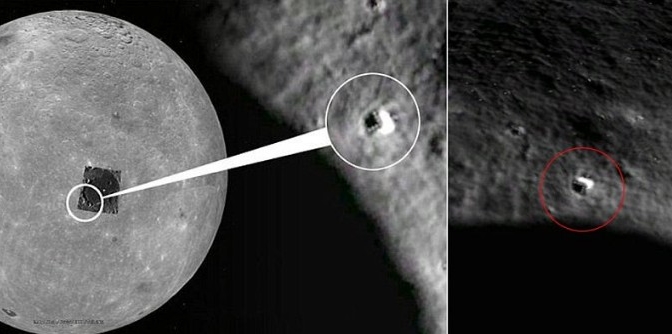
No source has confirmed alien structures on the Moon. What has been confirmed, repeatedly, through legitimate scientific missions and peer-reviewed research, is a genuinely strange and still-unfolding world worth exploring on its own terms, and future crewed missions under NASA’s Artemis program will only add to this growing, independently verifiable body of knowledge in the years immediately ahead.