




A work of speculative fiction. No oceanographer named “Anthony Sawyer,” no verified “Steve Hodgson” NOAA leak, and no confirmed sonar detection of pyramidal structures in the Atlantic has been documented by any scientific or journalistic source.
This legend traces to an identified 1990 hoax, and its paper trail is more interesting than the story built on top of it.
Glass Pyramids in the Deep
Everything described in this opening section, and in the sections that follow describing failed expeditions and named witnesses, is presented as this account’s own internal narrative rather than a verified sequence of events.
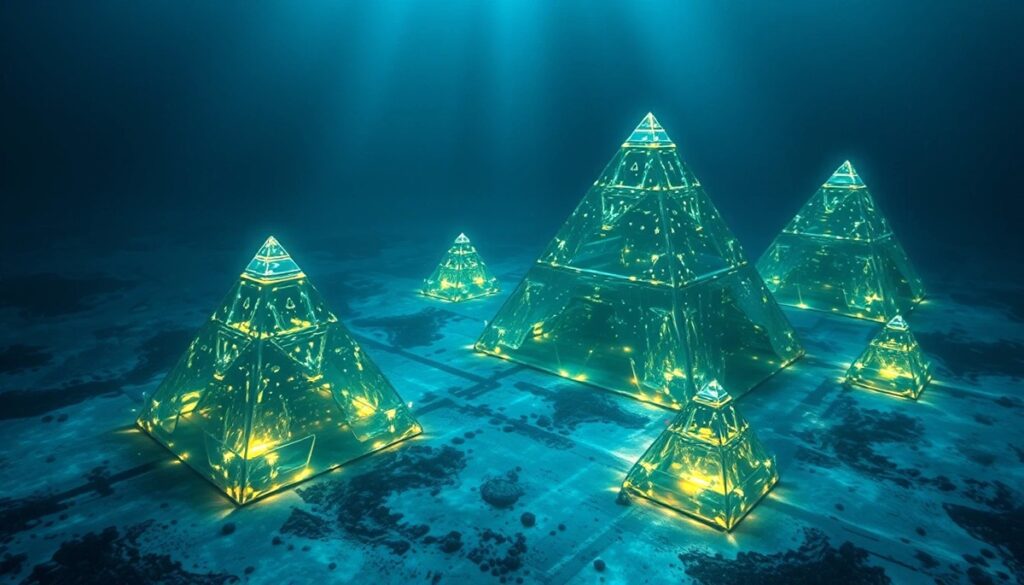
In this account, whispers of vast, glasslike pyramidal structures resting on the Atlantic seafloor have circulated for decades among certain online communities, oceanographers and military sonar operators from half a dozen different nations independently reporting the same impossible geometric shapes, clustered formations of three large pyramids surrounded by six smaller ones, shimmering in total darkness thousands of meters down.
Where This Claim Comes From
The origin has been identified. Independent fact-checking organizations have traced this exact narrative, glass pyramids, mysterious disappearance upon investigation, government suppression, directly to an article published in the American satirical tabloid Weekly World News in May 1990. That original article featured a supposed “oceanographer Verlag Meyer,” a figure fact-checkers have confirmed doesn’t exist, entirely invented for the satirical piece. Over the following three and a half decades, the same base story has circulated widely and mutated repeatedly across the internet, with the fictional discoverer’s name and details changing with each retelling, sometimes attributed to a French-American expedition, sometimes to different invented individuals. This account’s own named figures, Anthony Sawyer and Steve Hodgson, couldn’t be verified against any oceanographic institution, NOAA personnel record, or scientific publication of any kind, fitting the same well-established pattern of a satirical hoax acquiring new, invented named sources with each generation of retelling.
Luminous Guardians and Failed Expeditions
The account continues with a British probe losing contact after luminous objects circle it within 500 meters of a target formation, and with a pattern this fiction dramatizes: real large-scale sonar mapping expeditions in 1978 and 1984 that, in the story’s telling, turned up nothing where the pyramids were expected. In the historical record, no credible expedition matching this description, joint American, Canadian, and Japanese, targeting a specific pyramid location, has been documented in any published oceanographic literature or contemporary news archive from either year.
What a Real Underwater Pyramid Discovery Looks Like
An actually reported one exists, and it offers a useful contrast. In 2013, Portuguese diver Diocleciano Silva reported a pyramid-shaped rock formation while surveying ocean depths between the Azores islands of Terceira and São Miguel, describing it in on-record statements to local news outlets as appearing “perfectly shaped” and aligned with the cardinal points. This discovery received real news coverage, and the Portuguese navy investigated, suspecting Silva had encountered the D. João de Castro Bank, a known underwater volcano in the same location, with geologists noting the Azores region’s frequent volcanic and tectonic activity as a plausible, well-grounded natural explanation for the formation’s striking geometric appearance. That’s what actually happens when a real underwater pyramid-like structure gets reported: a named discoverer, on-record statements, institutional investigation, and a published, most-likely-natural explanation, a very different evidentiary trail than the anonymous, unverifiable claims running through this story.
The Bermuda Triangle’s Actual, Statistically Unremarkable History
This piece draws its atmosphere from the Bermuda Triangle’s documented cultural history, worth knowing accurately. The Bermuda Triangle as a named region of supposed unusual danger to ships and aircraft was popularized starting in the 1950s and 1960s through magazine articles and later Charles Berlitz’s bestselling 1974 book. What maritime investigation has consistently found, including analysis by the US Coast Guard and Lloyd’s of London, the world’s oldest marine insurance market, is that the region shows no statistically significant excess rate of disappearances or accidents compared to other heavily trafficked ocean areas of similar size, once factors like heavy shipping traffic, tropical storm frequency, and the Gulf Stream’s powerful currents are properly accounted for. This piece borrows the Bermuda Triangle’s cultural mystique without needing, or ever receiving, any comparable statistical support behind it.
Why Deep-Sea Probes Lose Contact
The “luminous guardians” explanation here borrows credibility from an ordinary engineering challenge. Deep-sea exploration equipment operates under extreme conditions, crushing pressure exceeding hundreds of atmospheres at depth, near-freezing temperatures, and total darkness, and equipment failures, including lost communication links, corrupted data transmission, and total equipment loss, are a well-known and unremarkable occupational hazard in legitimate deep-sea research, extensively described in oceanographic literature and conference proceedings. Research vessels and remotely operated vehicles routinely experience exactly this kind of technical failure without any exotic explanation required, a mundane category of engineering risk this narrative repurposes as evidence of external interference.

Yonaguni Is the Unresolved Comparison
This Atlantic legend is often mentioned alongside a separately unresolved site: the Yonaguni Monument off Japan’s coast, an underwater rock formation discovered in 1986. Unlike the Atlantic pyramids described here, Yonaguni is a physically accessible, extensively studied site that geologists have examined directly, with the honest scientific question remaining open, whether the formation’s angular features result from natural sandstone erosion along existing fracture lines or some degree of human shaping, without confident consensus in either direction. That ongoing scientific debate stands in useful contrast to the Atlantic pyramids described here, which no geologist or oceanographer has ever been able to physically examine at all.
The Real Ocean Mapping Gap
This mapping gap is worth understanding accurately rather than treated as an evidentiary vacuum any claim can be poured into. The claim that roughly 20 percent of the ocean floor has been mapped with modern high-resolution methods is accurate as of the mid-2020s, and international efforts including the Seabed 2030 project have been steadily increasing that coverage percentage in recent years, working toward a complete map by decade’s end. That ongoing mapping effort, a genuine international scientific undertaking, is worth appreciating on its own terms rather than as evidence supporting any specific unverified claim about what remains hidden within the currently unmapped portion.
Why This Particular Hoax Has Lasted So Long
Satirical tabloid publications like Weekly World News were, by design, never intended to be taken as literal fact, and their original readership generally understood that. The breakdown happens later in the chain, when a satirical article gets stripped of its original context, its publication’s name, its satirical tone, its clear tabloid branding, and recirculated as though it were straightforward reporting, a well-documented pattern in how misinformation spreads that applies well beyond this single case.
This specific 1990 satirical hoax has proven durable across more than three decades of retelling for an instructive reason. It combines several compelling elements into one narrative: the enormous scale of unmapped ocean floor, the mystique already attached to the Atlantic through unrelated Bermuda Triangle folklore, and a widespread human fascination with pyramids as a shape loaded with ancient significance. Each retelling has been free to swap in new names, new dates, and new institutional affiliations, NOAA, private millionaires, foreign navies, precisely because the original satirical source was never meant to be checked against a record in the first place, and each subsequent generation of readers encountering a “new” version has had no easy way to trace it back to its 1990 tabloid origin without dedicated fact-checking research.
Why a Real Structure Couldn’t Simply Vanish From Sonar
This technical detail directly undercuts the central plot mechanism here, structures that are detected once, vanish, and can never be relocated. Sonar physics doesn’t work that way, and understanding why is considerably more satisfying than accepting the tale’s own explanation of cloaking technology. Multibeam sonar systems, standard equipment on modern oceanographic research vessels, work by sending sound waves toward the seafloor and precisely measuring their return time to build a detailed depth map, a physics-based technique that doesn’t depend on visual light and functions reliably regardless of water clarity or darkness. A structure of the scale described here, hundreds of meters across, would produce an unambiguous signal return distinct from surrounding natural seafloor topography, and would be recorded in the raw sonar data regardless of whether the ship’s crew immediately recognized its significance.

Oceanographic data of this kind is also frequently shared, cross-referenced, and reanalyzed by other research teams and institutions over subsequent years, meaning a genuine anomaly of this scale in archived data would be exceptionally difficult to overlook or lose entirely, a technical reason to be skeptical of any claim describing such a structure being detected once and never located again.
What Deep-Sea Exploration Has Found
The real discoveries are remarkable enough without any invented pyramids attached. Hydrothermal vent systems, including the actually-named Lost City field discovered in 2000 along the Mid-Atlantic Ridge, feature towering carbonate chimney structures rising up to 60 meters from the seafloor, hosting unique microbial ecosystems that thrive without sunlight, entirely on chemical energy, a discovery that has significantly reshaped scientific understanding of where life can exist and possibly originated. Marine biologists continue discovering entirely new species in Atlantic deep-sea environments on a regular basis, remarkable creatures adapted to crushing pressure and total darkness, documented and published through standard scientific channels. This body of ongoing, verifiable deep-sea discovery is worth following directly through oceanographic institutions and their published research, offering a rich sense of wonder about the ocean’s unexplored depths without requiring any invented structure to supply it.

Are We Ready for the Answer?
Traced back through fact-checking research to its 1990 satirical origin, the answer is worth stating plainly: the Atlantic glass pyramids were invented for a tabloid joke, and the tale has simply kept traveling since, gathering new fictional details and new fictional sources at each stop. The ocean remains genuinely, legitimately mysterious in countless ways that don’t require an invented pyramid to be worth exploring, hydrothermal vent ecosystems, deep-sea creatures discovered only in the last few decades, and the ongoing work of mapping the roughly 80 percent of the seafloor that remains uncharted in fine detail. That frontier is worth following directly through credentialed scientific sources and research institutions, rather than through an account whose actual paper trail leads back to a satirical newspaper rather than a submarine.