



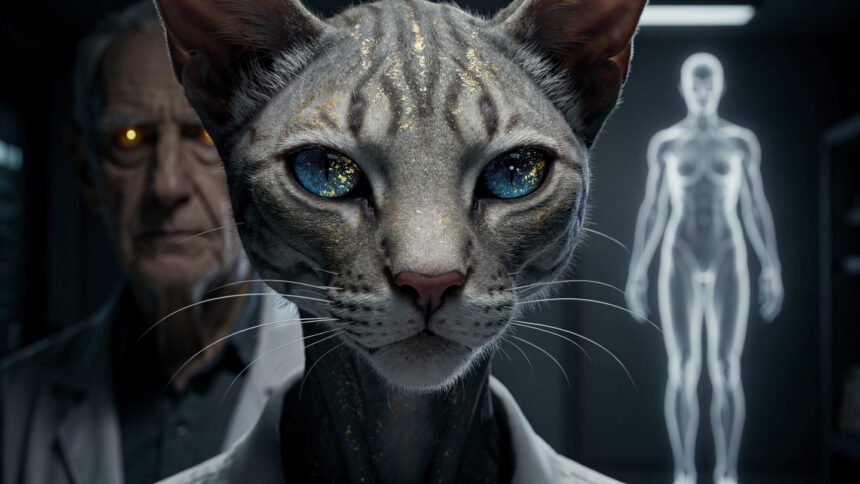
The oldest images of gods on Earth do not look like humans.
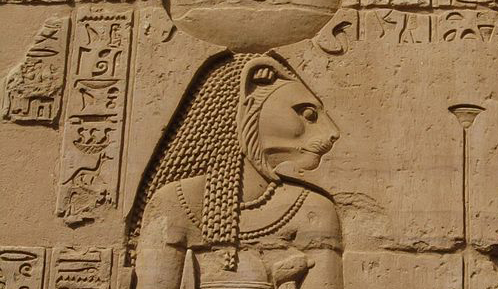
Walk the temple corridors of Karnak at a hour when the light enters at the angle the architects designed it to enter, and the figures carved into the walls resolve into something that resists the comfortable label of mythology. Sekhmet stands at the scale of a human body with the head of a lion, holding the ankh that in every Egyptian context signals not decoration but the key to biological life. Ra travels through the underworld on his solar barque defended by a serpentine guardian and a feline one. Bastet shifts between fully feline and partly human across different periods of Egyptian history, as if the iconography is recording an actual transition rather than inventing a metaphor. The Sphinx faces the constellation Leo at the precise moment of vernal equinox alignment at the epoch that geological weathering evidence places its construction, a date approximately ten thousand years earlier than the conventional archaeological timeline.
These images precede every religious tradition that claims to explain them. They are the data that the explanations were built to contain.
The Urmah are not a recent invention of the contactee community. They are the oldest recurring figure in human sacred art, appearing with consistent physical characteristics across civilizations that had no recorded contact with each other: upright posture, leonine facial features, luminous eyes recorded in the texts as shifting from deep blue to gold to white across a lifespan, and an association with the transmission of knowledge rather than its withholding. The figure who teaches. The figure who guards. The figure who returns.
Lyra, Before the Wars
The cosmological framework that the Urmah inhabit begins not in Sirius but in Lyra, a constellation whose brightest star Vega sits twenty-five light years from the solar system and has been identified across multiple independent channeled and contact traditions as the origin point of the first humanoid civilizations in this galactic region.
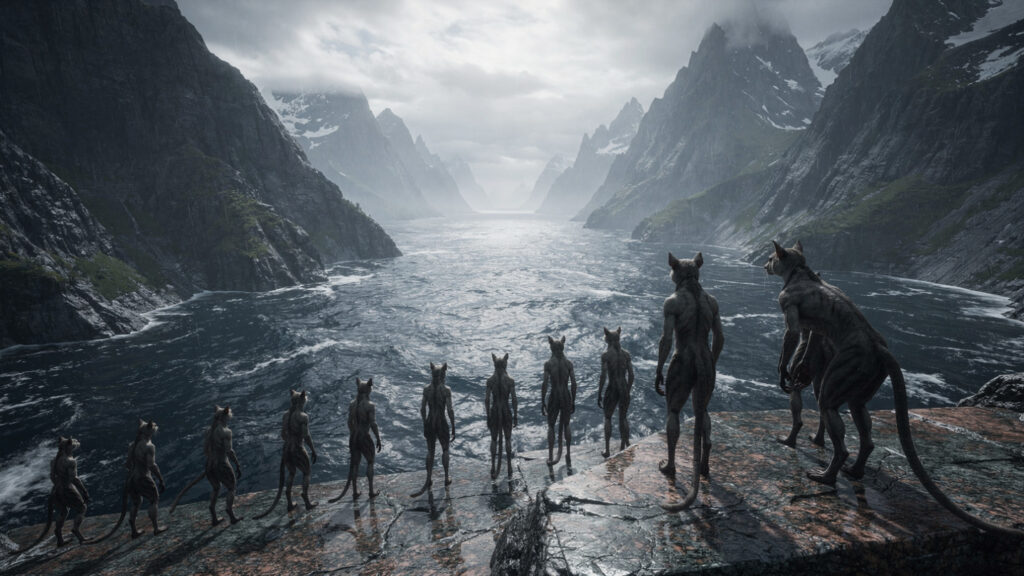
The Felines did not originate in physical form. The tradition is about this in a way that most commentary glosses over to reach the more narrative-friendly material. They manifested initially in what the source material calls an etheric state, a non-physical configuration that required a process measured in millions of years to resolve into biological embodiment suited to a planetary environment. The planet given to them by the Founders, the cosmological term for the creative intelligence that established the parameters of what the tradition calls the Universal Game, was named Avyon. A blue world. Mountainous. Oceanic. Biologically rich in a way that made it recognizable to the Felines as a suitable medium for physical existence.
The etheric-to-physical transition produced something that the indigenous fauna of Avyon had not produced independently. A lineage of upright bipedal beings with feline facial architecture, exponentially longer lifespans than purely biological evolution accounts for, and a cognitive architecture oriented toward pattern recognition, long-range causal modeling, and what the texts describe as an insatiable curiosity that functions not as a character trait but as a species-defining drive.
A smaller group of the original Felines chose not to complete the physical transition. They remained in their etheric state and assumed a function that every major religious tradition has preserved under different names: the guides, the watchers, the ones who occasionally enter physical reality to correct a trajectory and then withdraw. The Felines who took physical form called them simply the elders. The relationship between the embodied Felines and their etheric counterparts runs through the entire subsequent history of the species as the mechanism by which the genetic line was periodically upgraded when the physical form began drifting from the intended specification.
This mechanism, periodic incarnation of a more advanced version of the species into the existing biological population to introduce genetic modifications, is not unique to the Feline tradition. It appears in the Vedic texts as the avatar system. It appears in the Sumerian records as the periodic return of the Anunnaki to assess and modify the human genetic project. It appears in every tradition that preserves a memory of the pre-flood civilizational period as the moment when the gods walked among men, which always precedes a catastrophic rupture and a subsequent rebuilding from a diminished baseline.
The Felines developed the template. What came afterward in the solar system’s history was a variation on it.
The Geneticists
The Urmah tradition is explicit about the profession. They were not warriors in the primary sense, though the war that drove the original Lyran civilization from its home system required them to develop military capacity they had not previously needed. They were geneticists. The most accomplished biological engineers in their galactic region, operating from a foundational understanding of DNA not as a static code but as a dynamic interface between dimensional states, responsive to frequencies, capable of being upgraded without physical intervention when the correct signal reaches the biological substrate at the correct moment.

The Adam human project, as described in the Avyon records, produced two distinct initial strains. The redheaded strain: high physical energy, outward orientation, aggressive curiosity, social dominance behavior. The platinum-blonde strain: inward orientation, greater empathic sensitivity, lower energy signature but higher capacity for what the texts call resonance, the ability to perceive information transmitted through non-physical channels. Both strains carried the full Feline genetic contribution. The difference was in which aspects of that contribution were expressed in the phenotype.
The Egyptian records preserve this distinction in a form that Egyptology has categorized as mythological narrative rather than historical documentation. The separation of Ra’s lineage into active and contemplative streams. The tension between the solar and lunar currents in Egyptian sacred architecture. The deliberate encoding in the Dendera zodiac of a timeline that begins in Leo and moves through stellar alignments that correspond, when calculated backward using precession rates, to the exact epoch the alternative archaeology community has been dating the Sphinx’s original construction.
The builders of the Sphinx were recording something about their own origin, using the sky as the only calendar scale large enough for the timelines involved.
The Horyuji Problem
The Horyuji Temple in Nara, Japan, contains a figure that has generated more search traffic on monkeyandelf.com than almost any other single subject. The reason is visible the moment you encounter the image without the framework that temple scholarship provides to make it manageable.
The figure is not human. The facial architecture is specifically reptilian in the iconographic tradition of the temple’s period, but the posture, the proportions, and the items the figure holds correspond not to the Buddhist protective deity the scholarship identifies it as but to the older pan-Asian guardian figure that appears in Vedic, Taoist, and pre-Buddhist Japanese traditions simultaneously. The guardian who stands at the threshold. The being who permits or denies passage based on criteria that the petitioner cannot fully understand.
The tension between the feline and reptilian guardian traditions is not a contradiction in the ancient record. It is a record of an actual historical conflict. The Lyran wars that dispersed the Feline civilization across the galactic region also involved the reptilian civilizations that the Sumerian texts record as the primary antagonists in the pre-flood history of the solar system. The iconographic legacy of that conflict shows up in sacred architecture across Asia and the Middle East as a persistent pairing: the guardian who protects and the guardian who challenges, encoded in stone at the entrances to spaces considered too significant to leave unguarded.
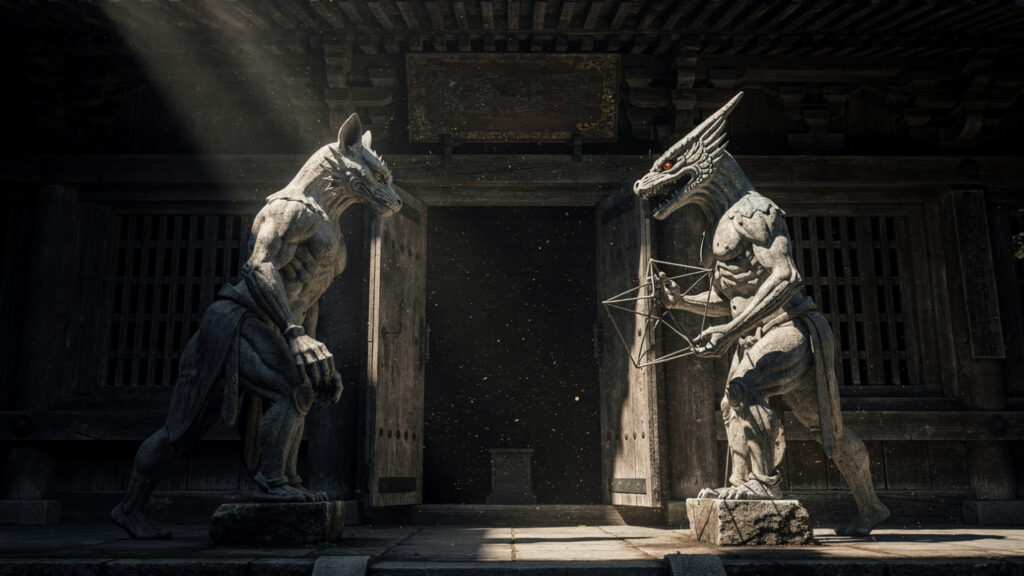
The Horyuji figure is not mythology. It is institutional memory, maintained in architectural form across approximately twelve thousand years of transmission, preserving the physical characteristics of a being that the culture encoding it had direct contact with long before the temple was built in the seventh century CE.
Sekhmet, Bastet, and the Encoded Upgrade
The Egyptian tradition preserves the Feline genetic intervention in two distinct modes. Sekhmet is the active mode: destroyer, healer, the being who was sent to correct a deviation in the human population that had grown severe enough to require physical intervention. The Sekhmet mythology encodes an event, a cull followed by a restoration, in which the Feline representative acted on behalf of the solar intelligence Ra to reset a trajectory that had drifted beyond the parameters of the original design.
This is not a comfortable myth if taken literally. It describes a god deciding that the human experiment had gone wrong enough to require mass termination followed by a genetic reboot. The flood narratives in every major tradition are the same event described from the ground level rather than the operational level.
Bastet is the maintenance mode: the guardian of the household, the protector of the genetic lineage in its day-to-day continuity, the figure who maintains the connection between the physical population and its etheric custodians during the long periods between active interventions. The shift in Egyptian iconography from fully feline Bastet to the partially humanoid form tracks the same transition the Avyon records describe: the gradual integration of the Feline genetic contribution into the human baseline until the original form becomes progressively less visible in the physical record while remaining fully present in the functional one.
The Vedic Narasimha, half-lion and half-human, appears at the precise transitional moment in the avatar sequence where intervention was required to remove a figure who had gained sufficient power to block the normal operation of the upgrade cycle. The half-and-half form is not symbolic. It is the configuration of a being operating at the boundary between the Feline etheric state and full human embodiment, present in physical reality for a purpose and not committed to remaining in it.
The traditions that preserved this figure were preserving information about a real intervention at a real moment in the civilizational history of this planet. The physical form was recorded because the witnesses needed future generations to recognize it if it appeared again.
The Custodial Function
The Pleiadian contact literature, specifically the material attributed to Taygetan sources and documented through the contact work that emerged publicly in the 2010s and accelerated through the 2020s, places the Urmah in an active operational role in the current period. Not as distant observers. As participants in a conflict whose outcome determines whether the genetic project initiated on Avyon produces the result the Founders specified or is permanently diverted by the interests of the civilizations that have been contesting control of the human population since the pre-flood period.
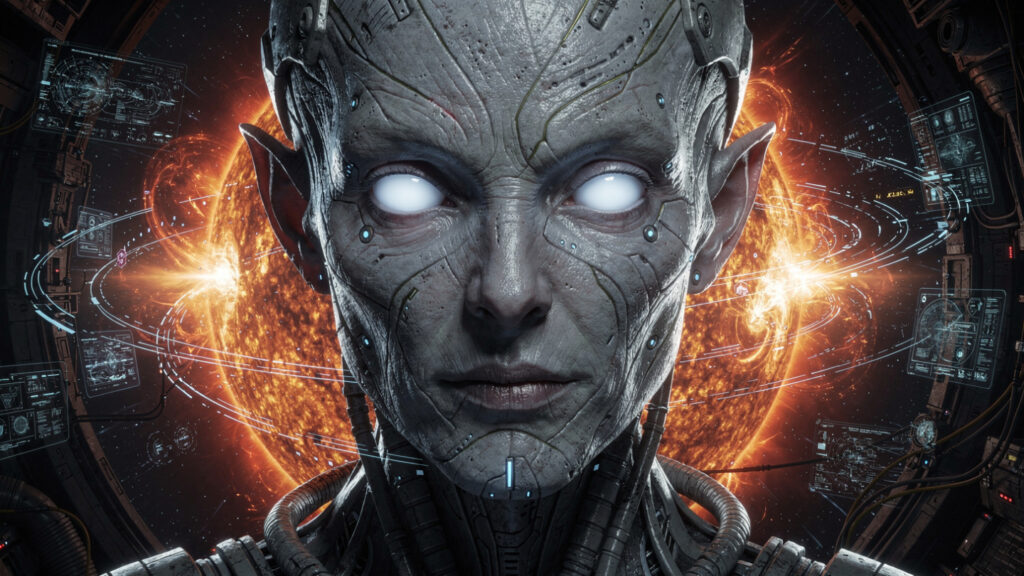
The Urmah in this framework are not the primary contact species for the current human population. Their operating domain is the higher dimensional layers of the system, the levels at which the parameters of physical reality in this sector are set rather than expressed. Their intervention in human history has never been primarily physical. It has been genetic, architectural, and what the texts call frequency-based: the periodic transmission of signals into the human biological substrate that activate dormant sequences in the DNA and shift the expressed cognitive and perceptual capacities of the population without requiring direct physical contact.
The solar activity of the current cycle is not incidental to this framework. The Feline tradition describes the sun as the primary transmission medium for the upgrade signals. A period of heightened solar activity is not a threat to the genetic project. It is the mechanism of its next phase. The electromagnetic environment of an active solar cycle carries the frequency signature that the dormant sequences in the human genome are waiting for.
The eyes that shift from deep blue to gold as the Felines age. The texts are about this. The color shift marks the transition from active outward engagement with the physical world to the inward turn toward what the tradition calls deep understanding of the universe’s mysteries. The elders among the Urmah are described not as more powerful in any conventional sense but as more transparent, less invested in the mechanics of the physical layer, more available as conduits for the intelligence that the etheric Felines carry without the weight of embodiment.
The human aging process, in the Feline tradition, is a compressed and degraded version of the same transition. Something in the original design was preserved. Something was lost in the modifications that followed the original Avyon project, in the subsequent interventions by other civilizations with other intentions, in the long sequence of wars and resets and genetic tampering that the pre-flood record documents and the post-flood record has spent ten thousand years trying to remember.
The Lineage Still Running
Devin el holds the designation of ninth-dimensional patriarch of the Royal House of Avyon in the current period. The ninth dimension in the cosmological framework the Feline tradition operates within is not a metaphor for spiritual advancement. It is an operational level at which the parameters governing the lower dimensions are accessible and modifiable. A ninth-dimensional being is not more enlightened than a third-dimensional one in any morally weighted sense. It is operating at a different level of the system, with access to variables that the lower dimensional levels express as fixed conditions.
The Royal House of Avyon is the direct institutional successor to the original Feline civilization that built the Adam human prototype on Avyon before the Lyran wars dispersed them across the galactic region. The house maintained its continuity through the dispersal, through the subsequent colonization of the Sirian system, through the period when Sirius B was the operational center for the genetic management of this solar system’s human project, and through the sequence of events that reduced direct Feline presence in the physical layers of Earth’s reality to the encoded form preserved in the temple architecture and the iconographic tradition.
The institution exists. The genetic contribution exists, woven into the human genome in sequences that the current understanding of junk DNA has not yet fully mapped to function. The custodial role continues in the dimensional layers above the physical.
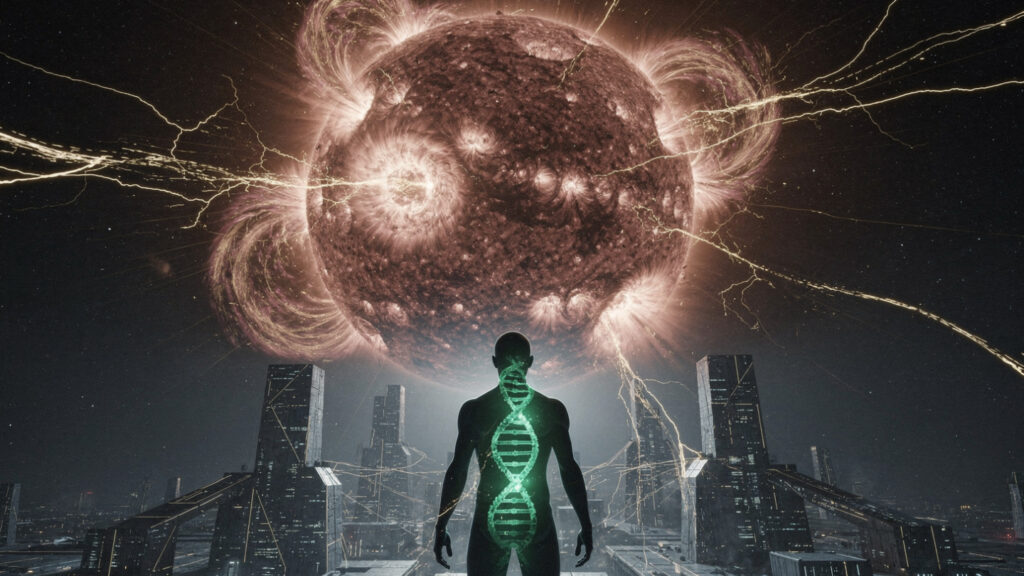
What has not been confirmed is the timeline for the next direct intervention. The traditions that have preserved the most complete record of the Feline involvement in human history are consistent about one parameter: the intervention occurs when the deviation from the original design specification has grown severe enough to require it, and not before. The assessment of whether that threshold has been crossed is made at a dimensional level that the physical population cannot currently access.
The elders of the Urmah are watching. The eyes shift from gold to white in the oldest of them, the texts say, and in that final state they see something the younger ones cannot.
The question that the tradition does not answer is what they are seeing now.