



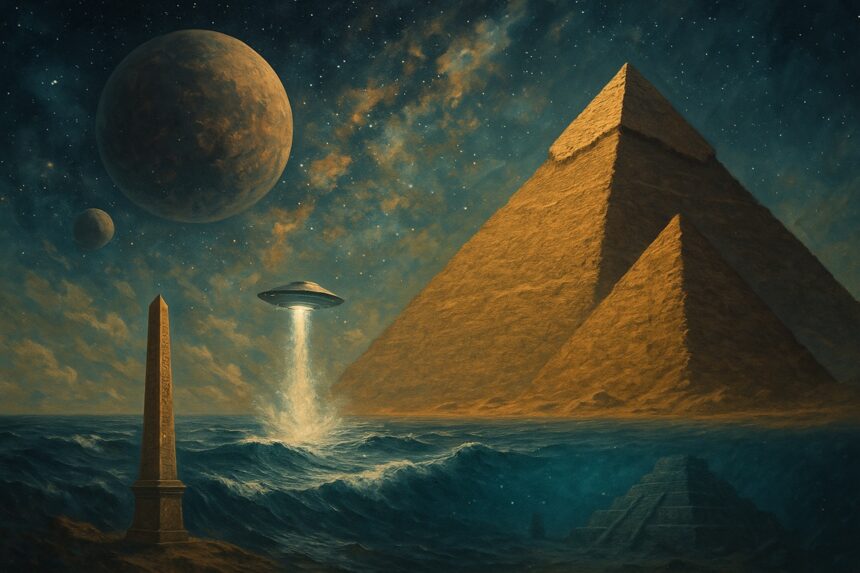
Fourteen extraordinary claims can sound equally convincing when they are presented in the same breath: objects emerging from the ocean, a hidden Planet Nine, coded Egyptian knowledge, dragons, an artificial structure beneath Yellowstone, an unexplained European blackout, fear-inducing pyramids, strange minerals beneath Antarctica, a deliberately engineered magnetic field, possible life on K2-18 b, artificial structures on Mars, ancient extraterrestrials in Sumerian texts, a submerged monument built by a lost civilization, and the possibility of time travel. But these claims do not occupy the same evidentiary universe. Some describe real scientific questions. Some begin with genuine observations and then leap far beyond them. Others cannot be traced to a credible source at all.
That distinction is the entire story. A strange observation does not automatically produce a strange explanation, and an unresolved scientific question is not evidence for the most dramatic answer available. The useful way to examine claims like these is not to ask whether they sound possible, but whether the underlying evidence can be traced: to a named researcher, a real institution, a published study, an identifiable dataset, or a primary historical source. Once that standard is applied consistently, the fourteen claims separate themselves surprisingly quickly.
1. UFOs Rising From the Ocean
There is a legitimate phenomenon underneath the sensational version of this claim. U.S. military personnel have reported unidentified objects in and around maritime environments, and the Pentagon’s All-domain Anomaly Resolution Office continues to receive and investigate UAP reports. AARO’s public record includes cases associated with military operations in maritime regions, which makes the basic subject a genuine national-security and aviation question rather than something that can simply be dismissed as internet folklore. But that is a very different proposition from proving that spacecraft are physically emerging from the ocean, the same evidentiary gap examined in claims about whether humanity’s ancient past has been erased by cosmic powers. “Unidentified” describes the state of the evidence, not the identity of the object, and an observation that appears to cross the air-water boundary requires extraordinarily good sensor data before it can be treated as evidence of a new physical capability.
The important distinction is therefore between transmedium behavior being reported and transmedium technology being demonstrated. The first is an investigative category. The second would be a scientific discovery. AARO’s existence proves the government takes anomalous reports seriously enough to investigate them; it does not establish an extraterrestrial explanation for them.
2. Planet X
This one survives the first test. There really is a serious astronomical hypothesis that a large, distant planet may exist beyond Neptune. In 2016, Caltech astronomers Konstantin Batygin and Michael Brown published a model showing that the unusual clustering of some distant Kuiper Belt objects could be explained by a massive planet on a distant, eccentric orbit. Subsequent work has explored additional dynamical consequences of the hypothesis. But “Planet Nine” remains a hypothesis, not a discovered planet: astronomers have not directly observed the proposed world, and competing explanations for the observed orbital patterns remain part of the scientific discussion.
That distinction matters because Planet Nine is an excellent example of how real science actually works. Scientists can infer the possible existence of something they have not seen by studying its gravitational effects, then spend years trying to find it. The uncertainty is not a weakness in the story. It is the story. Planet Nine is therefore neither a confirmed hidden planet nor a fringe fantasy. It is an unresolved astronomical hypothesis.
3. The Luxor Obelisk Contains Hidden Coded Knowledge
The Luxor Obelisk standing in Paris is completely real, and so is the ancient civilization that produced it. The monument dates to the reign of Ramesses II and originally stood at the Temple of Luxor before being transported to France in the nineteenth century. Its hieroglyphic inscriptions are not an undeciphered language waiting for a breakthrough. They belong to a well-studied Egyptian writing system and contain the sort of royal and religious material Egyptologists have been translating and contextualizing for generations. The Musée du Louvre’s documentation identifies the monument’s Ramesside origin and preserves extensive Egyptian material from the same historical and textual tradition.
That does not mean every ancient inscription has been completely understood in every historical nuance. Egyptology remains an interpretive discipline, and new discoveries can change readings and context. But that is radically different from saying the obelisk contains a hidden technological code suppressed by conventional scholarship. No published Egyptological evidence establishes such a code. The monument is mysterious only in the ordinary sense in which a surviving object from the thirteenth century BCE is mysterious: it is an extraordinary surviving piece of another civilization.
4. Dragons in Ancient Russia Were Descriptions of Flying Machines
Russian and wider Slavic traditions contain dragons, serpentine monsters, supernatural birds, heroes, saints, and other beings that occupy the borderland between folklore and mythology. Those traditions are real cultural evidence. They can tell historians how communities imagined danger, nature, enemies, monsters, sacred power, and the unknown. What they cannot automatically provide is a technical specification for an aircraft.
The recurring modern move is to reinterpret a supernatural creature as a misunderstood machine simply because the description contains flight, fire, brightness, or unusual movement. That is possible as a speculative exercise, but possibility is not historical evidence. Unless a source contains independently corroborated observations, identifiable technology, archaeological context, or a chain of transmission connecting the story to an actual object, a dragon remains a dragon in the historical record.
5. Yellowstone Has an Artificial “Lid”
Yellowstone really does contain enormous structures beneath its surface, but geology already gives us a remarkable explanation for them. Seismic imaging has revealed a complex magmatic system beneath the caldera, including a large crystal-rich magma reservoir and deeper bodies of magma. In 2025, researchers using controlled seismic sources were able to identify a sharp transition at the top of part of Yellowstone’s magma reservoir at roughly 3.8 kilometers beneath the surface. Other studies have mapped multiple layers and zones of melt and crystal-rich material beneath the caldera.
What the scientific literature does not describe is an engineered “lid” placed over Yellowstone by an unknown civilization. The subsurface really is structured, but geological structure is not synonymous with artificial construction. In fact, the real picture is more complicated than the popular image of Yellowstone containing a single giant underground tank of molten rock: the present system is a dynamic mixture of crystals, melt, fluids, and deeper magmatic bodies. The Yellowstone Volcano Observatory monitors this system continuously because its natural complexity is already consequential enough.
6. The 2025 European Blackout Was Caused by Electromagnetic Interference
The April 28, 2025 blackout across continental Spain and Portugal was real, enormous, and initially mysterious enough to invite almost any explanation. It was therefore a particularly good test of how speculation works: while theories about cyberattacks, electromagnetic interference, and other external causes circulated, investigators were simultaneously reconstructing what the electrical system had actually done. The final report from the 49-member ENTSO-E Expert Panel found a combination of interacting grid failures, including oscillations, gaps in voltage and reactive-power control, differences in voltage-regulation practices, rapid generation reductions and disconnections, and uneven stabilisation capabilities. Those factors produced rapidly increasing voltages and cascading disconnections.
That conclusion does not mean every detail of the event was simple or that every engineering question disappeared with the final report. It means the extraordinary explanation is not required to account for the observed failure. The blackout was a complicated electrical-system failure, not evidence that an external electromagnetic weapon or unexplained force switched Europe off. The interesting lesson is actually more uncomfortable: modern civilization depends on enormously complicated systems whose failure modes can look almost supernatural when the underlying engineering is invisible.
7. The Great Pyramid Was Designed to Manipulate the Human Brain
The Great Pyramid really does produce interesting acoustic and vibrational measurements, and modern researchers continue to study its internal spaces using instruments ranging from accelerometers to acoustic and seismic techniques. Recent research has measured the pyramid’s dynamic behavior and fundamental frequencies, while other experiments and analyses have explored how its chambers respond to sound and vibration. There is nothing inherently pseudoscientific about asking how an ancient structure behaves as a physical object.
The leap comes when measurable resonance is converted into evidence of intentional consciousness manipulation. A chamber having a resonant frequency does not establish that its builders selected its dimensions for that frequency, much less that they intended to induce visions, altered consciousness, fear, or spiritual experiences. Nor does the existence of frequencies below 20 hertz automatically demonstrate that anyone inside the pyramid experienced a particular psychological effect. The proper conclusion is narrower and more interesting: the Great Pyramid is a huge stone structure with measurable acoustic and mechanical properties, and those properties deserve measurement before mythology is layered on top of them. The resonance is real; the alleged purpose remains unproven.
8. Lake Vostok Contains Gold or Unknown Minerals
Lake Vostok is one of Earth’s genuinely extraordinary environments, which is precisely why fabricated additions are unnecessary. Buried beneath the Antarctic ice sheet, the lake exists in permanent darkness under enormous pressure and near-freezing conditions. Research on accreted ice associated with the lake has revealed evidence of microbial life and provided information about the lake’s physical and chemical environment. Direct sampling of the lake itself has historically been extraordinarily difficult, which means scientists have had to distinguish carefully between what is measured in overlying ice, what is inferred about the lake, and what has actually been recovered from the water below.
Claims of gold deposits, unfamiliar minerals, or mysterious artifacts therefore require something very specific: a published sample, a documented collection chain, laboratory analysis, and independent confirmation. Without those things, the claim is simply an assertion. The real scientific discovery is already extraordinary: an isolated subglacial environment can remain biologically interesting despite extreme cold, pressure, darkness, and long-term isolation.
9. Earth’s Magnetic Field Was Deliberately Designed
Earth’s magnetosphere produces phenomena that can sound almost engineered when described without context. One example is plasmaspheric hiss, a naturally occurring electromagnetic wave phenomenon associated with the interaction between Earth’s magnetospheric plasma and charged particles. Space physicists study these waves because they affect the behavior and distribution of energetic particles in near-Earth space. The underlying physics is real, measurable, and important to understanding the radiation environment surrounding our planet.
None of that establishes intentional design. The magnetosphere is the consequence of Earth’s internal dynamo and its interaction with the solar wind, while its many electromagnetic structures emerge from physical processes that can be modeled and measured. Calling those processes “designed” is a philosophical interpretation, not an observation supplied by the data. The distinction matters because natural systems can be astonishingly structured without being artificial.
10. K2-18 b Has Signs of Alien Life
This is one of the most genuinely interesting cases on the list because the underlying observation is real and the uncertainty is scientific rather than manufactured. James Webb Space Telescope observations have detected methane and carbon dioxide in the atmosphere of K2-18 b, a sub-Neptune orbiting within the nominal habitable zone of its star. Earlier analyses also reported a possible dimethyl sulfide signature, a molecule associated with biological activity on Earth. That result attracted enormous attention because a credible biosignature on an exoplanet would be one of the most consequential discoveries in modern astronomy.
But “possible biosignature” is not “life detected.” Follow-up analyses have challenged the statistical strength of the DMS and dimethyl disulfide interpretation, including a 2025 joint analysis that found insufficient evidence for those molecules in the combined JWST data under its tested assumptions. NASA itself emphasizes that atmospheric observations require multiple converging lines of evidence and careful consideration of biological and nonbiological explanations. K2-18 b remains fascinating precisely because the answer is not settled. The telescope found an important scientific question, not a confirmed alien biosphere.
11. NASA Photographed Artificial Structures on Mars
Mars is full of formations that look startlingly artificial when viewed in isolated photographs. Human vision is exceptionally good at extracting meaningful shapes from incomplete visual information, and that ability can produce faces, animals, buildings, machinery, and geometric structures where geology has produced nothing more than rock. Mars is particularly fertile territory for this effect because erosion, impact cratering, dust deposition, volcanic activity, and ancient water processes have produced an enormous variety of unusual landscapes.
That does not mean every unusual Martian image has been explained in detail, nor does it mean every apparent structure is visually uninteresting. It means that resemblance is not provenance. To establish an artificial structure on Mars would require evidence that survives higher-resolution imaging, multiple viewing angles, geological analysis, and independent examination. A rock that resembles a wall in one photograph has not crossed that evidentiary threshold.
12. Sumerian Creation Myths Describe Ancient Astronauts
Sumerian literature is real, ancient, complicated, and far more interesting than the modern extraterrestrial version usually suggests. Cuneiform tablets preserve creation traditions, divine genealogies, flood narratives, cosmological stories, royal ideology, hymns, myths, legal texts, administrative records, and ordinary economic documents. Collections such as the British Museum preserve actual tablets of works including Enuma Eliš, allowing modern scholars to study the surviving material directly rather than relying on modern translations detached from their archaeological context.
The ancient-astronaut interpretation usually works by translating gods into extraterrestrials, metaphor into technology, and mythological journeys into descriptions of spacecraft. That is an interpretive framework, not a conclusion demanded by the cuneiform. There is no need to deny the sophistication of Mesopotamian astronomy or the extraordinary achievements of Sumerian civilization to reject the extraterrestrial reading. The texts are already evidence of something remarkable: human beings were building elaborate models of the universe thousands of years ago.
13. Yonaguni Is a Lost Underwater City
Yonaguni is one of the more interesting archaeological-looking natural formations on Earth precisely because the debate is not completely trivial. The submerged sandstone formation off Japan contains terraces, sharp edges, steps, walls, and broad flat surfaces that can look unmistakably architectural in photographs. Some researchers and divers have argued that at least portions may have been modified by humans, while geological interpretations emphasize the properties of the local sandstone, its bedding planes, joints, and natural fracturing. The fact that a real scientific and geological debate exists is very different from saying a lost city has been discovered.
Robert Schoch, a geologist who has personally examined and dived the site, has argued for a natural geological origin, particularly emphasizing the way the rock fractures. That interpretation does not require pretending the formation looks ordinary; it requires asking whether natural processes can produce the observed geometry. Until archaeological material, datable human activity, inscriptions, tools, unmistakable construction debris, or another independent signature of human construction is established, “underwater city” remains an interpretation rather than an archaeological fact.
14. General Relativity Proves Time Travel Is Possible
This claim begins with real mathematics and then usually outruns it. Einstein’s general relativity admits solutions containing closed timelike curves, mathematical paths through spacetime that can return an object to an earlier point in its own history. Wormhole geometries have also been studied as possible mechanisms for connecting distant regions of spacetime and, under certain conditions, producing causal loops. These are legitimate subjects in theoretical physics. They are not experimental demonstrations that a machine can send a human being into the past.
The physical problems are severe. Traversable wormhole models generally require forms of exotic stress-energy that have no demonstrated macroscopic realization, while other proposed routes to closed timelike curves raise problems involving stability, singularities, quantum effects, or causality. Stephen Hawking’s chronology-protection conjecture argued that the laws of physics may prevent closed timelike curves from becoming physically realizable, although the ultimate status of chronology protection remains an open question in quantum gravity. The honest conclusion is therefore much narrower than “time travel is real”: general relativity contains mathematical worlds in which causal loops can occur, and physics has not established that nature permits us to build one.
Why Naming the Source Changes Everything
Look across the fourteen claims and a pattern appears. The strongest ones can be traced immediately. Planet Nine has named astronomers and published dynamical models. K2-18 b has JWST observations, competing atmospheric analyses, and an active scientific debate. The Iberian blackout has a multinational expert panel and a published reconstruction. Yellowstone has decades of seismic imaging. Chelyabinsk has satellite observations, infrasound records, recovered meteorites, and physical models. The weakest claims tend to reverse that structure: they begin with an unnamed “expert,” a supposedly suppressed discovery, a mysterious photograph, or an assertion that cannot be connected to a primary document.
This is not a rule that every published claim is true or every unpublished claim is false. Science has always contained discoveries before publication, mistakes after publication, and important ideas that began outside institutions. The point is traceability. A claim that can be checked can be corrected. A claim that cannot be traced can be endlessly rewritten without ever encountering a fact capable of killing it. That is why the source matters almost as much as the claim itself.
The Five Questions That Cut Through Almost Anything
When the next extraordinary claim arrives, five questions usually do more work than an hour of speculation. Who actually made the claim? Not “scientists,” but which scientist? Where is the original evidence? Not a screenshot of a screenshot, but the paper, dataset, archive, laboratory result, photograph, recording, or government document. Has anyone independent checked it? A second laboratory or research group matters because independent disagreement is one of the mechanisms by which science corrects itself. What ordinary explanation has already been tested? The existence of an unexplained observation does not eliminate natural explanations. And finally: What would prove the claim wrong? If the answer is “nothing,” the theory has stopped behaving like a testable explanation and started behaving like a belief system.
What Actually Survives
After the dramatic claims are stripped back, the world does not become boring. Quite the opposite. There may be a planet nobody has seen yet shaping the architecture of the outer Solar System. There is a lake sealed beneath Antarctic ice containing evidence of life in one of Earth’s most hostile environments. A distant exoplanet has an atmosphere complicated enough to keep astronomers arguing over whether an intriguing molecule is really there. Yellowstone contains a vast, dynamic magmatic system beneath the ground. The Great Pyramid has physical properties that researchers can still measure more than four thousand years after it was built. General relativity permits mathematical universes in which causality itself becomes strange. And the military really does investigate objects that it cannot immediately identify.
None of those facts needs an alien civilization, an ancient technological empire, a secret weapon, a hidden code, or a planetary cover-up added to it. The temptation to add one is understandable because extraordinary explanations make extraordinary stories. But the better stories are the ones that survive contact with evidence. The question is never whether the universe is strange enough to permit the claim. Almost anything can be imagined. The question is whether reality has supplied enough evidence to require it.
Fourteen questions went in. Some remain genuinely open. Some became much narrower once the evidence was examined. Some collapsed completely. And that distinction is not a disappointment. It is the mechanism by which we find out what is actually worth being astonished by.