




Some of the strangest stories ever told about the underground world begin with something real: a cave, a tunnel, a sunken city, a submarine lost in deep water, a landscape that has physically dropped beneath the sea. Then the story acquires a second layer. A newspaper adds a lost civilization. A disaster becomes a hidden encounter. A geological anomaly becomes proof of a hollow Earth. A traveler reports a legend, and generations later the legend returns as an alleged eyewitness account. By the time the story reaches the internet, the original evidence and the mythology can be almost impossible to separate.
That is what makes the underground legends worth investigating. Not because they form one secret history, but because they show how secret histories are manufactured. The Grand Canyon really exists, but the Smithsonian expedition described in a sensational 1909 newspaper story does not. USS Thresher and USS Scorpion really disappeared beneath the Atlantic, but neither loss provides evidence for an underground tunnel. Long Beach really did sink by nearly thirty feet, but the cause was not a hollow crust beneath California. Ferdinand Ossendowski and Nicholas Roerich really did write about mysterious kingdoms and sacred geographies in Central Asia, but their books do not constitute archaeological evidence for a technologically advanced civilization beneath the Earth. And medieval Europe really did contain hundreds of strange underground passage systems whose original purpose remains debated.
The pattern is more interesting than the conspiracy. Real evidence keeps appearing at the edges of the story, while the grand explanation keeps getting larger than the evidence can support.
The Grand Canyon Cave That Began With a Newspaper
The most famous American version begins on April 5, 1909, when the Arizona Gazette published a sensational front-page story under the headline “Explorations in Grand Canyon.” It described an explorer named G.E. Kinkaid who supposedly discovered an enormous underground citadel while traveling down the Colorado River. The story claimed that Smithsonian-backed archaeologists were investigating the complex and that its chambers contained mummies, hieroglyphic inscriptions, weapons, tablets, copper and gold objects, and evidence suggesting an ancient migration from the Old World. The newspaper even presented the discovery as potentially one of the most important archaeological finds in the United States.
There is a detail here that matters enormously: the newspaper story itself is real. What is not real is the archaeological discovery it reported. The article can be traced directly to the Arizona Gazette, and the Smithsonian has repeatedly said that it has no record of the expedition or of the people the story claimed were associated with it. The Pima County Public Library likewise identifies the story as false, while the Smithsonian itself has listed the episode among persistent myths falsely attributed to the institution. In other words, there is no need to invent a later cover-up to explain the origin of the legend. The original sensational article is already sitting there in the historical record.
The names themselves are part of the problem. G.E. Kinkaid and Professor S.A. Jordan became the supposed human anchors of the story, yet the surviving institutional record does not produce the expedition that the article describes. There is also an earlier Arizona Gazette article from March 12, 1909 describing Kinkaid’s supposed journey down the Colorado River, meaning the April story did not appear from nowhere. It was preceded by a smaller piece that established the explorer as a real-seeming character before the extraordinary archaeological claims arrived. That sequence makes the episode look less like a suppressed scientific discovery and more like a newspaper story being built into a larger one.
Historian Don Lago went further. In his research for the Grand Canyon Historical Society, he argued that the article strongly resembles the work of Joe Mulhatton, a notorious early-twentieth-century newspaper hoaxer whose reputation was built on manufacturing extravagant stories. Lago’s case is detailed and sourced, and it is the strongest historical explanation for the story’s authorship, but it should still be described as an attribution rather than a confession discovered in an archive. There is no surviving document in which Mulhatton signs the Grand Canyon article and admits that he wrote it. That distinction matters because the investigation is supposed to end at the edge of the evidence, not cross it for dramatic effect.
The modern mythology then performed a familiar trick. The absence of evidence became evidence of suppression. The Smithsonian’s inability to produce the expedition became proof that the Smithsonian was hiding it. The lack of artifacts became proof that the artifacts had been removed. A newspaper story that was almost certainly invented was transformed into an archaeological discovery supposedly too dangerous to acknowledge.
And that is how a hoax becomes an archive.
The Grand Canyon itself remains every bit as extraordinary. Its genuine archaeology, geology, Indigenous histories and enormous inaccessible spaces do not need a fictional Egyptian chamber added to them.
The Hopi Underworld Is a Different Story
This is where another distinction becomes essential. Indigenous origin traditions involving emergence from an underworld are genuine traditions with cultural and religious significance. They should not be retrofitted into a 1909 newspaper hoax simply because both stories happen to involve underground worlds. A living sacred tradition is not evidence for an archaeological expedition, and a fabricated newspaper report does not become Indigenous history because later writers place the two beside each other.
The Hopi emergence traditions belong to their own history and should be treated on their own terms. The Grand Canyon newspaper story belongs to the history of American sensational journalism. Connecting them into a single hidden-civilization narrative tells us considerably more about modern myth-making than it tells us about either.
Then There Were the Submarines
Two of the twentieth century’s most haunting underwater disasters were real enough to generate their own mythology. USS Thresher disappeared on April 9, 1963, during deep-diving tests off Cape Cod. All 129 people aboard died. The Navy’s investigation concluded that a seawater piping-system joint had failed, producing flooding and a cascading loss of the submarine’s ability to recover. The disaster exposed weaknesses in submarine construction, testing, inspection and emergency recovery procedures, and the Navy responded by establishing the SUBSAFE program to impose far more rigorous controls on the integrity of submarine systems.
There is nothing mundane about that explanation. A single failed component inside a machine operating thousands of feet below the surface can become a chain of events from which an entire crew has no way back. The tragedy is precisely that the submarine did not need to encounter anything unknown. Engineering failure at extreme depth was enough.
USS Scorpion is more complicated. The submarine disappeared in the Atlantic on May 22, 1968, killing all 99 people aboard. The Navy’s investigation was unable to establish the cause with certainty, and later technical analysis examined multiple possibilities. One prominent hypothesis involves a malfunction or accidental detonation of a Mark 37 torpedo, but the official record does not justify rewriting that hypothesis as a solved conclusion. The Navy itself has acknowledged that the precise cause could not be determined.
That unresolved uncertainty is exactly what conspiracy narratives need. An unexplained disaster leaves a door open. A possible torpedo failure becomes a secret weapon. A wreck on the ocean floor becomes a collision with an unknown structure. And because nobody can reconstruct every second of a catastrophic event decades after the fact, the gaps become places where almost anything can be inserted.
But uncertainty about a disaster is not evidence for a tunnel.
The City That Really Did Sink
Long Beach provides a much better mystery because the strange thing actually happened. Parts of the city and harbor area really did sink dramatically during the development of the Wilmington oil field. At the center of the subsidence bowl, the land surface dropped by roughly 29 feet, or nearly nine metres. Streets, railways, pipelines and harbor infrastructure were damaged, and seawater invaded areas that had previously stood above it. The phenomenon was so severe that it became one of the classic examples of human-caused land subsidence in an oil-producing region.
The mechanism was not an empty world beneath Long Beach. It was the opposite. Decades of extracting fluids from the Wilmington reservoir reduced underground pressure and allowed reservoir sediments to compact under the weight of the overlying material. The ground above responded by moving downward. Water injection was subsequently used to restore pressure and control further compaction and subsidence, a response that became a major engineering component of the field’s operation.
This is what a real geological mystery looks like. The ground moves. Buildings crack. Harbor facilities deform. Scientists measure the displacement. Engineers identify the mechanism. Models are constructed. Water is injected. The phenomenon becomes understandable without becoming any less astonishing.
Sometimes the truth is stranger than the explanation. It is simply less cinematic.
Agartha Was Real as a Story Long Before It Became a Conspiracy
Central Asia produces a different kind of underground mythology. Here the mistake is not inventing a completely nonexistent traveler, but flattening a complicated literary and religious history into a modern claim that someone discovered an underground super-civilization.
Ferdinand Ossendowski was a real Polish writer, traveler and engineer who published Beasts, Men and Gods in 1922. The book recounts his journeys through Mongolia and Central Asia during the upheavals surrounding the Russian Civil War, but it also contains stories of a subterranean kingdom called Agharti or Agartha and a mysterious spiritual ruler known as the King of the World. Ossendowski presented these accounts as things he encountered and heard during his travels. The book is therefore a genuine historical document of what he wrote, but it is not independent archaeological confirmation that the kingdom existed.
That distinction becomes even more important with Nicholas Roerich. Roerich was a major artist, writer and mystically inclined intellectual who led an extensive Central Asian expedition in the 1920s. He was not simply a neutral scientist passing through the region and reporting folklore. Shambhala became central to his spiritual worldview, and his writings deliberately blended geography, legend, religion and esoteric interpretation. Modern scholarship has examined precisely this entanglement between Roerich’s travels, his spiritual movement and the mythology of Shambhala.
Roerich’s own writings even place Agharti, subterranean cities, hidden passages and other legendary places into a much larger constellation surrounding Shambhala. That does not make Roerich a fraud. It makes the historical record more interesting. He was participating in the creation and reinterpretation of a modern esoteric geography, not merely discovering a hidden physical civilization and handing the coordinates to archaeology.
The later mythology reversed the direction of the evidence. A traveler reported legends. Later writers treated the legends as reports. A mystic wrote about Shambhala. Later conspiracy literature treated the writing as testimony about a physical underground state. Eventually Agartha became less a literary and spiritual idea than a supposed place on a map.
Europe Really Is Full of Strange Tunnels
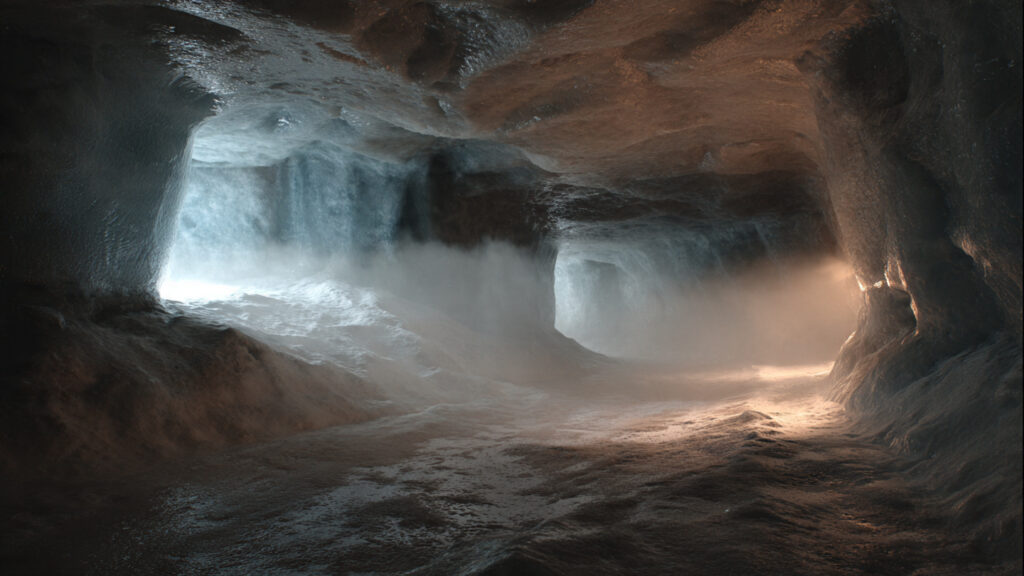
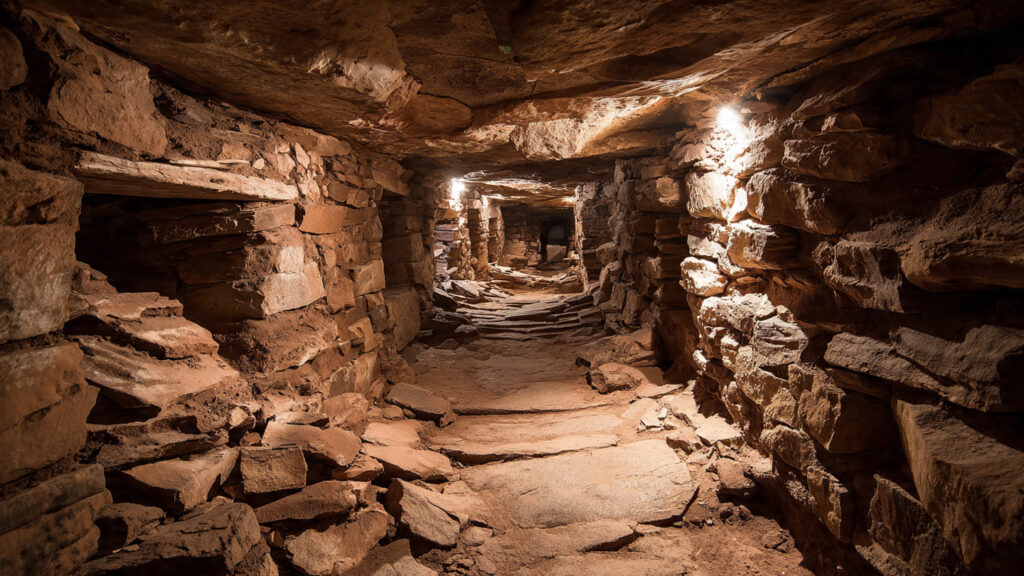
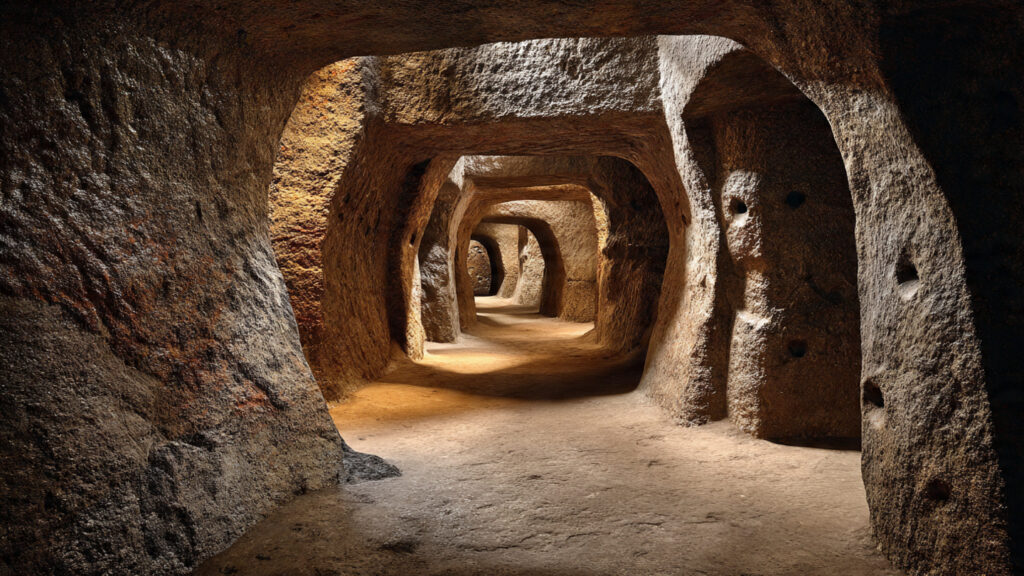
Then there is the part of the story that does not need exaggeration at all. Across Central and Western Europe are thousands of small artificial underground structures known as Erdställe. They are narrow galleries, chambers and passages, often extraordinarily uncomfortable to enter, and their precise original purpose remains debated. But one important correction changes the entire picture: the archaeological literature generally places Erdställe in the medieval period, commonly around the High and Late Middle Ages, not in a mysterious prehistoric age 12,000 years ago.
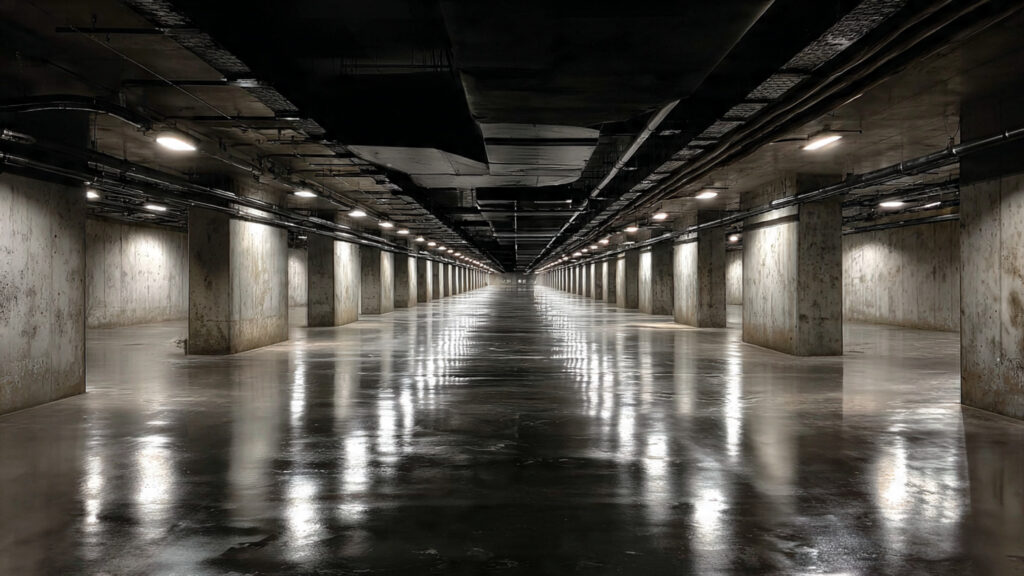
Their distribution is nevertheless remarkable. Particularly large concentrations occur in Bavaria, Austria and adjacent parts of Central Europe, with comparable structures reported farther west. They are generally small rather than monumental, often consisting of narrow passages, constrictions and chambers. Some researchers have proposed refuge or hiding functions. Others have investigated ritual, symbolic or other purposes. There is no universally accepted explanation, and archaeological evidence is often frustratingly sparse.
That uncertainty has produced its own folklore. Some local traditions associated the passages with dwarfs, elves or other underground beings. Other legends imagined tunnels connecting castles, churches and settlements over enormous distances. Yet the actual physical structures usually do not resemble the continent-spanning transit systems later conspiracy writers describe. Many are extremely short, narrow and difficult to navigate. Some have only a single entrance and exit through the same opening.
The real mystery is therefore not, “Where is the 12,000-year-old European tunnel network?” It is much more interesting: why did medieval communities invest enormous labor in building these peculiar underground spaces, and why have so few records survived explaining what they were for?
The Missing University Study
This is another place where a spectacular claim should be separated from a real research problem. There is no need to invoke a University of Edinburgh confirmation of a prehistoric underground network running uniformly from Spain to Turkey. The available research on Erdställe instead describes a scattered European phenomenon whose chronology, distribution and function are still being investigated. Researchers continue to survey individual structures, reconstruct their architecture in three dimensions and debate their original purposes.
That is a much better mystery than a fabricated university citation. Archaeologists actually have the tunnels. They can enter them. They can map them. They can date some of them. What they cannot yet do with confidence is explain why all of the strange architectural decisions were made.
Why Humans Keep Putting Their Mysteries Underground
There is a reason these stories keep converging on the same direction: down.
Caves conceal. Tunnels separate. Deep water destroys evidence. Underground chambers cannot be seen from the surface. Once something disappears beneath rock, soil or ocean, the imagination is given enormous freedom because the physical object itself is no longer available to ordinary inspection. The underground becomes a natural stage on which a culture can place ancestors, gods, enemies, lost civilizations, forbidden knowledge and entire worlds.
That pattern appears in radically different traditions without proving that those traditions describe the same place. Indigenous emergence stories, Central Asian sacred geography, European tunnel folklore and modern newspaper hoaxes can all involve subterranean worlds while having completely different origins and meanings. Treating them as interchangeable destroys precisely the distinctions that make each one historically interesting.
The same psychological mechanism operates in modern conspiracy culture. An unexplained submarine loss becomes a hidden collision. A newspaper hoax becomes a suppressed archaeological expedition. A real geological anomaly becomes evidence of a cavity beneath a city. A traveler’s account of mythology becomes an eyewitness report. A medieval tunnel whose function is unknown becomes a surviving fragment of a prehistoric continental network.
Each transformation follows the same direction: uncertainty becomes secrecy, secrecy becomes conspiracy, and conspiracy becomes certainty.
The Underground Is Not Empty
There is an irony buried beneath all of this. The debunking does not reveal an ordinary world. It reveals an extraordinarily complicated one.
The Grand Canyon contains genuine archaeological sites, geological structures and enormous areas whose history remains incompletely documented. The ocean floor contains wrecks whose final moments can never be reconstructed with perfect certainty. Long Beach provides a spectacular example of the Earth’s surface moving because human beings altered pressure conditions kilometers below it. Central Asia contains an immense body of religious, political and literary traditions surrounding places such as Shambhala and Agartha. Central Europe contains thousands of artificial underground structures whose original purposes remain imperfectly understood.
None of that requires an ancient global civilization.
It requires something more uncomfortable: accepting that different mysteries can have different answers.
Some are hoaxes. Some are geological processes. Some are engineering failures. Some are unresolved historical questions. Some are religious traditions that were never intended to function as archaeological reports. Some are physical structures whose purpose has genuinely been lost. And some become legends precisely because the evidence is incomplete enough to let later generations write themselves into the gaps.
What the Evidence Actually Leaves Behind
The temptation is always to connect the dots. The Grand Canyon cave, the submarines, Long Beach, Agartha, the European tunnels: put them on one page and they begin to resemble pieces of a single hidden architecture. But chronology pulls them apart. So does geography. So does the evidence. A 1909 newspaper hoax belongs to the history of journalism. The Thresher disaster belongs to the history of engineering and naval safety. Long Beach belongs to petroleum geology. Agartha belongs to a complicated history of Asian religious traditions, travel writing and Western esotericism. Erdställe belong to medieval European archaeology.
They do not converge on one underground civilization.
They converge on something more human: our persistent desire to believe that the world beneath the visible world explains the world above it.
Sometimes that desire produces a myth. Sometimes it produces a religion. Sometimes it produces a newspaper hoax. Sometimes it produces a conspiracy theory. And sometimes, after the stories have been stripped away, there really is a narrow medieval tunnel waiting in the dark, and nobody yet knows why someone built it.
That last category may be the most unsettling of all.
This is one of eight such traced stories collected in one place.