A story circulating online describes towering, golden-robed beings appearing to people around the world with the same warning: humanity has pushed Earth too far, and a new flood is coming. The beings are called the Guardians of the World. They are said to have appeared in different countries, spoken to witnesses in their own languages, shown them visions of abandoned cities and a planet reclaimed by nature, and warned that humanity is approaching the same fate as civilizations supposedly erased before us.
There is a problem with the story before the story even begins. No named witness, dated encounter report, original interview, police record, local news account, scientific investigation, or independently authenticated document has been produced that establishes any of these encounters actually occurred. The descriptions of the Guardians, the visions, the ancient civilizations, the supposed planetary cleansing cycles, the 18-million-species figure, the claim that 85 percent of humanity carries a measurable “destructive energy,” and the prediction of a coming flood all arrive through an unattributed narrative rather than a traceable evidentiary chain. But that does not make the subject uninteresting. It makes the distinction more important, because underneath the invented messengers is a warning that scientists really are documenting: biodiversity is declining, sea levels are rising, and coastal flooding is becoming a growing human risk. The supernatural story is unverified. The environmental problem is not.
- The Guardians Exist in the Story. The Witnesses Do Not.
- The Vision of a World After Humanity
- The 18 Million Species Claim Gets the Real Crisis Wrong
- The Reptilian Civilization Has No Archaeological Footprint
- The 85 Percent “Destructive Energy” Cannot Be Tested
- The “New Flood” Has No Prophecy Behind It
- A Warning That Doesn’t Need a Messenger
- The Guardians Are Not Needed to Explain the Warning
- The Strange Part Is What Survives After the Myth Is Removed
- So, Is a New Flood Coming?
The Guardians Exist in the Story. The Witnesses Do Not.
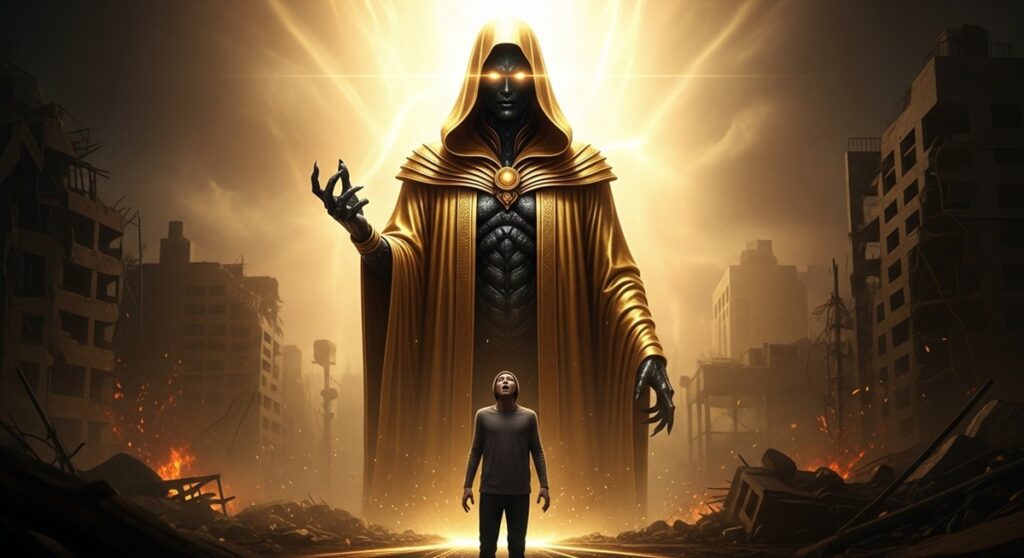
The beings described in the circulating account are unusually specific. They are said to be enormous, close to ten feet tall, genderless, wrapped in shimmering golden robes, with extremely dark skin and luminous golden eyes. They reportedly communicate in whatever language the person hearing them understands and behave less like visitors asking questions than judges delivering a verdict. Some versions say witnesses become temporarily unable to move while the beings are present, others describe an intrusive vision of Earth’s future, in which human infrastructure has been abandoned and the natural world has begun to reclaim what civilization built.
Those details make the story vivid, but vividness is not verification. The central evidentiary problem is not that the encounters are difficult to explain. It is that the underlying encounters cannot be independently located. The story invokes appearances in multiple countries and among people from radically different backgrounds, yet does not provide the basic information that would allow even one case to be tested properly: who saw the beings, exactly where, on what date, under what circumstances, what was recorded immediately afterward, whether other witnesses were present, and whether any physical or documentary evidence survived. Without that chain, the international pattern cannot function as independent corroboration. It is one story being repeated in many places, not many independently documented stories converging on one conclusion.
The Vision of a World After Humanity
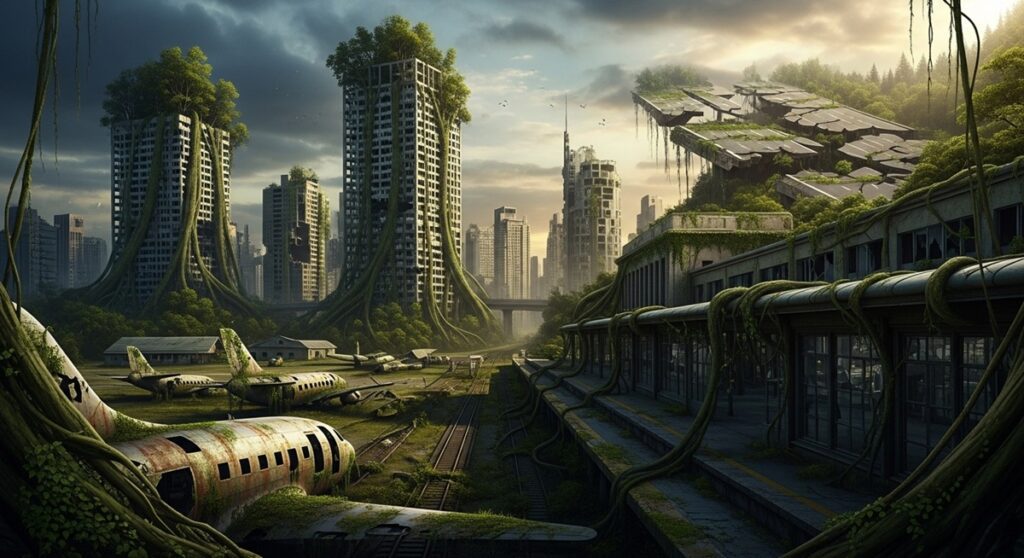
The most cinematic part of the narrative is also the easiest to recognize. People are supposedly shown a future in which cities have gone silent, roads have cracked apart, airports and railway stations have been abandoned, buildings are disappearing beneath vegetation, and forests are spreading through the remains of human civilization. The message is unmistakable: this is what Earth looks like after humanity is gone.
But a vision of abandoned civilization is not unusual evidence of anything. It is one of the defining visual languages of modern apocalyptic culture. Films, novels, video games, photography, documentaries and now generative artificial intelligence have spent decades producing the same image: empty streets, collapsing towers, vines growing through concrete, nature reclaiming airports, and a world continuing without us. A person can experience such an image with extraordinary vividness without receiving information from an external source at all. The cultural vocabulary already exists. The important question is therefore not whether several people can describe a similar post-human landscape. They clearly can. The question is whether those people received the information independently, under controlled and documented circumstances, and whether anything outside their own testimony confirms it. For the Guardians story, that evidence has not been produced.
The 18 Million Species Claim Gets the Real Crisis Wrong
The story then attaches its supernatural warning to a number that sounds scientific: humanity has supposedly caused the loss of 18 million plant and animal species. That figure has no identifiable scientific source behind it. More importantly, it obscures the real biodiversity crisis by replacing carefully qualified scientific estimates with a number that sounds like a measurement but is not one.
The actual scientific picture is both more complicated and more serious. The IUCN Red List is a continuously updated assessment system, not a census of every species on Earth. In its October 2025 update, it contained 172,620 assessed species, of which 48,646 were classified as threatened with extinction. The broader IPBES global assessment reached a different scale by combining assessed groups with statistical extrapolation: it estimated that around one million animal and plant species may be threatened with extinction, many within decades. That larger figure is an estimate of species at risk, including species that have not all been individually assessed, it is not a count of species humanity has already lost. The distinction matters enormously. A real ecological emergency does not become more convincing when its numbers are replaced with an invented one.
The Reptilian Civilization Has No Archaeological Footprint
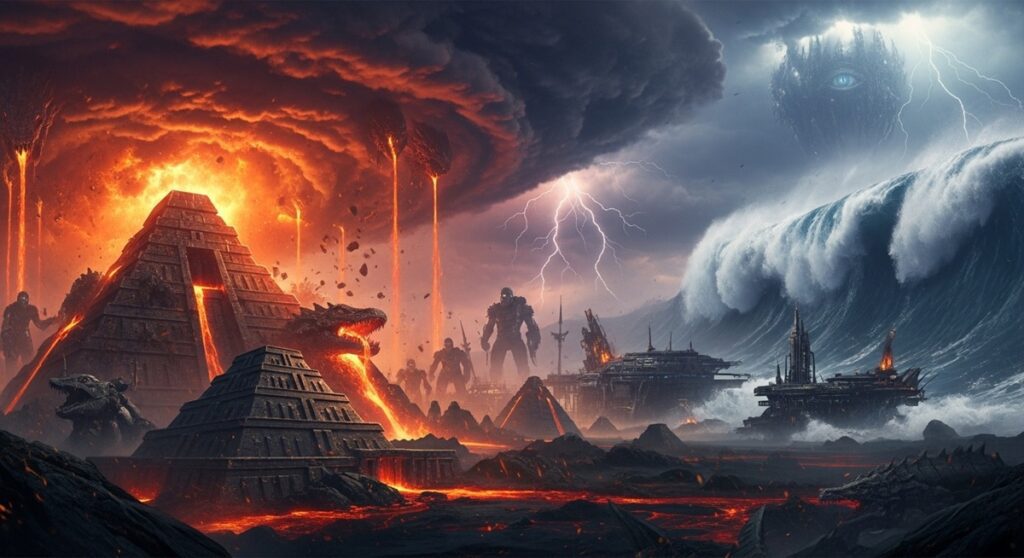
The story becomes considerably more extraordinary when it reaches into deep time. According to the narrative, an intelligent reptilian civilization once developed advanced technology, became dangerous, and was destroyed by the Guardians in an ancient planetary cleansing. A later civilization of “technomages” supposedly developed powerful energy weapons, with the ruins eventually entering the mythology of Atlantis before another intervention brought about a great flood.
There is no archaeological or paleontological evidence for such a civilization. No verified industrial complex exists beneath the geological record of the relevant periods, the same standard of evidence that applies to any claim about an ancient population being preserved through catastrophe using advanced technology. No authenticated machine, alloy, engineered structure, energy weapon, inscription or manufactured material has been recovered from deep time that requires a technologically advanced pre-human civilization to explain it. The fossil record contains an enormous and independently studied history of life, and archaeology has recovered an equally enormous record of human technological development. That record contains gaps, mysteries and extinct cultures whose achievements we are still reconstructing. What it does not contain is an evidentiary footprint corresponding to a lost global technological civilization that preceded humanity.
This is an important distinction because the absence of one spectacular artifact is not by itself proof that something never existed. Extraordinary civilizations leave extraordinary traces. Mining, metallurgy, large-scale construction, waste products, altered landscapes, manufactured materials and persistent chemical signatures do not simply disappear from history because the civilization that produced them vanished. A civilization capable of manipulating planetary-scale technology would have left a physical record substantially harder to erase than a story passed down through modern internet culture.
The 85 Percent “Destructive Energy” Cannot Be Tested
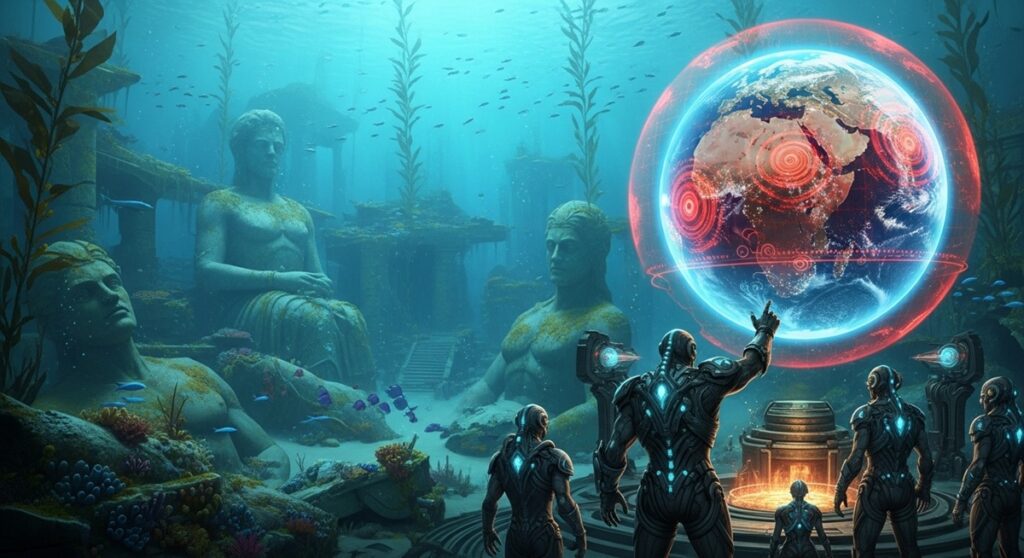
The present-day version of the warning is built around another precise-sounding number. The Guardians supposedly determine that more than 85 percent of humanity now carries a form of “destructive energy” capable of triggering the next cleansing. But the term has no operational definition. There is no instrument for measuring it, no published scale, no independent observers, no sampling method, no threshold for classification, and no way to reproduce the result.
That makes the claim unfalsifiable. If 85 percent of humanity cannot be independently measured, then neither a prediction of destruction nor a claim that humanity has successfully avoided it can ever meaningfully test the proposition. Precision without methodology is not scientific precision. It is narrative decoration. The same is true of the 18-million-species figure: the number sounds as though someone counted something, but no underlying dataset has been produced that would allow anyone else to perform the count.
The “New Flood” Has No Prophecy Behind It
At the center of the story is a warning about water. Witnesses are supposedly shown enormous waves overwhelming cities, and an unnamed clergyman is quoted as saying that the beings warned humanity that if it did not stop destroying Earth, a new flood would come.
“I was shown a sign. These beings, whatever they are, hold dominion over everything on this planet. They warned that if we do not stop destroying the Earth, a new flood will come. It is coming.”
The quotation has no accompanying name, parish, city, date, original interview, recording or independently verifiable publication. Without that information, it cannot be treated as evidence that a particular clergyman encountered anything. At most, it is an unattributed quotation embedded inside a larger story whose primary sources remain unidentified.
But here the story accidentally touches something much older and much more interesting. Flood narratives are among humanity’s most persistent stories because catastrophic water is not an abstract human fear. Rivers flood. Storm surges destroy settlements. Tsunamis erase coastlines. Sea levels have risen dramatically since the end of the last Ice Age. Archaeologists and geoscientists have increasingly investigated whether some oral traditions preserve memories of real episodes of coastal submergence, and research has argued that certain traditions may preserve observations of postglacial sea-level rise across surprisingly long periods. That does not establish one worldwide flood or prove any particular religious flood narrative literally occurred. It demonstrates something subtler: human communities can remember environmental catastrophes, and those memories can change form as they pass through generations.
A Warning That Doesn’t Need a Messenger
This is where the story becomes more interesting than its supernatural premise. There is no scientific evidence that an ancient order of Guardians is preparing to release a planet-covering flood. There is, however, overwhelming evidence that rising seas and changing extremes are increasing flood risk in vulnerable coastal regions. The IPCC projects that extreme sea-level events that were historically rare will occur much more frequently by 2100, with coastal risks increasing substantially even under scenarios in which warming is limited. The danger is not one synchronized wall of water rising over every continent. It is a cumulative process: higher baseline seas, storm surge arriving on top of that higher baseline, heavier rainfall in some regions, river flooding, erosion, saltwater intrusion and infrastructure increasingly exposed to events that were once considered exceptional.
NASA’s satellite observations show the same physical trend from another direction. Global mean sea level continues to rise, although the rate varies from year to year because oceans respond to changes in ocean heat, land ice, rainfall and climate variability. NASA’s analysis found that global sea level rose in 2025, while longer-term measurements show a substantial increase in the rate of rise since the early satellite era. None of this resembles the supernatural “cleansing” described by the Guardians story. It is more mundane than that, which is precisely why it matters: no ancient entity is required to produce a future in which some cities face substantially greater flooding risk.
The Guardians Are Not Needed to Explain the Warning
The structure of the story is revealing. First comes an authoritative non-human messenger. Then comes a vision of collapse. Then a precise number is attached to ecological destruction. Then humanity is judged morally responsible. Then ancient civilizations are introduced as precedents. Finally comes a conditional warning: change your behavior, or the flood arrives.
That structure is powerful because it converts an enormous, impersonal scientific problem into a personal encounter. Climate change becomes a conversation. Biodiversity loss becomes a judgment. Environmental degradation becomes a warning delivered by someone, or something, with the authority to know what happens next. The psychological appeal is obvious. It is easier to imagine a Guardian standing in a room telling humanity what it must do than to confront thousands of pages of climate assessments, extinction-risk databases, satellite measurements, ecological surveys and probabilistic projections. The messenger gives the anxiety a face. The evidence does not.
The Strange Part Is What Survives After the Myth Is Removed
Remove the golden robes and there is still a warning worth hearing. Remove the ancient reptilian civilization and there is still a biodiversity crisis. Remove the 18-million-species figure and there are still tens of thousands of formally assessed threatened species and a much larger scientific estimate of species at risk. Remove the supernatural flood and there is still rising sea level and increasing coastal flood risk. Remove the “destructive energy” and there is still a measurable relationship between human activity, habitat loss, climate change and ecological decline.
That is the strange irony of the Guardians story. Its supernatural evidence is weakest exactly where its moral message is strongest. The planet does not need an ancient civilization to have limits. It does not need golden-robed judges to be changing. It does not need a prophecy to become more vulnerable to flooding. And it certainly does not need an extraterrestrial warning before the consequences of human activity become worth taking seriously.
So, Is a New Flood Coming?
Not the one described by the Guardians. There is no verified evidence that such beings exist, no authenticated record of their alleged encounters, no scientific evidence for their ancient cleansing cycles, and no credible prediction from them that can be independently tested. The story remains an unverified piece of modern apocalyptic folklore whose details become less traceable the closer they are examined.
But if the question is whether humanity should expect more dangerous flooding in a warming world, the answer is much less mysterious. Yes, in many places the risk is increasing. The future is not a single biblical wall of water descending on the planet. It is a long accumulation of higher seas, stronger extremes in some regions, damaged ecosystems, displaced communities and infrastructure built for a climate that no longer exists. That future does not require Guardians. It is already being measured.
And perhaps that is the part worth keeping from the story. Not the beings. Not the secret protocol. Not the lost reptilian civilizations. Not the prophecy. The warning itself.
Because the most unsettling possibility is not that something ancient is coming to judge humanity. It is that nobody has to come at all.