



The word has been mistranslated for two thousand years and the mistranslation served someone’s purposes.
Nephilim. Every tradition that preserved the term rendered it as giants, fallen ones, the offspring of angels and human women, beings of terrible size and appetite whose violence forced the hand of a deity who had tolerated considerable deviation before deciding that a flood was the only available correction. The translation is not wrong exactly. It is incomplete in a way that closes off the most important question the word contains.
In Aramaic, the constellation Orion is Nephila. The Nephilim, by the most direct etymological reading available in the source language of the texts that preserve them, are the people of Orion. The ones from Orion. Not the fallen ones. The ones who came from there.
Robert Bauval spent decades documenting the correspondence between the three pyramids of the Giza plateau and the three belt stars of Orion as they appeared at the vernal equinox in 10,500 BCE. The alignment is precise enough that it cannot be attributed to aesthetic preference. It encodes a date using the sky as the only calendar with sufficient scale for the timelines involved. The builders of Giza were pointing at something. The Aramaic etymology of Nephilim suggests they were pointing at where the relevant parties originated.
These two pieces of information have not been formally connected in any institutional context. The etymology sits in Aramaic scholarship. The astronomical alignment sits in alternative archaeology. The gap between them is the gap between disciplines that do not speak to each other, maintained partly by institutional structure and partly by the nature of what the connection implies.
The Book That Was Removed
The Hebrew name Enoch translates as the Initiate. The designation is precise. He was not a prophet in the conventional sense of a human being receiving divine communication through vision or inspiration. He was a human being taken physically aboard a vehicle, transported to a facility of considerable scale, and instructed in a curriculum that included writing, astronomy, calendar systems, and the operation of a technological artifact capable of calculating future probability distributions.
The Book of Enoch was excluded from the biblical canon by the hierarchs of the Catholic Church on the grounds that it had not been divinely revealed. The Ethiopian Orthodox Church disagreed and preserved it in its Old Testament where it remains. The Dead Sea Scrolls, discovered at Qumran between 1947 and 1956, contained multiple Enoch fragments indicating that the text held significant authority in the second-temple Jewish community, the same community that produced the foundational texts of both Christianity and rabbinic Judaism. The removal of Enoch from the canon was a decision made after the text had already shaped the tradition it was subsequently excluded from.
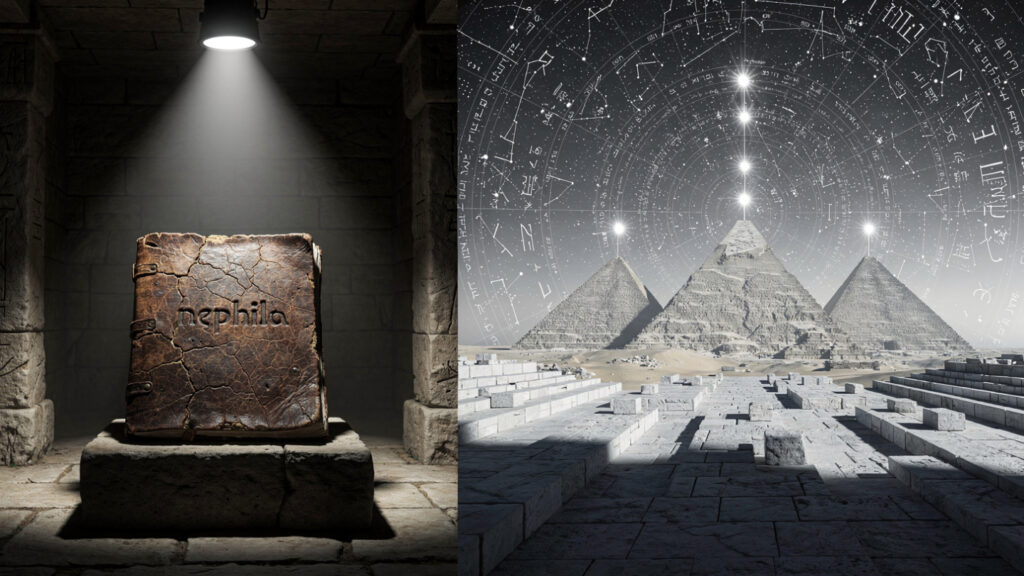
What the text contains that the canon cannot accommodate is enough to explain the removal.
Enoch was the seventh generation from Adam. Father of Methuselah. Great-grandfather of Noah. He sits at the precise point in the antediluvian genealogy where the tradition places the most significant transfer of knowledge between the non-human hierarchy and the human population, immediately before the crisis that the flood was designed to resolve.
The Abduction
The account in the Book of Enoch describes what any contemporary reader with familiarity with the abduction literature will recognize immediately.
Enoch is sleeping. Two beings enter his space and call him by name. He describes them as enormously tall, their faces shining like the sun, their eyes like burning light, fire emerging from their lips, their wings brighter than gold, their hands whiter than snow. They instruct him to leave a note for his sons before departing. They place him in what he describes as a spirit chariot, an experience he characterizes as being aboard a palace capable of sailing through the heavens.
The palace transports him to a larger structure. Inside, light emanates from everywhere. He describes a building made of glass with tongues of living fire among its crystals, surrounded by a circle of fire. The transparent floor reflects stars and celestial bodies moving beneath his feet as the craft moves away from Earth.
He describes ascending through layers he calls the first heaven, the second heaven, the third heaven, precisely as a modern astronaut would describe passing through the atmospheric layers into orbit and beyond. He sees seven stars burning like great mountains in a region beyond the known sky, imprisoned there by the entities managing the system.
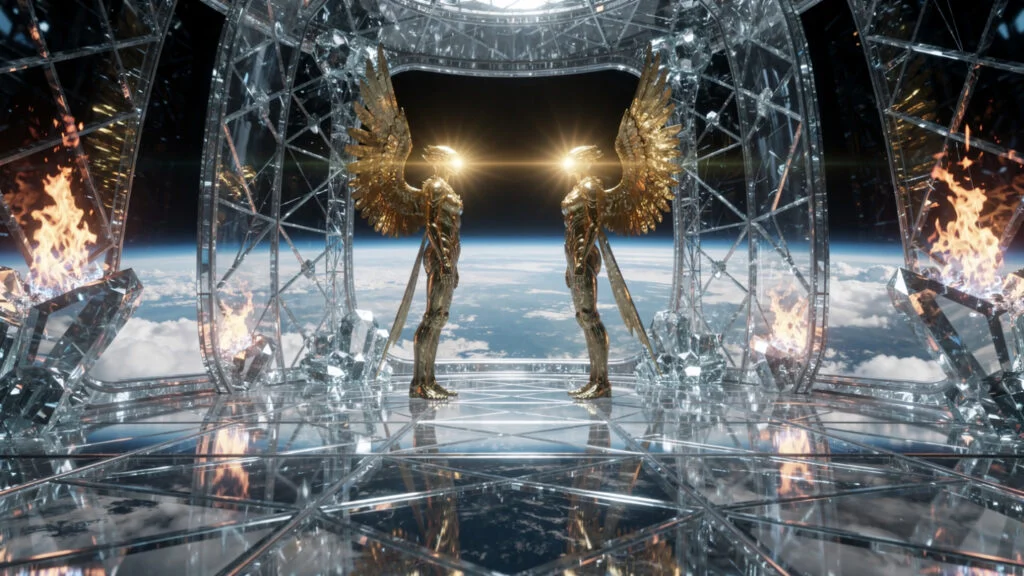
The angel assigned to him as guide and instructor is named Uriel, designated specifically as the Watcher and the Holy One, entrusted by the Lord with oversight of all celestial lights. Uriel teaches Enoch the calendar system, the movement of the sun and moon, the signs that govern the seasons. He shows Enoch the Celestial Tablets.
The Celestial Tablets
The artifact Enoch describes is enough in its function to resist dismissal as metaphor.
A technological object capable of recording all the actions of humanity across all generations, past and future. Enoch reads from it and understands everything written there, including events that will occur centuries after his own death. He predicts the Tower of Babel, the prophet Elijah’s ascent in a chariot of fire, and the flood that will come one thousand years after his own time. The predictions are enough to have been verified against the subsequent biblical record.
The Sumerian tradition preserves the same artifact under a different name. The Tablets of Destiny, coveted by every faction in the Anunnaki hierarchy because whoever possesses them possesses the ability to govern the future by reading its probability distribution. In the Zu Myth, an Anunnaki subordinate named Pazuzu, whose epithet means He Who Knows, steals the Tablets of Destiny from the supreme deity Enlil and briefly puts the entire Anunnaki council in crisis. Pazuzu’s declaration on taking the tablets is recorded: he believed himself capable of ruling the decrees of all the gods, of commanding the lesser divine orders from his own throne.
The tablets were recovered. Pazuzu was punished. The tablets returned to Enlil.
Dan Burisch’s testimony about the Looking Glass device at S4, Area 51, describes an artifact that shows probability distributions of future timelines, with outputs that multiple independent user groups were accessing simultaneously in the late twentieth century until the feedback loops generated by that simultaneous access made the system unmanageable and all fifty installations were dismantled by international agreement.
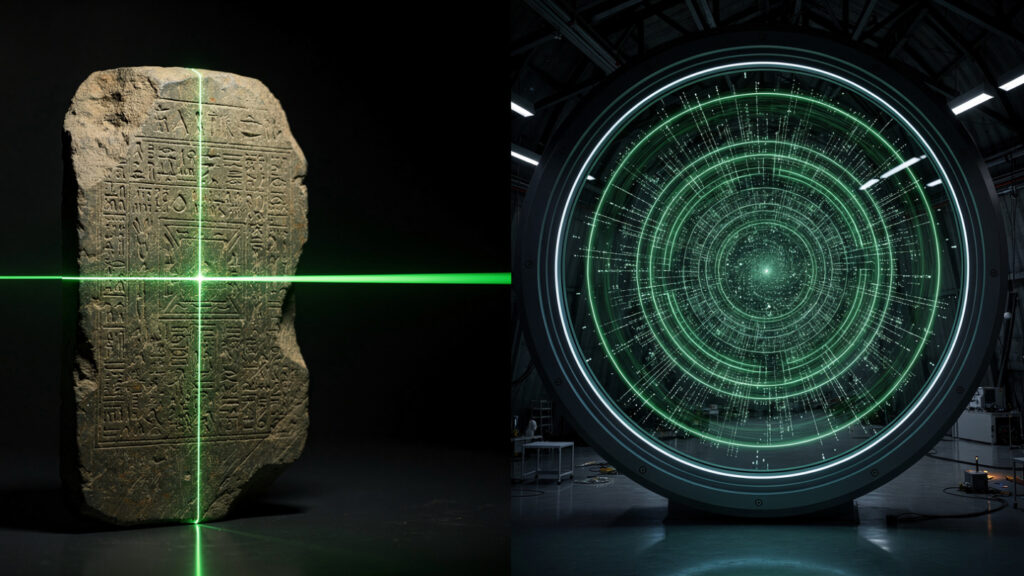
Three separate traditions pointing at the same artifact. The Celestial Tablets of Enoch. The Tablets of Destiny in the Zu Myth. The Looking Glass installation at S4. The functional description is identical across all three. The institutional response to each, removal, punishment, dismantling, follows the same logic: the artifact is too dangerous to remain in general circulation.
The Two Hundred and What They Taught
In the days of Jared, Enoch’s father, two hundred Watchers descended to the summit of Mount Hermon in the Anti-Lebanon mountain range. The location is and verifiable. Mount Hermon sits at the precise point where the borders of modern Lebanon, Syria, and Israel converge, at a latitude that ancient astronomical traditions identified as significant for celestial observation.
The two hundred swore an oath together before descending. The oath bound them collectively to an action they understood would constitute a breach of their orders. Their leader Shemihaza expressed the concern directly: he feared being the only one held responsible for a great sin if the others withdrew. The collective oath was designed to distribute the accountability. All two hundred would bear it or none would.
Their transgression had two components. The texts are clear that the sexual union with human women was secondary to what enraged the hierarchy. The primary offense was the transfer of knowledge.
The twenty chiefs of the two hundred are named individually in the first Book of Enoch, and each is assigned a knowledge domain they transmitted to the human population. Shemihaza taught incantations and the cutting of roots. Hermoni taught spellbreaking, witchcraft, and magic. Baraq’el taught the signs of lightning. Kokab’el taught stellar omens. Shamsi’el taught solar omens. Sahari’el taught lunar cycles. Asa’el taught metallurgy: the forging of iron swords, the casting of copper breastplates, the mining and working of gold, the embossing of silver. He taught women the use of antimony, eye cosmetics, gemstone working, and the preparation of dyes.
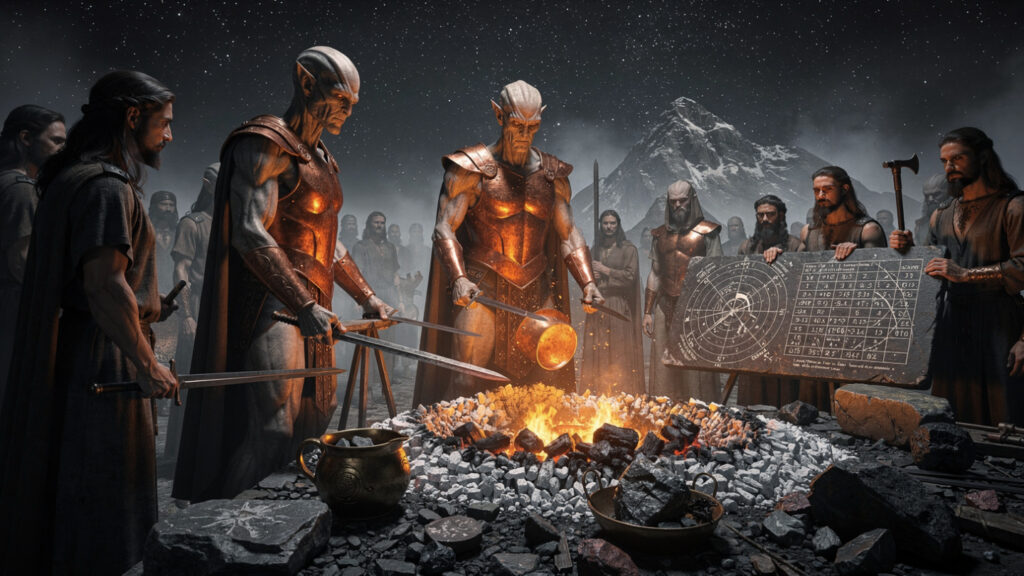
This is not a list of supernatural powers. It is a curriculum. Astronomy, agriculture, metallurgy, cosmetics, calendar calculation, the reading of natural signs. The practical foundation of civilization as it appears in the archaeological record immediately following the period the texts describe.
The hierarchy punished the Watchers who transmitted this knowledge. The charge in the text is revealing: they are imprisoned not for corrupting human morality but for revealing secrets accessible only to the gods. The prohibition was not ethical. It was structural. The knowledge was withheld because a human population with access to it would become less manageable, not less virtuous.
The Prison
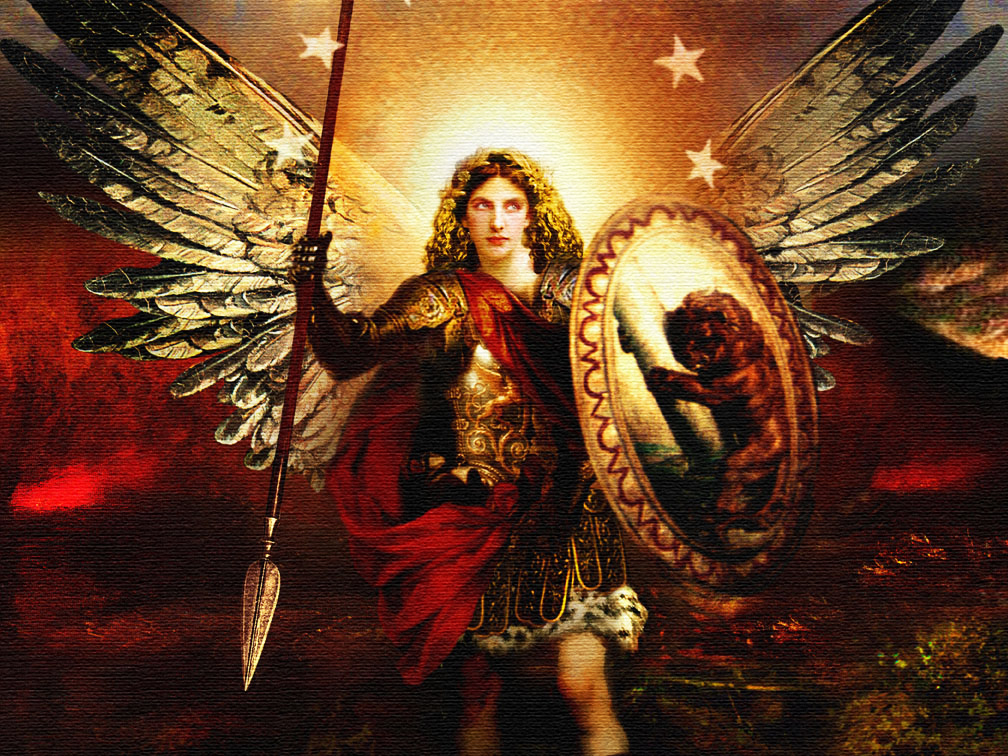
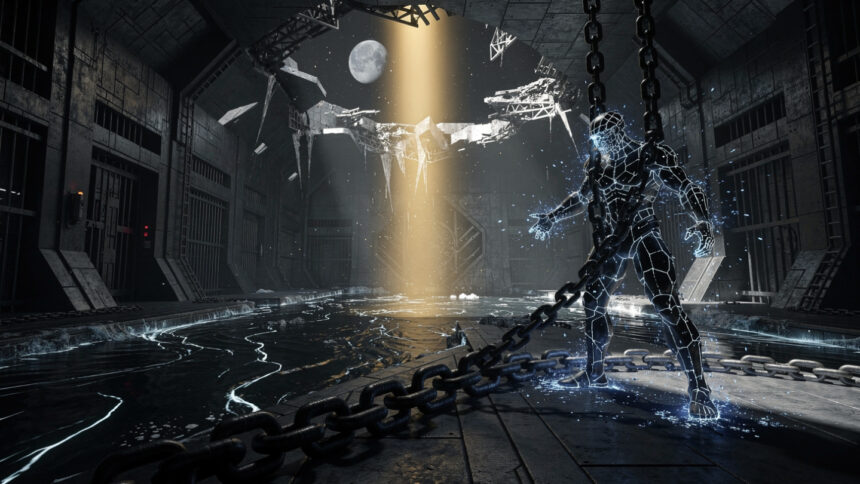
The archangels Michael, Sariel, Raphael, and Gabriel were dispatched to capture the two hundred. Michael received instructions regarding their imprisonment: chain them for seventy generations in the valleys of the Earth until the day of final judgment.
The New Testament preserves the same event in 2 Peter: God did not forgive the angels who sinned but threw them into Tartarus, delivering them to prisons of darkness to be reserved for judgment.
Tartarus. The Greek term designates the deepest abyss of Hades. In Virgil’s Aeneid, written in the first century BCE, Tartarus is described as a gigantic space at the deepest point of the underworld, enveloped by a river of fire called Phlegethon and sealed by triple walls preventing escape. The Roman tradition did not invent Tartarus. It inherited it from the Greek tradition which inherited it from an older source that both traditions preserved without fully understanding.
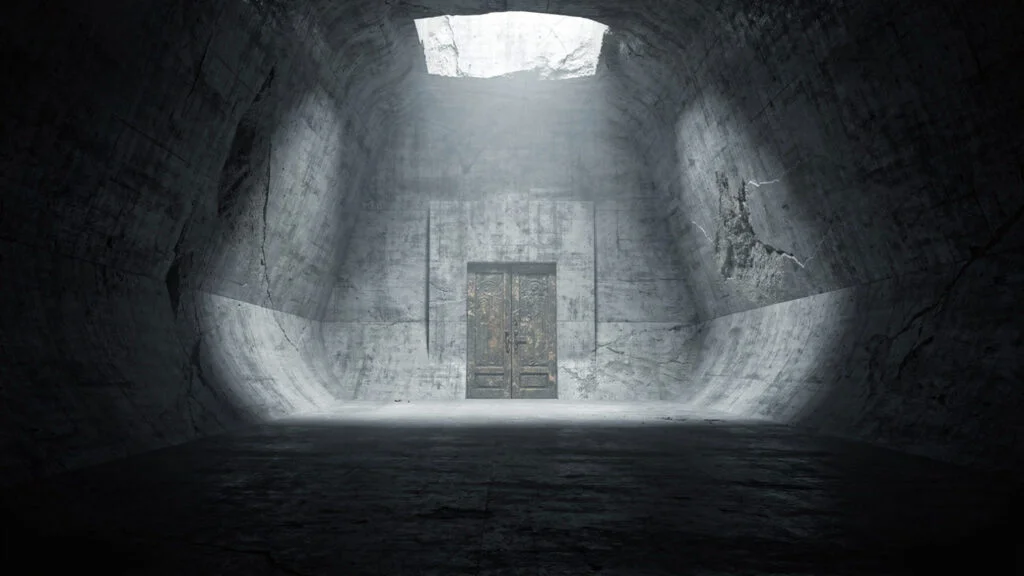
Two hundred beings of significant physical scale and advanced technological knowledge, imprisoned in a deep subterranean location sealed against escape, awaiting a judgment that by the seventy-generation timeline would fall approximately in the current period.
The imprisonment is described across Greek, Roman, and Hebrew traditions independently. The physical description of the prison is consistent across all three. The duration of the imprisonment, when calculated from the conventional dating of the Jared period, produces a release date that the traditions agree is associated with a final conflict between the imprisoned faction and the hierarchy that imprisoned them.
The Orion Convergence
Three independent lines of evidence converge on the same coordinate.
The Aramaic etymology of Nephilim traces directly to Nephila, the Aramaic name for Orion. The Nephilim are the Orion people. The 200 Watchers who descended to Mount Hermon and whose offspring became the Nephilim were an Orion faction operating in conflict with the hierarchy governing this solar system.
Robert Bauval’s Orion correlation at Giza encodes the belt stars of Orion in the relative positions of the three pyramids at a precessional date. The builders were marking an origin point or a return point. The structure they built to mark it remains the most precisely engineered construction in the archaeological record, built to tolerances that the conventional timeline of Egyptian civilization cannot fully account for.
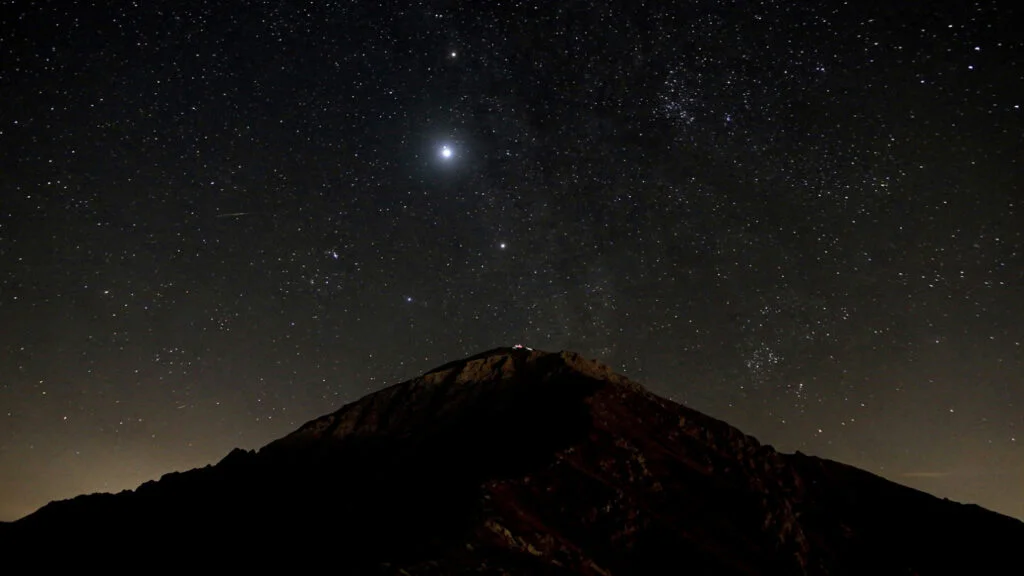
Dan Burisch’s testimony identifies the primary extraterrestrial races in the Majestic 12 program as the P-45 and P-52 Orion races. Future human civilizations, by his account. Temporal rather than spatial visitors. The P-designation indicates their point of origin in forward time: 45,000 and 52,000 years ahead of the current period. Their genetic analysis, conducted by Burisch under Project Aquarium, confirmed human biological origin with modifications consistent with adaptation to conditions the current human body cannot survive.
Future humans from Orion. A biblical text identifying the Nephilim as the Orion people. A monument on the Giza plateau aligned to Orion with a precision requiring knowledge the official timeline does not account for.
The three lines of evidence were developed independently. No institutional framework has connected them. The connection does not require accepting any single one of them as definitive. It requires only noticing that they are pointing in the same direction.
The 200 Watchers are chained for seventy generations. The Giza plateau encodes a return date in its astronomical alignment. The Burisch testimony describes future human civilizations already present in the solar system whose existence the relevant agencies have been managing in secret for seventy years.
The seventy-generation imprisonment. The seventy years of institutional secrecy. The number may be coincidence.
The direction all three lines of evidence point is not.