




A strange formation of lights really was filmed over Astana, Kazakhstan. It really did look unlike an ordinary aircraft, and it really did attract enough attention to become a viral UFO story. But the most dramatic part of the story was added afterward: the claim that the lights were somehow a warning of a major earthquake in the Drake Passage. That connection collapses once the dates, locations, and actual scientific evidence are put back in order. The sighting remains interesting. The earthquake theory does not.
That distinction matters because there is a persistent temptation with unexplained footage to force the entire story into one verdict. Either the object was definitely something extraordinary, or it was definitely something ordinary, either the earthquake proves a hidden connection, or the whole video must be dismissed. The evidence supports neither shortcut. What can be established is considerably more precise: a strange light was recorded over Astana on May 1, 2025, local astronomers offered a plausible atmospheric-lighting explanation, no definitive identification has been publicly established, and the major Drake Passage earthquake occurred the following day, thousands of kilometres away. The coincidence is real. The causal claim is not.
The Astana Sighting Really Happened
The first thing the viral version gets right is that there was a genuine event behind the footage. Local reporting by Tengrinews says residents filmed an unusual glowing formation over Astana on the night of May 1, 2025, with the circulating video showing several bright lights apparently suspended in the night sky. A separate report submitted to the National UFO Reporting Center described a golden object apparently hovering over the city for roughly 30 minutes and said more than 20 people witnessed it, although a NUFORC witness report is not independent scientific confirmation of what the object was. The footage therefore belongs in the category of an unidentified observation, not an established spacecraft.
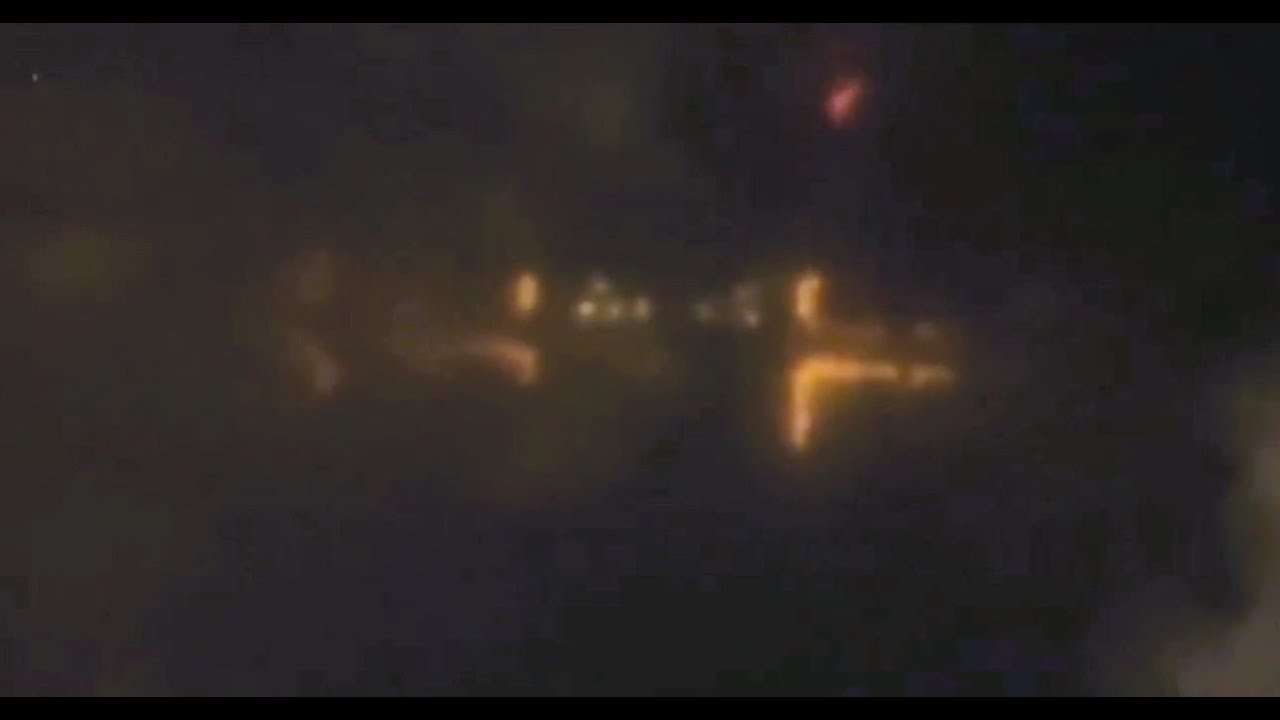
There is an important wrinkle in the online record. The YouTube version of the clip carries a generic title referring to an object over Russia, while the local reporting and contemporary social-media trail identify the widely circulated footage with Astana. That is exactly why the provenance of viral video matters: titles, captions, repost dates, and locations can change as footage travels. In this case, the May 1 Astana attribution has something substantially better behind it than a random social-media caption: contemporaneous local reporting that contacted people familiar with astronomy in the city and investigated the footage when it first circulated.
Astana’s Own Astronomers Offered a Mundane Explanation
The most important evidence is also the least sensational. Tengrinews contacted amateur astronomer Artur Gaiduk, founder of the Astro Astana project, and amateur astronomer Murat Sieubaev. Gaiduk questioned whether the video was authentic at all, pointing out that a genuinely enormous object over the capital would be difficult to reconcile with the city’s continuously monitored airspace. Sieubaev offered a different possibility: architectural lighting reflected from a cloud layer, producing what appears in the video to be a structured object rather than a collection of ordinary lights. Neither explanation constitutes a laboratory identification, but both are substantially more useful than simply declaring the footage extraterrestrial.
Later analysis of the same footage explored the geometry in greater detail and argued that the apparent structure can be consistent with city lights interacting with an elevated cloud or ice-crystal layer. That matters because the visual impression is exactly what makes the footage persuasive: the lights appear arranged into a coherent object. But coherence in an image does not necessarily mean coherence in physical space. A distant light source projected or scattered through a nonuniform atmospheric layer can produce a shape that appears to belong to the sky itself, while actually encoding the geometry of something much closer to the observer. This is why identifying the apparent position of an object is not the same thing as establishing its physical position.
The Video Never Needed an Alien Explanation to Become Strange
There is a useful distinction here between unidentified and unexplainable. The first simply means that the available evidence has not established the object’s identity. The second makes a much stronger claim: that ordinary physical explanations have been ruled out. Nothing in the Astana evidence gets us to the second category. The footage is short, the geometry is difficult to interpret, the exact optical conditions are not completely reconstructed, and the available material does not provide the triangulation, calibrated imagery, independent sensor data, or multiple synchronized observations that would allow investigators to calculate the object’s distance and physical dimensions with confidence.
That missing information is crucial. Without a known distance, apparent size is almost meaningless. Without reliable motion relative to fixed landmarks, apparent movement can be deceptive. Without knowing the atmospheric layers between the camera and the apparent object, an image can place a phenomenon visually somewhere it is not physically located. And without multiple independent recordings from known positions, the apparent three-dimensional geometry cannot easily be reconstructed. The mystery therefore survives, but in a much narrower form than the internet usually allows. We have unusual-looking lights whose exact optical source has not been conclusively demonstrated.
Then the Earthquake Entered the Story
This is where the chronology becomes essential. The Astana footage was reported as having been recorded on May 1, 2025. On May 2, 2025, a magnitude 7.4 earthquake struck the Drake Passage between the southern tip of South America and the Antarctic Peninsula. The United States Geological Survey places the earthquake at 56.809°S, 68.102°W, at a depth of 10 kilometres, and identifies its mechanism as shallow reverse faulting associated with the complex tectonic setting where the South American, Antarctic, and Scotia plates interact.
The original article used the August 22, 2025 Drake Passage earthquake in this comparison. That is a different event. The August earthquake was magnitude 7.5 and occurred roughly three and a half months after the Astana recording, on August 22 at 02:16 UTC. The earthquake that actually fits the viral chronology is the May 2 magnitude 7.4 event. Correcting that date does not strengthen the conspiracy. It merely makes the coincidence cleaner, and therefore makes it more important to test rather than embellish.
But a Coincidence Is Not a Precursor
There is a legitimate scientific subject hiding underneath the bad argument: earthquake lights. Researchers have documented reports of luminous phenomena associated with some earthquakes, including observations described as occurring before, during, or after seismic events. The literature is controversial, heterogeneous, and far from establishing a reliable earthquake-warning technology. Some reviews have reported alleged pre-earthquake lights appearing from seconds to much longer intervals before earthquakes, while emphasizing the difficulty of establishing their statistical significance and physical mechanism.
That nuance actually makes the Astana claim easier to test. The question is not whether earthquake lights are physically conceivable. The question is whether this particular light display has evidence tying it to this particular earthquake. At present, it does not. There is no published seismological analysis demonstrating that the Astana phenomenon was generated by tectonic activity, no instrumental electromagnetic measurement connecting the two events, no reproducible mechanism showing how a luminous display over Kazakhstan could have been produced by a fault rupture beneath the Drake Passage, and no independent study establishing the footage as an earthquake precursor.
There is an even simpler problem: the proposed relationship was noticed after the earthquake occurred. That makes the claim vulnerable to one of the oldest traps in interpreting unusual events, retrospective pattern matching. Once two dramatic events are placed beside one another, their coincidence feels meaningful because the human mind is exceptionally good at finding relationships between salient events. The scientific test is harder: record the phenomenon prospectively, define the prediction in advance, specify the geographic and temporal window, and determine whether it predicts earthquakes better than chance. The Astana video does none of those things.
The Distance Makes the Claim Harder, Not Stronger
The geography matters too. Astana is in northern Kazakhstan, the May 2 earthquake occurred thousands of kilometres away in the far South Atlantic/Antarctic region. A claim that the lights were a seismic precursor therefore requires more than temporal coincidence. It requires a physical transmission mechanism capable of producing a visible atmospheric phenomenon at the observed location and then linking it specifically to the later rupture. That is a much stronger proposition than saying, after the fact, that two unusual things happened around the same time.
Earthquake-precursor research itself illustrates why this distinction matters. A systematic review of reported precursors found that the anomalies discussed in the scientific literature generally become stronger closer in time to an earthquake and tend to be geographically associated with the eventual source region. That does not prove that distant electromagnetic or atmospheric effects are impossible, it means that a claim involving a remote, visually observed phenomenon requires correspondingly strong evidence before it can be promoted from coincidence to precursor.
The Older Kazakhstan UFO Pattern Is Relevant, But Not Proof
Kazakhstan has produced other spectacular-looking aerial-light videos, which is useful context but not a shortcut to identifying the Astana event. A separate 2022-era video from Kazakhstan circulated internationally as a UFO, while other rocket-launch phenomena across the region have repeatedly produced luminous formations that look artificial when viewed without their launch context. The lesson is not that every strange Kazakhstan sky video is a rocket. The lesson is that the prior probability of atmospheric, optical, aerospace, and photographic explanations is substantial enough that those possibilities have to be exhausted before an extraordinary interpretation becomes persuasive.
What Would Actually Solve the Astana Mystery?
A definitive investigation would look very different from an argument on social media. Investigators would want the original, uncompressed video rather than a repost, the exact recording time and location, the camera’s orientation and lens information, weather observations at several altitudes, cloud-base and upper-atmosphere data, photographs from other fixed locations, and, if available, radar or air-traffic records. With several synchronized viewpoints, investigators could attempt triangulation. With the atmospheric profile, they could model whether city lights could generate the observed geometry. With a confirmed physical object, its angular motion could be compared against aircraft, satellites, balloons, drones, or other known sources.
That is the standard the story should be held to precisely because the footage is genuinely intriguing. If the light is eventually identified as reflected architectural illumination, the video remains a striking demonstration of how easily atmospheric optics can manufacture the appearance of an enormous object. If a different terrestrial explanation emerges, the same principle applies. And if future evidence genuinely rules those explanations out, then the unresolved status becomes more significant. Leaving the question open is not a failure of skepticism. It is what skepticism looks like when the evidence has not finished arriving.
What the Astana Footage Actually Proves
The strongest conclusion is therefore narrower than either side of the internet debate wants. The Astana footage documents a real visual phenomenon reported over the city on May 1, 2025. Local astronomers proposed that architectural lighting interacting with a cloud layer could account for it, and later analysis has explored atmospheric optical mechanisms in greater detail, but the available public evidence does not amount to a definitive forensic identification. The object should therefore remain unidentified rather than being promoted to extraterrestrial, technological, or seismic status.
The earthquake connection is different. The relevant earthquake really did happen, one day later, in the Drake Passage, at magnitude 7.4. But nothing in the USGS record establishes a relationship between that earthquake and the Astana lights, and the broader earthquake-lights literature does not transform a coincidence into a demonstrated prediction mechanism.
The Mystery Is Smaller, and Better, Than the Viral Story
There is a temptation to think that correcting a UFO story makes it less interesting. In this case, the opposite is true. The real puzzle is not a secret earthquake warning system hiding above Kazakhstan. It is how easily a layer of city light, atmosphere, distance, camera geometry, and human perception can combine into something that looks like a gigantic object suspended over a capital city, and how quickly a second event thousands of kilometres away can be recruited into the same story once the internet supplies a connection.
The Astana lights deserve uncertainty until the evidence improves. The May 2 earthquake deserves to remain what seismology says it was: a major natural earthquake produced by tectonic faulting in the Drake Passage. And the space between those two facts is exactly where the conspiracy theory was built. The sighting remains a question. The earthquake connection does not.
The same pattern played out over Ukraine. That mysterious light was identified as a Chinese rocket within hours, not decades.