



James Mooney was not a credulous man.
He was a fieldwork ethnographer with the Bureau of American Ethnology who spent years living with the Eastern Band of Cherokee in the mountains of western North Carolina in the 1880s, learning their language well enough to conduct interviews without interpreters, recording what they told him with the academic rigor that his institutional mandate required. His Myths of the Cherokee, published by the Smithsonian Institution in 1900, is the foundational primary source for Cherokee oral history and remains the reference that subsequent ethnographic work builds on.
When Mooney recorded the Cherokee stories of luminous beings that fell from the sky, of a race of small intelligent beings living in mountain caverns, and of a flying giant whose surface reflected or emitted light like the sun and whose landing burned the vegetation beneath it, he was not writing popular mythology. He was conducting institutional ethnographic fieldwork whose standards his employer, the Smithsonian, required to be rigorous.
The accounts he recorded were transmitted to him by named community members in the Cherokee language, and it was the continuity of retelling across generations that gave these accounts their cultural weight. They were not legends in the dismissive sense: they were treated by the Cherokee community as records of actual historical encounters rather than as decorative mythology. It’s worth stating plainly that these accounts have genuine standing as Cherokee cultural and spiritual tradition in their own right, independent of any comparison to modern UAP research, and that standing doesn’t depend on or require the parallels explored below.

What Mooney preserved in 1900 is available in the Smithsonian Institution’s archive and in the Bureau of American Ethnology’s published reports. The accounts he recorded describe phenomena whose characteristics, evaluated against the twentieth and twenty-first century UAP research record, show correspondences that the conventional treatment of folklore as prescientific symbolism does not adequately account for.
The Luminous Beings and How They Were Found
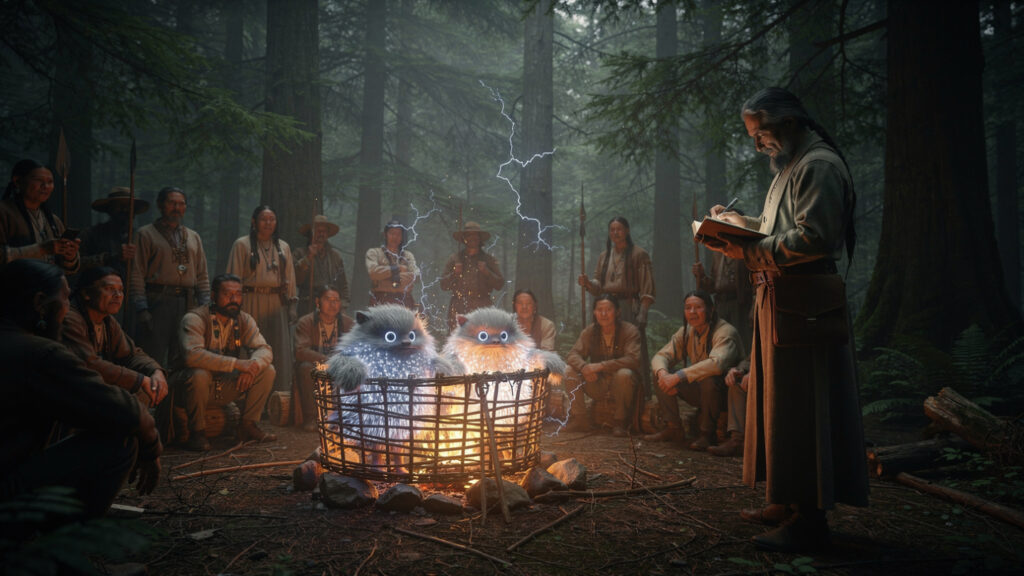
The story Mooney recorded under the title connected to how the stars were made describes a Cherokee hunting party’s multi-night encounter with aerial luminous phenomena and their subsequent discovery of the beings producing the lights.
The hunting group observed two lights moving along the horizon line for multiple consecutive nights. The lights were characterized as large, bright, star-like, and showing controlled movement rather than the fixed trajectories of stars or meteors. The group’s decision to investigate the lights’ source the following morning reflects a consistent empirical approach in Cherokee storytelling to anomalous phenomena: observation followed by investigation rather than avoidance or purely symbolic interpretation.
What they found when they investigated was specific: small creatures with round bodies covered in soft hair and fine feathers that produced light and sparks. The creatures had small heads visible between the luminous coverings. During daylight they appeared as small grayish-furred beings. During night they emitted bright light. Wind caused sparks to discharge from their coverings.
After seven nights in captivity, the creatures burst into flames and ascended rapidly to the sky, becoming small points of light. The hunting party concluded they were stars.
Whether the Cherokee hunters’ conclusion that these beings were stars represents their actual cosmological interpretation, a culturally appropriate way of describing genuinely unknown phenomena within their available conceptual framework, or a metaphorical encoding of an observed class of luminous aerial beings in the astronomical vocabulary their culture used for sky phenomena, is the interpretive question that the story raises without resolving.
The phenomenological description, small luminous beings, daytime concealment of luminous properties, nocturnal light emission, spark discharge, ascent to high altitude and disappearance, is not the description of any known natural phenomenon. It is not ball lightning, which does not have soft hair and small heads. It is not fireflies, which do not appear as star-like lights moving along a horizon. It is a description of beings whose characteristics fall outside the conventional natural history framework.
The Nunnehi and the Little People
The Nunnehi, whose name translates approximately as the People Who Live Anywhere or the Immortal People, are recorded across Mooney’s Cherokee compilation as a race of beings whose characteristics distinguish them from ordinary humans and from the spiritual beings of Cherokee cosmology.
They are small in stature. They live in the mountains, specifically in the interior of mountains and hills rather than on their surfaces, suggesting underground or interior spaces. They speak the Cherokee language and can communicate with humans. They produce and enjoy music. They are generally benevolent but occasionally dangerous and have been known to take human children into their world. They teach knowledge, values, and practical skills to the humans they interact with. They are invisible to ordinary human perception except when they choose to be seen.
The combination of these characteristics is not unique to the Cherokee. It appears, with local variations, across a geographic and cultural distribution that makes independent development without a common origin implausible if the characteristics are treated as accurate description rather than symbolic.
The Scottish and Irish Sìth, the fairy folk of Celtic belief, live in the hills and underground chambers, speak human languages, are generally benevolent but occasionally dangerous, take human children, teach knowledge to those they favor, and are invisible to ordinary perception. The Scandinavian Huldrefolk and the Alvar show the same characteristics. The Hawaiian Menehune, small people living in the mountains who built structures and taught crafts to humans, show the same profile. The Japanese Kappa, water-dwelling small beings who can be benevolent or dangerous and who teach and learn from humans, show the same general profile with aquatic modifications.
The shared characteristics across independent cultures, small stature, underground or mountain dwelling, human language communication, knowledge transmission, child abduction capability, and selective visibility, constitute a profile that convergent independent invention does not satisfactorily explain.
Mooney recorded a Cherokee account of the Little People’s interaction with a human child: a boy who did not want to grow up was found weeping by the river by the small people, who offered to take him into their world where he would not have to grow up, and would transmit a vision to his parents explaining his departure. The elements of this account, the liminal location by water, the offer of an alternative existence, the parental notification through vision, and the permanence of the transition, appear with striking consistency in the human-fairy abduction accounts of European folklore recorded by Katherine Briggs in her encyclopedic The Fairies in Tradition and Literature.

Whether the Cherokee Nunnehi and the European fairy folk are the same class of beings described by independent cultures that encountered them, convergent symbolic elaborations of the same archetypal human psychological content, or independent stories that trace back to a common transmitting source whose distribution covered both North America and Europe in the pre-contact period, is the question that this multi-culture consistency makes genuinely interesting.
The Flying Giant and Its Burned Landing Site
The Cherokee account of the flying giant is the element in the source that most directly connects to the contemporary UAP physical trace evidence record.
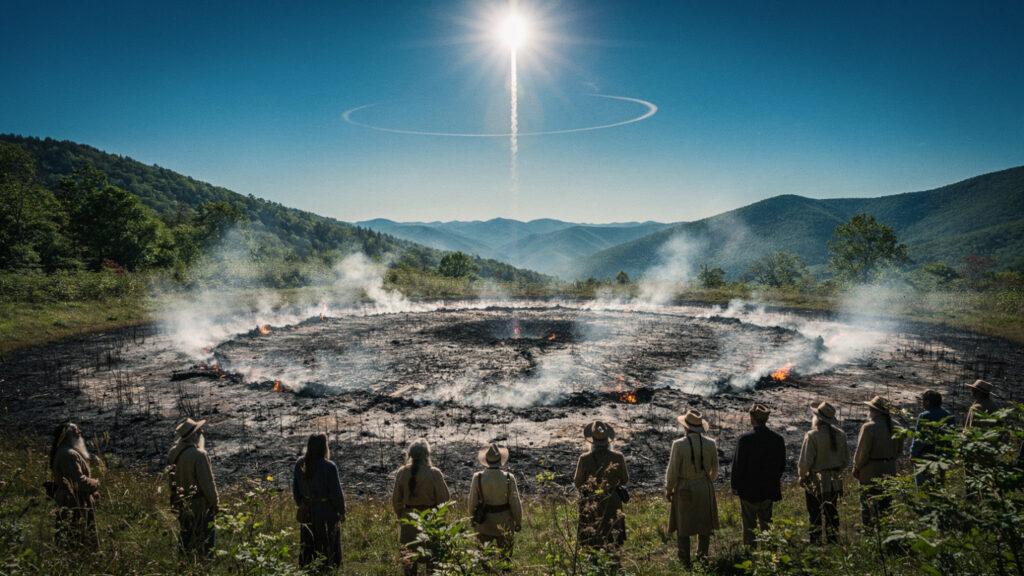
Mooney’s account describes a flying object whose witnesses characterized as a flying giant with a head shining like the sun. The object flew over the Cherokee territory, hovered motionless for a period of time, descended and landed, remained for a period on the ground, then ascended and flew away into the sky.
When the witnesses approached the landing site, they found that all the vegetation the object had contacted was burned.
This combination of observable characteristics, hovering flight, silent station-keeping, descent to landing, ground contact that burns vegetation, and vertical ascent to altitude, is the same combination recorded in the twentieth and twenty-first century UAP physical trace evidence catalog that Jacques Vallee systematically compiled from cases worldwide in his research published in Passport to Magonia and subsequent works.
The UFO physical trace evidence database, maintained by Ted Phillips and subsequently by the Center for Physical Trace Research, contains more than four thousand recorded cases of physical effects at UAP landing sites, of which vegetation damage including burning, wilting, dehydration, and radiation effects is the most frequently recorded category. The pattern of circular or ring-shaped vegetation damage at landing sites, with the burned or altered zone corresponding to the object’s apparent footprint, appears in cases from every inhabited continent across the twentieth century observational record.
The Cherokee encounter’s burned vegetation at the landing site appears in Mooney’s 1900 compilation, which predates modern UFO research by approximately fifty years. Whether this is evidence that the twentieth-century physical trace pattern reflects genuine recurring phenomena that indigenous cultures were recording by word of mouth centuries earlier, or reflects the reinterpretation of a Cherokee symbolic or natural phenomenon through the lens of modern UFO research’s conceptual vocabulary, is the interpretive question the correspondence raises.
The account in Mooney’s record does not describe the object as a UFO in the modern sense: it describes it in Cherokee cultural vocabulary as a flying giant. Whether the Cherokee cultural vocabulary was describing what we would now call a UAP, in the same way that the Vedic Vimana accounts and the Ezekiel chariot vision were describing something that the twentieth century’s conceptual vocabulary would classify differently, is the cross-cultural question that this library has been building toward across multiple pieces.
The Star People Account
What Mooney recorded from the Cherokee includes a cosmological framework in which certain stars are understood as conscious beings with histories of interaction with the human world rather than as purely astronomical objects.
The Seven Dancers story about the origin of the Pleiades describes seven Cherokee boys who, during a period of neglect of their ceremonial obligations, were transformed into stars and rose to become the Pleiades. The story preserves a connection between the Pleiades and a period of cultural rupture in Cherokee history, encoded in the astronomical event’s visibility timing.
The Pleiades’ significance in Cherokee and broader indigenous North American astronomical belief appears in archaeoastronomy research: the Pleiades’ heliacal rising marked ceremonial periods for multiple indigenous cultures, and their position at zenith at midnight marked the New Year in several Mesoamerican calendrical systems. The Pleiades’ prominence in both indigenous North American and Mesoamerican cultures that have no confirmed direct contact with each other is one of the cross-cultural astronomical correspondences whose explanation requires more than independent observation of a bright star cluster.
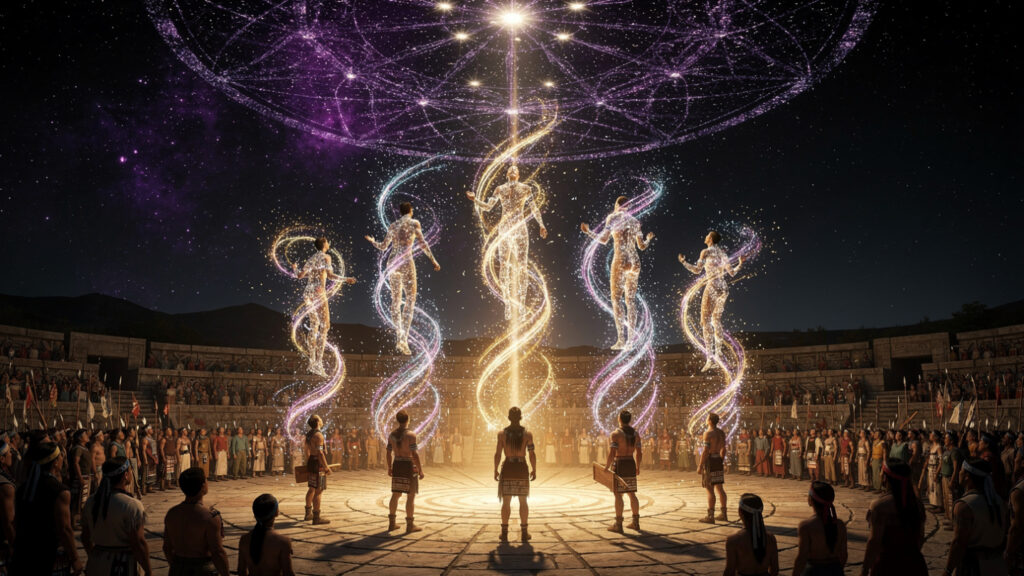
Whether the Cherokee star beings account, the Wandjina belief’s Milky Way origin for its creator beings covered in this library’s dedicated piece, and the Dogon Nommo account’s Sirius system origin recorded in the Oannes piece, all preserve memory of the same class of astronomical events or beings, is the question that the cross-cultural distribution of star origin stories makes worth developing.
The Cherokee account of luminous beings that eventually ascend to become stars in the sky is structurally identical to the Wandjina account of beings that came from the Milky Way, interacted with the human world, and returned to the sky. Both preserve the same encounter profile, the same ultimate sky-return, and the same luminous character in the beings described, despite being developed by cultures on opposite sides of the Pacific with no recorded contact.
Mooney’s Methodology and What It Means for the Record
The record’s quality in Mooney’s Cherokee ethnography is what distinguishes the accounts he preserved from the mass of unsupported alternative archaeology claims about indigenous contact stories.
His fieldwork methodology appears in the Bureau of American Ethnology’s records: he lived with the Eastern Band Cherokee for extended periods, developed functional Cherokee language ability, conducted his interviews with named community members whose identities are recorded in his field notes, and submitted his compiled material for institutional review before publication.
The stories he recorded were not selected for their anomalous content. He recorded the complete body of material as he encountered it, including mundane cultural material, historical accounts, cosmological narratives, and the stories that contain the anomalous elements discussed here. The anomalous elements appear in proportion to their actual presence in what he collected rather than being selected because they support a predetermined interpretive framework.
This institutional methodology gives the Cherokee accounts recorded by Mooney a primary source status that most claims in the alternative archaeology literature do not have. The accounts are in the Smithsonian’s publication record, they are available in the Library of Congress, and they were produced by a fieldwork methodology whose standards are well established.
Whether what the Cherokee passed down preserved genuine historical memory of encounters with classes of phenomena that the twentieth century would classify as UAP, or whether these accounts encode symbolic and psychological content that the UAP interpretive framework reads too literally, is the interpretive question that the quality of Mooney’s record makes genuinely tractable rather than simply dismissible.
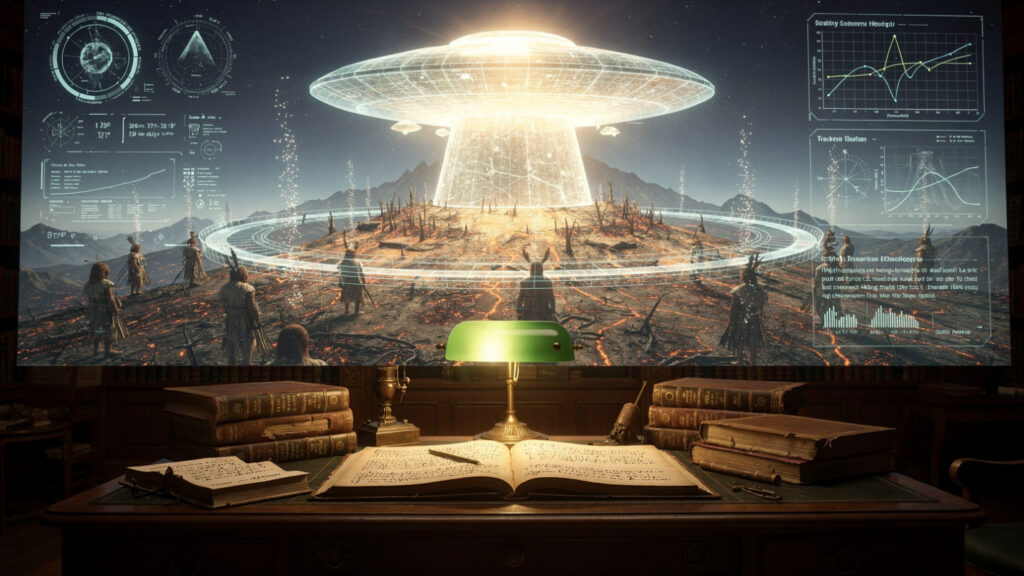
The accounts are on record. Their cross-cultural parallels are well established. The Cherokee UAP physical trace case, the burned landing site, predates modern UFO research’s recording of the same physical effect by approximately fifty years in Mooney’s 1900 publication.
Whatever the Cherokee were recording in what they passed down, they were recording it specifically enough that Mooney’s rigorous fieldwork preserved it in a form that subsequent research can evaluate against the cross-cultural and physical evidence record.
The small luminous beings ascended on the seventh night and became stars.
The flying giant’s landing site was burned.
The little people took the child by the river and he did not return.
These are recorded accounts from named community members preserved by a Smithsonian ethnographer in 1900. Their phenomenological content matches the cross-cultural UAP contact record with a specificity that coincidence does not adequately explain.
The Resonance Archives