



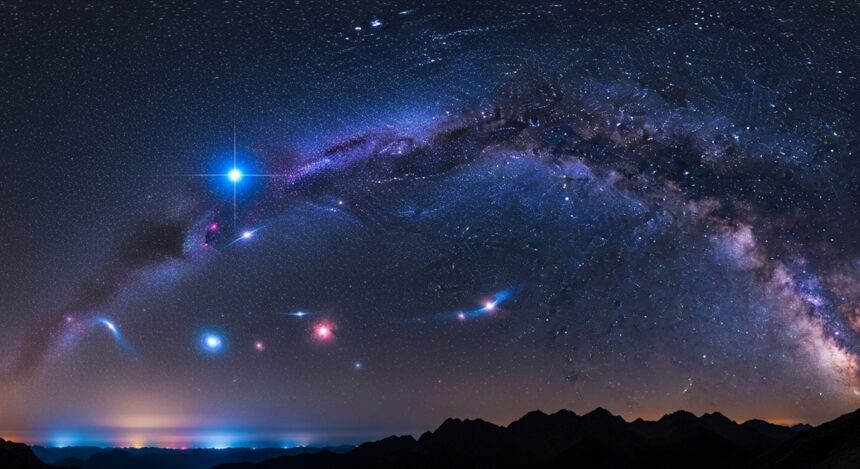
Something really does run through the space around the Sun.
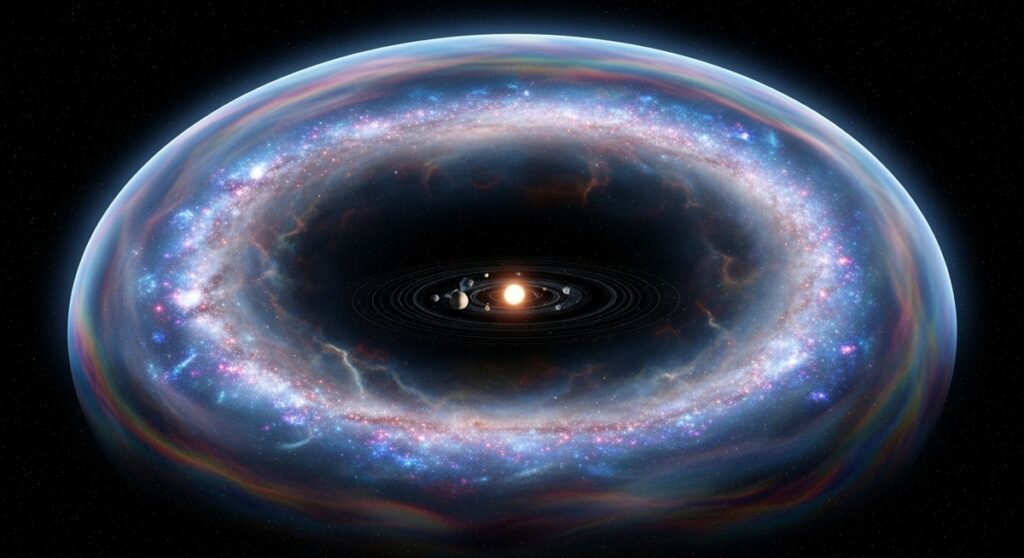
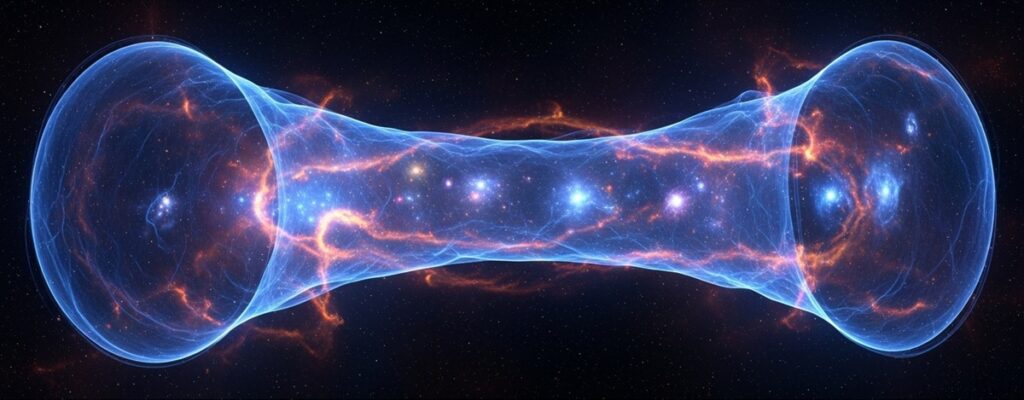
In 2024, astronomers using the eROSITA X-ray telescope produced a new three-dimensional map of the Local Hot Bubble, the enormous, million-degree cavity of thin plasma in which our Solar System happens to sit. The map revealed a previously unidentified tunnel toward the constellation Centaurus, a structure that may connect our local cavity with another region of hot interstellar gas. A second low-density channel in the broader local environment points toward Canis Major. The word “tunnel” sounds like science fiction, but the object itself is entirely physical: not a wormhole, not a passage through spacetime, and not a road to another star. It is a corridor of unusually sparse, hot plasma carved into the interstellar medium by the same stellar violence that helped create the bubble around us in the first place.
That distinction matters because the real discovery is arguably more consequential than the sensational version. We are not living inside an isolated pocket of emptiness. The space surrounding the Sun appears to be part of a complicated, evolving network of cavities, shells, channels and hot gas created by supernovae and stellar winds over millions of years. For the first time, instruments capable of mapping the sky in X-rays are allowing astronomers to reconstruct part of that architecture in three dimensions. The question is no longer whether there are “tunnels” in interstellar space. There are. The more interesting question is how extensive the network is, how it formed, and what it tells us about the violent history of the neighborhood through which the Sun has been traveling.
The Telescope That Made the Invisible Visible
The discovery began with eROSITA, the extended ROentgen Survey with an Imaging Telescope Array, the X-ray telescope carried by the Spektr-RG observatory. Unlike visible light, soft X-rays cannot simply pass through Earth’s atmosphere to ground-based telescopes, which makes space-based observations essential for studying the diffuse X-ray glow of the nearby interstellar medium. eROSITA’s first all-sky survey therefore offered something previous instruments could not provide at the same combination of coverage and spectral information: a much more detailed way to separate the local hot plasma surrounding the Solar System from the complicated X-ray background beyond it.
The team led by Michael C. H. Yeung and colleagues at the Max Planck Institute for Extraterrestrial Physics combined eROSITA observations with earlier ROSAT data, distance measurements and information about nearby interstellar material. Instead of treating the Local Hot Bubble as a simple sphere surrounding the Sun, they reconstructed a much more irregular three-dimensional structure. The result showed a hot, tenuous cavity with strong asymmetries in both shape and temperature, consistent with a history far more complicated than a single explosion producing one clean bubble. The researchers also identified regions where the surrounding cooler material appears to be interrupted by narrow channels of hotter, lower-density gas.
We Already Knew We Were Living Inside a Bubble
The Local Hot Bubble itself is not new. Astronomers have known for decades that the Solar System occupies an unusually rarefied region of the interstellar medium, filled with plasma at temperatures of roughly a million degrees. It is enormous on human scales, extending hundreds of light-years across parts of the local Galactic environment, yet its density is so low that “hot” does not mean anything like the heat we experience on Earth. There are simply too few particles packed into the volume for energy to be transferred efficiently by ordinary collisions.
What matters is how that cavity got there. The leading picture is violent but ordinary by astronomical standards: generations of massive stars lived, exploded and pushed energy into their surroundings. Supernova shocks and stellar winds swept cooler gas outward, heating and evacuating enormous volumes of space. Over time, neighboring cavities could expand toward one another, collide, merge and leave behind openings in the surrounding walls of denser material. A theoretical framework for interconnected hot “tunnels” in the interstellar medium was proposed as far back as the 1970s, and observations over subsequent decades have found evidence for low-density pathways between local cavities. The eROSITA result therefore did not invent the concept. What it did was provide a much sharper three-dimensional view of the local structure and identify a new channel toward Centaurus.
The New Tunnel Is Real. The “Star Highway” Is Not.
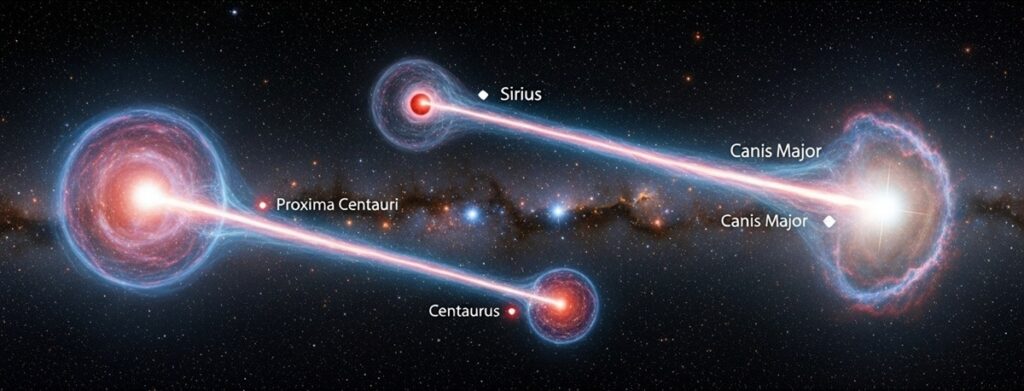
This is where the language surrounding the discovery needs to be handled carefully. The newly identified feature points toward Centaurus, the region of the sky containing the Alpha Centauri system, including Proxima Centauri, our nearest known stellar neighbor. But a direction on the sky is not the same thing as a physical connection to a star. The published research describes a tunnel through the local interstellar medium, not a tube terminating at Proxima Centauri, and certainly not a structure that carries matter or spacecraft between stellar systems.
The same caution applies to the second channel associated with the direction of Canis Major. It has been discussed in the context of possible connections between local cavities and larger structures such as the Gum Nebula and other surrounding regions of the interstellar medium. These are geological-looking structures on a Galactic scale: regions of different density, temperature and composition shaped by enormous stellar events. Calling them “tunnels” is scientifically legitimate because the term describes the geometry of the gas. Calling them wormholes changes the physics entirely.
Nothing Here Bends Spacetime
A wormhole is a hypothetical structure in spacetime associated with general relativity. In the popular imagination, it is a shortcut: enter one end and emerge somewhere enormously distant without crossing the ordinary distance in between. The eROSITA tunnels have nothing to do with that concept. They do not shorten the distance to Alpha Centauri. They do not create a second route through spacetime. They do not allow information to travel faster than light. They are simply places where the distribution of interstellar gas appears unusually sparse and hot compared with the surrounding material.
In fact, the physical distinction is almost comically large. Interstellar space is already extraordinarily empty. Removing some additional gas from an already rarefied region does not turn it into a vacuum highway in any meaningful engineering sense. A spacecraft traveling through such a channel would not suddenly acquire a new propulsion mechanism or a shorter journey. The tunnel is important because it records the structure and history of the medium through which the spacecraft travels, not because it makes the journey easier.
The Galaxy May Be More Like a Sponge Than a Void
This is the part of the discovery that deserves more attention. For most of human history, “space” meant emptiness. Even modern astronomy often encourages the same mental picture: stars scattered through an otherwise blank black background. But the interstellar medium is not empty. It contains gas, dust, magnetic fields, radiation, cosmic rays and enormous structures created by the deaths and births of stars. Those components interact across scales so large that a single supernova can become part of a structure hundreds of light-years across.
The older maps already hinted at this. Three-dimensional surveys of nearby neutral gas have shown that the Local Cavity is porous rather than sealed, with low-density pathways leading toward neighboring cavities. Earlier work even described local interstellar space in terms of “tunnels” connecting regions that otherwise appear separated by denser material. The 2024 eROSITA work adds an important new dimension because it traces the hot plasma itself rather than relying only on the distribution of cooler gas. What emerges is less like a collection of isolated bubbles and more like a fragmented network whose pieces may have been sculpted by the same long sequence of stellar explosions.
The Local Bubble Is a Fossil Record of Violence
There is something almost paradoxical about living inside the aftermath of destruction. The environment surrounding the Sun was not necessarily created for the Sun at all. It is the residue of stars that existed long before our present Solar System reached this part of the Galaxy, their deaths depositing energy into the interstellar medium and reshaping enormous volumes of space. The Solar System subsequently moved through that environment, turning what was once a violent stellar event into the apparently quiet backdrop of human existence.
That history may matter to planetary systems in ways astronomers are still trying to understand, a question examined directly in whether life began before Earth, and the Proxima Centauri b mystery that could rewrite human history. High-energy particles and radiation produced by nearby stellar explosions can affect planetary atmospheres and biological environments, while the same generations of stars that end their lives in supernovae manufacture and disperse many of the heavier elements from which rocky planets and living organisms are ultimately built. But this is where the article must resist its own temptation: the fact that the Sun entered the Local Hot Bubble within the broad span of recent biological evolution does not demonstrate that the bubble caused any particular evolutionary event. Interesting temporal proximity is not a mechanism.
And Then Sirius Appears
Sirius is where an astronomical discovery can very quickly become something else. The star has enormous cultural importance, particularly in ancient Egyptian astronomy and religion, and it has also become central to one of the most famous modern claims about supposedly impossible astronomical knowledge: the assertion that the Dogon people of Mali possessed detailed knowledge of Sirius B before modern astronomy could have supplied it.
The problem is not that the Dogon tradition is uninteresting. It is that the strongest version of the modern claim depends on a historical record that is far more complicated than the popular version admits. Anthropologist Walter van Beek’s later fieldwork did not reproduce the picture presented in the famous mid-20th-century accounts, and raised serious questions about how information about Sirius may have entered the ethnographic record. Whatever conclusion one ultimately draws about Dogon astronomy, nothing in the eROSITA paper establishes a connection between the Dogon tradition and the newly mapped plasma structures, the same evidentiary gap examined in claims that they came from the Dog Star wearing light. The tunnel points toward a region of the sky. It does not validate an ancient astronomical transmission theory.
A Question Bigger Than the Headline
The temptation is to ask whether the tunnel leads somewhere. The more scientific question is what the tunnel tells us about where we already are.
We are inside a vast cavity of million-degree plasma. Its boundaries are irregular. Its temperature is uneven. Its history appears to involve multiple generations of stellar explosions. Its walls contain colder clouds and denser structures. And portions of the cavity may open into neighboring regions through channels carved by the same long-running machinery of stellar feedback. The Solar System is therefore not sitting in an empty patch of Galaxy. It is moving through the surviving architecture of ancient astrophysical violence.
That is why the word “tunnel” should not be discarded simply because it sounds exotic. It should be understood correctly. The tunnel is not a door to another star. It is a scar in the medium between the stars, a low-density channel left behind by processes that unfolded millions of years before human beings existed. And the more of these structures astronomers map, the harder it becomes to think of the Milky Way as a collection of stars suspended in empty space.
The extraordinary part was never that eROSITA discovered a shortcut through the universe. It discovered that the space between the stars has architecture. We are inside it. We have been traveling through it all along. And now, for the first time, we are beginning to see the corridors.
That structure is best understood as a tunnel through space built by hot gas, not a portal to anywhere.