




Michael Kratsios really did tell an audience in April 2025 that American technologies could “manipulate time and space” and that future discoveries could “bend time and space.” The words are genuine. The leap from those words to secret free-energy machines, antigravity propulsion or a hidden physics-breaking weapons program is not.
That distinction matters because the original speech is stranger, and more revealing, than the internet version. Kratsios, then Director of the White House Office of Science and Technology Policy, was delivering a sweeping political argument about American technological ambition, productivity, regulation and the future of science. The White House published the remarks itself, identifying them as “as prepared for delivery,” and the surrounding language repeatedly speaks in the vocabulary of productivity, distance, industrial capacity and technological progress. Nothing in the published remarks announces a working time machine, an antigravity craft, a limitless-energy device or a discovery that overturns known physics. The document is public.
But there is another reason this story refuses to disappear. The United States really did fund and test bizarre-looking Navy patents involving inertial mass reduction, electromagnetic fields, gravitational waves and room-temperature superconductivity. Nikola Tesla really did leave behind papers that were examined by an MIT engineer who happened to be Donald Trump’s uncle. David Grusch really did testify to Congress about alleged UAP retrieval and reverse-engineering programs. And a Navy executive really did tell the patent office that one of Salvatore Pais’s extraordinary inventions could become a reality. Every one of those facts is real. The mistake is turning a collection of real documents, real people and real anomalies into evidence for a conclusion none of them actually establishes.
What Michael Kratsios Actually Said
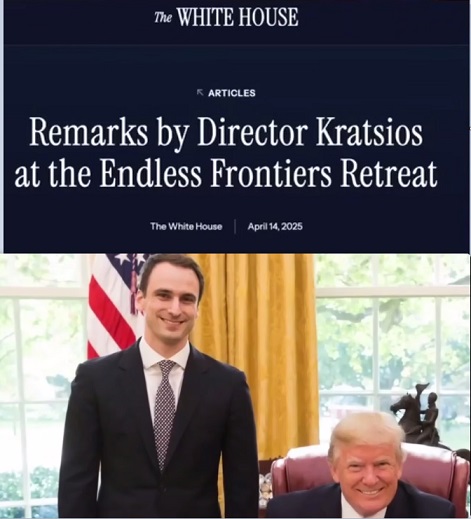
On April 14, 2025, at the Endless Frontiers Retreat in Austin, Texas, Kratsios delivered a speech titled The Golden Age of American Innovation. The speech was not a classified briefing. It was a public policy address arguing that America had become too slow, too bureaucratic and too reluctant to build. Kratsios attacked what he called the “sclerosis of the state,” argued for renewed technological productivity, and invoked the American tradition of pushing into new frontiers. The White House text then contained the sentence that detonated across social media: “Our technologies permit us to manipulate time and space.” Later, he spoke of scientific discoveries that would “bend time and space.”
Read in isolation, the sentence sounds extraordinary. Read with the sentences around it, the intended rhetorical register becomes much clearer. Kratsios immediately describes technologies that “annihilate” distance, make things grow and improve productivity. He then contrasts technological progress with debt, cheap labor and bureaucratic stagnation, before calling on individuals to build more with less and push America into an “endless frontier.” This is not the language of an engineer unveiling a new metric-engineering device. It is the language of a politician describing technology as something that effectively compresses time, distance and human limitations.
That does not make the wording precise. It is not. “Manipulate time and space” is an extraordinarily loose way to describe technological progress, and that looseness is precisely why the sentence went viral. Contemporary coverage likewise treated the statement as metaphorical rather than a literal announcement that the government had discovered a way to violate the laws of physics.
The strongest conclusion is therefore narrower than either side of the internet argument. We do not need to pretend Kratsios said something ordinary. He said something spectacularly grandiose. But the published speech provides no evidence that he was announcing an operational technology capable of literally warping spacetime.
There Is No “Free Energy” Announcement in the Speech

This is where the story begins accumulating inventions that do not belong to the original document. The published Kratsios remarks contain no announcement of a “free energy technology,” no disclosure of an antigravity propulsion system, no reference to zero-point energy extraction and no claim that the United States has discovered a machine capable of producing unlimited energy. The speech discusses energy policy, industrial productivity, technological development and the regulatory barriers surrounding American construction, but it does not disclose an exotic energy breakthrough.
That distinction is more important than it sounds. Once the phrase “bend time and space” is detached from the speech and placed beside the words “free energy,” “antigravity” or “secret weapons,” the reader is no longer investigating what Kratsios said. The reader is investigating a new story assembled from several unrelated stories. Those stories can still be interesting. They just need to be kept separate long enough for the evidence to breathe.
And Then There Are the Navy’s Strange Patents
This is the part that deserves more attention than the Kratsios quote itself.
The U.S. Navy really did file a remarkable series of patents associated with engineer Salvatore Pais. Among them were inventions involving a high-energy electromagnetic field generator, an inertial mass reduction device, a high-frequency gravitational-wave generator, a proposed room-temperature superconductor and a plasma-compression fusion device. The patents are public records, not internet fabrications. One of them, Craft Using an Inertial Mass Reduction Device, was assigned to the U.S. Department of the Navy and ultimately granted as U.S. Patent 10,144,532.
And the paperwork becomes genuinely bizarre. During prosecution of the inertial-mass-reduction patent, Naval Aviation Enterprise Chief Technology Officer James Sheehy intervened with the patent office. His letter argued that Pais’s research could ultimately produce field-induced propulsion and stated that China was investing in similar work. Sheehy wrote that he would prefer the United States to hold the patent rather than eventually have to pay others to use the technology. That is a real statement in a real patent prosecution history. It is also much stronger evidence of official interest than anything in Kratsios’s speech.
But official interest is not the same thing as demonstrated physics.
The Pais Effect Was Actually Tested
This is the detail that changes the entire story.
The Navy did not merely file Pais’s patents and walk away. The Naval Air Warfare Center Aircraft Division tested the underlying concept known as the “Pais Effect.” According to the Navy’s own later account, testing ran from October 2016 through September 2019 and cost approximately $508,000, with most of the expenditure going toward personnel. At the conclusion of the work, NAWCAD said the Pais Effect “could not be proven,” and said there was no further research and no transition of the project to another government or civilian organization.
That is not evidence that the Pais patents were secretly successful. It is almost the opposite: the government spent real money attempting to test the central claim and did not establish that the effect existed.
There is, however, a fascinating unresolved historical wrinkle. The patent record shows Navy officials supporting the inventions during prosecution and describing them as operable or potentially revolutionary, while the later experimental program failed to demonstrate the Pais Effect. Those two facts can coexist without requiring a secret breakthrough. Governments fund speculative research. Military organizations pursue technologies far ahead of demonstrated capability. Patent strategy can be driven by competition. Scientists and engineers can sincerely believe an unconventional idea might work and still be wrong.
The patents therefore belong in the story, but as evidence of an unusual episode in defense research, not as proof that antigravity or spacetime propulsion secretly exists.
Tesla Really Did Have His Papers Examined by Donald Trump’s Uncle
The Tesla connection is real enough without embellishment. After Nikola Tesla died in January 1943, the U.S. government took control of his papers and asked electrical engineer John G. Trump to examine them. Trump was an MIT professor and worked with the National Defense Research Committee during the war. He was also, quite literally, Donald Trump’s uncle.
The resulting assessment is often quoted because it cuts directly against the mythology that later developed around Tesla’s final years. Trump found Tesla’s late ideas speculative and promotional and reported that they did not contain new, sound and workable principles for the production and wireless transmission of power. That assessment is historically documented. It does not mean every Tesla idea was worthless, nor does it prove that every paper was perfectly understood. It simply means the surviving record does not support the claim that Trump’s uncle discovered a revolutionary energy technology and quietly buried it.
Tesla himself is already interesting enough. He worked seriously on wireless power transmission, high-frequency electrical systems and increasingly speculative ideas about energy and communication. Turning that complicated legacy into a family-cover-up story makes it less interesting, not more.
David Grusch Is a Different Story Entirely

David Grusch belongs in this article only if the distinction is kept brutally clear. In July 2023, the former intelligence officer testified before a House Oversight subcommittee concerning unidentified anomalous phenomena. His written statement said that he had been informed during his official duties of a purported multi-decade UAP crash-retrieval and reverse-engineering program from which he had been denied access. The congressional record confirms that he appeared as a witness.
Those are serious allegations. They are not the same allegation as “the White House has free energy.” Grusch’s testimony concerned alleged UAP programs and alleged non-human technology. It did not establish that the government possesses a functioning free-energy generator, an antigravity engine or a machine capable of manipulating spacetime. His claims therefore cannot be used as a missing evidentiary bridge between Kratsios’s speech and the Pais patents.
That bridge is tempting because all three stories orbit the same cultural territory: secret technology, government research and things that appear to exceed ordinary engineering. But thematic similarity is not evidence of institutional connection.
The “500-Year Jesuit Plan” Collapses Before the Physics Begins
Another layer of the online story claims that the Jesuits have spent centuries executing a coordinated plan to suppress revolutionary technology and control humanity, sometimes with the Book of Revelation folded into the chronology. This fails an elementary historical test.
The Society of Jesus was formally recognized in 1540, although Ignatius of Loyola and his companions had formed their original group several years earlier. The Book of Revelation, by contrast, is an ancient Christian apocalypse generally placed in the late first century. The text therefore predates the Jesuit order by roughly fourteen and a half centuries.
That does not settle every question about the history of the Bible, Christianity or the Jesuits. It does settle one much narrower question: the Jesuits did not invent the Book of Revelation. A theory that requires an organization founded in the sixteenth century to author a text already circulating in antiquity is not an alternative interpretation of history. It is a chronology problem.
Why “Bend Time and Space” Was Always Going to Go Viral

There is a linguistic trap buried inside the controversy. Modern technology really does alter our practical relationship with time and space. A fiber-optic network can make geographical distance almost irrelevant to communication. Satellites allow information to cross continents without physical transport. Artificial intelligence can reduce hours of human analysis to seconds. Commercial aviation turns journeys that once took weeks into a few hours. A computer can effectively compress enormous amounts of work into a fraction of the time required by older methods.
Calling that “manipulating time and space” is scientifically imprecise but rhetorically understandable. Calling it evidence of literal spacetime engineering is a completely different proposition.
Kratsios’s own speech gives away the rhetorical frame. He talks about trains, flying cars, productivity, energy, regulation, labor and American industrial capacity before arriving at the language of manipulating time and space. The next movement is not a technical description of a new propulsion system. It is a call for individuals to build and innovate. The phrase belongs to a speech about what technology can do to human capability, not a patent disclosure about a new metric tensor.
But There Is a Real Question Hiding Underneath the Hype
The debunking should not become another form of laziness. There is a legitimate reason people found the Kratsios remark interesting: governments really do fund speculative science, defense laboratories really do investigate technologies that sound impossible until somebody proves otherwise, and the historical record contains genuine examples of military research being conducted far ahead of public understanding.
The Pais patents demonstrate that point perfectly. They show that the U.S. Navy was willing to put its institutional weight behind extraordinarily ambitious concepts. They show that officials invoked national-security competition when arguing for patent protection. They show that money was actually spent attempting to test the underlying physics. And they show something equally important: after the testing, the Navy said the Pais Effect could not be proven.
That is a far more interesting story than “the Navy secretly has antigravity.” It is a story about how governments decide which improbable technologies are worth pursuing, how national-security competition changes those decisions, how patent systems interact with speculative research, and how an idea can travel from a laboratory notebook into an official government document long before anyone knows whether nature will cooperate.
The Real Mystery Is Not Whether Kratsios Revealed a Time Machine
He didn’t.
What he revealed was something both less spectacular and, in its own way, more consequential: the language of American technological policy has become so ambitious that a senior White House science official can stand before an audience and say that “our technologies permit us to manipulate time and space” without stopping to define what that means physically.
That sentence is worth examining precisely because the words are real. So are the Navy patents. So is the $508,000 experiment. So is John G. Trump’s examination of Tesla’s papers. So is David Grusch’s congressional testimony. So is the extraordinary language used by Navy officials during the prosecution of the Pais patents. But none of those facts automatically unlocks the next one.
There is no documented chain running from Tesla to John Trump to Pais to Grusch to Kratsios that ends with a secret free-energy civilization hiding in plain sight. What exists instead is a much messier archive: speculative inventors, ambitious military programs, unusual patents, bureaucratic competition, failed experiments, congressional allegations and political rhetoric that sometimes sounds like science fiction.
The strange part is not that someone finally admitted America can bend time and space. The strange part is that the government really has spent decades investigating ideas that sound like science fiction, and the public record lets us see both the ambition and the failures. That is where the evidence ends. And that is where the real mystery begins.