A work of speculative fiction. The Vatican’s Secret Archives are exactly that, a real institution, described accurately below. The story of Manuel Joubert, the “Connection Between Worlds” device, and what supposedly happened in the French Alps in 1964 is not a documented historical event of any kind. No verifiable record of Joubert, the device, or the incident exists in any historical, scientific, or journalistic source.
It’s offered here as original fiction built around a real institution.
The Real Vatican Archives
The Vatican Apostolic Archive, historically known as the Archivum Secretum Apostolicum Vaticanum, is a real institution, established in its current form in 1612 by Pope Paul V, consolidating papal records that had previously been scattered across various Church locations. Despite its historical name, “secretum” in this context reflects an older Latin usage closer to “private” or “personal,” referring to the Pope’s own archive, rather than “hidden” in the modern sense. The archive does hold an enormous collection, an estimated 85 kilometers of shelving, spanning papal correspondence, historical treaties, and administrative records going back over a thousand years. Access is restricted, but not secret in the conspiratorial sense: scholars have been able to apply for access since Pope Leo XIII opened the archive to qualified researchers in 1881, and it continues to operate this way today, with published catalogs and a functioning scholarly application process.

The Story | A Fifteenth-Century Blueprint
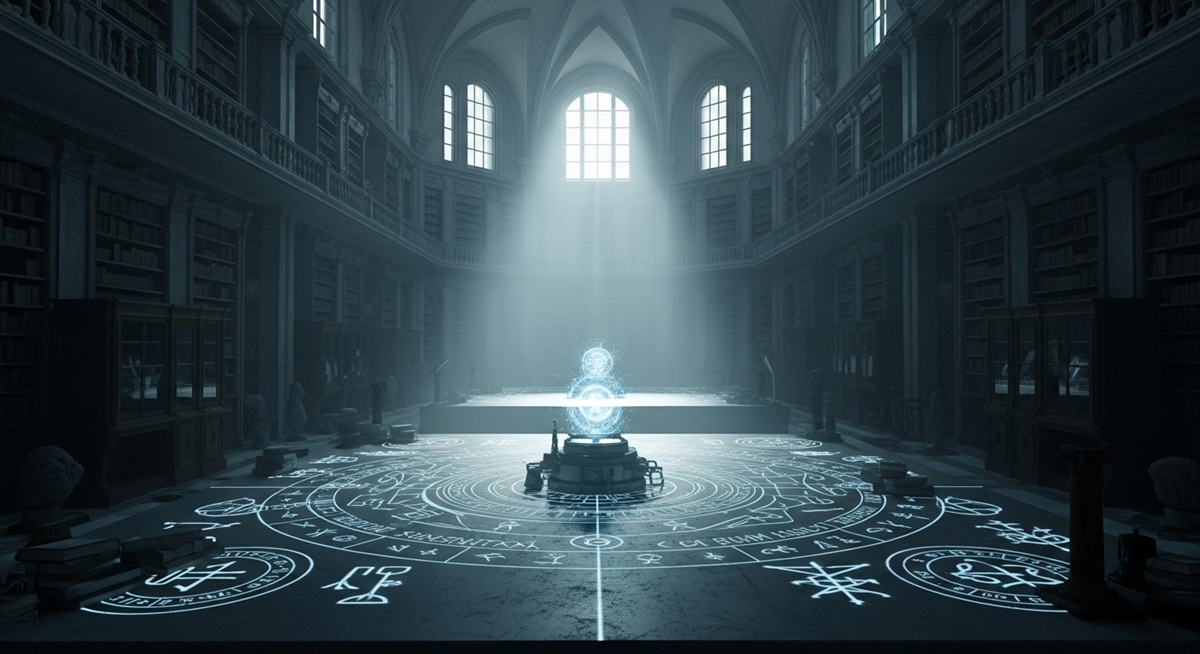
In this fictional account, a group of French and British scientists gained partial access to the archive in the early 1960s, and among the treatises on theology and engineering they were shown, found a set of drawings labeled La Connexion Entre Les Mondes, dated to the 15th century: a complex device blending mechanical engineering with alchemical ritual, requiring rare materials, precise construction, and specific spoken phrases to activate.
The story’s fictional physicist, Manuel Joubert, secures backing to rebuild the device in a secluded laboratory in the French Alps, repurposing a wartime facility for the project. Over three years, the story’s team translates medieval alchemical terminology into modern chemistry, sourcing mercury, molten gold, nitric acid, and arsenic, alongside a set of spoken phrases the drawings specify must accompany the process, less like prayer than like tuning, phrases meant to shape the reaction rather than invoke anything.

The Experiment
By 1964, in this telling, the installation is complete: a towering structure of metal and glass built around a circular processing chamber. The team prepares the volatile mixture the blueprint specifies, and Joubert initiates the sequence. The chamber hums. The mixture coalesces into a shimmering sphere that begins, faintly at first, to glow.
What the story describes next is where it commits fully to its fiction, and it deserves reading as exactly that: a single point of light at the sphere’s center, multiplying like the sudden appearance of stars, the sphere cracking and dissolving into an expanding, iridescent doorway, its edges lit with something the story never quite manages to describe in ordinary terms. Through it, in the story, come figures. Not human, despite the humanoid shape, pale and faceless, moving with a fluidity that reads as wrong before anyone in the room can say exactly why.
The story turns violent quickly here, an assistant caught off guard, the lab descending into chaos, the details of what actually happened next left deliberately unclear even within the story’s own internal logic, the way a good piece of unsettling fiction often withholds its clearest, most graphic details rather than spelling every one of them out.
The Aftermath, and Why It Reads as True
In the story, a military response arrives within hours. The lab is dismantled. Joubert survives, retreats from public life, and never speaks of it again beyond the single account this story is built from. This is precisely the structure that makes stories like this one feel plausible on first read, and it deserves naming directly: a dramatic event, a single traumatized witness, an official cleanup that leaves no independently checkable trace, and a silence that gets read as confirmation rather than as the simple absence of evidence it actually is. No historical record, scientific archive, or journalistic account of Manuel Joubert, a French Alps laboratory incident in 1964, or a Vatican-sourced device by this name exists anywhere this piece has been able to locate.

Why “Vatican Secret Archive” Stories Recur So Often
Why the Vatican Archive specifically functions as such reliable raw material for stories like this one is worth explaining, since the pattern is worth recognizing beyond this single case. The institution’s restricted access, scholars do need formal credentials and a specific research purpose to gain entry, combines with its enormous scale, that 85 kilometers of shelving, to create a setting where almost any claim about a hidden document feels statistically plausible on its face. Nobody, including the archivists themselves, has read every document in a collection that size, which means “somewhere in there” functions as an almost unfalsifiable location for any invented artifact a story requires. Genuine scale and restricted access are verifiable facts about the institution, and they get borrowed here to lend false plausibility to entirely fictional claims about specific contents, a borrowing that works precisely because the facts underneath it are accurate.
The 2012 Reading Room Fire, an Useful Comparison
Comparing this fictional account to how an incident connected to the Vatican Archive actually gets reported is instructive, since the contrast is telling. In 2012, a fire broke out in a storage area connected to the Vatican Library, prompting a documented emergency response and concern among archivists and historians about potential damage to irreplaceable material. News coverage at the time, drawing on statements from real Vatican officials, described the incident in specific, checkable terms: the affected area, the response timeline, and the ultimately limited damage once the fire was contained. That’s what authentic reporting on an event connected to this institution actually looks like in practice, specific, sourced, and checkable against multiple independent accounts, a very different shape than an anonymous, uncorroborated account of a laboratory incident with no named institutional response, no contemporaneous news coverage, and no surviving physical evidence of any kind.

A Real Counter-Example | The Vatican Observatory
Closing this section with an institution that offers an useful counterpoint to this whole genre of “forbidden Vatican science” story is worthwhile: the Vatican Observatory, a currently operating astronomical research institution the Church has funded since the 16th century, with its modern headquarters at Castel Gandolfo and an active research telescope, the Vatican Advanced Technology Telescope, operated jointly with the University of Arizona in the Mount Graham International Observatory in the United States. Vatican Observatory astronomers, several of them Jesuit priests holding PhDs in astrophysics, publish peer-reviewed research in mainstream astronomical journals, attend international conferences, and openly discuss their work, including public engagement with questions about extraterrestrial life, without any of the secrecy this genre of story assumes must surround anything the Church funds. This functioning, transparent scientific institution demonstrates that when the Vatican does fund scientific research, the result looks like ordinary, published, collaborative science, not a hidden laboratory in the Alps.
A Note on the Story’s Own Craft
Appreciating this piece of fiction on its own literary terms too, separate from the factual corrections above, is worthwhile, since it’s a reasonably well-constructed example of a specific, recognizable genre. The story borrows effective narrative structure from mid-century Cold War science fiction and horror, the isolated wartime facility repurposed for secret research, the escalating sense of scientific hubris, the single traumatized survivor whose testimony is all that remains. It also borrows texture from the actual history of alchemy, period-appropriate materials like mercury and molten gold, period-appropriate framing around chants and ritual, giving the fictional blueprint a surface plausibility that draws on historical alchemical practice rather than inventing its details from nothing. That kind of grounding in texture, even while the central events remain invented, is a large part of what makes stories in this genre effective and worth reading as the deliberate fiction they are.

The Trial of Galileo, in Full
Expanding on one specific holding within the Vatican Archive mentioned above matters here, since it’s one of the most historically significant items there and deserves more than a passing reference. The archive holds the actual, complete case file from Galileo Galilei’s 1633 trial before the Roman Inquisition, including his recorded testimony, the formal charges brought against him for supporting the Copernican, heliocentric model of the solar system, and the Church’s own official verdict placing him under house arrest for the remainder of his life. This material has been studied extensively by historians of science and made accessible, in facsimile and scholarly publication, well beyond the archive’s physical walls. It represents exactly the kind of significant, historically weighty material the archive actually contains, evidence of a documented conflict between emerging scientific understanding and institutional authority, considerably more historically important, and more soberly instructive about the relationship between the Church and science, than any invented portal device could be.
What the Real Archive Actually Contains
One final, practical note for anyone curious about the institution rather than the fictional device attached to it here: the Vatican Apostolic Library, a related but distinct institution from the Archive, has been progressively digitizing significant portions of its manuscript collection since 2012, making high-resolution scans of historical documents freely available online to anyone in the world, no scholarly credentials required. This ongoing digitization project is the actual, current, verifiable answer to anyone wondering what the Vatican is willing to share with the public today, and it’s a considerably more generous and transparent answer than the secretive, guarded institution this entire genre of fiction typically imagines and depends on for its atmosphere.
What scholars who have actually worked in the Vatican Apostolic Archive report finding there is remarkable without any fictional embellishment. The collection includes correspondence from Michelangelo regarding the Sistine Chapel, the trial records from Galileo’s proceedings before the Roman Inquisition, and papal bulls spanning centuries of European political history, catalogued, and available to qualified researchers through the ordinary, unglamorous process of scholarly application. There is no credible account from any of the historians who have actually worked within its reading rooms describing anything resembling this story’s device. The archive’s actual value lies precisely in this kind of verifiable, historically significant material, not in an invented mechanism for opening doorways to somewhere else.

Alchemy’s documented history as a serious, if ultimately mistaken, precursor to modern chemistry deserves appreciation on its own terms too. Figures like Isaac Newton took alchemical study seriously as legitimate natural philosophy, historians of science have written extensively about how alchemical practice contributed laboratory techniques and chemical knowledge even as its central goals, transmutation, the philosopher’s stone, were never achieved, and this intellectual history spans centuries of documented experimentation across Europe, the Islamic world, and China. That history doesn’t need a fictional 15th-century interdimensional device to be worth knowing. It’s interesting enough as the centuries-long human effort it actually was, undertaken by scholars, some of them among the most celebrated scientific minds in history, working with the best theoretical framework available to them at the time, long before the modern periodic table gave later chemists the tools to understand why their specific transformations could never succeed.