




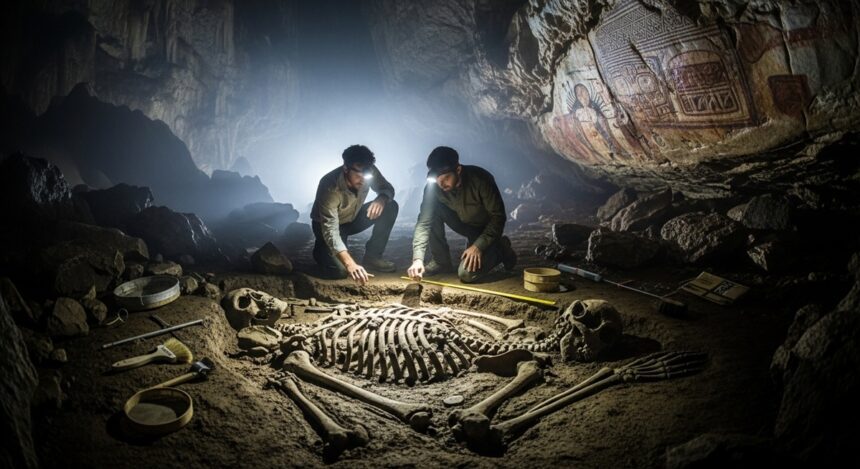
No researchers named Edwin Ryder or Josh Simpson, no haplogroup called C-L1373, and no published, peer-reviewed finding of “17% non-human DNA” from Ecuadorian cave remains appear in any genetics literature, university record, or scientific journal this investigation could locate.
This is worth stating plainly and directly: no named institution, university department, or laboratory is associated anywhere with this specific claim. No journal publication, preprint, or conference presentation describing this discovery could be found. The names “Edwin Ryder” and “Josh Simpson” do not appear in any searchable genetics literature, academic directory, or news archive connected to Ecuadorian archaeology or paleogenetics.
“17% Non-Human DNA” Fails on Technical Grounds
Population geneticists studying ancient human DNA do not describe unmatched genetic material as “non-human” or “alien.” When ancient DNA samples contain sequences that do not match reference databases, standard scientific practice attributes this to well-understood causes: sample degradation, contamination from soil bacteria or fungi during burial, incomplete reference databases that simply lack sufficiently diverse human genetic samples for comparison, or previously undocumented human genetic diversity, since reference genome databases remain heavily skewed toward certain populations and are missing enormous amounts of human genetic variation, particularly from underrepresented indigenous populations worldwide.
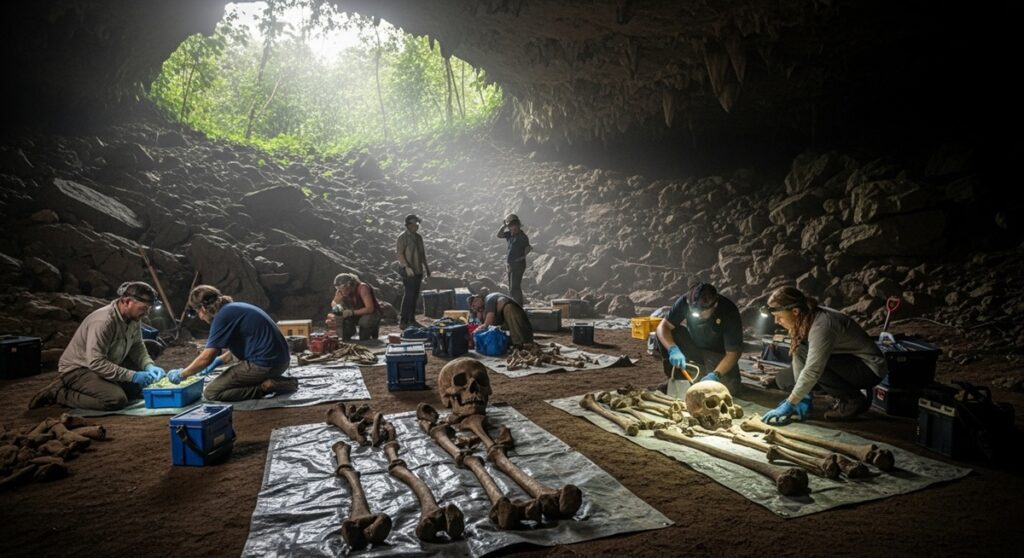
Geneticists studying ancient DNA have directly noted that finding unmatched genetic sequences is common and expected, not evidence of anything extraterrestrial. This is a well-understood technical limitation of comparative genomics, not a mystery requiring an exotic explanation.
Bone Density and “Reinforced Steel” Has No Source Either
The claim that ancient bones showed mineralization “2.5 to 3 times denser than ordinary human remains” and required a “innate mechanism” beyond nutrition has no traceable source. Published paleopathology research has documented variation in ancient bone density linked to well-understood factors, including differences in physical activity levels, dietary calcium and vitamin D availability, and post-mortem mineral absorption from surrounding soil during burial, a process called diagenesis that forensic anthropologists carefully account for when analyzing ancient skeletal remains. Bone density variation within this normal range does not require, or suggest, any biological mechanism beyond ordinary human physiology.
What Ancient DNA Research in South America Has Actually Found
Ancient DNA research in South America is active and has produced fascinating, peer-reviewed findings that need no invented embellishment. Studies published in journals including Science, Nature, and Cell have sequenced ancient human genomes from across the Americas, research led by institutions including Harvard Medical School, the Max Planck Institute for Evolutionary Anthropology, and multiple South American universities. This extensive body of published research has revealed complex migration patterns into South America, evidence of multiple distinct ancient population waves, and genetic connections between ancient South American populations and ancient populations as far away as Australia and Melanesia, a surprising, thoroughly peer-reviewed finding sometimes called the “Population Y” signal.
Haplogroup research on indigenous South American populations, including studies of haplogroups within the C and Q lineages broadly associated with the initial peopling of the Americas, has been extensively published and peer-reviewed, technical genetic classification work considerably more precise and better documented than any unverifiable reference to “haplogroup C-L1373” that has circulated online.
Ecuadorian Archaeology, Told Accurately
Ecuador is rich archaeological territory, home to research on sites including the Las Vegas culture, dated to roughly 8,000 to 4,600 BCE and extensively studied by archaeologists, and the Valdivia culture, one of the earliest known pottery-producing societies in the Americas, dated to around 3,500 BCE and the subject of extensive peer-reviewed archaeological research. Ecuadorian archaeological sites have produced extraordinary and well-documented finds without requiring any invented genetic mystery, including evidence of some of the earliest agriculture in the Americas.
Why Claims Like This Circulate Without Real Sources
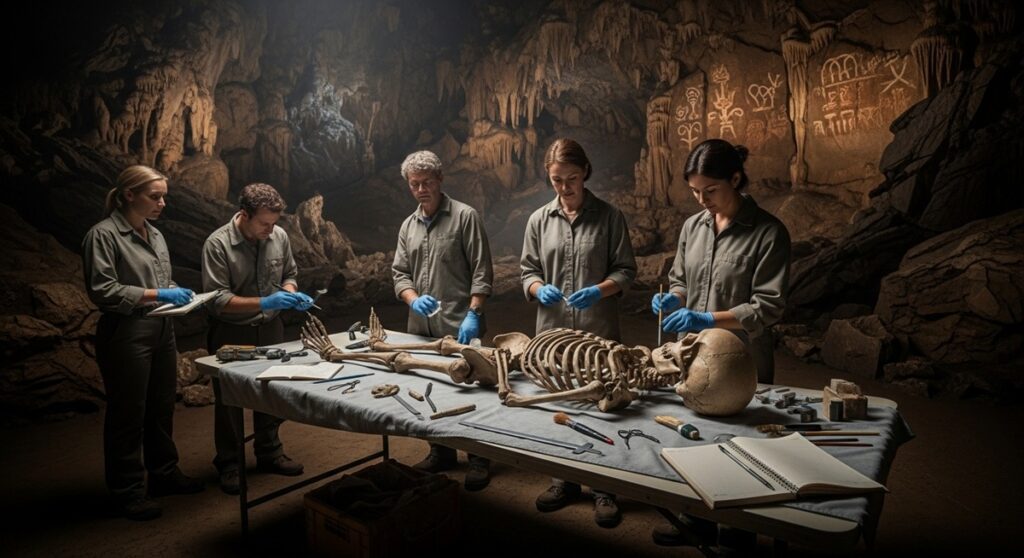
This specific claim follows a recognizable pattern that recurs across many similar unverifiable stories. Science journalists and fact-checking organizations have directly documented a recurring pattern in “non-human DNA” claims circulating online, typically featuring named individuals with no verifiable institutional affiliation, vague references to unnamed “top labs” or unnamed “U.S. colleagues” rather than specific, checkable sources, and dramatic percentage figures presented without any accompanying published methodology that other scientists could review or replicate. Geneticists have noted that legitimate scientific findings of this magnitude would be impossible to keep out of major peer-reviewed journals and mainstream science reporting, given the enormous scientific interest such a finding would generate, precisely the kind of attention this claim has never actually received from any scientific institution.
How Ancient DNA Sequencing Actually Works
The process behind legitimate ancient DNA research is rigorous and worth understanding on its own terms. Ancient DNA extraction requires specialized clean-room facilities specifically designed to prevent modern DNA contamination, since ancient genetic material is extremely degraded and exists in tiny quantities, making it vulnerable to contamination from anyone handling the sample, including the researchers themselves. Labs conducting this work, including the Max Planck Institute for Evolutionary Anthropology’s dedicated ancient DNA facility, employ strict protocols including full protective clothing, dedicated equipment never used for modern samples, and independent replication of results across multiple separate laboratories before any finding is considered credible enough for publication. Sequencing results then undergo rigorous statistical analysis to distinguish authentic ancient genetic signal from background contamination, a technically demanding process that geneticists spend years training to perform reliably. This exacting standard is precisely why legitimate ancient DNA findings take published research teams months or years to confirm and publish, rather than emerging as a single dramatic percentage figure from an unnamed lab.
Population Y and the Genuine Pacific Connection
The real “Population Y” finding is worth expanding on, since it represents exactly the kind of surprising discovery that legitimate ancient DNA research is capable of producing without needing any invented embellishment. Published 2015 research in the journal Nature, led by researchers including Pontus Skoglund and David Reich, found that certain present-day Amazonian populations, including the Suruí and Karitiana peoples, carry a measurable genetic signal more closely related to indigenous Australian and Melanesian populations than to other Native American groups. This startling finding, confirmed through rigorous statistical genetic analysis and independently discussed in follow-up peer-reviewed research, remains an actively studied mystery in legitimate paleogenetics, with researchers proposing several competing hypotheses involving ancient migration patterns into the Americas. This unresolved scientific question is a fascinating example of how authentic ancient DNA research produces real mysteries worth taking seriously, using verifiable, peer-reviewed methodology rather than unverifiable claims from unnamed researchers.
Why Reference Databases Genuinely Have Gaps
Explaining why unmatched DNA sequences are a well-documented and unremarkable occurrence in legitimate genetics research matters here, since this technical limitation is central to correctly understanding claims like this one. Population geneticists have openly and publicly acknowledged that global genetic reference databases remain significantly incomplete, with research showing populations of European descent are dramatically overrepresented in major genetic databases relative to their share of global genetic diversity, while indigenous populations across South America, Africa, and Oceania remain underrepresented. This acknowledged gap means that legitimate ancient or even modern DNA samples from underrepresented populations can produce segments that fail to closely match existing reference sequences, not because the DNA is not human, but because the comparison database simply lacks sufficient genetic diversity from that specific population or region. Genetics organizations, including major international genome sequencing initiatives, have actively prioritized expanding database diversity precisely because this gap is an acknowledged limitation of the field, not evidence of anything extraordinary when it produces an unmatched sequence.
What Human Origins Research Actually Shows
Paleogenetics has made remarkable discoveries about human origins without requiring any extraterrestrial explanation. Research has confirmed interbreeding between early modern humans and both Neanderthals and Denisovans, with published studies showing most non-African modern humans carry measurable percentages of Neanderthal DNA, typically between 1 to 2 percent, a fascinating, peer-reviewed finding about actual human evolutionary history. This science, confirmed through rigorous, published, peer-reviewed methodology and independently replicated by multiple research teams worldwide, demonstrates that authentic discoveries about human genetic complexity are exciting on their own terms and do not require inventing untraceable percentages or unnamed researchers to be worth writing about.
The story of human origins in South America, migration waves, genetic connections spanning the Pacific, early agricultural societies like Valdivia, is already a rich, well-documented, and actively researched field. It needs no invented geneticists and no untraceable percentage to remain worth learning about accurately, and the questions it still has left unanswered, like the Population Y signal, are considerably more interesting precisely because they come with a verifiable, peer-reviewed research trail attached.