




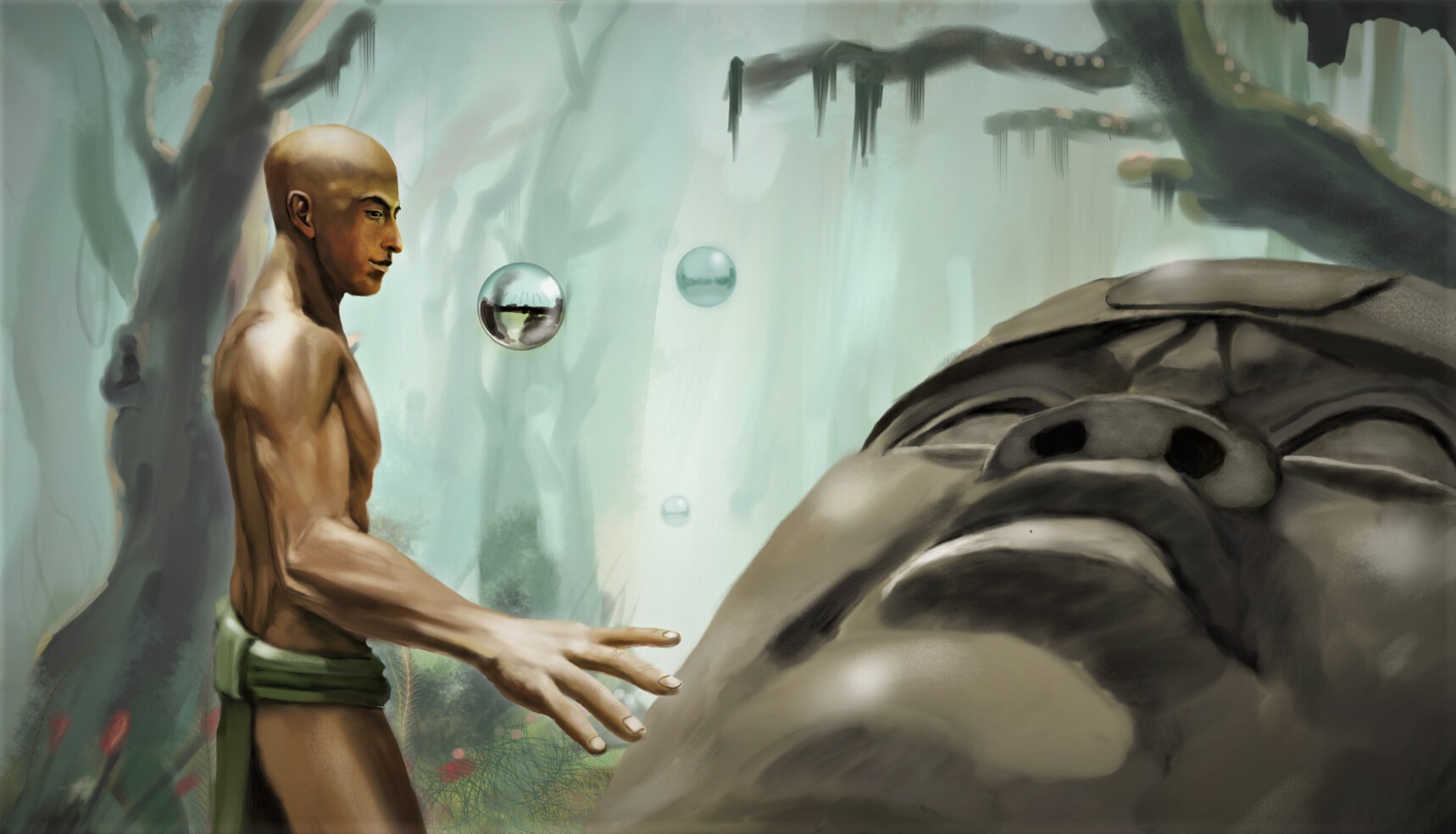
The heads were looking at the sky.
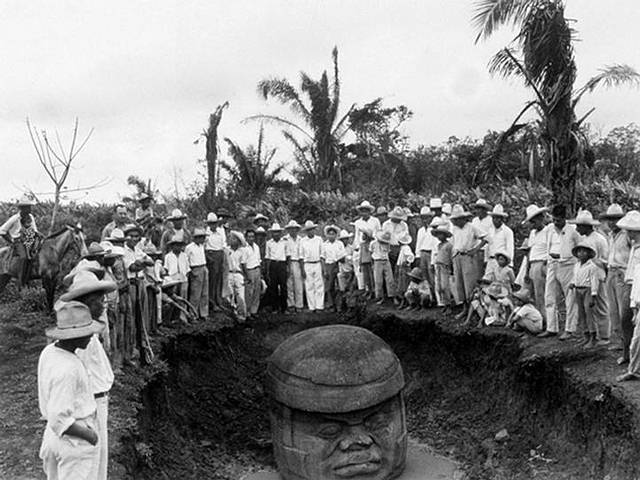
They always were, but Matthew Stirling did not know that when he began excavating the first of them at Tres Zapotes in 1938. He was the first professional archaeologist to conduct systematic excavation of Olmec sites, and what he found in the volcanic basalt of the Gulf Coast lowlands of Mexico challenged everything the conventional account of pre-Columbian civilization had established.
The heads are colossal. The largest measures approximately three and a half meters in height and weighs approximately fifty tons. The seventeen that have been excavated so far, ten at San Lorenzo, four at La Venta, two at Tres Zapotes, and one at Cobata, are each unique: individual portraits rather than idealized representations, each face different from the others, each wearing a helmet whose design varies between figures.
The helmets have been identified as the headgear worn for the Olmec ballgame, the ritual sport whose cosmic significance in Mesoamerican religion is recorded across the subsequent cultures that inherited the Olmec tradition. The Maya, the Aztec, and every major Mesoamerican civilization that followed the Olmecs practiced the ballgame. All of them traced the tradition back to the Olmecs. The Olmecs traced it back to no one, because nothing is known about the Olmecs’ origins.
The faces present the anomaly that has driven the most sustained research and the most unresolved debate in Olmec scholarship: they show pronounced features described by multiple independent researchers, including physical anthropologists analyzing photographic records and casts of the heads, as morphologically West African in character. Wide noses, full lips, prominent cheekbones, and the soft-tissue facial architecture that differs from the indigenous Mesoamerican populations of the region are recorded across multiple heads at multiple sites.
Where the Olmecs came from is not established. Where the people depicted in their colossal heads came from is not established. No Olmec skeletal remains have been recovered because the Gulf Coast lowlands’ extreme humidity has prevented bone preservation across the centuries since the civilization’s decline.
The faces in the stone are the only direct evidence of what the people looked like. The stone says Africa.
The Basalt Engineering Problem
The volcanic basalt from which the colossal heads were carved is not local to the sites where the heads were found. The nearest source of the basalt used for the San Lorenzo heads is the Cerro Cintepec volcanic massif in the Tuxtlas mountains, approximately 60 kilometers to the northwest.
Sixty kilometers is not a great distance by modern transport standards. By Olmec transport standards, it is one of the most significant engineering problems in the pre-Columbian record.
The conventional archaeological consensus is that the Olmecs did not use the wheel for transport. This consensus rests on the absence of evidence for wheeled vehicles in the Olmec archaeological record, combined with the absence of domesticated pack animals capable of pulling wheeled transport in Mesoamerica. The horse, the ox, and the donkey were all absent from the Americas until European contact. The wheel itself, as a transport mechanism, is conventionally described as unknown in the pre-Columbian Americas.
The paradox that Matthew Stirling’s 1940s excavations at Tres Zapotes introduced into this conventional picture is the wheeled animal toys. Stirling found small ceramic figurines of dogs and other animals mounted on axles with functioning wheels. The toys appear in his published fieldwork and are now in museum collections.
Whether this finding means the Olmecs understood the wheel as a mechanical principle and chose not to apply it to transport, or means the conventional account of the absence of wheeled transport in pre-Columbian America requires revision, is the interpretive question that the toys raise without resolving.
If the Olmecs understood wheels sufficiently to make wheeled toys, the question of why fifty-ton basalt blocks were transported sixty kilometers without wheeled transport requires either a reason for this apparent inefficiency or a revision of the assumption that wheeled transport was unavailable.
The conventional explanation for the transport, human labor organized at sufficient scale to move the blocks on wooden rollers or sledges along the route from the Tuxtlas to the sites, is physically plausible but requires a level of organized labor whose institutional basis in the early Olmec period, before the development of the complex social hierarchy that would facilitate such organization, is not fully established.
Whether the basalt transport required technology whose evidence has not been recovered, technology that the conventional framework does not accommodate, or simple organized human labor at scales that early Olmec society could achieve, is a question that the wheeled toy paradox makes more interesting than it would be otherwise.
The Cascajal Block and the Undeciphered Script
In 1999, workers quarrying a road in the village of Cascajal near San Lorenzo uncovered a carved serpentine block that represents the most significant Olmec inscription discovery in the history of the field.
The Cascajal Block, its discovery published in Science in 2006 by Stephen Houston of Brown University and colleagues including Karl Taube, Michael Coe, and Richard Diehl, bears 62 signs carved into one face in an arrangement that the researchers identified as displaying the characteristics of a genuine script: signs used in combination and sequence, signs appearing at higher frequency than others, and a positional structure consistent with a system encoding language rather than simple iconography.
The Houston team’s conclusion, published in one of the world’s most prestigious scientific journals, was that the Cascajal Block preserves the oldest known writing system in the Western Hemisphere, predating the previously known earliest Mesoamerican scripts by several centuries and dating to approximately 900 BCE in the early San Lorenzo period.
The Cascajal script has not been deciphered. Unlike the Maya script, which was eventually decoded through the combined efforts of multiple researchers over decades, the Cascajal script has no bilingual key, no large corpus of parallel texts, and no direct descendants in the subsequent Mesoamerican writing systems that might provide interpretive leverage.
What the undeciphered Cascajal script means for the question of Olmec origins is that the civilization developed a writing system sophisticated enough to deserve publication in Science, whose character differs from all other known Mesoamerican scripts, and whose content is completely unknown.
The Olmecs had things to write about. What they wrote is not accessible.
Whether the Cascajal script encodes the Olmec language, whose nature is completely unknown since no proposed Olmec linguistic identification has achieved consensus in the linguistic literature, or represents a script system borrowed from an even earlier tradition, is a question that the script’s isolation from all known Mesoamerican linguistic families makes genuinely open.
La Venta and the Other People
The colossal heads’ African-featured faces are not the only anomalous human representations in the Olmec artistic record.
At La Venta, the second major Olmec center whose monumental architecture and ceremonial complex date to approximately 800-400 BCE, steles show human figures with physical characteristics that differ dramatically from the heads: tall, slender figures with long thin noses, straight hair, and beards, whose facial morphology has been described by multiple researchers as Caucasian or specifically Mediterranean in character.
The same site that produced the African-featured colossal heads also produced sculptural representations of people who look like they came from the opposite side of the world.
The conventional archaeological explanation for the apparent racial diversity in the Olmec artistic record is that the figures represent mythological beings, ancestors, or cultural archetypes rather than actual human individuals of different ethnic origins. This explanation is not unreasonable: Mesoamerican art conventionally depicts supernatural beings and ancestors whose physical features encode cosmological content rather than literal portraiture.
The problem with this explanation, as Graham Hancock and others have noted, is that the colossal heads are specifically identified by the conventional account as royal portraits: individual rulers depicted with individual faces. If the heads are portraits, the faces are real. If the faces are real, the African morphology is real.
Whether the La Venta steles’ Caucasian-featured figures are also portraits of real individuals, rather than mythological figures, is the interpretive question that the heads’ portrait identification raises by implication. If the Olmec artistic tradition was capable of portraiture for the heads, the question of whether the steles also represent actual people from an actual population present at La Venta is genuinely open.
Whether that population was Phoenician navigators, as some researchers have proposed, or representatives of the older civilization that Hancock proposes as the common source of both Olmec and Egyptian civilization, or something else entirely, is a question that the La Venta steles raise without resolving.
The Atlantis Framework and the Third Civilization
The question that the Olmec anomalies, the African-featured heads, the Caucasian-featured steles, the undeciphered script, the wheeled toys, and the basalt engineering, collectively raise is the same question that the Sphinx’s anomalous geological age and the Egyptian Old Kingdom’s sudden technical sophistication raise in the Egypt cluster: where did this come from?
Graham Hancock’s third-civilization hypothesis proposes that both the Olmec and Egyptian civilizational foundations derive from a common source: a pre-catastrophic civilization whose survivors dispersed across the globe following a catastrophic event, carrying astronomical, engineering, and artistic knowledge that they transmitted to the populations they encountered.
The mythological evidence Hancock cites for this dispersal is the cross-Atlantic parallel: American myths and Egyptian, Mesopotamian, and other Old World myths describe the same sequence of cosmic events, great fires, great floods, great cold, and times of chaos, in language whose correspondences suggest either a common transmission or a common experience of the same physical catastrophe.
The precession of the equinoxes, the 26,000-year cycle through which Earth’s rotational axis traces a complete circle relative to the fixed stars, appears in both the Mesoamerican calendar system and the ancient Egyptian astronomical tradition with a precision that requires long-term systematic observation of the night sky. Whether both traditions acquired this knowledge independently, or whether both inherited it from a common source whose astronomical knowledge was sufficiently advanced to measure the precessional cycle, is the question that the cross-cultural astronomical correspondence raises.
The Hapgood earth crust displacement theory, which proposes that the entire outer shell of the Earth periodically shifts relative to the planetary interior, producing rapid geographic relocations of crustal regions and the associated catastrophic effects, is the mechanism Hancock proposes for the catastrophic event that destroyed the third civilization and dispersed its survivors.
Whether the earth crust displacement theory is physically viable is contested in the geological literature. What is not contested is that the mythological record of both the Old and the New World describes catastrophic events at a period roughly 10,000-12,000 years ago with a cross-cultural consistency that independent invention does not easily explain.
Whether the Olmec colossal heads represent the African members of this dispersed civilization, the La Venta steles represent its Caucasian members, and the San Lorenzo plateau represents one of the founding sites where these survivors established a new civilization on the ruins of the old one, is the interpretive framework that the documented anomalies support without establishing.
What the Olmecs Established and What They Left
The Olmec civilization declined gradually between approximately 400 and 100 BCE without a documented catastrophic ending. The reason for the decline is not established in the archaeological record. What the Olmec tradition transmitted to its successors is documented extensively: the ballgame, the jaguar deity, the Long Count calendar, the pyramid-building tradition, the astronomical knowledge encoded in Mesoamerican sacred architecture, and the cultural and religious foundations that the Maya, Aztec, and every subsequent Mesoamerican civilization built upon.

The Olmecs have been described as the mother culture of Mesoamerica. Everything that followed them traces its roots to them. And the Olmecs’ own roots are completely unknown.
Their script is undeciphered. Their language is unknown. Their ethnic identity is irresolvable without skeletal evidence that does not exist. Their colossal heads show faces that do not match any known indigenous Mesoamerican population. Their steles show people who do not match each other or the heads. They made wheeled toys but transported fifty-ton blocks without wheels. They created the oldest writing in the Western Hemisphere and left no texts that anyone can read.
The heads are still looking at the sky.
Dr. Óscar Padilla Lara said they are waiting for the return of the gods. Whether the gods they are waiting for came from space, from Africa, from the Mediterranean, from an Antarctic civilization that preceded all of them, or from nowhere that any available framework can currently map, the stone faces are not telling anyone.
They were carved to last. They have lasted. The question they were carved to commemorate is still the question.