
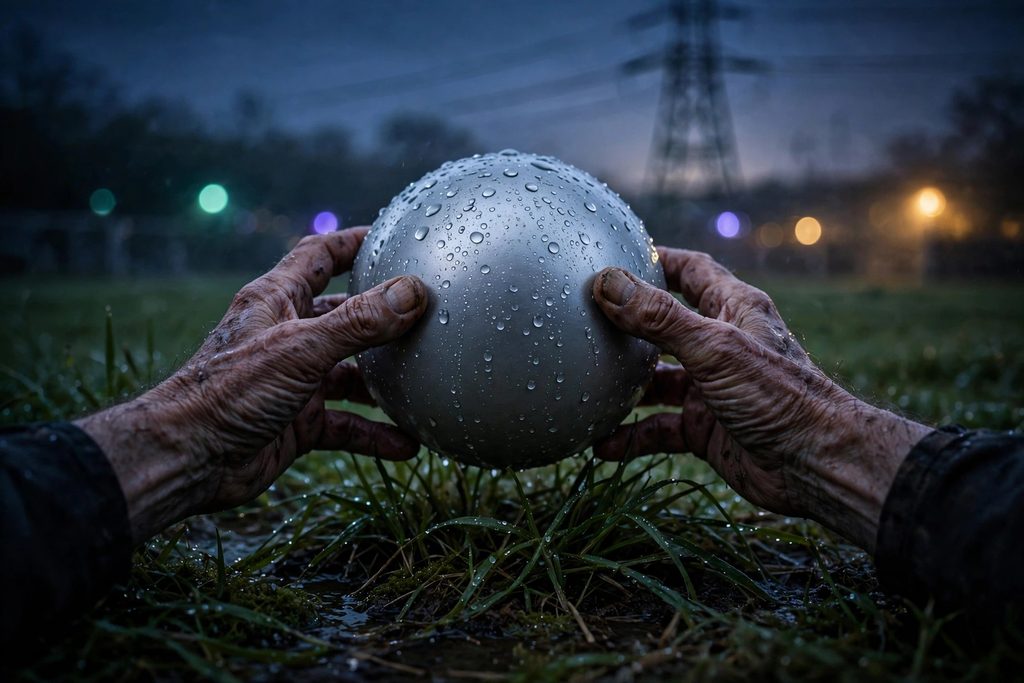
On 2 March 2025, people in the Colombian town of Buga looked up and saw a silver ball in the sky. It did not fall like a stone or drift like a balloon. In the videos they took, it hangs, slides sideways and changes direction, a bright point against the clouds above the valley. Then it came down on the edge of town.
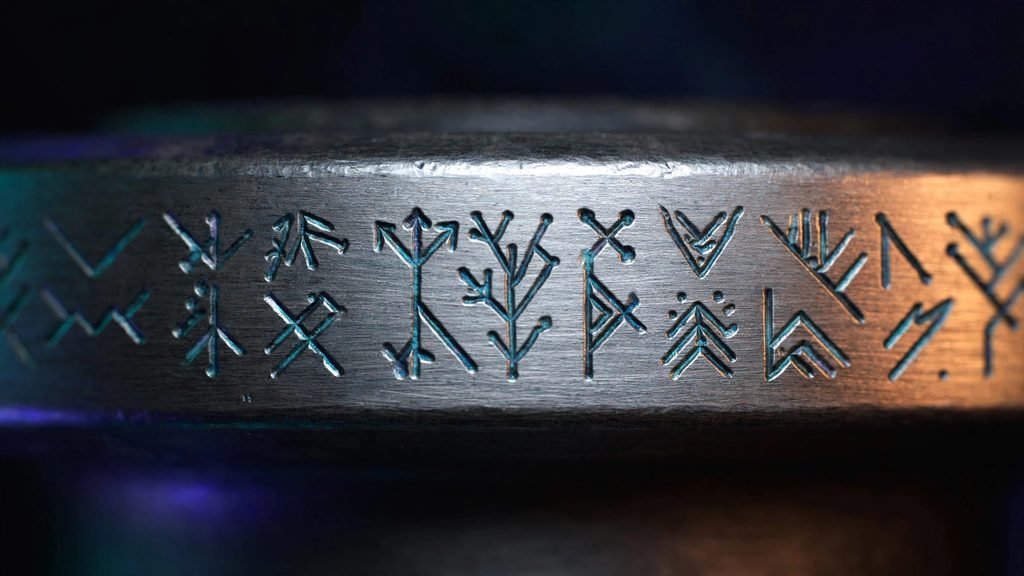
A local man named José Arias was among the first to reach it. Those who touched it said it was cold, about the temperature of something taken from a refrigerator. It was the size of a football, smooth and silver-grey, and it weighed about two kilograms. There was no seam on it anywhere, no weld, no join, no hatch, no screw. Only a band of small strange characters, etched into the metal like the letters of a forgotten alphabet.
Within weeks a radiologist had X-rayed it and found something inside. Within months it had crossed into Mexico, been cut, sampled and carbon dated, and been billed in Washington as an object twelve and a half thousand years old. The Buga sphere is one of the strangest objects of the decade. Nobody who has held it has yet let the rest of the world find out what it is.
The Town of the Lord of Miracles
Guadalajara de Buga lies in the green valley of the Cauca River in the department of Valle del Cauca, about seventy kilometres north of Cali. It is an old colonial town of white walls and red roofs, and it is famous across Colombia for one thing. Its great basilica holds the Lord of Miracles, a crucifix venerated by pilgrims who come in their hundreds of thousands.
According to the town’s legend, an Indigenous washerwoman found a small crucifix in the river centuries ago and took it home, and as she prayed to it, it grew. It is a story about an object found by chance at the water’s edge that would not stay the size it was. Few towns could have been better prepared for what came down in 2025.

The Fall
The first videos of the sphere spread online in the weeks that followed. They show the silver ball in flight over Buga, and in some accounts it struck power lines before it came to rest. Later footage shows its recovery from the ground. Nobody has explained what kept it aloft. The sphere has no wings, no propeller, no vents and no visible way to steer.
It did not go to the police or to any government agency. It passed instead into the hands of a small group of private researchers. One of the first was José Luis Velázquez, a Colombian radiologist. He studied the sphere’s surface and found what he called a very rare piece. “I’ve never seen a piece like this,” he said. Above all he was struck by what was missing. There were no welds or joints, the marks that almost every human object made of metal carries somewhere on its skin.
Through the X-Rays
What Velázquez saw when he X-rayed the sphere made it famous. The ball was not hollow. Its wall was built of three concentric layers of metal, a few millimetres thick in all, with no gap between them. Inside, small dense balls were arranged around a centre. The first reports counted nine of these microspheres. Later scans, at higher exposure and from more angles, counted sixteen or eighteen, set in two rings. At the very heart sat a dense, many-sided object that the researchers called the chip, joined to the small spheres by fine connections like the spokes of a wheel.
The sphere was hard to see through. Its density forced the team to take images again and again at stronger settings. And when one of the later teams cut a small section and looked at it under an electron microscope, they reported fine strands running through the metal near its equator, more than fifty of them, from about forty to three hundred and fifty thousandths of a millimetre across. They called them fibre optics. Some of the strands, they said, ran out to small copper-rich pins set in the surface.

- 1The shellThree concentric layers of metal a few millimetres thick, with no seam, weld or join. Reported as about ninety-five percent aluminium.
- 2The small spheresDense balls arranged around the centre. Nine in the first X-rays, sixteen to eighteen in later scans, set in two rings.
- 3The chipA dense, many-sided core at the heart, joined to the small spheres by fine connections.
- 4Fibres and pinsMore than fifty fine strands near the equator, reported running out to copper-rich pins in the surface.
- 5The symbolsA band of etched characters around the shell, unlike any known script and still unread.
The Writing on the Shell
Around the sphere runs a band of etched symbols. To some viewers they look like runes. To others they recall the Irish Ogham script, the wedges of Mesopotamia or the traces of a printed circuit. No linguist has identified them as any known script, and no one has shown that they form a language at all.
Many people have tried to read them anyway. The team studying the sphere put them through an artificial intelligence program and announced a translation: the origin of birth through union and energy in the cycle of transformation. Another decoder online claimed they were an alphabet from an old computer game and spelled a quotation from Arthur C. Clarke, though others counted the symbols and found too few for the phrase. Examiners who looked closely at the grooves described the carving as of only moderate quality, perhaps done by hand. Under magnification the metal inside the letters oxidised differently from the rest of the shell, which may mean they were cut after the sphere was made.
Into Mexico
In the spring of 2025 the sphere began to appear on the programmes of Jaime Maussan, the Mexican television journalist who has spent half a century reporting on UFOs. Maussan is no stranger to astonishing objects. In September 2023 he presented two small mummified bodies to the Mexican Congress as non-human beings from Peru. Independent scientists who examined similar figures found them to be made from human and animal remains.
On his programmes, engineers presented as working with the National Autonomous University of Mexico described what they had found. The shell, they said, was about ninety-five percent aluminium, with a few percent of manganese and iron. They reported its hardness as far greater than ordinary aerospace aluminium. They described the internal fibres, the copper pins, an inner core that seemed magnetic, and a shell that was not. In one test, water dropped on the surface was said to flash into vapour while the metal stayed cool. Geiger counters found nothing above the background.
None of this has been published in a scientific journal. No accredited laboratory has issued a formal report of its own on the composition, the hardness or the fibres. Everything known about the inside of the sphere has come from people chosen by those who hold it.

The Weight That Grew
Then came the strangest claim of all. In June 2025 the researchers said the sphere had grown heavier. From about two kilograms when it was found, they reported, it had climbed to around five times that weight. Their explanation was that the sphere had held itself up with a field of its own, and that as the field faded the true weight of the object returned.
No outside scientist has weighed the sphere over time to test this. But in Buga, a town that has told for centuries of a crucifix that grew in a washerwoman’s hands, the story of an object from the sky that would not stay the weight it was felt strangely familiar.

Twelve Thousand Five Hundred and Sixty Years
In September 2025 the sphere took its most startling turn. Dr Steven Greer, the founder of the Disclosure Project, announced that a sample of resin from inside the sphere had been carbon dated by the Center for Applied Isotope Studies at the University of Georgia. The result, he said, made it about 12,560 years old, older than the pyramids by more than ten thousand years, from the age of the mammoths and the last great cold of the Ice Age.
The lab report he shared does not quite say that. It gives the sample as 20.94 percent modern carbon, which is how radiocarbon labs record what they measure. Converted into years in the usual way, that figure does come to about 12,560 radiocarbon years. But a laboratory dates only the material it is sent. The report was addressed to Greer’s own company, it says nothing about where the sample came from, and in one place its text even describes the material as foraminifera, tiny sea shells, before calling it resin in its table.
There is a further twist that the number cannot settle. Resin made from petroleum carries no radiocarbon at all, because the oil it comes from is millions of years old. A filler or paint that blended about one part of fresh plant material with four parts of petroleum product would give exactly the same reading as a pure resin twelve thousand years old. The number is precise. What it measures is unknown.
In May 2026 Greer’s Disclosure Project billed Maussan as a special guest at a press conference at the National Press Club in Washington, to present the sphere’s analysis with the resin date at its heart. The sphere itself remained where it had been since the spring of 2025, in the care of Maussan’s team.

Reading one. A single ancient material
Resin from a tree that died about 12,560 radiocarbon years ago. Its radiocarbon has been decaying ever since, and about a fifth of it is left.
Reading two. A modern blend
A filler or coating made today from one part fresh plant material and about four parts petroleum product, which holds no radiocarbon at all.
The Skeptics
From the start, some of the people most open to the idea of visitors were the least convinced by the sphere. Julia Mossbridge, a physicist and founder of the Institute for Love and Time, who takes the study of unidentified objects seriously, looked at the Buga sphere and told Fox News, “It looks to me like a really cool art project.” She urged its owners to hand it to a group such as Harvard’s Galileo Project, which studies unidentified objects with open methods and outside review.
Every feature that seems impossible has a human answer waiting. Aluminium alloys are made by the million. Seamless metal shells can be cast, spun, forged or printed. Fine glass and plastic fibres are cheap and common. Copper pins and small dense balls can be set inside a casting. None of this proves the sphere was made by a person. It does mean that nothing seen in it so far would need anyone else.
Spheres That Fell Before
Buga is not the first town to find a mysterious ball. In March 1974 the Betz family of Fort George Island, Florida, found a polished metal sphere about twenty centimetres across in the woods near their home after a small brush fire. They said it rolled by itself, stopped and changed direction, and seemed to answer when their son played the guitar. The world’s press came running. The Navy examined it and found stainless steel. It turned out to be a ball check valve, a heavy industrial part, and an artist later said several such balls had rolled off the roof rack of his Volkswagen bus near Jacksonville three years before. The ball moved, it seems, because it was almost perfectly balanced and the old stone floors of the house were not level.
Metal spheres also fall from the sky in earnest. Rocket stages carry round pressure tanks, and from Australia to Brazil to the Pacific islands, people have found them in fields and on beaches, scorched, smooth and strange. Most are traced within weeks. The Buga sphere does not look like one. But every one of them was, for a little while, a mystery that had fallen out of the sky.

What Would Settle It
The answer to the Buga sphere could be found quickly. The sphere is solid, it can be weighed and it can be cut. An independent laboratory, or better several, could measure its alloy, examine its fibres, test its weight over months and date any organic material inside it, with a record of every hand the object passed through. Julia Mossbridge named the kind of place it could go, open groups such as the Galileo Project or the Scientific Coalition for UAP Studies.
So far that has not happened. Until it does, the sphere sits in a strange place between two worlds, an object anyone can photograph that nobody outside its circle can study.
So Close to an Answer
Most mysteries of the sky are made of light, a glow on a video, a shape on radar, a smear on a photograph. The Buga sphere is different. You could hold it in two hands. It is heavy and cold, it has been X-rayed and cut open and run through a dating laboratory, and inside it sits a core ringed by small spheres, with lines of unknown script around its skin. If something made elsewhere ever did land among us, many people imagine it would look a great deal like this.
And yet every one of its wonders arrives by the same road. The seamless shell that flew, the weight that grew, the writing nobody can read and the date from the close of the Ice Age are all reported by the people who keep the sphere, and none has yet been tested by anyone outside that circle. A visitor, a sculpture or something made to be found, it remains within arm’s reach of an answer, and no closer.

The Verdict | Unresolved
The Buga sphere exists. It came down near the town of Buga in Colombia in March 2025, it has been scanned and sampled, its alloy is reported to be mostly aluminium, and a sample described as resin from inside it returned 20.94 percent modern carbon at the University of Georgia, which its custodians read as an age of about 12,560 years. What has not happened is the step that would let anyone else judge it. None of the analyses has appeared in a peer-reviewed journal, and no independent laboratory has examined the sphere with a clear record of where each sample came from.
That is why this file stays open. Nobody outside its circle can yet say what the sphere is made of, who made it, how it moved through the air, or what the sample in Georgia came from. Any independent laboratory could begin to answer those questions in a matter of weeks, the day the sphere is allowed to travel to one.
- Claim tested
- The metal sphere that came down at Buga, Colombia, in March 2025 is of non-human origin and about 12,560 years old.
- Oldest record
- Rung 2 · Reported at the time
Witness videos from Buga in March and April 2025, the X-rays of the radiologist José Luis Velázquez in May 2025, and the University of Georgia radiocarbon report of September 2025. - The record supports
- A seamless metal sphere with a layered interior, small dense spheres, fibres and etched symbols, filmed in apparent flight, and a sample read at 20.94 percent modern carbon.
- It does not support
- A non-human origin or a great age for the object itself. No analysis has been published or repeated independently, the sample’s source is not recorded, and every feature described so far can be made by people.
- Explanations weighed
- A craft or probe from elsewhere, an art object, a deliberate hoax, and industrial or aerospace hardware.
- What would change it
- Independent analysis by accredited laboratories with a full chain of custody, published for review, showing materials or a structure no human process can produce.
Other things that seemed to arrive from beyond have their own files. The interstellar traveller of 2017 is in Oumuamua, and a dark shape photographed over the Earth in the Black Knight satellite. A crystal orb said to hide a message is the subject of the orb of Salvator Mundi, while the long skulls that Jaime Maussan’s circle has also made famous appear in the Paracas skulls. Our Verdict Index gathers every judgement, and the Archive Standard shows how they are made.
Quick Answers About the Buga Sphere
What is the Buga sphere?
A metallic ball about the size of a football and weighing about two kilograms that was filmed in the sky over Buga, Colombia, on 2 March 2025 and recovered on the edge of the town. It has no visible seams or welds and carries a band of etched symbols.
What is inside the Buga sphere?
According to X-rays taken by the radiologist José Luis Velázquez and later scans, three concentric layers of metal, a ring or rings of nine to eighteen small dense spheres, and a central object called the chip. Researchers working with its custodians also reported fine fibres running to copper pins in the surface.
What is the Buga sphere made of?
Researchers presenting on Jaime Maussan’s programmes reported a shell of about ninety-five percent aluminium with some manganese and iron. No independent laboratory has published its own analysis.
Is the Buga sphere 12,560 years old?
A sample said to be resin from inside it was measured at the University of Georgia in 2025 at 20.94 percent modern carbon, which corresponds to about 12,560 radiocarbon years. The lab dated only the sample it was sent. A blend of modern plant material and petroleum products would give the same reading.
Who has the Buga sphere now?
Since the spring of 2025 the sphere has been in the care of the team around the Mexican journalist Jaime Maussan. It has not been handed to any independent scientific group.
Have the symbols on the Buga sphere been deciphered?
No. An artificial intelligence program produced a translation for the team studying the sphere, and others have offered their own readings, but no linguist has identified the symbols as a known script or shown that they form a language.