



Plato was not writing fiction.
This is the claim that academic scholarship has resisted for two thousand years, and the resistance is understandable. Plato was a philosopher whose use of myth as a vehicle for philosophical argument is established throughout his corpus, and the Timaeus and Critias, where the Atlantis account appears, have consequently been treated as philosophical works whose historical details were subordinate to their larger intellectual purpose. That framework gave generations of scholars a reasonable basis for reading Atlantis as allegory rather than history. But there is a problem with dismissing the account so completely: buried beneath the story of the island, the war, and the destruction is a chronological statement precise enough to be tested against the physical record.
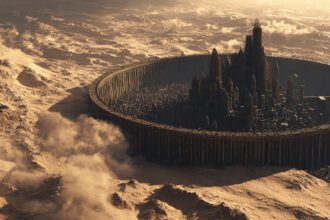
The detail that deserves renewed attention is not Atlantis itself. It is the date. According to Plato, the Egyptian priests at Saïs told Solon that the destruction had occurred approximately 9,000 years before his visit. Solon is generally placed in Egypt around 590 BCE, which puts the Egyptian chronology at roughly 11,590 years ago. That number does not land in an empty stretch of prehistory. It falls remarkably close to one of the most consequential climatic transitions in the human past: the end of the last Ice Age and the Younger Dryas, a period of abrupt environmental change that transformed the conditions under which human societies were developing.
The Younger Dryas ended approximately 11,700 years ago. The Younger Dryas Impact Hypothesis, meanwhile, places a proposed catastrophic cosmic event at approximately 12,900 years ago, near the beginning of the Younger Dryas. These are not the same date, and they should not be presented as though they are. The chronological relationship is instead the point: the Egyptian date preserved by Plato falls within the broader Younger Dryas window, within several centuries of its onset depending on the chronology, transmission, and calendar conversions involved in an account that supposedly passed from Egyptian priests to Solon, from Solon into Greek tradition, and eventually into Plato’s written dialogues.
Plato did not know about the Younger Dryas. The Egyptian priests could not have known modern paleoclimatology. Neither possessed the terminology of impact physics, ice-core chronology, or geochemical stratigraphy. Yet the date they reportedly preserved places the destruction they described in the same broad period that modern researchers recognize as one of the most dramatic environmental transitions in the post-glacial human record. The date alone does not prove Atlantis, and it does not prove an impact. What it does is create a chronological question that becomes considerably more interesting when it is placed beside the astronomical traditions, catastrophe narratives, and encoded numbers preserved elsewhere.
The date is not the only element that maps onto the Younger Dryas period. It is simply the most direct chronological clue. The other traditions preserve their information differently, through astronomical cycles, calendrical numbers, stories of destroyed worlds, flood narratives, and claims that knowledge was deliberately carried from one age into another.
Hamlet’s Mill and the Encoding System
In 1969, Giorgio de Santillana, a historian of science at MIT, and Hertha von Dechend, a historian of science at the University of Frankfurt, published Hamlet’s Mill: An Essay Investigating the Origins of Human Knowledge and Its Transmission Through Myth. Their thesis was provocative because it treated mythology not simply as primitive storytelling, but as a possible vehicle for preserving sophisticated astronomical concepts across generations. They argued that ancient myths from widely separated cultures contain recurring astronomical structures, particularly references that can be interpreted through the phenomenon of precession, with characters functioning as celestial markers, narrative events corresponding to astronomical configurations, and numerical relationships embedded in stories that could act as mnemonic devices.
Precession is the slow change in the orientation of Earth’s rotational axis, a cycle of roughly 25,920 years in the traditional approximation. Because the orientation of the celestial sphere changes over that immense interval, the stars associated with particular seasonal or horizon positions gradually shift. Detecting such movement requires observations spanning generations, recognizing its full cycle requires an even greater temporal perspective. The central question raised by Hamlet’s Mill is therefore not whether ancient people could observe the heavens—they plainly could—but whether some ancient traditions preserved an understanding of long-term astronomical cycles through symbolic systems capable of surviving without modern mathematical notation.
De Santillana and von Dechend identified what they regarded as recurring structural elements across Greek, Norse, Finnish, Icelandic, Indian, Persian, Polynesian, and Mesoamerican traditions. Rotating or grinding mechanisms could represent cosmic motion. Numerical relationships could correspond to precessional periods. Mythological catastrophes could mark transitions between astronomical ages. The result, in their reading, was not a collection of unrelated myths but a kind of distributed astronomical language, one in which stories carried information that would otherwise have been difficult to transmit across centuries of oral tradition.
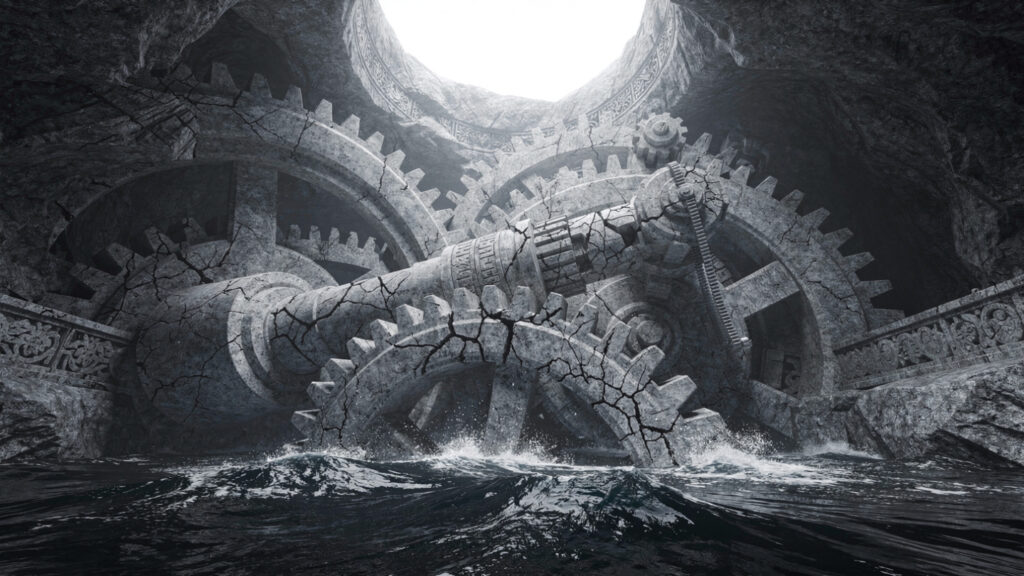
The mill in Hamlet’s Mill is the world mill: a cosmic mechanism that turns the ages. Different traditions give the mechanism different forms, including Amlodhi’s mill in Norse mythology, the churning of the cosmic ocean in Hindu tradition, rotating celestial imagery in Finnish mythology, and related astronomical concepts in other cultures. The recurring structure is more important than any individual version. The cosmic mechanism turns, the order of an age eventually changes, and the old configuration gives way to another. In the mythic language, the mill breaks. The world changes with it.
The astronomical configuration associated with such transitions is not arbitrary within a precessional framework. It represents a particular point in the slow movement of the celestial coordinate system, the kind of transition that later observers can calculate backward using modern stellar-motion data. The Younger Dryas boundary falls within a precessional configuration that has been interpreted by some researchers as corresponding to the transition between the astronomical ages of Gemini and Taurus, when the vernal equinox point moved from one constellation to another. That interpretation is part of the larger archaeoastronomical argument and should not be confused with an established archaeological consensus, but it is precisely the kind of claim that makes the ancient material testable rather than merely poetic.
De Santillana and von Dechend were not attempting to explain the Younger Dryas. They were not geologists, climatologists, or impact researchers. Their work belongs to a different intellectual tradition: the history of science and the study of ancient cosmological symbolism. That distinction matters because the argument here depends upon convergence rather than circular reasoning. One line of inquiry begins with ancient mythology and identifies a possible astronomical encoding system. Another begins with geological evidence and identifies a period of abrupt environmental change. The question is whether the two lines can legitimately be placed on the same timeline.
The convergence is therefore the interesting part. Not because convergence automatically proves a common source, but because independent evidence becomes more difficult to dismiss when it repeatedly points toward the same chronological neighborhood. The astronomical system and the catastrophe record are different kinds of evidence. Their significance depends on whether the connection between them survives critical examination.
The Sumerian Account and Its Numbers
The Sumerian King List presents another form of encoded chronology. The cuneiform tradition lists rulers who reigned before and after the flood, assigning the pre-flood kings reign lengths so extraordinary that they immediately separate the text from ordinary historical chronology. Alulim is given 28,800 years, Alaljar 36,000, En-men-lu-ana 43,200, and the sequence continues across eight pre-flood rulers whose combined reigns total 241,200 years. Conventional interpretation treats these figures as mythological or symbolic numbers. The alternative interpretation asks whether the apparent absurdity is itself part of the encoding.
The numbers are striking because many of them can be expressed through the familiar precessional constant of 72 years per degree. In the traditional approximation, a complete precessional cycle of 25,920 years is 360 multiplied by 72, while a 2,160-year precessional age is 30 multiplied by 72. A reign of 43,200 years is 600 multiplied by 72, and the number 432,000, which appears in other ancient cosmological traditions, is 6,000 multiplied by 72. None of this by itself establishes that the Sumerian scribes intended a precessional code, but the numerical recurrence is precisely why the King List has attracted attention from researchers interested in ancient astronomical symbolism.
The number 432,000 appears again in Norse tradition. In the account of Ragnarök preserved in the Prose Edda, 800 warriors are said to emerge from each of 540 doors of Valhalla for the final battle. Eight hundred multiplied by 540 produces 432,000. Placed beside the Sumerian numbers and the 432,000-year figure associated with the Kali Yuga in Indian cosmological tradition, the recurrence is difficult to ignore. The question is what it means. It may be a symbolic numerical tradition shared across cultures, an astronomical encoding system, or simply the product of numerical patterns that later interpreters have found meaningful. The strongest version of the argument requires more than noticing that the numbers can be multiplied into one another, it requires demonstrating that the surrounding systems independently preserve the same astronomical structure.
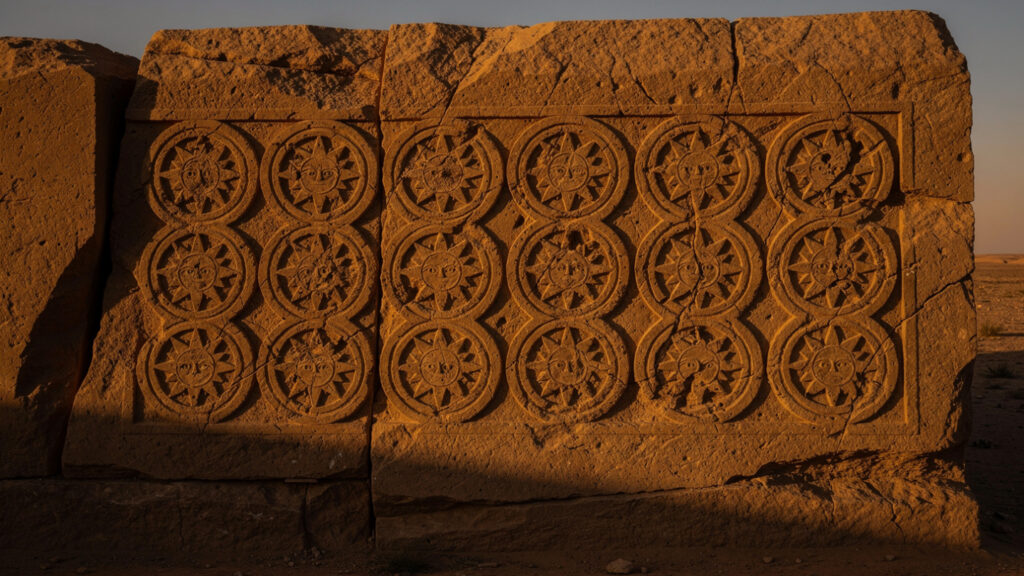
That broader pattern is what makes the numbers relevant to the larger argument. The Sumerian, Vedic, and Norse traditions all place extraordinary knowledge in a period before the civilization that preserves it. The Sumerians attributed important knowledge to the Anunnaki. Vedic tradition traced knowledge through earlier sages and cosmic ages. Norse tradition located its deepest cosmological knowledge within the older order of the gods. In each case, the surviving civilization presents itself less as the inventor of the entire system than as the inheritor of something older.
Vedic Belief and the Great Dissolution
The Vedic cosmic cycle system divides time into four yugas whose combined duration forms a Mahayuga of 4,320,000 years, with larger cycles built from related numerical structures. These numbers are deeply embedded in Indian cosmology and are associated with successive ages of the world rather than with ordinary human chronology. The cycle eventually reaches dissolution, or pralaya, after which another cosmic order emerges. The important feature for the present argument is not the literal duration of the cycles, which belongs to a religious cosmological framework, but the recurring structure: worlds arise, decline, disappear, and are followed by new worlds that inherit what survived from the previous order.
The form of dissolution varies. Some traditions emphasize fire, others emphasize water. The story of Manu, the figure who survives the great flood and preserves the seeds of life and the essential knowledge required for the next age, provides one of the clearest examples of a recurring ancient structure: catastrophe does not end the human story completely because something is deliberately carried through the boundary. The same architecture appears in the Sumerian Utnapishtim, the biblical Noah, and numerous Mesoamerican flood traditions, although the details, chronology, theology, and cultural meanings differ substantially.
The parallel is therefore structural rather than literal. A previous world is destroyed. A survivor or small group passes through the catastrophe. Something essential is preserved. The subsequent civilization begins not from absolute zero but from an inheritance. That pattern is widespread enough that it cannot, by itself, establish a single historical event behind every version. Floods are universal human experiences, and societies naturally transform environmental disasters into stories about beginnings. The more difficult question is whether the stories also preserve specific astronomical information that could have originated from a much older observational tradition.
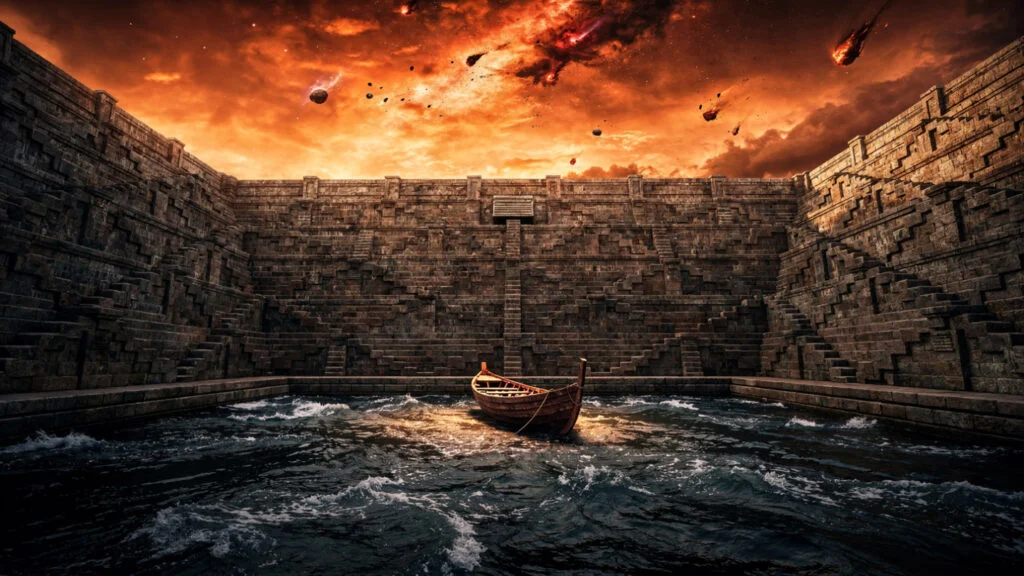
This is where the astronomical argument becomes important. Researchers such as David Frawley have argued for much earlier astronomical horizons within Vedic literature, although such datings remain debated within Vedic scholarship. What is not controversial is that Vedic tradition itself presents knowledge as something inherited from earlier ages and preserved through successive cycles. The question is whether some of the numerical and astronomical structures embedded within that tradition are remnants of observations substantially older than the surviving texts that record them.
The Mesoamerican Fifth Sun
Aztec cosmology presents the same basic problem in a different form. The tradition of the Five Suns describes successive worlds, each ending in catastrophe. The first ends with jaguars, the second with wind, the third with rain of fire, and the fourth with a flood. The present world is the fifth sun, created after the destruction of the previous order. The sequence is not a simple copy of the Sumerian or Vedic traditions, but its architecture is familiar: the world is not imagined as having existed only once. It has already ended several times.
The fourth sun’s destruction by flood creates an obvious structural parallel with the Sumerian, Vedic, and biblical traditions, but the more interesting question is the calendrical system surrounding the mythology. John Major Jenkins argued in Maya Cosmogenesis 2012 that the Mesoamerican Long Count contains an astronomical framework associated with the precessional cycle and the alignment of the winter-solstice sun with the galactic center. That interpretation has been disputed in Maya studies, and it should not be presented as settled fact. Yet the underlying achievement of Mesoamerican calendrical astronomy remains extraordinary regardless of whether Jenkins’s particular precessional interpretation is accepted.
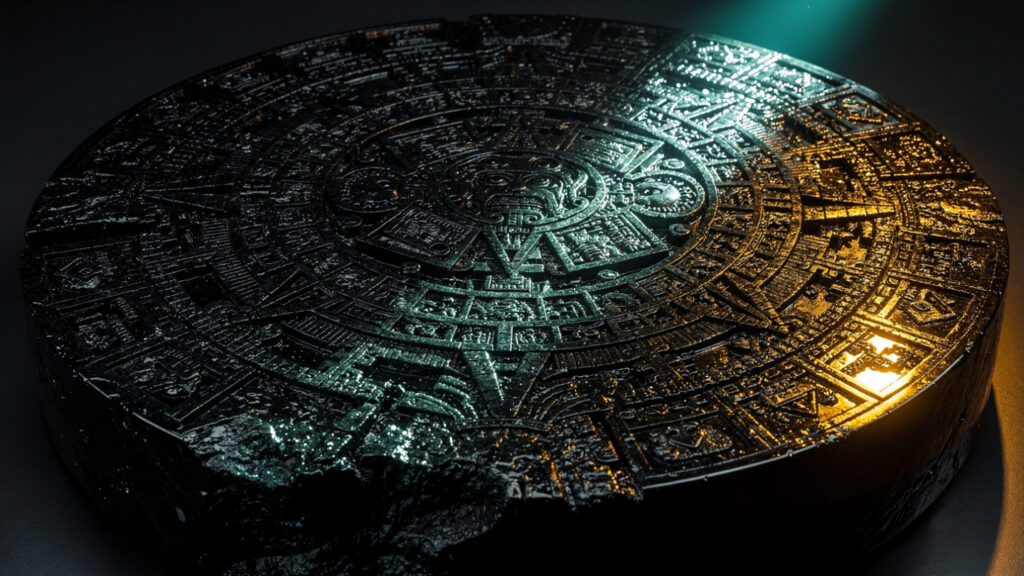
What matters to the larger pattern is that Mesoamerican traditions combine elaborate calendrical knowledge with a cosmology of successive worlds and catastrophic renewal. The calendar is not merely a device for counting ordinary days. It places human history inside a much larger cosmic order, one in which worlds have beginnings, endings, and transitions. The tradition therefore preserves both a catastrophe narrative and a mechanism for locating human existence within an astronomical framework.
The Book of Enoch and the Deliberate Transmission
The Book of Enoch, preserved in its complete form in Ge’ez and within the Ethiopian Christian tradition, contains perhaps the clearest ancient narrative of deliberate knowledge transmission across a catastrophic boundary. In the text’s account of the Watchers, dangerous or forbidden knowledge is introduced to humanity before the flood. The flood then becomes more than a natural disaster. It becomes a mechanism through which a corrupted pre-flood order is destroyed and its dangerous inheritance is interrupted.
Enoch occupies the space between the two worlds. In the text, he is taken into the celestial realm and shown the structure and movements of the heavens, the calendar, and the cosmic order, after which he becomes a transmitter of knowledge to future generations. The importance of this narrative for the present argument is not whether the Watchers were historical beings. It is the explicit idea that knowledge can be deliberately preserved through catastrophe, placed into a form that allows it to cross a boundary between worlds even when the civilization that originally possessed it does not survive intact.
That idea connects directly to the argument developed in the Map piece. If the Younger Dryas catastrophe was the event whose memory later traditions preserved, then the astronomical orientations attributed to Göbekli Tepe, the numerical structures of the Sumerian King List, the Master of Animals motif, and long-lived astronomical traditions can all be interpreted as possible examples of the same basic strategy: preserve what matters, encode it redundantly, and place it into stories, symbols, numbers, and monuments that can survive even when the original intellectual context has disappeared.
The Pleiades mythology, according to the research discussed elsewhere in this series, may preserve an exceptionally old astronomical memory. The precessional constants survive in the King List’s seemingly impossible reign lengths. Astronomical orientations have been proposed at Göbekli Tepe. The Master of Animals motif appears across geographically separated traditions. None of these observations proves a single prehistoric civilization. What they demonstrate is something more modest and, in some ways, more intriguing: human beings have repeatedly found ways to preserve information by distributing it across different cultural forms.
The transmission does not have to survive as a single intact document. It can survive as a number whose original meaning is forgotten, a constellation embedded in a story, a ritual whose astronomical purpose has disappeared, or a monument whose builders are no longer known. Once information is distributed across enough independent forms, the civilization that created it can disappear while fragments of the information remain.
The Hopi and the Third World
Hopi traditions in the American Southwest describe the present world as the fourth world, preceded by three earlier worlds that ended in catastrophe. The third world is associated with destruction by flood, after which survivors entered the fourth world through a transition guided by spiritual beings including Spider Grandmother and the twin war gods. The tradition contains its own geography of survival, migration, and renewal, preserving a narrative in which the catastrophe does not erase humanity but separates one world from another.
Researcher Gary David has argued that aspects of Hopi settlement geography correspond to the pattern of the constellation Orion. Whether such correspondences are intentional remains debated, and the claim should be treated accordingly. The broader point is that Hopi tradition, like the other systems considered here, places human history inside a succession of worlds and preserves an account of how knowledge and people move from one destroyed order into another.
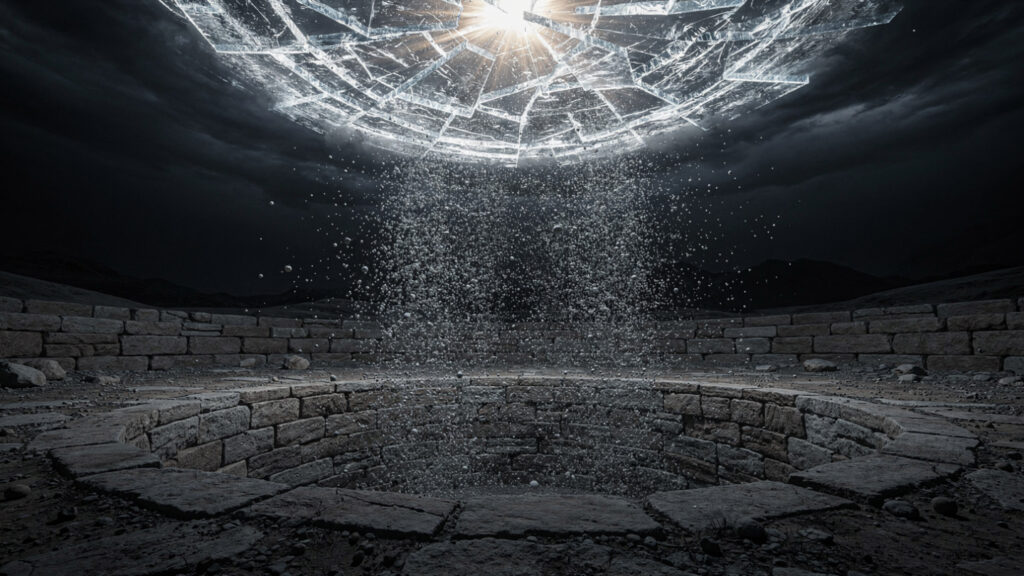
Descriptions associated with the third world’s destruction include darkness, environmental upheaval, and the survival of a limited population that carries the seeds of the next world. These motifs are compatible with the kinds of environmental consequences that can follow major atmospheric disturbances, although compatibility is not identification. A large impact or volcanic eruption can inject particulate material into the atmosphere, reduce sunlight, alter temperatures, and disrupt ecosystems, but those physical processes do not prove that a particular oral tradition records a specific event.
The Younger Dryas Impact Hypothesis proposes a cosmic airburst or impact around the beginning of the Younger Dryas and therefore provides a physical mechanism that could, in principle, generate some of the environmental conditions represented in ancient catastrophe traditions. The Hopi account does not provide an independently verified date for such an event. It provides a description of conditions. The argument becomes interesting only when those conditions are placed beside independently dated geological evidence.
The Journal of Geology Paper
Martin Sweatman and Dimitri Tsikritsis published an analysis in 2017 proposing that carvings at Göbekli Tepe encode the date of a cosmic impact event. Their attention focused particularly on the Vulture Stone, one of the site’s most elaborate pillars, whose imagery includes a vulture, scorpion, headless human figure, and other symbols that have attracted extensive astronomical interpretation. Sweatman and Tsikritsis argued that these images could represent celestial configurations whose positions can be calculated backward through precession.
Their calculation produced a date around 10,950 BCE, placing the proposed astronomical configuration close to the beginning of the Younger Dryas. A later paper by Sweatman extended the argument, proposing that Göbekli Tepe’s carvings constitute a deliberate astronomical record of a cosmic impact and that the builders encoded both the event and its date into the monument’s symbolic program. The claim is controversial, and the interpretation remains debated within archaeoastronomy. That debate is important because it separates what can actually be observed—the presence of repeated animal and celestial imagery—from the much stronger claim that the imagery forms a precise astronomical code.
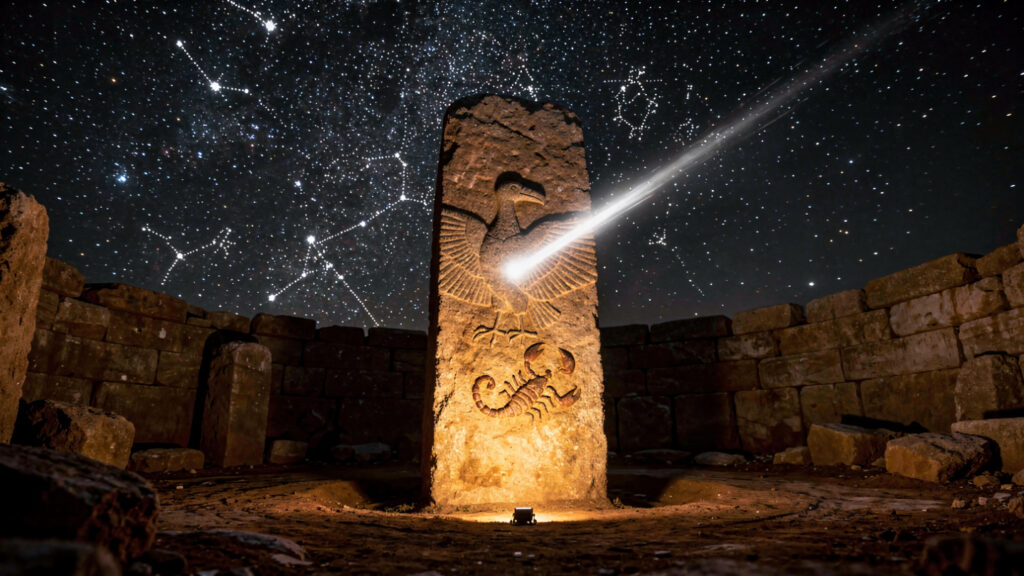
If the proposed astronomical decoding is ultimately demonstrated to be correct, the implication would be extraordinary. Göbekli Tepe would not merely represent an early monumental complex constructed after the end of the Ice Age. Its builders would have been recording an earlier catastrophe in astronomical language, preserving the memory of an event that occurred near the beginning of the climatic upheaval from which their own world had emerged. The monument would then be doing something more than commemorating the past. It would be preserving information for people who had not yet been born.
The first monument would have been a warning.
The Firestone Paper and the Physical Evidence
Richard Firestone and 25 co-authors published their Younger Dryas Impact Hypothesis paper in the Proceedings of the National Academy of Sciences in 2007. They proposed that a cosmic impact or airburst approximately 12,900 years ago contributed to the onset of Younger Dryas cooling, megafaunal extinctions, and the disruption of human populations including the Clovis culture in North America. The hypothesis immediately attracted attention because it offered a single catastrophic mechanism for several changes that had previously been studied largely as separate problems.
The proposed physical evidence included a thin boundary layer identified at multiple archaeological and geological sites and containing various unusual materials, including nanodiamonds, magnetic microspherules, platinum-group anomalies, carbon-rich spherules, and charcoal. The significance of these materials is not that any one of them automatically proves an impact. Each must be evaluated in its geological context, with attention to alternative formation mechanisms, contamination, dating, and replication. The argument depends on the combination of markers occurring synchronously at the Younger Dryas boundary.
Subsequent work has produced both supporting and critical results, and the Younger Dryas Impact Hypothesis remains contested rather than universally accepted. Studies have disagreed over the identification, abundance, and interpretation of several proposed impact markers, particularly nanodiamonds and microspherules. Claims of confirmation should therefore be handled carefully. The existence of a substantial research literature is established, the conclusion that a single cosmic impact caused the Younger Dryas remains a matter of scientific dispute.

That distinction does not make the geological evidence irrelevant. It makes it more important. If the impact hypothesis is eventually confirmed, the physical record would provide an independently dated catastrophic event against which the ancient traditions could be tested. If it is rejected, then the historical and astronomical parallels would have to be explained without that mechanism. Either outcome is scientifically more useful than simply assuming that every catastrophe story describes the same event.
The Convergence
Plato’s Egyptian chronology places the destruction of Atlantis at approximately 11,590 years ago. Göbekli Tepe begins to emerge as a monumental complex around 11,500 years ago, in the period immediately following the Younger Dryas. Robert Schoch’s work on the Sphinx has argued that its weathering is consistent with substantial rainfall and therefore raises questions about the chronology of the monument, although that interpretation remains disputed. Firestone’s impact hypothesis places the proposed cosmic event around 12,900 years ago. Sweatman’s astronomical interpretation of Göbekli Tepe produces a date around 10,950 BCE. And the long-lived Pleiades traditions discussed elsewhere in this series potentially preserve an astronomical memory extending far beyond the conventional chronology of the civilizations that later recorded it.
These are not six independently confirmed dates proving one event. They are six lines of evidence or interpretation that occupy overlapping chronological territory, with very different levels of evidentiary strength. Some are literary. Some are archaeological. Some are geological. Some are archaeoastronomical. Some remain highly controversial. The significance lies not in pretending that they are equivalent, but in asking whether their convergence is meaningful enough to justify putting them on the same analytical map.
None of the researchers involved was attempting to prove the others’ conclusions. Plato was not a geologist. Firestone was not a classical scholar. Schoch was not an archaeoastronomer. Norris was not studying impact layers. Sweatman was not analyzing flood mythology. De Santillana and von Dechend were not examining Younger Dryas sediments. Each discipline approached a different fragment of the problem, using a different vocabulary and a different evidentiary standard.
That is precisely why the convergence is worth examining. The pieces did not originate as one argument. They became connected only after later researchers began comparing them.
What the Six Accounts Were Doing
The six traditions considered here—the Egyptian account preserved by Plato, the Sumerian flood tradition, the Vedic cosmic cycle, the Mesoamerican succession of worlds, the Hopi sequence of destroyed worlds, and the Book of Enoch’s account of knowledge surviving a catastrophic boundary—do not need to be identical for the comparison to matter. Their stories are different. Their gods are different. Their moral frameworks are different. Their chronology is different. What recurs is the architecture: an earlier order exists, catastrophe destroys or transforms it, a remnant survives, and knowledge or life is carried into the next world.
Anthropologists have long recognized that flood narratives can arise independently because flooding is a universal human experience. A local disaster can become a cultural memory, and cultural memory can become myth. That explanation is entirely plausible for many flood traditions. The harder question is whether it explains the additional astronomical and numerical material. A flood story is one thing. A flood story combined with recurring astronomical cycles, precessional numbers, calendrical systems, and claims that ancient knowledge was deliberately transmitted from an earlier age is a more complicated phenomenon.
That does not mean the complicated explanation is automatically correct. It means the evidence should be separated into its individual claims and tested accordingly. If the numbers are astronomical, demonstrate the astronomical relationship. If a monument encodes a date, demonstrate that the encoding is intentional and uniquely recoverable. If a myth preserves an ancient event, establish that the proposed event fits the chronology better than alternative explanations. And if several traditions really do preserve one memory, show that the similarities cannot be explained more economically by independent cultural development.
The strongest version of the argument therefore does not require us to believe that every ancient culture inherited a secret message from a vanished civilization. It requires only the possibility that some ancient societies inherited fragments of astronomical knowledge whose original context was already ancient when they received it. Such knowledge could have been encoded in numbers, calendars, stories, architectural orientations, and ritual traditions, allowing information to survive even when the civilization that first organized it disappeared.
Whoever created such a system would not need to leave a single archive. They would need redundancy. Put the same information into a number, a story, a monument, and a calendar, and the destruction of any one medium does not destroy the message. The forms become independent survival channels. Centuries later, one culture remembers the story, another preserves the number, another maintains the astronomical tradition, and another builds a monument whose original purpose is forgotten. The pieces become separated. The information survives anyway.
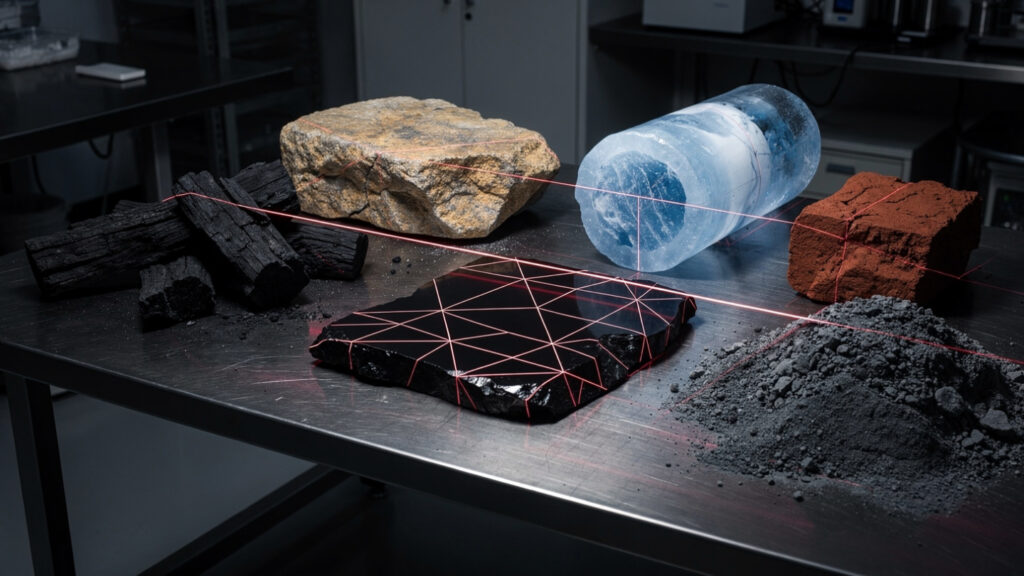
We inherited the fragments. Then we divided them among disciplines. Archaeologists studied the monuments. Historians studied the texts. Astronomers studied the heavens. Geologists studied the boundary layers. Anthropologists studied the myths. Each discipline became exceptionally good at reading its own fragment while having little reason to ask whether another discipline possessed the missing piece.
The Warning in the Firmware
The Architects piece examined the possibility of error-correcting structure embedded in the universe’s fundamental equations. The Maintenance piece examined three research programs interpreted as evidence for active intervention in human consciousness. The Map piece assembled the evidence for a post-Younger Dryas transmission of knowledge. This piece adds another layer: the possibility that the ancient transmission was not simply preserving the memory of an event but preserving information about a recurring cosmic cycle.
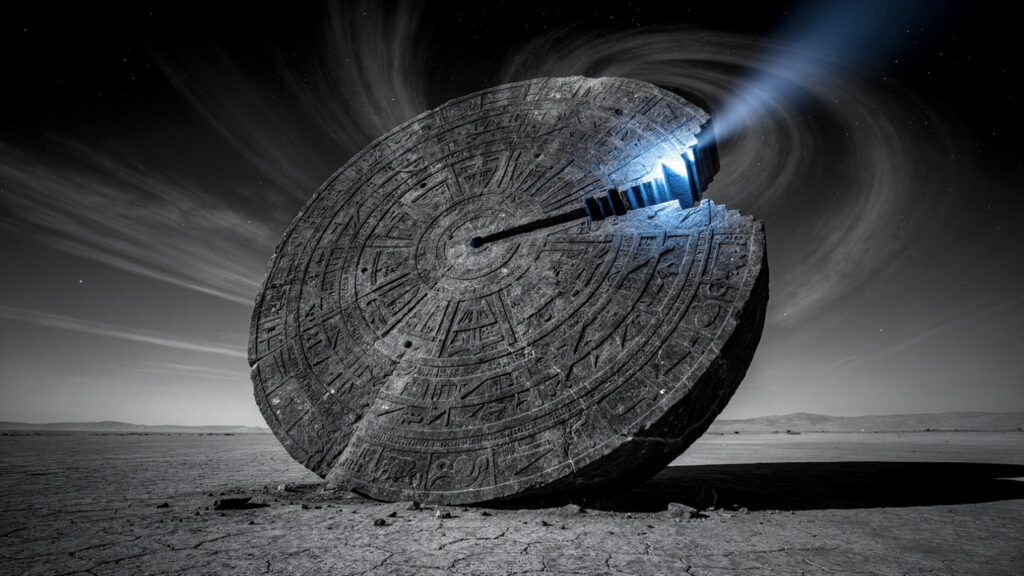
Vedic cosmology describes repeated dissolutions rather than a single end. Mesoamerican traditions describe successive worlds destroyed and replaced. Hopi tradition describes multiple worlds before the present one. The Sumerian numerical system, in the interpretation advanced here, encodes astronomical cycles rather than a single historical chronology. If these traditions are genuinely preserving astronomical knowledge, then the catastrophe is not the only information being transmitted. The larger cycle matters because it provides a coordinate system within which the catastrophe can be placed.
A transmission designed to survive catastrophe would therefore have two functions. It would preserve the memory of what happened, and it would preserve enough information for a future civilization to recognize the pattern. That would explain why astronomy becomes so important. A story can be forgotten or transformed. A number can be misunderstood. A monument can lose its builders. But the sky continues to move according to rules that can eventually be reconstructed. If an ancient culture deliberately anchored its warning to astronomical cycles, then future observers equipped with sufficient mathematics could, in principle, recover the coordinates even after the original language had vanished.
The Younger Dryas Impact Hypothesis places a proposed cosmic event at approximately 12,900 years ago. The traditional precessional cycle is approximately 25,920 years, meaning that a given precessional configuration recurs on a roughly 26,000-year timescale. That recurrence does not demonstrate that catastrophes themselves recur at precessional intervals. It simply provides a reason to ask whether ancient traditions were using precession as a clock for something they believed had happened before and might happen again.
Paul LaViolette’s work on galactic superwaves proposes a different kind of periodic cosmic mechanism, in which powerful episodes of energy originating in the galactic environment could affect the solar system. The hypothesis remains outside scientific consensus, and it should not be presented as an established explanation for the Younger Dryas. But it illustrates the larger question raised by the ancient traditions: if catastrophic events have astronomical causes, would an ancient civilization that had survived one attempt to record the conditions under which it occurred?
The six traditions do not provide a scientifically established mechanism. They provide something more ambiguous: a recurring structure of catastrophe, astronomical order, survival, and transmission. Whether that structure reflects historical memory, independent mythological development, later astronomical interpretation, or some combination of all three remains an open question. The evidence is not strong enough to justify turning the hypothesis into fact. It is strong enough, however, to make the question difficult to dismiss merely because the answer is uncomfortable.
The warning may not be what we thought it was. It may not be a prophecy. It may not be a message from a vanished civilization. It may be nothing more than humanity doing what humanity has always done: remembering catastrophe, watching the sky, and turning uncertainty into stories that can survive the people who first told them.
But there is another possibility.
That somewhere inside the myths, numbers, monuments, and calendars, an older civilization left enough of its astronomical knowledge behind for another civilization to reconstruct the coordinates of the world that disappeared.
The transmission survived. The pieces remain. And if the map is real, the most important question is no longer simply what happened 12,900 years ago.
It is where we are in the cycle now.