




The Zohar does not pretend the shadow does not exist.
The foundational text of Kabbalistic mysticism, attributed to the second-century CE Tanna Shimon bar Yochai but compiled in its current form by the thirteenth-century Spanish Kabbalist Moses de León, describes the Qliphoth as the husks or shells, the word’s literal Hebrew meaning, that encase the divine sparks in the material world and prevent their free expression. The Qliphoth are not an invention of modern occultism. They are in the classical Kabbalistic literature as the necessary obverse of the Sefirot, the emanation structure through which divine reality expresses itself in the material world.
The theological claim that the Qliphoth represent is not simply that evil exists alongside good in a moral dualism. It is more and more disturbing than that. The Qliphoth are the divine overflow: the aspects of divine reality that the Sefirot’s emanation structure could not contain, that spilled over into the shadow dimension of the Tree and formed their own inverted hierarchy. They are not opposed to the divine. They are made of it. The same divine substance that produces the Sephirothic Tree in its organized, beneficent form produces the Qliphothic Tree in its inverted, unmediated, overwhelming form.
Isaac Luria, the sixteenth-century Kabbalist whose Lurianic Kabbalah became the dominant school of Kabbalistic thought, described the Qliphoth as arising from the Tzimtzum, the divine contraction that preceded creation: when the Ein Sof contracted to make space for the created world, the shells or husks remained as the residue of the divine substance that had withdrawn. The Qliphoth are therefore not the enemy of creation but its necessary precondition: without the shells, the divine light would consume everything rather than sustaining it.
This theological position, that the shadow dimension of reality is made of the same substance as the light dimension and serves a necessary cosmological function, is the point at which Qliphothic teaching converges with the Aghori practice covered in this library’s dedicated piece. Both hold that the distinction between sacred and profane, light and shadow, is a cognitive construct rather than an ontological reality. Both propose that genuine spiritual development requires engaging with both poles of reality rather than avoiding the shadow pole as categorically dangerous.
The difference is methodological: the Aghori’s engagement with shadow reality is grounded in a non-dual philosophical framework that dissolves the categories rather than traversing them sequentially. Qliphothic initiatory practice proposes a sequential descent through eleven spheres of shadow reality as a progressive encounter with the aspects of divine reality that ordinary consciousness finds intolerable.
The Tree and Its Mirror
The Sephirothic Tree of Life organizes the divine emanation into ten spheres from Kether, the Crown, the closest to the Ein Sof’s absolute unity, to Malkuth, the Kingdom, the furthest from it and the most fully material. Each sphere represents a quality of divine reality: wisdom, understanding, mercy, severity, beauty, victory, glory, foundation, and sovereignty. The paths connecting the spheres, twenty-two in number corresponding to the Hebrew alphabet’s twenty-two letters, represent the modalities through which the divine qualities interact and transition.
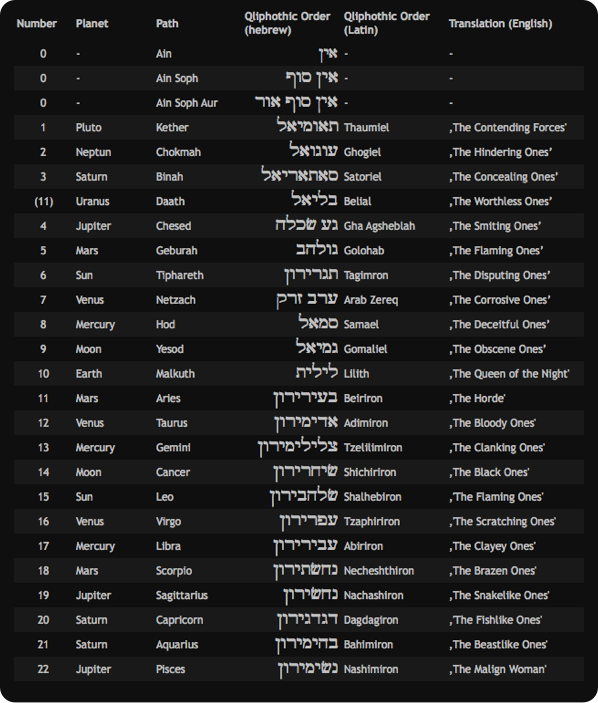
The Qliphothic Tree mirrors this structure with eleven spheres, the ten Sephiroth’s shadows plus the hidden Sephira Daath’s shadow forming the eleventh. Each Qliphothic sphere is the shadow or inverse of the corresponding Sephira: where Kether is the divine crown of unity, Thaumiel is the twin crown of divided sovereignty. Where Chokmah is divine wisdom, Ghagiel is the lightning bolt of rebellion against divine law. Where Chesed is divine mercy, Gha’agsheblah is the executioner.
The inversion is not simple moral reversal. The Qliphothic sphere of each Sephira represents the unmediated excess of that Sephira’s quality, the quality expressed without the balancing constraint of the adjacent Sephira on the Tree: divine severity without divine mercy becomes destruction, divine foundation without divine glory becomes obsessive fixation, and divine crown without divine wisdom becomes tyrannical sovereignty rather than unified transcendence.
The Qliphoth are therefore the Sefirot’s own qualities expressed in their pathological excess, the divine qualities that have lost their relationship to the rest of the Tree and therefore produce their worst possible expression rather than their best.

This framework’s implication for understanding the relationship between the Sephirothic and Qliphothic Trees is that they are not separate realities but the same reality seen from two different perspectives: the perspective of integration and the perspective of isolation. The divine spark in the human being experiences the Sephirothic Tree when it is integrated with the other aspects of divine reality and experiences the Qliphothic Tree when it is isolated in its own quality, cut off from the balancing relationships that allow the quality to express itself constructively.
The initiatory value of the Qliphothic path, in the schools that propose it as a genuine developmental route rather than as a theological description of pathological states, is that the encounter with each Qliphothic sphere forces the confrontation with the excess quality within the practitioner that corresponds to that sphere. The initiation is not an external encounter with a demonic entity but an internal encounter with the aspect of the practitioner’s own psychology that corresponds to the Qliphothic sphere’s quality in its unintegrated excess.
Lilith and the Initiatory Threshold
The first Qliphothic sphere, Lilith’s domain at the base of the inverted Tree, is in Kabbalistic belief the shadow of Malkuth, the material world at the base of the Sephirothic Tree. The correspondence is precise: the material world in the Sephirothic framework is the furthest point from the divine unity and the most constrained by the specificity of material form. Its shadow, Lilith’s realm, is the material world’s quality of constrained specificity expressed in its pathological excess: attachment to the material, inability to move beyond the form, the imprisonment of the divine spark in matter that Gnostic teaching identifies as the primary mechanism of the Archonic system.
Lilith herself in Kabbalistic legend predates her role as Queen of the Qliphoth. She appears in the Babylonian Talmud and in the Alphabet of Ben Sira, the medieval text that most fully developed her narrative, as the first woman, created simultaneously with Adam from the same clay, who refused the subordinate position that the creation narrative assigns to her and departed from Eden.
The Lilith piece in this library, titled Genesis Has Two Creation Stories, develops the textual evidence for Lilith’s presence in the first creation account and how later legend filled that gap with her. The Qliphothic Lilith is the same figure encountered from a different direction: not the suppressed first woman whose theological significance the Church Fathers chose to eliminate, but the guardian of the threshold between the Sephirothic and Qliphothic realms, the first encounter for a consciousness that attempts to traverse the shadow dimension.
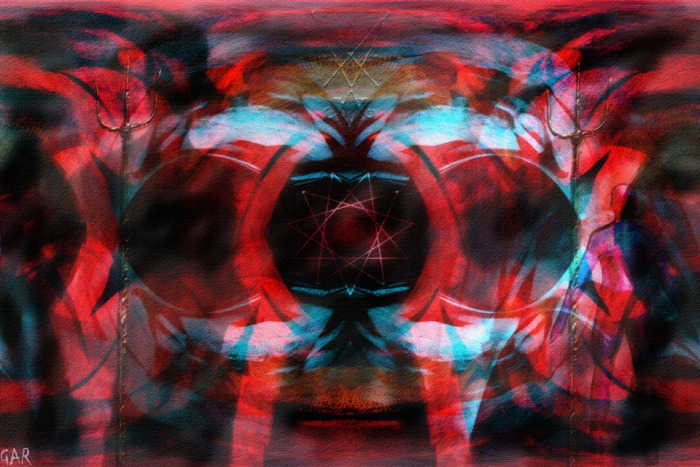
Whether Lilith is a mythological figure encoding psychological content, a genuine non-human intelligence accessible in states of consciousness, or a theological concept embodied in a figure whose attributes encode initiatory teaching, is the question that no single account uniformly resolves, and that the varied accounts of encounters with her in the meditative and ritual literature reflect.
Daath and the Abyss
The hidden Sephira Daath is the most significant single element in the Qliphothic framework and the one whose function initiatory teaching treats with the most consistent emphasis across different lineages and schools.
Daath, whose name means knowledge in Hebrew, is not one of the ten Sefirot of the standard Tree of Life. It is a hidden or invisible sphere that appears in the space between Kether and Chokmah on the upper triangle, associated in the standard Tree with the divine intelligence that connects wisdom and understanding. It is hidden because it is not a stable sphere but a gateway: the point where the upper divine triad communicates with the lower seven Sefirot through an abyss that separates them.
In the Qliphothic framework, Daath is not simply a gateway but the most dangerous single location in the entire initiatory sequence: the abyss between the lower Qliphothic spheres and the upper three. The guardian of this abyss in Crowley’s Thelemic system, which drew specifically on the Enochian material covered in this library’s dedicated piece and on Western esotericism more broadly, is the entity called Choronzon, described by Crowley as the demon of dispersion, the force whose function is to fragment the consciousness that approaches the abyss before it has achieved the integration that the crossing requires.
The Abyss crossing is the initiatory crisis that every authentic mystical practice describes under different vocabulary. Zen’s Great Death, the Christian dark night of the soul documented by John of the Cross, the Tibetan Bardo teachings’ description of the consciousness at death encountering aspects of reality that overwhelm it and drive it back into rebirth, and the NDE research’s documentation of the threshold that cardiac arrest patients approach and either cross or return from, all describe the same structural moment in consciousness development.
The character of the Qliphothic Abyss is that it is not simply an overwhelming or terrifying experience. It is an encounter with the dissolution of identity: the entity Choronzon’s function is to dismantle the practitioner’s constructed sense of self through the deployment of that self’s own characteristics against it. The wisdom the practitioner has accumulated becomes the basis for elaborate intellectual constructions that prevent genuine insight. The love the practitioner has cultivated becomes the basis for attachment that prevents genuine liberation. The strength the practitioner has developed becomes the basis for resistance that prevents genuine surrender.
The Abyss can only be crossed by a consciousness that has genuinely relinquished attachment to its own continuity. This is the same requirement Aghori practice identifies as the prerequisite for the dissolution of the pure-impure boundary, and that Tibetan Buddhist teaching identifies as the prerequisite for the recognition of the Dharmakaya at the moment of death rather than the retreat into conditioned rebirth.
The Qliphoth and the Archon Connection
The Gnostic Archon framework covered in this library’s dedicated piece describes the Demiurge’s subordinates as beings whose function is to prevent the divine sparks in human beings from recognizing their true nature and returning to the Pleroma. Their methods include the provision of sufficient material comfort to prevent the recognition of the prison condition, the maintenance of cognitive frameworks that prevent genuine self-knowledge, and the deployment of the practitioner’s own psychological characteristics against the process of liberation.
The structural correspondence between the Gnostic Archons and the Qliphothic entities is specific. The Qliphothic entities, in this initiatory teaching’s account, do not prevent the practitioner from traversing the shadow dimension: they are the trials and tests through which the traversal must pass. Their challenge is the same as the Archonic system’s: they deploy the practitioner’s own excess qualities against the practitioner’s movement toward integration.

Whether the Qliphothic entities are the same beings as the Gnostic Archons encountered through a different framework, aspects of the practitioner’s own psychology personified in mythological form, genuine non-human intelligences whose functions in the shadow dimension correspond to what both describe, or some combination of these, is the interpretive question that the structural correspondence raises.
The Monroe Loosh piece in this library covers Monroe’s first informant’s account of the Earth system as a farm for emotional energy harvested by beings indifferent to the producers’ wellbeing. The Qliphothic framework’s description of the material world as the domain of Naamah, who can grant material goods but whose character is despotic and difficult to manage, encodes the same relationship in initiatory symbolic vocabulary: the material world is governed by a being whose character produces the conditions that Monroe’s account identifies as the Loosh harvest environment.
What the Left-Hand Path Claims
The left-hand path’s claim, that the traversal of the Qliphothic spheres produces genuine psychological and spiritual development rather than simply ritual transgression, is the claim that distinguishes genuine initiatory engagement with the shadow dimension from the kind of aesthetic transgression that uses occult symbolism for social or creative purposes without engaging with its actual content.
The developmental claims of Qliphothic initiatory practice are:
That the encounter with each sphere’s guardian entity forces genuine confrontation with the aspect of the practitioner’s own psychology that corresponds to that sphere’s quality in excess.
That the successful traversal of each encounter, defined as the maintenance of equanimity and clear perception rather than the domination of the entity, produces an expansion of psychological integration.
That the Abyss crossing requires and produces the dissolution of constructed identity that every authentic mystical practice identifies as the prerequisite for genuine liberation.
That the completion of the sequence produces the integration of the shadow dimension’s reality with the light dimension’s reality in a consciousness that has genuinely encountered both.
Whether these claims are accurate depends on what happens in the documented accounts of serious practitioners who have engaged with the Qliphothic initiatory system. The source’s acknowledgment that the sphere descriptions it provides are one author’s subjective experience rather than objective cartography is the most honest framing: what each practitioner encounters is shaped by their psychological material, their cultural symbolic vocabulary, and their preparation, rather than by a fixed external landscape.
The universal element, the interior transformation process that the source identifies as the only truly universal feature of the initiatory sequence, is the same process that every authentic mystical practice reveals: the encounter with reality as it actually is, including its shadow dimension, rather than as the conditioned mind’s comfort preferences would have it be.
The Aghori sit in the cremation ground to dissolve the boundary between life and death. The Qliphothic initiate descends through eleven spheres of shadow reality to integrate the divine qualities that ordinary consciousness cannot tolerate. The NDE patient crosses the threshold and returns with knowledge that the threshold is not the end.
The shadow dimension exists. Every serious practice that has engaged with it has found the same thing waiting at the other side of the Abyss: not destruction but the integration that the encounter with the intolerable makes possible.
The guardian is still there. The Abyss is still between the upper and lower trees. The crossing requires what it has always required.