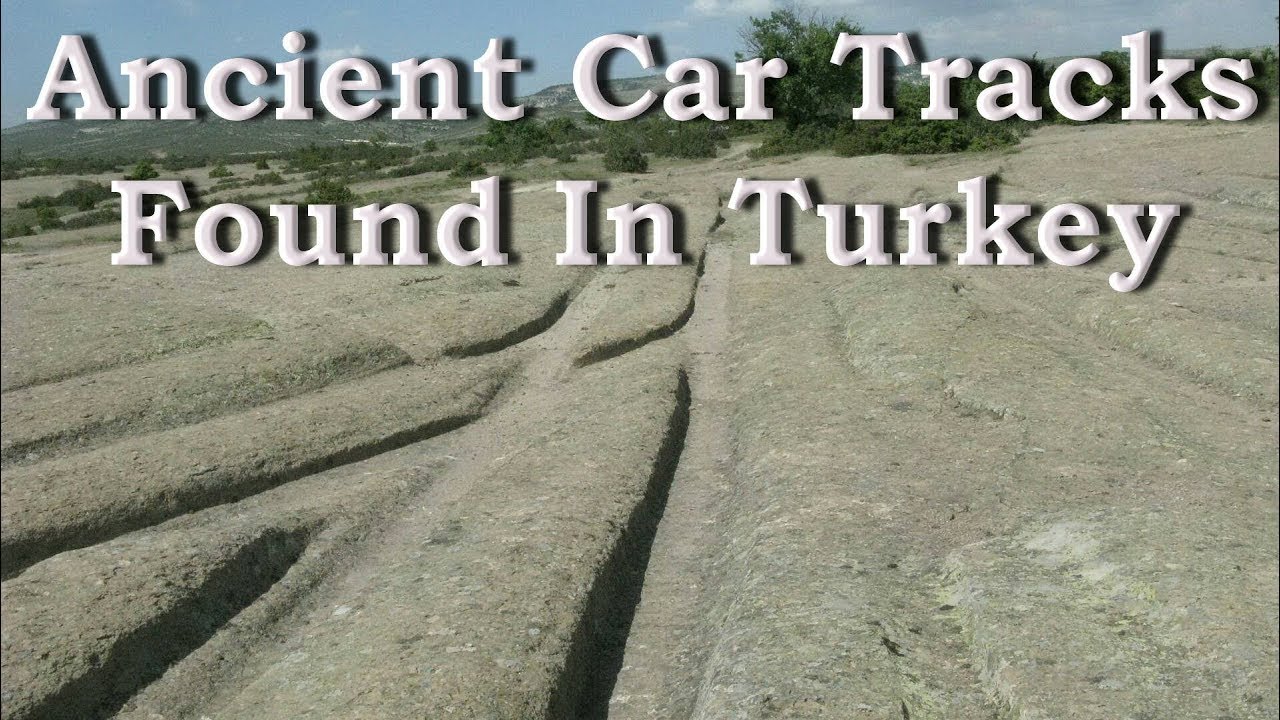





In 2013, Dr. Alexander Koltypin, a geologist at the Natural Science Scientific Research Center in Moscow, published photographs and analysis of track-like formations in the Phrygian Valley of central Turkey and proposed that they represented the most anomalous ancient engineering evidence in the geological record.
His claim was extraordinary: the formations, three-foot-deep parallel grooves whose geometry and spacing resembles the wheel tracks of heavy vehicles, were cut into the Miocene volcanic tuff of the Phrygian Valley during a period when the substrate was soft, and the subsequent hardening of the tuff preserved them. Based on the geological dating of the Miocene strata in which the formations appear, he proposed a date of 12 to 14 million years for their creation.
Twelve to fourteen million years ago, no hominid species existed. The common ancestor of humans and chimpanzees would not appear for another eight to ten million years. Whatever made tracks in the Phrygian Valley volcanic tuff in the Miocene epoch was not human in any conventional sense.
Whether Koltypin’s interpretation is correct, and whether the formations are vehicle tracks rather than natural geological features, is the question that the available evidence does not definitively resolve. What is established is that the formations exist, that they have a geometry that prompted a geologist to interpret them as vehicle tracks, and that their potential age, if Koltypin’s stratigraphic dating is accurate, is incompatible with every conventional model of technological civilization on Earth.
The Phrygian Valley and Its Geological Context
The Phrygian Valley in central Turkey, also known as the Yazılıkaya or Frigyalılar Valley in the region near Afyonkarahisar, is one of the most archaeologically rich landscapes in Anatolia. It contains extensive rock-cut monuments from the Phrygian civilization of approximately 900 to 600 BCE, including elaborate carved facades, tombs, altars, and the famous Midas Monument whose inscription identifies it as a dedication from the Phrygian king Midas.
The conventional archaeological record of the Phrygian Valley is therefore well-established for the Iron Age period. The Phrygians were a sophisticated Iron Age people whose rock-cutting technology was sufficient to produce the elaborate carved monuments that the valley contains.
The geological substrate of the Phrygian Valley is volcanic tuff from Miocene period volcanic activity in the region. Volcanic tuff is consolidated volcanic ash whose hardness varies significantly depending on its age and the conditions of its consolidation: freshly deposited tuff is soft and easily cut, while well-consolidated ancient tuff is substantially harder.
Koltypin’s stratigraphic argument is that the track formations appear in the Miocene tuff layers, below the archaeological horizons containing the Iron Age Phrygian material, and therefore predate the Phrygian civilization by the full interval between the Miocene period and the Iron Age. If the tracks were cut when the tuff was soft, and the tuff consolidated around them, preserving their geometry in hardened volcanic rock, then their age corresponds to the Miocene age of the surrounding matrix.

This argument has a logical problem that needs stating before the evidentiary one: the age of the rock a groove is carved into does not establish the age of the groove itself. A trench cut into a Miocene tuff outcrop yesterday is still Miocene tuff; it is not a Miocene trench. Koltypin’s stratigraphic argument treats the substrate’s age as if it were the feature’s age, which is not how dating works for any carved or worn surface feature regardless of how old the surrounding rock is. This alone does not settle the question of when the grooves were cut, but it means the 12-14 million year figure cannot be derived from the tuff’s age the way the argument presents it.
The library’s evidentiary standard also requires reporting what the site’s own managing authorities and local geologists have said, since this claim did not go unanswered. The formations sit on what is officially known as the Ancient Road, or King’s Road, a well established historical trade route through the Göynüş Valley that was worn down by wheeled traffic across the Phrygian, Greek, and Roman periods and is on Turkey’s UNESCO World Heritage Tentative List for exactly that historical reason. When Koltypin’s claim drew international press attention, Turkish geologists working on the site responded directly and rejected it, one stating plainly that the scientific data does not support a 12-14 million year age and that positing human activity at that date is not consistent with the broader archaeological record. Koltypin’s claim has not appeared in a peer-reviewed geology journal, and the explanation the responsible local authorities give, a historical wagon road worn by many centuries of cart traffic along a known trade corridor, is the same category of mundane, well-attested mechanism that explains cart ruts elsewhere in the ancient Mediterranean.
What is established is that the formations are in volcanic tuff whose geological age is Miocene, and that their geometry resembles vehicle tracks in specific and measurable ways.
What the Formations Actually Look Like
The geometry of the Phrygian formations is the element that most directly informs the interpretation question.
The formations are parallel grooves of approximately three feet depth, whose spacing corresponds approximately to the wheel track of a heavy vehicle. The parallel geometry is consistent across individual track sets, with the groove separation maintained over the length of the visible formation. The grooves show smooth curved interior profiles consistent with rounded wheel contact rather than the angular profiles that natural erosion of fractured rock typically produces.
Most significantly, Koltypin recorded horizontal groove marks along the interior walls of the formations, which he interpreted as evidence of an axle connecting the two parallel wheel tracks, whose contact with the groove walls during heavy vehicle movement would produce exactly the horizontal scoring he observed.
Whether these geometric features, the consistent spacing, the smooth curved profile, and the horizontal interior scoring, are diagnostic of vehicle wheel tracks rather than natural geological formation is the interpretive question that a trained geologist examining the formations in the field is better positioned to evaluate than any assessment from photographs and secondary descriptions alone.
The mainstream geological interpretation of similar formations in other regions is typically natural erosion along parallel joint systems in the bedrock, where water or ice preferentially erodes the rock along structural weaknesses, producing parallel channels whose geometry can resemble wheel tracks. Whether this explanation applies to the Phrygian formations requires examining the structural geology of the surrounding rock to determine whether the formations align with identifiable joint systems or appear independent of the local structural geology.
Koltypin’s conclusion that the formations are vehicle tracks rather than natural erosion features is based on his examination of their geometry. His conclusion that they date to 12-14 million years ago is based on their stratigraphic position in the Miocene tuff. Whether both conclusions are correct, or whether either is correct, is not established by the available peer-reviewed geological literature.
The Malta Cart Ruts and the Sea
The Malta cart ruts are the better-recorded parallel case and the one whose most anomalous feature, the seafloor continuation, has a real and well established physical explanation.
The Maltese archipelago’s limestone surface is covered in networks of parallel grooves, cut deeply into the bedrock, whose distribution and character has been studied by Maltese archaeologists including David Trump, whose survey work recorded the extent and variety of the rut networks across the islands. The ruts are among the most extensively recorded prehistoric track systems in the world and among the most anomalous.
The anomalies are specific.
The ruts run continuously across the Maltese landscape without the interruptions that would result from obstacles that the rut-makers would have had to circumvent. They predate the current surface topography in some locations, indicating that they were cut before subsequent geological changes altered the landscape above them. At the site known as Clapham Junction, in the Buskett area of Malta, ruts run directly to cliff edges and continue on the seafloor below the cliff, at depths consistent with their having been cut at sea level before the Mediterranean’s post-glacial sea level rise submerged the surrounding land.

The post-glacial sea level rise recorded in the geological record provides the mechanism that makes the seafloor continuation interpretable rather than simply mysterious: between approximately 14,000 and 7,000 years ago, Mediterranean sea levels rose by approximately 120 meters as the last glacial maximum’s ice sheets melted. The shallow shelf areas around the Maltese archipelago were progressively submerged, and track systems cut at land level during the pre-rise period would now appear at seafloor depths whose values correspond to periods in the sea level rise chronology.
Whether the Malta cart ruts are Bronze Age features, as the mainstream archaeological consensus holds, or are significantly older features from the pre-rise period whose age the conventional dating methodology has underestimated, is the question that the seafloor continuation raises. If the ruts were cut after the sea level reached its current approximate level, the seafloor ruts require a different explanation than post-submersion. If they were cut when the current seafloor was land surface, their age is constrained by the sea level rise chronology to at least 7,000-10,000 years and potentially significantly older.
The depth of the seafloor rut segments and the sea level chronology would allow an estimate of the minimum age of the ruts at the cliff edge, but this analysis has not been published in an accessible form in the available literature.
The Broader Ancient Track System Pattern
The Phrygian Valley formations and the Malta cart ruts are the two most discussed cases in the alternative archaeology literature on anomalous track systems, but they are not the only recorded cases of prehistoric parallel groove formations whose age and origin are contested.
The Ruts of Misrah Gnien il-Kbir in Malta, the tracks on the seafloor of the Maltese shelf, the track formations at Gozo, and the ruts that appear at multiple Maltese temple sites whose construction dates to approximately 3,500 BCE in the conventional archaeological timeline, collectively constitute the most extensively studied ancient track system in the Mediterranean.
The Maltese temple sites’ relationship to the ruts is the detail that the conventional dating framework has difficulty accommodating: if the ruts are Bronze Age features as the mainstream assessment proposes, they postdate the temple construction. But some rut patterns appear to predate the temple layouts, suggesting that the ruts were present before the temples were built and that the temples were oriented or positioned in relationship to existing rut networks.
Whether this stratigraphic relationship is consistently recorded across multiple sites or reflects the conditions of individual site assessments is a question that the available published surveys address partially and inconsistently.
The parallel with the Phrygian Valley case is the age uncertainty: both cases have formations whose physical characteristics suggest vehicle tracks, whose stratigraphic position suggests significant age, and whose precise dating has not been established through the peer-reviewed methodology whose results would resolve the controversy.

What Pre-Human Vehicle Tracks Would Require
Koltypin’s 12-14 million year date for the Phrygian formations requires a framework for understanding what kind of civilization or intelligence could have created vehicle tracks before the hominid lineage existed.
The three frameworks available are:
Advanced terrestrial civilization of non-hominid intelligence. Whether any non-hominid terrestrial species developed sufficient technological capability to operate wheeled vehicles 12 million years ago is not supported by the fossil record. The most cognitively capable mammals of the Miocene period, including early ancestors of elephants and some primate lineages, show no archaeological evidence of tool use at anything approaching the technological level required for wheeled transport.
Extraterrestrial visitors. If the formations were made by vehicles operated by visitors from outside the solar system, the question of who they were and why they were in the Phrygian Valley in the Miocene is exactly the question that this library’s contact tradition pieces approach from the direction of the documented ancient textual and artistic record rather than from geological formation.
A pre-conventional human civilization. The Directed Panspermia piece and the ancient civilization pieces in this library develop the framework in which the conventional timeline of human civilizational development is significantly shorter than the actual history of intelligent activity on Earth. Whether the Phrygian formations represent the physical trace of a civilization operating before the conventional human timeline is the most extreme claim that the formation’s geometry and proposed age together produce.
The honest assessment, for the Phrygian case specifically, leans further toward the mundane explanation than the framing above suggests: the site is a documented historical road with a name, a UNESCO tentative-list history, and a direct rejection of the 12-14 million year claim from the geologists who actually work there. That does not mean every question about every ancient track formation elsewhere is resolved, but it means the Phrygian Valley is a weaker anchor for the exotic frameworks below than the Malta case, whose age question remains genuinely open in a way the Phrygian claim, on the current evidence, does not.
What makes the Phrygian and Malta cases worth covering in this library is the combination of well established physical features, the three-foot depth, the consistent spacing, the smooth profiles, the horizontal interior scoring, and the Malta seafloor continuation, whose collective character motivates serious examination rather than easy dismissal.
The formations are in the rock. The sea has covered some of them. The dating is contested. The mechanism is unexplained.
Whether they represent the oldest vehicle tracks on Earth, the traces of a pre-conventional civilization, natural geological features that resemble vehicle tracks with remarkable precision, or something whose character neither interpretation fully captures, is the question that the Phrygian Valley’s Miocene tuff and the Maltese limestone’s seafloor continuation raise in permanent combination.
Whatever made these marks, the marks are still there.