




Alexander Barchenko really did lead a Soviet expedition to the Kola Peninsula in 1922, ordered by Felix Dzerzhinsky himself. Its documented purpose was studying miryachit, a real, documented psychogenic startle disorder among the Sami people, still studied by neurologists today, not searching for a hollow-earth entrance. That’s one thread among many woven together here, Hyperborea, Atlantis, a hollow planet, Admiral Byrd, the Book of Enoch, each borrowed from a real historical or literary source and then extended well past what that source says.
None of these threads were originally connected to each other. Untangling them, one at a time, at roughly the length each deserves, is the only way to see what’s documented and what’s been added.
Hyperborea in the Actual Greek and Roman Sources
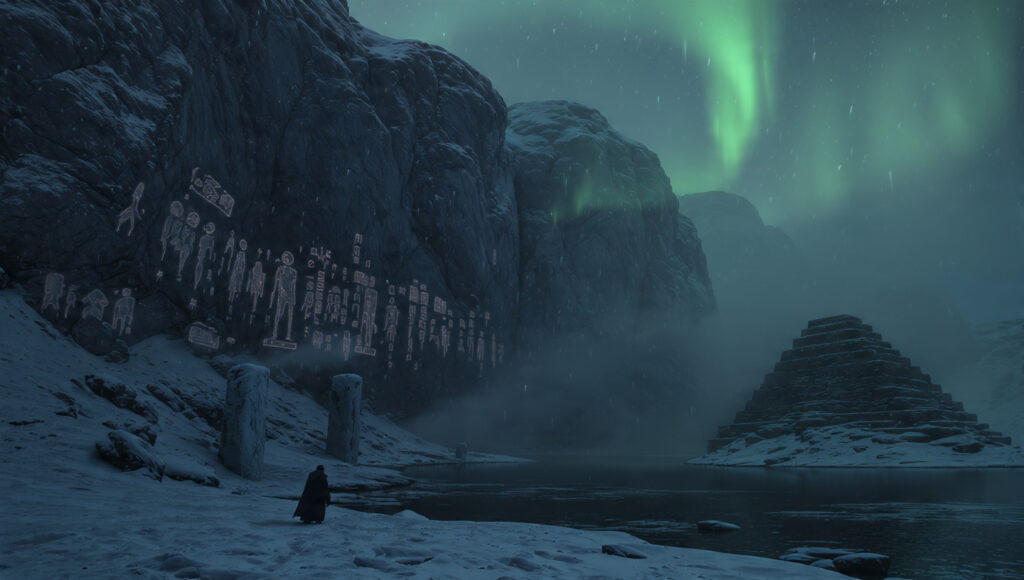
The real literary tradition is genuinely rich, spanning nearly a thousand years of Greek and Roman writing, and it deserves to be read on its own terms rather than as encoded testimony. The earliest surviving reference appears in a fragment of Hesiod’s Catalogue of Women, from the late 8th or early 7th century BCE, describing a blessed people living far to the north. Pindar’s Pythian Ode 10, composed in the early 5th century BCE, paints Hyperborea as a paradise beyond ordinary human reach, a place of feasting and unbroken joy under Apollo’s particular favor. Herodotus, writing his Histories in the mid-5th century BCE, treated the subject with open, stated skepticism rather than reverence: he reports the Delian tradition of offerings passed hand to hand from Hyperborea, relates the story of Abaris carrying Apollo’s arrow only as something “said” to have happened, and closes his brief treatment with a dry rhetorical jab, “If there really are Hyperboreans, then there are also Hypernotians,” people beyond the south wind, a joke pointing out how little verifiable evidence existed either way. Later writers, Callimachus in the 3rd century BCE, Pliny the Elder in the 1st century CE, added detail and geographic speculation without ever claiming to possess suppressed knowledge.
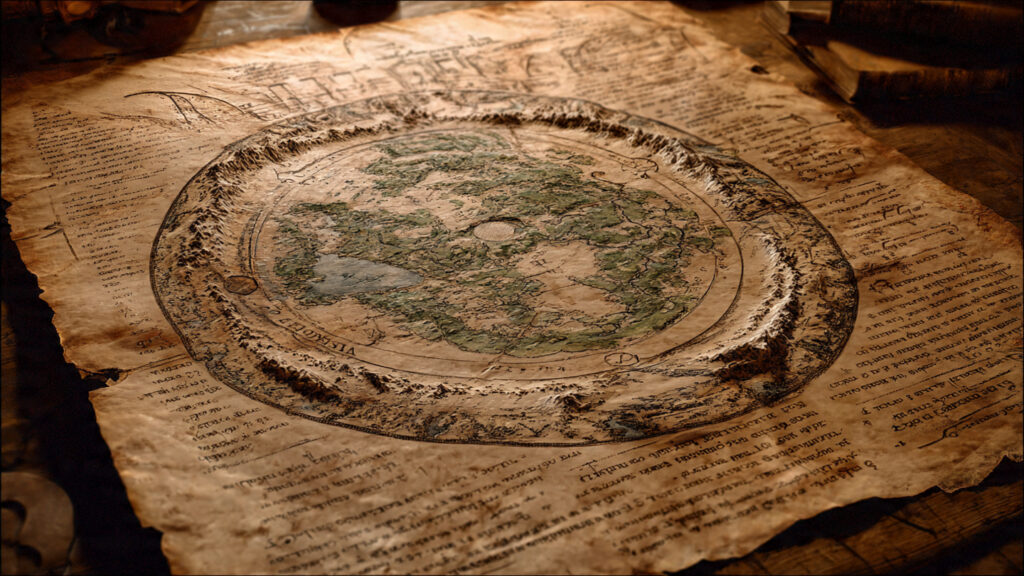
Pliny explicitly weighs and discards several competing theories about Hyperborea’s exact location, the mark of a writer working with uncertain secondhand reports, not a custodian of hidden fact. The consistent thread across nine centuries of this tradition is poets working in the register of utopian myth and historians treating the whole subject with open doubt, not a conspiracy requiring “misdirection” to explain. The claim that the Rig Veda, the Avesta, and the Norse Eddas encode the same secret doesn’t survive contact with those actual texts either. The Rig Veda’s real hymns to Uṣas and its flood narrative belong to an entirely separate Vedic religious tradition, composed in a different language on a different continent, with no documented reference to Hyperborea or a polar civilization at all. The Avesta’s Aryan homeland myth, Airyanem Vaejah, is a real feature of Zoroastrian cosmology, but scholars read it as a symbolic, idealized point of origin, the way many cultures locate a mythic homeland, not a shared technical record. The Eddas describe Norse cosmology on entirely its own terms, with no textual overlap with Greek Hyperborean material. Auroras, meanwhile, have a complete, real, verified physical explanation requiring no hidden conflict beneath the crust: charged particles from the solar wind, guided by Earth’s magnetic field toward the poles, collide with oxygen and nitrogen in the upper atmosphere and release light, a mechanism directly observed, measured, and photographed by modern satellites, first proposed in recognizable form by the same Kristian Birkeland who spent decades doing the actual laboratory work to confirm it in the early 20th century. Ancient cultures across the Northern Hemisphere independently described the aurora in vivid, often supernatural terms because it’s a genuinely striking phenomenon, not because they were all encoding the same suppressed event.
Where Mercator’s Arctic Islands Actually Came From
This deserves precise sourcing rather than a claim about smuggled records. Mercator’s 1595 map, published posthumously by his son Rumold, does depict the North Pole as four large islands separated by rushing channels around a central landmass, a striking image that was, at the time, the widely accepted geographic consensus among leading cartographers including Abraham Ortelius and John Dee. Mercator’s own stated source for this specific polar geography was the 1558 map published by Nicolò Zeno the Younger, which claimed to document a 14th-century voyage by his ancestors. This site has covered that Zeno map’s documented history elsewhere: modern historical consensus treats it as a probable hoax, or at best a garbled retelling of a genuine but far more modest voyage, not confirmed navigational fact. Mercator wasn’t drawing on suppressed truth. He was drawing, like most of his era’s mapmakers, on the best geographic information then available, which happened to include a source now regarded as unreliable.

What Barchenko’s Expedition Actually Studied
The documented history here is genuinely stranger and more human than a hollow-earth expedition. Barchenko, a Soviet biologist and researcher of anomalous psychology born in 1881, worked under neurologist Vladimir Bekhterev studying miryachit, a documented culture-specific startle syndrome among the Sami involving involuntary imitation and automatic obedience to commands, still documented by researchers today, including a 2025 peer-reviewed study in Movement Disorders Clinical Practice confirming the condition remains endemic among the Kola Sami. Dzerzhinsky, head of the Cheka, personally took interest, and in August and September 1922 Barchenko’s team traveled to Lovozero and Seydozero, where they documented smoothed granite formations resembling pyramids and what looked like paved paths leading underground.
When Barchenko presented his findings to OGPU leadership in December 1924, a follow-up expedition led by Arnold Kolbanovsky in 1923 had already methodically dismantled the claims: the “pyramid” was a natural stone bulge, the underground shafts didn’t exist, and other formations were ordinary wind erosion. Barchenko wasn’t fully ostracized, but the pattern of arrests that followed is documented: he and several colleagues from the expedition were caught up in Stalin’s purges, and Barchenko himself was arrested and executed in 1938, one year after his patron Gleb Bokiy met the same fate.
What Plato Actually Wrote About Atlantis
Plato’s actual text deserves to be read as what it is: a philosophical dialogue with an internal literary frame, not a suppressed historical record. In the Timaeus and the unfinished Critias, written around 360 BCE, Plato has the character Critias relate a story supposedly passed down from Solon, who supposedly heard it from Egyptian priests at Sais roughly two centuries earlier. That’s already three layers of secondhand retelling within the text itself, a structure many classicists read as a deliberate literary device Plato used elsewhere, presenting philosophical points through a frame narrative, rather than a claim of documentary fact. The dialogue describes Atlantis as an advanced, prosperous naval power that grew arrogant and was defeated by an idealized ancient Athens before sinking beneath the sea in a single catastrophic night. Geologist Pierre Termier’s 1915 Atlantis paper, published in the Smithsonian Institution’s annual report, translating an actual 1912 lecture he’d delivered to the Institut Océanographique as director of France’s Geologic Chart Service, argued genuine geological and zoological evidence supported a sunken Atlantic landmass. It received a documented, direct scientific rebuttal in January 1917, when Charles Schuchert of Yale published a firm counterargument in Geographical Review. Worth knowing too: Termier’s broader scientific judgment on major geological questions hasn’t aged well by the standard the field itself now uses.

In 1924, he published a paper rejecting Alfred Wegener’s theory of continental drift as fanciful, a theory now considered foundational to modern plate tectonics. A credentialed geologist can be wrong about one of the biggest questions in his own field and right about a specific published rebuttal existing. Both facts are part of the same historical record. Modern plate tectonics has definitively closed the question Termier was working on a century ago: there is no evidence anywhere on the Atlantic seafloor of a sunken continent, a conclusion built on decades of sonar mapping, core sampling, and satellite gravimetry unavailable to any early-20th-century geologist.

Ancient opinion on Atlantis was genuinely divided from the start, not secretly unanimous. Aristotle, according to a later citation preserved by the geographer Strabo, treated the story as Plato’s own invention. Crantor, writing around 300 BCE as the earliest known commentator on the Timaeus, took the opposite position and accepted it as real history. A much later source, the 5th-century-CE philosopher Proclus, reports that Crantor claimed to have personally seen columns in Egypt bearing the story in hieroglyphics, a claim modern scholars regard as implausible precisely because it survives only through Proclus, writing roughly seven centuries after Crantor supposedly saw them, with no earlier corroboration anywhere. Helena Blavatsky, founder of the Theosophical movement, gave Atlantis its modern esoteric shape in her 1888 book The Secret Doctrine, presenting it as the fourth of seven “Root Races” in a scheme of human spiritual evolution, technologically advanced but morally corrupt, a framework she built directly on Ignatius Donnelly’s 1882 book Atlantis: The Antediluvian World, citing Donnelly’s oceanographic claims at length. Manly P. Hall’s own 20th-century writing on Atlantis draws explicitly on this same Crantor-via-Proclus lineage and on Blavatsky’s Theosophical framework, not on any independent primary source. That’s a real, traceable citation chain, Plato to Crantor to Proclus to Donnelly to Blavatsky to Hall, each link a real, identifiable author building on the one before, not independent confirmation converging from separate directions.
The Real, Two-Century History of Hollow Earth Theory
This lineage is genuinely documented, name by name, and it ends in real, definitive scientific refutation, not open mystery. Edmond Halley, the astronomer of comet fame, presented a real paper to the Royal Society in 1681, proposing Earth consisted of a hollow shell around nested inner spheres, an attempt to explain anomalous compass readings that ship captains had genuinely reported. Leonhard Euler later simplified Halley’s model to a single shell around a small central sun. Scottish scientist John Leslie proposed two inner suns, naming them Pluto and Proserpine. The theory received serious, real scientific testing decades before its most famous popularizers: Pierre Bouguer’s 1740 measurements and Charles Hutton’s 1774 Schiehallion experiment, meticulously measuring a mountain’s gravitational pull to calculate Earth’s true density, definitively showed the planet is far too dense to be hollow, ruling the concept out as serious science well before it became popular legend. That didn’t stop John Cleves Symmes Jr., a War of 1812 veteran, from campaigning loudly for a polar expedition starting in 1818, proposing “holes at the poles” roughly 1,400 miles across. His advocacy reached President John Quincy Adams’s desk and helped inspire the real 1838 U.S. Exploring Expedition to Antarctica, even though Symmes’s own specific theory had already been scientifically obsolete for nearly eighty years. Cyrus Reed Teed took the idea in the opposite direction in 1869, founding a religious cult called the Koreshans around the claim that humanity lives on the inside of a hollow sphere looking inward at the stars. Marshall Gardner patented a working model of his own version in 1913. Raymond Bernard’s 1969 book The Hollow Earth revived the theme for a new generation, adding UFO mythology that none of the earlier theorists had proposed. Each of these men is real, and each proposed a genuinely different, often contradictory model. What they share is a real, documented history of being tested against evidence and found wanting, not a suppressed truth their successors kept discovering independently.

The specific furnishings added to this legend in the 20th century, gravity reversing at a null point, breathing and heartbeat becoming unnecessary, nine-foot telepathic inhabitants, named inner cities like Agartha, Telos, and Shamballa, a hollow Moon and Mars, contact with the ten lost tribes of Israel, appear nowhere in Halley, Euler, Symmes, or Teed’s actual proposals. Agartha and Shamballa are real terms, but they belong to real Tibetan Buddhist and Hindu spiritual traditions describing a hidden, non-physical realm of enlightened beings, a concept later borrowed and literalized by 20th-century Theosophical and esoteric writers, including Ferdinand Ossendowski’s 1922 travel account and subsequent occult publishing, into a physical underground kingdom the original traditions never described that way. Telos, the specific claim of a domed city beneath Mount Shasta, traces to a single 1940s book with no independent corroboration. None of these additions are drawn from Halley’s mathematics, Symmes’s petitions to Congress, or Teed’s religious writings. They’re a separate, later layer, and treating them as part of the same continuous scientific inquiry that began with a real 1681 paper about compass anomalies misrepresents both the science and the mysticism.
What Admiral Byrd Actually Did

Richard Byrd was a genuine, accomplished polar aviator, and his real career doesn’t need an inner-Earth encounter to remain remarkable. He led real, historic flights toward the North Pole in 1926 and over Antarctica in 1929, and commanded Operation Highjump, a real, large-scale US Navy Antarctic operation in 1946 and 1947 involving roughly 4,700 personnel, thirteen ships, and multiple aircraft, with a documented, publicly stated purpose: training personnel and testing equipment in extreme polar conditions, establishing research stations, and asserting a US presence in Antarctica during the earliest years of the Cold War. The famous “secret diary” describing Byrd flying through a polar opening into a hollow, inhabited interior has no connection to any verified archive. It first appeared in later pseudoscience publishing, decades after Byrd’s own death, has no documented provenance or verified chain of custody back to any original manuscript, and contains language and thematic concerns entirely absent from his authenticated expedition journals and personal correspondence, the hallmarks of a later literary fabrication rather than a suppressed primary source. It was never authenticated against Byrd’s own papers, and has been directly disputed by researchers who’ve examined his real, extensive documented record. Byrd’s real diaries and expedition logs, held in verified archives, describe exactly the kind of operation Highjump’s public record already establishes: cold-weather military exercises, not a confrontation with anything beneath the ice.
What the Book of Enoch Actually Is
The Book of Enoch is a genuine, historically significant ancient text, and it deserves to be read as the religious literature it actually is rather than a geological survey. Composed in sections across roughly the 3rd to 1st centuries BCE, it survives complete only in Ge’ez, the classical language of Ethiopia, where the Ethiopian Orthodox Church still regards it as canonical scripture, while Aramaic fragments confirming its antiquity were recovered among the Dead Sea Scrolls at Qumran. Its documented content, layered heavens, the Watchers who descend and take human wives, the birth of the Nephilim, visions of judgment, belongs to a real, well-studied genre of ancient Jewish apocalyptic literature, using cosmic geography as symbolic and theological language, the way Dante later used a similarly structured underworld in the Divine Comedy. Biblical scholars who work directly with the Ge’ez and Aramaic texts read its “chambers” and “prisons” as visionary and moral architecture, describing where and how divine justice operates, not literal coordinates for physical caverns inside the planet. Treating a genuine second-century-BCE religious text as encoded engineering documentation isn’t an interpretation the text or the scholarship supports.
Where the Hollow Earth Material Turns Away From History Entirely
The claim of a surviving Nazi state inside the planet led by Hitler until 1974 deserves direct address rather than a source trace, because no version of it has any documentary basis. Hitler’s suicide in the Führerbunker on April 30, 1945, is confirmed through multiple independent lines of evidence: eyewitness testimony from bunker staff, Soviet forensic examination of remains including dental records matched against his own dentist’s charts, and decades of subsequent historical research with no credible dissent in serious scholarship. Claims of a hidden inner-Earth German state, an underground civilization descended from a 1572 Portuguese expedition, or reptilian occupants contesting territory beneath the crust exist only within a specific, traceable strand of twentieth-century esoteric publishing, not in any geological, historical, or archival record. These claims deserve to be named as fiction directly, not traced as if they were merely an obscure but genuine historical thread.
How These Ideas Became One Story
The merger itself has a real, traceable timeline, and knowing it explains why an article like this one takes the shape it does. Hyperborea originates in Greek myth roughly 2,700 years ago. Atlantis enters the record through Plato around 360 BCE, already a separate tradition with no documented connection to the first. Hollow Earth theory develops independently across the 17th through 19th centuries as a genuine, if ultimately discredited, scientific hypothesis, still unconnected to either ancient legend. The real turning point where these previously separate threads began merging into a single system was Blavatsky’s Theosophical movement in the 1880s, which explicitly wove Atlantis, Lemuria, and Hyperborea together into one sequential Root Race cosmology for the first time, giving later writers a ready-made template for combining ancient myths that had never been linked before. Nazi-era esoteric interest in Hyperborea as an imagined Aryan homeland added a second layer in the 1930s, entirely separate from and later than Blavatsky’s original synthesis.

Post-war UFO contactee literature, expanding rapidly from the late 1940s onward, supplied a third layer, reptilians, inner-Earth aircraft, secret treaties, grafted onto structures that originally had nothing to do with extraterrestrial contact. Writers from the 1960s through the 1990s, Raymond Bernard chief among them, completed the synthesis, combining all three accumulated layers, mythological, esoteric, and ufological, into the single overarching narrative that pieces like this one still draw from today. Each layer is a real, dateable addition by a specific author or movement. None of them was present in the sources the earlier layers actually came from.
Why These Separate Traditions Got Fused Together
Each thread traced here, Hyperborea, Atlantis, hollow-earth cosmology, Byrd’s polar career, the Book of Enoch, developed independently, in different centuries, different languages, and different genres, poetry, philosophy, natural science, military history, and religious apocalyptic literature. They share a common appeal, the idea that some vanished or hidden place holds knowledge the ordinary surface world has lost, which is precisely why twentieth-century esoteric writers found it so easy to braid them into a single narrative: each borrowed thread lends the others a borrowed credibility, a real Greek poet’s name propping up a fabricated Soviet motive, a real scientist’s paper propping up a fictional inner sun. Separated back into their own centuries and their own documented sources, each tradition remains genuinely worth studying. None of them requires the others to be true.
Three Thousand Years, One Real Paper Trail
Separating the documented from the invented leaves specific, verifiable history worth knowing, spanning nearly three thousand years. Hesiod, Pindar, and a skeptical Herodotus gave the documented Hyperborea its shape. Mercator drew on a disputed 16th-century hoax, not a suppressed archive. Barchenko’s expedition is confirmed, its documented scientific purpose and outcome, both the debunking and the executions, are documented. Plato’s Atlantis is a philosophical dialogue whose geological claims a real scientist tried and failed to defend, and whose absence from the real seafloor record is now settled by plate tectonics. Halley through Teed proposed real, differing hollow-earth models, each tested and scientifically obsolete decades before its popular heyday. Byrd’s real career was genuinely historic without any of it. And the Book of Enoch remains a real, significant piece of ancient religious literature, not a map. None of these threads needed a hollow planet or a surviving Reich to stay genuinely interesting. The actual paper trail, stretching from an 8th-century-BCE poet to a 1974 scientific consensus about plate tectonics, is already a stranger and better documented story than the one built on top of it.