
Ritual magic has appeared in human societies for thousands of years, in forms that vary enormously in language, symbolism and theology but repeatedly share the same underlying structure: a desired outcome, an uncertain world, and a prescribed sequence of actions believed to establish some form of influence over what happens next. The universality of the pattern is itself worth taking seriously. Long before laboratories attempted to measure belief, human beings were already developing elaborate ways of responding to the things they could not reliably control.
The interesting question, however, is not whether every spell ever performed altered reality. It is what happens inside the person performing it.
That distinction matters. A ritual can fail to produce the supernatural effect its practitioner attributes to it and still produce a measurable psychological effect. It can reduce anxiety, create a sense of order, sharpen attention, reinforce commitment, strengthen group identity and give an individual something concrete to do when the outcome itself cannot be controlled.
That does not establish magic. But it does establish something else. The human mind has a powerful need to act at the precise point where knowledge stops being sufficient. And that pattern is old enough to have been observed by anthropologists long before modern psychology gave it a vocabulary.

Malinowski Found the Boundary
One of the clearest early observations came from Bronisław Malinowski’s fieldwork among the Trobriand Islanders of Melanesia. Working in the region beginning in 1915, Malinowski documented a distinction that became enormously influential in the anthropological study of magic: the islanders did not simply use magic everywhere, indiscriminately, as a substitute for practical knowledge.
They knew how to fish. They knew how to cultivate gardens. They knew how to build boats and navigate their environment. And where those skills offered relatively predictable control over an outcome, practical knowledge dominated.
The difference became especially visible in fishing. In the protected waters of the lagoon, where conditions were comparatively familiar and predictable, fishermen could rely heavily on accumulated skill and experience. When they ventured into the open sea, where weather, waves, currents and the behavior of fish introduced far greater uncertainty, elaborate magical practices became much more prominent. Malinowski put it directly in his own later work: in lagoon fishing, where a man could rely completely on his knowledge and skill, magic did not exist, while open-sea fishing, full of danger and uncertainty, carried extensive magical ritual to secure safety and good results.
The same pattern appeared in gardening, later documented at length in his 1935 study Coral Gardens and Their Magic. Agricultural knowledge did not disappear simply because ritual existed. The two systems operated alongside one another, with practical knowledge handling what could be known and controlled while ritual became particularly important where outcomes remained vulnerable to forces outside the practitioner’s control.
Malinowski’s observation was important because it challenged a simplistic assumption that magical thinking exists merely because people do not understand how the world works. The Trobriand Islanders were not ignorant of causality. They were acutely aware of it. They knew that boats needed to be built correctly, that gardens required cultivation and that fishing demanded practical expertise. Magic appeared most strongly after those forms of knowledge had reached their limits.
That makes ritual less interesting as a failed primitive science than it first appears. It becomes a technology for confronting uncertainty.
When Knowledge Runs Out
This distinction still matters because uncertainty creates a peculiar psychological problem. When an outcome is predictable, action feels rationally connected to consequence. A person studies for an examination because studying can improve performance. A surgeon follows a procedure because the procedure has an established relationship to the desired result. A farmer prepares soil because preparation affects the probability of a successful harvest.
But what happens when the relationship between action and outcome becomes radically uncertain? The storm may arrive. The market may collapse. The opponent may perform unexpectedly. The patient may respond differently. The aircraft may encounter turbulence. The fishing net may come back empty.
At that point, knowledge can become insufficient without becoming useless. A person may understand every controllable variable and still have no guarantee about the final result. That is precisely where ritual has a psychological advantage. It provides something to do. A sequence is performed. Words are spoken. Objects are arranged. A gesture is repeated. A charm is carried. A particular routine is followed before the uncertain event begins.
The ritual creates structure at the point where reality refuses to provide certainty. That does not mean the practitioner is irrational in every other respect. It means that human cognition has difficulty remaining passive in the presence of uncertainty. When direct control disappears, symbolic control can become psychologically attractive. And that tendency is not confined to ancient societies. It is visible everywhere.

Why Ritual Can Feel Like It Works
There are several different mechanisms that can make ritual feel effective without requiring the ritual to possess the supernatural causal power attributed to it.
One is ordinary pattern recognition. Human beings are exceptionally good at finding relationships between events, including relationships that are not actually causal. If a person performs a particular ritual before something desirable happens, the successful pairing can become memorable. The unsuccessful occasions may receive less attention. Over time, the association becomes reinforced: the ritual was performed, the desired event followed, therefore the ritual worked.
The same cognitive tendency appears in much more secular environments. Athletes develop pre-game routines. Gamblers develop superstitions. Executives develop rituals before major negotiations. Performers repeat gestures before going on stage. None of these behaviors requires a belief in spirits or occult forces to develop the same underlying structure.
There is another mechanism that is more interesting still. The ritual can change the practitioner even when it does not change the world. Research into ritualized behavior has found that structured rituals can affect psychological states surrounding stressful or uncertain situations. Performing a familiar sequence can reduce anxiety, increase subjective feelings of control and create a sense of psychological readiness before a demanding task.
That distinction is crucial. A ritual does not have to alter external reality to alter the person who is about to enter it. And the altered person may then behave differently. A calmer performer may concentrate more effectively. A person who feels less overwhelmed may make fewer impulsive decisions. Someone who believes they have completed a preparation ritual may approach an uncertain task with greater confidence and consistency.
None of this demonstrates that the ritual itself controls the external event. It demonstrates something arguably more revealing: the mind can manufacture a feeling of agency when objective agency is limited. That feeling may be inaccurate as a theory of causation while still being consequential as a psychological state.
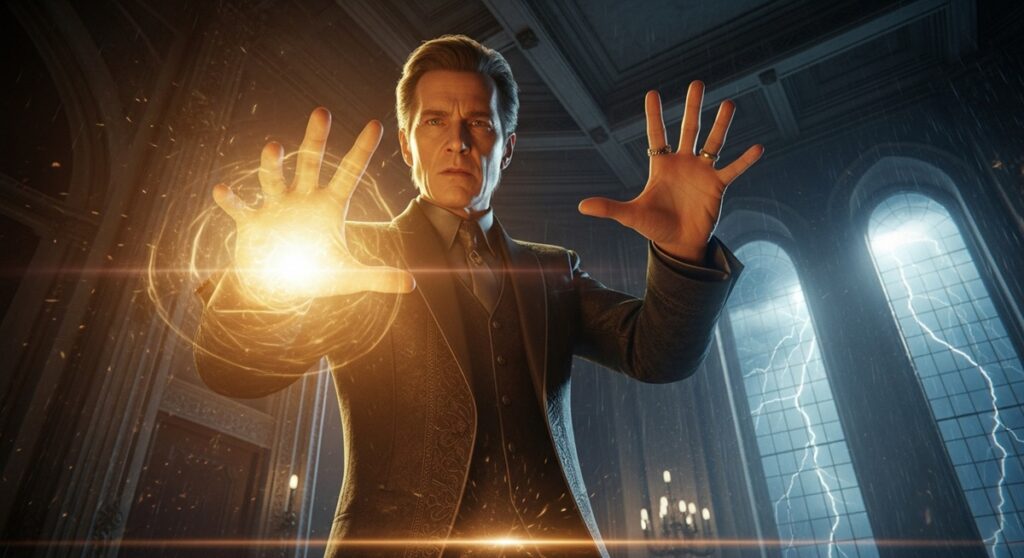
The Magician Who Was Also a Scientist
History becomes especially interesting when the people involved refuse to fit neatly into modern categories.
John Dee is an unusually good example. Born in 1527, Dee was a mathematician, astronomer, astrologer, cartographer and adviser associated with the court of Elizabeth I. He participated in the intellectual world of Renaissance science, maintained an extensive library and was deeply engaged with mathematics and natural philosophy.
He was also intensely interested in angelic communication. For years, Dee conducted sessions with Edward Kelley, recording their conversations and visions in detailed diaries. Those records became part of the tradition later known as Enochian magic.
The contradiction is only apparent if modern categories are projected backward onto the sixteenth century. Dee did not experience mathematics, astronomy, natural philosophy, theology and angelic revelation as members of neatly separated departments. The intellectual world he inhabited had different assumptions about what constituted legitimate knowledge and where the boundaries between natural and supernatural explanation lay.
That makes Dee historically valuable precisely because he complicates the easy story. He was not simply a scientist who secretly knew magic. Nor was he merely an occultist pretending to be a scientist. He was a Renaissance intellectual whose conception of knowledge was fundamentally different from the modern one.
Aleister Crowley presents a later and far more extreme version of the same problem. Crowley became one of the most influential ceremonial magicians of the twentieth century, producing an enormous body of writing on ritual, mysticism, symbolism and occult practice. His life has generated extensive mythology of its own, including claims about his activities beyond the occult world. Historical research has documented his contacts with intelligence circles, although the precise significance assigned to those relationships remains disputed.
The important point is simpler. Crowley spent his life treating ritual as a serious technology of consciousness. That makes his work historically significant. It does not make the supernatural claims associated with it experimentally established. Those two statements can coexist without difficulty.
The Ritual Does Not Need to Be Supernatural to Be Powerful
This is where the subject becomes more interesting than either conventional dismissal or occult certainty allows.
The skeptic can say: there is no reliable evidence that ritual magic bends external reality. That is a defensible position. The magician can respond: but ritual changes consciousness. That statement can also contain something true. The mistake is assuming that one claim automatically proves the other.
A person can enter a ritual believing that the ceremony will influence an external event. The ritual can simultaneously produce measurable changes in attention, emotion, confidence and behavior. Those psychological effects are real regardless of whether the supernatural explanation is.
This distinction becomes particularly important in high-pressure environments. An athlete taps the same object before every competition. A trader follows a carefully repeated routine before placing a position. A soldier performs a familiar preparation sequence before entering danger. A surgeon follows an established preoperative routine. A religious believer lights a candle and speaks a prayer before confronting uncertainty.
These activities are not identical, and they should not be flattened into one category. But they share a psychological architecture: when the outcome cannot be fully controlled, repetition creates an island of controllable behavior. The ritual says, in effect: this part can still be done. That can be psychologically powerful even when the universe remains completely indifferent to the ceremony.

Why Powerful People Have Rituals Too
One of the persistent myths surrounding ritual is that magical thinking belongs primarily to the uneducated or powerless. The historical record does not support such a clean division. Ritual and superstition appear in environments filled with expertise, wealth and technological sophistication. Professional athletes maintain elaborate routines. Traders develop superstitious behaviors. Performers cultivate pre-performance sequences. Political and military institutions surround important events with ceremony.
That should not be interpreted as evidence that powerful people possess a hidden magical technology. It suggests something more universal. Expertise does not eliminate uncertainty. A billionaire can still lose a market position. A world-class athlete can still lose a competition. A surgeon can still encounter an unexpected complication. A political leader can still face an outcome that no amount of preparation can completely determine.
The more consequential the uncertainty becomes, the more psychologically attractive control can become. And ritual offers a peculiar substitute for control: not necessarily control over the event, but control over the self confronting the event.
That distinction may explain why ritual survives even in cultures that possess scientific explanations for phenomena that earlier civilizations attributed to spirits, gods or magical forces. Technology expands the territory of what can be controlled. It does not abolish uncertainty. There is always another boundary.
The Ancient Question Was Not Entirely Wrong
This is also why the modern instinct to laugh at magical thinking can become intellectually lazy. The ancient magician was often wrong about causation. That does not mean the ancient observation was worthless.
People really do experience uncertainty differently when they have performed a ritual. People really do become attached to symbolic objects. People really do report increased confidence after completing familiar sequences. People really do search for patterns when outcomes are uncertain. And people really do construct elaborate systems of meaning around events they cannot control.
The error lies in moving from that genuine psychological phenomenon to the conclusion that the symbolic action therefore controls the external world. The ritual may reveal something true about the human being while revealing nothing supernatural about the universe. That is an important distinction. Because the alternative is to make the opposite mistake: assuming that because the supernatural explanation has not been established, there is therefore nothing interesting left to investigate. There is plenty.

What Ritual Actually Reveals
Ritual magic may tell us less about hidden forces acting upon the universe than about the extraordinary lengths to which consciousness will go when it encounters the limits of its own control.
Malinowski saw the pattern in fishermen facing the open sea. Modern psychology can observe related patterns in people confronting stress and uncertainty. History preserves them in figures such as Dee and Crowley, whose attempts to transform consciousness through ritual became part of intellectual and cultural history. Contemporary life reproduces the structure in settings that would never describe themselves as magical at all.
The surface changes. The architecture remains.
Knowledge handles what can be predicted. Skill handles what can be practiced. Technology handles what can be engineered. But eventually every human being reaches an edge where none of those things can guarantee the outcome. That is where ritual appears. It gives uncertainty a shape. It gives the individual an action. It turns waiting into doing, helplessness into procedure, and an uncontrollable future into a sequence that can at least be completed.
Whether anything beyond the human mind responds to that sequence remains a separate question. And that question should remain separate. Because the deeper mystery is already observable. When human beings cannot control reality, they do not simply accept the absence of control. They build rituals around it. They have done so for as long as history can see.
Perhaps the most revealing thing about magic, then, is not that humans once believed they could command the hidden machinery of the universe. It is that, faced with a universe that refuses to guarantee what happens next, the human mind almost cannot resist pretending that it still has a hand on the controls.
Ritual practice inside MS-13 itself follows a documented folk religious logic rather than anything supernatural, the same human impulse examined here from a different angle.