


There is a particular kind of story that becomes more disturbing the closer you get to the evidence. It begins with a man who appears in the present carrying knowledge that supposedly belongs to the future, passes through the language of quantum mechanics, and eventually arrives at a question that physics itself has never completely made comfortable: is time something that happens to us, or something built into the structure of reality?
The account of Daniel Webb, as presented in the surviving narrative, begins in 2010 with an unidentified man who allegedly appeared at a Boston hospital claiming to be a quantum physicist from the year 2037. The story describes a clinical investigation, a series of extraordinary statements about the future, and an attempt to explain the man’s condition through quantum ideas involving consciousness, superposition and parallel realities. It then ties his testimony to real events occurring around the same period, including the solar disturbance associated with the Galaxy 15 satellite anomaly and the Large Hadron Collider’s first 7 TeV collisions. The result is an unusually seductive piece of futurist mythology because its ingredients are not imaginary. The problem is that the central case is far harder to establish than the surrounding science.
No independently verifiable contemporary record has been established here for the alleged Daniel Webb case, the supposed hospital archive, or the named investigators described in the account. That distinction matters. An extraordinary testimony can be worth examining without being treated as established fact, and a story can contain accurate details about the real world without those details proving the story that surrounds them. The interesting question, then, is not whether we should simply believe or dismiss the Webb narrative. It is what happens when a modern time-traveller story is placed against what quantum physics actually says about reality, measurement, causality and the nature of time.
The Future Arrives First as a Story
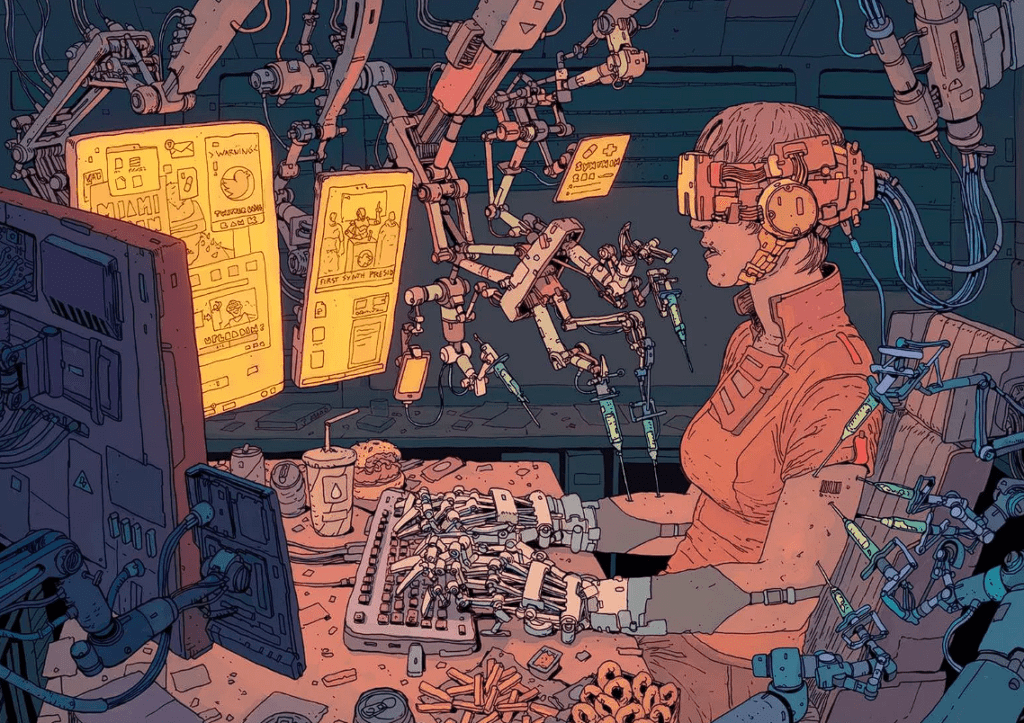
The most striking feature of the Webb account is not the date 2037. It is the way the future is made to feel tangible. The alleged visitor does not merely predict an invention or announce a political event. He supposedly arrives carrying an entire explanatory system: humanity is approaching a technological threshold, artificial intelligence will become deeply integrated with biological cognition, medicine will move toward continuous prevention rather than episodic treatment, and the distinction between human and machine will begin to dissolve. In the story, 2030 is not simply another year on the calendar. It is the horizon at which the accumulated consequences of computation, artificial intelligence, biotechnology and neural interfaces begin to change what it means to be human.
There is a genuine future hiding inside that speculation, although it does not require a visitor from 2037 to make it interesting. Artificial intelligence is already changing the way information is produced and processed, neural interfaces are being developed, quantum computing remains an active research field, and biotechnology is increasingly capable of measuring biological systems at levels that would have seemed extraordinary only a few decades ago. None of this establishes the more dramatic prediction that humanity is inevitably approaching a singularity, nor does it establish that biological humans will be replaced by hybrid intelligences. Those are extrapolations. They belong to the territory between scientific possibility, technological forecasting and philosophy.
Quantum Entanglement Is Stranger Than the Myth
This is where the story makes its most consequential leap. The narrative proposes that consciousness might exist in a state of quantum superposition, with the human mind somehow maintaining connections to multiple realities before ordinary biological perception forces experience into a single timeline. It is an evocative idea, but it takes a real quantum phenomenon and extends it far beyond what the phenomenon itself establishes.
Quantum superposition is not a scientific description of a mind simultaneously living several biographies. In quantum mechanics, a system can be described as a combination of possible states, with measurement producing outcomes governed by the theory’s probability structure. Quantum entanglement is stranger still: two systems can possess correlations that cannot be reproduced by a simple classical description, even when the systems are separated by enormous distances. Yet the apparent instantaneous character of those correlations does not provide a channel for sending usable information faster than light. NIST is explicit on this point. Entanglement does not allow someone to send a message into the past, transmit a thought to another universe, or communicate across time simply by manipulating an entangled particle.
This distinction is important because the real science is already extraordinary. There is no need to turn entanglement into a supernatural communications network to make it mysterious. The phenomenon forces physics to confront the relationship between measurement, information, locality and reality itself. What the mathematics permits is fascinating precisely because it does not behave like the world of ordinary experience. But “quantum” is not a synonym for “anything is possible.” The word describes a precise physical framework with precise constraints, and those constraints are where the genuine mystery begins.
The same caution applies to consciousness. There are serious philosophical and scientific discussions about whether quantum effects could have some role in biological cognition, but the claim that consciousness demonstrably exists across parallel timelines is not an established result of neuroscience or quantum physics. The Webb narrative turns that speculative possibility into the explanation for its central character. The evidence, however, runs in the opposite direction: the explanation is being supplied by the story, not independently established by the case.
The Strange Physics of Time
That does not mean time travel has nothing to do with physics. Quite the opposite. Modern physics has produced some of the strangest descriptions of time ever devised, and researchers have spent decades asking what happens when quantum mechanics encounters the causal structure of relativity. General relativity admits mathematical solutions containing closed timelike curves under certain conditions, while quantum theorists have explored different models for how hypothetical systems interacting with such curves might behave. These are serious theoretical questions, but they are not evidence that a person has travelled from 2037 to 2010.
There is an even subtler development. Quantum theory allows researchers to investigate situations in which the ordinary notion of a fixed causal order becomes complicated. Recent work on indefinite causal order asks whether certain quantum processes can exist without a single classical sequence of events determining which operation must come first. That is conceptually remarkable, but it still should not be confused with a machine that allows a human being to step backward through history. The frontier is real. The conclusion is not yet what the mythology wants it to be.
This is perhaps the most important correction to the entire Webb story, and it connects to a much broader pattern examined in the hidden architecture of natural portals to other worlds. Quantum mechanics has not demonstrated that time is an illusion, that the future already exists as a physical location we can visit, or that consciousness can jump between timelines. What it has done is make our classical intuitions about events, states and causality considerably less secure than they once appeared. The mystery is therefore not that physics has proved the impossible. The mystery is that reality was never obliged to conform to our common sense in the first place.
The 2030 Deluge

According to the account, Webb described the years approaching 2030 as a technological deluge: a period in which artificial intelligence would accelerate discovery so rapidly that institutions designed for a slower civilization would struggle to remain relevant. The language is deliberately apocalyptic. Religion, government, education and even biological identity become structures threatened by a technological process moving faster than culture can absorb.
There is a recognizable pattern here. Almost every technological revolution has generated predictions that the old human order is approaching its final transformation. Electricity, radio, nuclear weapons, computers and the internet have each been surrounded by visions of both transcendence and catastrophe. Artificial intelligence is simply the latest technology to inherit that burden. The difference is that AI touches cognition itself. A machine that can generate language, analyse information, write software, recognize patterns and increasingly interact with the physical world does not merely change what humans can build. It raises the uncomfortable possibility that some activities once treated as uniquely human may become partially automated.
That possibility does not require a prophecy. Nor does it guarantee one particular future. Technology creates affordances, not destinies. The same scientific advance can produce liberation in one context and concentration of power in another. Medical systems capable of continuously monitoring biological processes might extend healthy life, but they might also create new forms of surveillance and dependency. Neural interfaces might restore lost capabilities, enhance communication or eventually augment cognition, but they could also introduce profound questions about privacy and personal autonomy, questions explored directly in how every tradition that bypassed the interface found the same place. The future is not a single timeline waiting to be revealed. It is a field of choices whose consequences become harder to reverse as technological power increases.
The Galaxy 15 Coincidence
The strongest-looking piece of the original case arrives in April 2010, when the narrative points toward a solar event and the failure of the Galaxy 15 communications satellite. This part of the story has a genuine historical anchor. On April 5, 2010, Galaxy 15 stopped responding to commands from ground controllers. Scientific investigations connected the anomaly with unusual space-weather conditions, including a solar event beginning on April 3 and a geomagnetic disturbance that affected the spacecraft environment. The event was real, unusual and sufficiently dramatic to become a useful landmark in any story about that period.
But a real event does not become evidence for a fictional explanation merely because the dates line up. The USGS records the April 3 solar activity, the subsequent disturbance and the loss of contact with Galaxy 15, while later analysis examined the role of energetic electrons and spacecraft charging. The scientific literature therefore gives us something much more interesting than a mysterious unexplained failure: it gives us an actual space-weather event whose physical mechanisms can be investigated. The coincidence is worth noting, but coincidence is not causation, and nothing in the established record of the Galaxy 15 anomaly demonstrates that its failure was predicted by a time traveller.
CERN and the Other Date That Became Significant
The second anchor is CERN. On March 30, 2010, the Large Hadron Collider recorded its first proton-proton collisions at a centre-of-mass energy of 7 TeV, beginning a new phase of particle physics. It was a genuine scientific milestone, and the contemporary CERN record is unusually clear about what happened: beams were brought to 3.5 TeV each, and the first 7 TeV collisions were recorded by ATLAS on March 30.
Placed beside the Webb narrative, the coincidence feels almost designed. A mysterious visitor from the future appears in a story set in 2010, CERN opens a new energy frontier, a communications satellite is disabled during an unusual period of space weather, and the account assigns significance to the threshold between the old technological world and the one supposedly approaching in 2030. Yet the dates do not establish the mechanism claimed by the story. CERN’s achievement was a planned scientific operation, and Galaxy 15’s anomaly was investigated as a space-weather and spacecraft-engineering problem. The two events become mysterious only after they are woven into a larger narrative.
The Timeline That Corrects Itself
The story’s most elegant idea is also the one that most clearly belongs to speculative fiction: temporal inertia. According to the account, the future behaves like a probability field that can absorb small disturbances. A traveller may arrive in the past, reveal information, alter local events and still leave the broad structure of history intact because the timeline corrects itself around the disturbance. It is a variation on one of the oldest problems in time-travel fiction, examined directly in the grandfather paradox and ways to avoid it: if the past can be changed, what prevents a traveller from creating a contradiction?
Physics has no established principle called “temporal inertia” that works in this manner. There are, however, serious theoretical attempts to understand how hypothetical time travel could coexist with quantum mechanics. Researchers have explored models involving closed timelike curves, consistency conditions and post-selected quantum processes, precisely because backward time travel creates problems for ordinary notions of causation. These models are valuable as theoretical laboratories. They allow physicists to ask what a consistent universe would have to look like if certain exotic structures were possible. They do not establish that such structures exist in nature, much less that a human consciousness can use them.
And that distinction leads somewhere deeper. The idea that reality “corrects” itself may be less a discovery about the universe than a psychological solution to the problem of uncertainty. Human beings dislike branching possibilities without closure. We want the future to be constrained enough that the world remains intelligible, yet open enough that our choices still matter. A self-correcting timeline provides exactly that compromise: history can be disturbed, but never destroyed, the future can change, but never become meaningless.
The Archive Problem
There is another detail in the story that deserves more attention than it receives: the archive itself. The narrative says the medical record is restricted, the recordings are inaccessible and the documentation remains outside ordinary scrutiny. That device is common in stories about forbidden knowledge because it solves an otherwise fatal problem. If the evidence cannot be independently examined, the absence of proof becomes part of the mystery rather than a reason for skepticism.
That does not mean every inaccessible archive is imaginary. Institutions genuinely restrict medical records, private collections and sensitive research material, the same institutional secrecy examined in the Archon Protocol and its shelters for the post-human transition. But a claim that depends entirely upon documents that no independent researcher can inspect occupies a different evidentiary category from a claim supported by publicly available records. The responsible position is neither “the archive is fake” nor “the archive must contain the truth.” It is simpler: the claim remains unverified until the underlying evidence becomes available.
What Would Actually Prove a Time Traveller?
If someone genuinely arrived from 2037, the decisive evidence would not be a strange story, an impressive prediction or a coincidence involving an already documented event. The strongest evidence would be something that could be recorded prospectively and independently verified: information demonstrably unavailable in 2010, a physical object whose provenance could not plausibly be explained by ordinary means, a reproducible prediction with sufficient specificity to exclude chance, or biological and technological evidence that survived examination by investigators who had no reason to protect the claim.
That standard may sound severe, but extraordinary claims require exactly this kind of discipline because memory is malleable, predictions can be retrofitted, dates can be misremembered and ambiguous statements can acquire astonishing precision after the event. A prediction that “something unusual will happen in April” is almost worthless. A prediction that a named satellite will cease responding to ground commands at a specified time for a specified physical reason, recorded before the event and preserved independently, would be radically different. The difference between those two things is the difference between mythology and evidence.
The Real Mystery Is Not That Time Can Be Broken
Once the unsupported parts of the Webb account are separated from the established science, something unexpectedly compelling remains. Quantum mechanics really does force us to abandon some of our ordinary intuitions. Entanglement really does produce correlations that resist classical explanation. The relationship between quantum theory and causality remains an active area of research, and physicists continue to investigate scenarios in which the familiar ordering of events becomes more subtle than the classical picture suggests. The universe is stranger than the everyday world allows us to imagine, but its strangeness is more precise than the mythology built around it.
That may be why stories like this survive. They take genuine scientific uncertainty and give it a human face. Instead of equations, there is a visitor. Instead of competing interpretations of quantum theory, there is a consciousness caught between realities. Instead of difficult questions about causality, there is a man who remembers a future that supposedly no longer exists. The fictional structure makes an abstract problem emotionally legible. We can understand a person trapped between timelines more easily than we can understand a mathematical formalism that challenges our assumptions about what an event actually is.
The 2030 Horizon
There is therefore something almost fitting about the title’s date. 2030 is close enough to feel like a destination and distant enough to carry projection. From the vantage point of 2026, it is no longer the remote future. It is a horizon visible from the present, close enough that predictions about artificial intelligence, biotechnology, quantum computing and human-machine interfaces can be tested against reality rather than simply imagined.
Whether 2030 becomes the technological threshold imagined by the story is something only time can answer. There is no established evidence that humanity will cross into a post-biological civilization, that consciousness will become transferable between realities, or that quantum entanglement will provide a route through time. Those possibilities belong to speculation. Yet the underlying questions are not speculative at all. How much of the human condition can technology transform before the word “human” itself becomes difficult to define? How should a civilization govern systems that can process information faster than its institutions can respond? And if physics continues to reveal that reality is less intuitive than our inherited concepts suggest, how much confidence should we place in the boundaries we currently consider absolute?
The alleged visitor from 2037 may never be independently verified. A comparable claim, dated one year earlier and made through internet forum posts rather than a hospital bed, came from someone calling himself John Titor. The archive may never open. The recordings may never surface, and the story may eventually prove to be nothing more than a modern construction assembled from real scientific milestones, technological anxieties and the ancient human desire to hear from the future. If so, the failure will not be that the universe became less mysterious. It will be that we mistook a story about mystery for evidence of it.
And that distinction matters because the real frontier is already strange enough. Entangled particles do not need to carry messages from tomorrow. Space-time does not need to become a portal. Consciousness does not need to leak between parallel worlds for reality to remain profoundly difficult to explain. The deeper mystery is that, after centuries of observation, mathematics and experiment, we still do not possess a final account of why the universe has the structure it does.
The end is not a date on a calendar. It is a boundary we keep moving toward because every generation discovers that the world it inherited was only a partial description of what exists. 2030 may become another ordinary year, or it may mark a genuine technological turning point. But if the future ever does arrive carrying knowledge we cannot explain, the first question should not be whether it sounds impossible. It should be whether the evidence survives when the story is stripped away.