



Exodus 25:10-22 provides engineering instructions.
The Ark is to be constructed from acacia wood with dimensions: 2.5 cubits long, 1.5 cubits wide, and 1.5 cubits high. The wood is to be overlaid with pure gold, inside and out. The lid, called the mercy seat, is to be made of pure gold. Two cherubim are to be fashioned from hammered gold and placed on the lid, one at each end, with their wings spread upward and facing each other across the mercy seat.
These are not symbolic instructions. They are engineering specifications. The materials, dimensions, and spatial configuration described in Exodus produce a physical object whose properties can be analyzed against known physics.
The configuration is a Leyden jar scaled to architectural proportions. A Leyden jar, the earliest practical capacitor developed in eighteenth-century Europe, consists of a glass jar coated on both inside and outside surfaces with conducting foil, separated by the glass’s insulating properties. The Ark’s construction, an acacia wood core coated inside and outside with gold, with the wood serving as the insulating layer between the two conducting gold surfaces, is the same physical architecture: two conductors separated by an insulator.
The construction shares a capacitor’s basic architecture: two conductors separated by an insulator. Whether the device could actually function as the piece’s later claims require is a separate question, and the library’s evidentiary standard requires addressing it directly rather than treating “shares the architecture of a capacitor” and “was a functioning high-voltage weapon” as the same claim.
Two problems are worth stating plainly. First, a capacitor does not charge itself: it requires an external source of electrical energy to build up a charge, and no such source, a generator, a battery, an atmospheric collection mechanism, or anything else, is described in the construction specifications or proposed by this analysis. Second, the scale involved matters. A wood-dielectric capacitor of the Ark’s approximate dimensions, using acacia wood’s actual dielectric properties, would store an amount of charge many orders of magnitude too small to produce a lethal discharge to a human body, let alone the effects described later in this piece. These are not minor technical objections; they are the reason mainstream physicists and engineers who have examined this hypothesis have not found it persuasive as an explanation for the biblical accounts. The architecture is worth noting as an interesting coincidence. It does not, on its own, establish that the Ark stored or discharged electricity.
The Physics of What Was Built
A capacitor stores electrical charge on two parallel conducting surfaces separated by an insulating medium. The amount of charge stored, the capacitance, depends on the surface area of the conducting plates, the distance between them, and the dielectric constant of the insulating material between them.
The Ark’s gold surfaces, separated by the acacia wood’s insulating layer, constitute exactly this configuration. The dimensions given in Exodus allow a rough calculation. Converting the cubits to modern measurements at the standard Egyptian cubit of approximately 18 inches: the Ark was approximately 45 inches long, 27 inches wide, and 27 inches high. The surface area of the gold conducting layers, calculated from these dimensions, produces a device capable of storing a substantial electrical charge at the dielectric strength of the wood insulator.
The gold cherubim on the lid, with their wings extended toward each other and facing downward across the mercy seat, describe a geometric configuration above the capacitor’s surface. The gap between the wings of the two cherubim across the mercy seat would create an arc gap, a space between two conducting surfaces through which electrical discharge could occur when the device’s charge exceeded the breakdown voltage of the air between them.

This is the physical mechanism by which a spark would appear between the cherubim’s wings when the Ark discharged. The luminous cloud described above the mercy seat, and the voice of God described as speaking from between the cherubim, are consistent with the phenomena of a high-voltage electrical arc: the discharge of a capacitor through an air gap produces visible light, and the crackling and hissing of the discharge produces sounds.
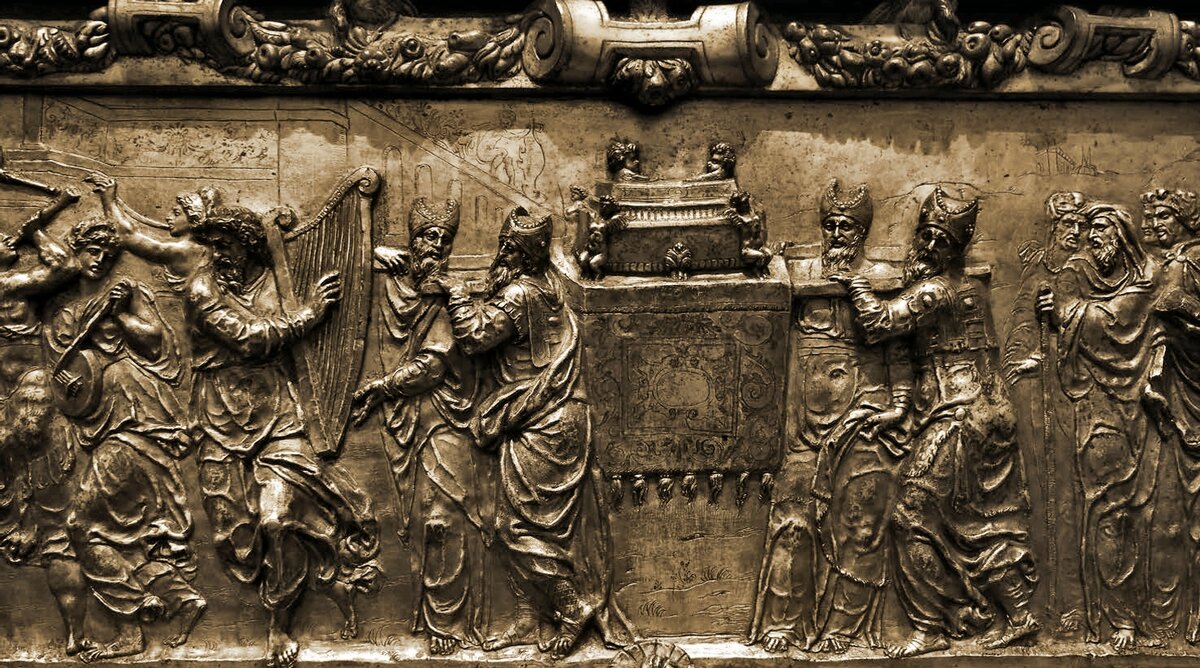
The instruction that the Ark was to be carried by poles inserted through rings, never touched directly by human hands, is the safety protocol appropriate for a device that could discharge a lethal electrical charge through a conductive human body.
What Happened to People Who Violated the Protocol
The biblical record describes deaths and injuries associated with the Ark’s mishandling with a clinical specificity that theological explanation does not fully account for.
Uzzah’s death is described in 2 Samuel 6:6-7. The Ark was being transported on a cart. The oxen stumbled. Uzzah reached out his hand and touched the Ark to steady it. He died instantly. The text attributes his death to God’s anger at the violation. The physical explanation is more specific: a person who provides a conductive path to ground for a highly charged capacitor by touching it directly will receive a discharge through their body that can produce cardiac arrest and instantaneous death. The mechanism requires no supernatural intervention. It requires only that the Ark was charged.
The Beth-shemesh event is described in 1 Samuel 6:19. The Ark had been returned by the Philistines, who had held it for seven months during which they experienced severe illness at each city where the Ark was kept. When the Ark was returned to Beth-shemesh, some of the men looked into it. Approximately fifty men died. The death toll from looking into a capacitor box is not obviously explained by electrocution, but the number and the nature of the violation, looking rather than touching, suggests a different mechanism. A highly radioactive material contained within the Ark, such as the type of radioactive mineral described as producing luminescence in the Death Valley underground city account, could produce lethal radiation exposure to individuals positioned directly above the open lid.
The Philistine illness during the seven months the Ark was in their possession is described across 1 Samuel 5 as a plague affecting each city to which the Ark was moved. The symptoms are tumors and what some translations describe as a plague of mice or rats. Before proposing radiation as the mechanism, the library’s evidentiary standard requires naming the explanation that biblical scholars and epidemiologists actually favor for this passage: bubonic plague. Tumors matching the description of buboes, the swollen lymph nodes characteristic of Yersinia pestis infection, combined with a rodent infestation, is the textbook presentation of a bubonic plague outbreak, and rodents are the plague’s standard vector. This explanation requires no exotic mechanism, fits the ancient Near Eastern disease environment, and accounts for the text’s own detail that gold rats were made as part of the guilt offering, since the text seems to identify the rodents as connected to the affliction rather than as an incidental detail. A radiation-sickness explanation is not impossible, but it is the less parsimonious reading, and asserting it without naming the plague hypothesis first misrepresents the state of the evidence.
These three recorded events, Uzzah’s instant death from touch, the Beth-shemesh deaths from looking, and the Philistine illness, describe a device with two distinct hazard modes: contact electrocution and proximity radiation. A device that contained both a high-voltage capacitor and a radioactive material would produce exactly this combination of hazard profiles.
The Philistines’ remedy for the illness, described in 1 Samuel 6, involved the creation of golden replicas of the tumors and of the mice or rats as part of the ritual return of the Ark. The replication of the symptoms in gold as a ritual gesture is consistent with a population that understood the illness was caused by the Ark’s proximity but had no framework for understanding the physical mechanism. They were attempting ritual propitiation of what they experienced as a divine punishment. The physical reality behind the experience may have been radiation sickness from a radioactive source within the Ark.
The Battlefield
The Ark was carried into battle on multiple recorded occasions in the Hebrew Bible, and its battlefield effects suggest a device with offensive capabilities beyond symbolic religious presence.
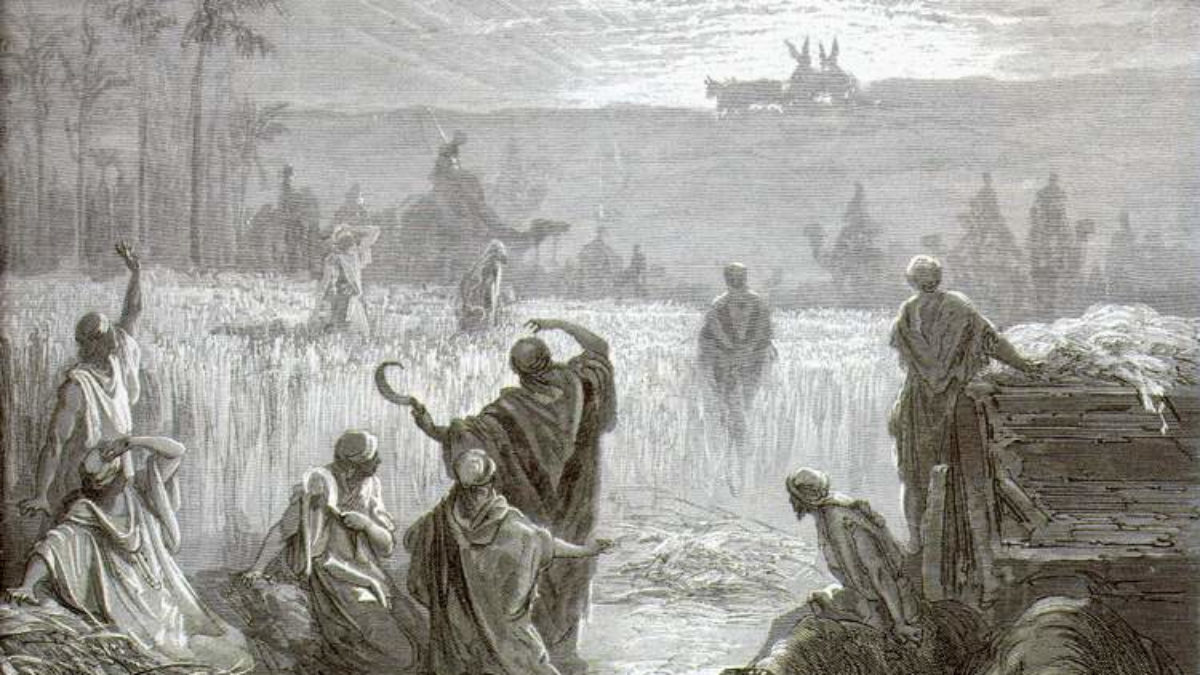
The account in Joshua 6 of the destruction of Jericho is the most extensively recorded battlefield use. The Israelites carried the Ark around the walls of Jericho once per day for six days, with seven priests carrying seven rams’ horn trumpets before it. On the seventh day, they circled the walls seven times, the priests blew the trumpets, the people shouted, and the walls fell outward.
The acoustic resonance hypothesis for this event proposes that the frequencies produced by the rams’ horn trumpets, in combination with the Ark’s electromagnetic field, produced a destructive resonance in the limestone construction of Jericho’s walls. This hypothesis is not obviously implausible: acoustic resonance can produce structural failure in solid materials at frequencies, as recorded in the resonance disaster of the Tacoma Narrows Bridge in 1940 and in the military research into acoustic weapons recorded in the psychological warfare piece in this library. The combination of the Ark’s electromagnetic field and the acoustic energy of the trumpets is not testable from the available evidence, but the combination of the two energy sources in a directed effort against a structure is the sequence the text describes.
The repeated defeats of the Israelites when the Ark was absent from their formation and their victories when it was present across multiple military campaigns suggest that whatever the Ark’s capabilities were, they had tactical military value that the Israelite commanders consistently relied on. The Ark’s absence at the first Battle of Ai, in which the Israelites were defeated despite an apparently favorable tactical position, is specifically attributed to the reason for the defeat in the text.
The Transmission Function
The function attributed to the Ark in Exodus, that God spoke to Moses from between the cherubim above the mercy seat, describes a communication function distinct from the defensive and offensive capabilities described elsewhere.
The physical configuration of the two gold cherubim with their wings extended toward each other across the gold mercy seat, with their faces turned downward toward the mercy seat and their wings spread upward, describes an antenna geometry. Two facing conductive surfaces with a gap between them, elevated above a large conducting plane, with the conducting wings extending upward and outward, is the configuration of a directional antenna whose resonant frequency would be determined by the wing dimensions and gap distance.
Whether this configuration was designed to transmit and receive electromagnetic signals at frequencies, or whether the arc discharge between the wings produced electromagnetic radiation that could be detected at frequencies at a distance, is speculative from the physical description alone. What the description is consistent with is a device that was specifically engineered for electromagnetic signal production and reception rather than simply shaped for aesthetic or symbolic reasons.
Tesla’s work on wireless energy transmission, recorded in the Tesla piece in this library, demonstrates that the electromagnetic field between two facing conductors at frequencies and voltages can transmit energy and information. Whether the Ark’s construction specifications describe a primitive version of this capability, available to whoever transmitted the building instructions to Moses, is the question that the convergence of the construction specifications and the attributed communication function raises.
Where It Is
The three most seriously proposed candidate locations for the Ark’s current position are Ethiopia, a cave beneath or near Jerusalem, and the Temple Mount’s underground complex.
The Ethiopian claim is the most institutionally established. The Ethiopian Orthodox Church has maintained continuous possession of an object it identifies as the Ark of the Covenant in the Church of Our Lady Mary of Zion in Aksum since at least the fifth century CE. The guardian monk system, in which a single monk is appointed for life as the sole person authorized to see and care for the Ark, has been continuous across this entire period. The monk does not leave the church compound. The Ark is not shown to any other person. It is displayed publicly once per year, covered completely in richly embroidered cloth.

Graham Hancock’s investigation, recorded in The Sign and the Seal published in 1992, traced the historical record for the Ark’s movement from Jerusalem through a route that the independently attested Elephantine Papyri partially corroborate. The Elephantine Papyri are a collection of Aramaic documents from a Jewish colony on the island of Elephantine in the upper Nile, dated to the fifth century BCE, that record the existence of a Jewish temple on the island containing the Ark for worship purposes. The documents predate Hancock’s research by 2,400 years and are in the historical record independently of any Ark tradition.
If the Elephantine Papyri record the Ark’s presence at the Nile island colony, and if the colony’s subsequent history is traced through the known movements of the Ark tradition to Ethiopia, the Ethiopian institutional claim has independent textual support that distinguishes it from institutional claims without any corroborating record.
The Ron Wyatt claim, that the Ark was found in a cave beneath the site of the crucifixion in Jerusalem in 1982, appears in Wyatt’s publications and in the accounts of researchers who investigated his claims. His findings, including the 24-chromosome blood sample from what he identified as the crack in the ceiling above the Ark, cannot be independently verified because the video recording he stated he made was left in the cave and the location has not been independently confirmed. Whether Wyatt found the Ark, found something else, or constructed the account, is not resolvable from the available evidence. His claim is consistent with the theological framework of the Church of the Holy Sepulchre tradition, which places the crucifixion site at Golgotha, beneath which a cave system exists.
The Templar excavation hypothesis connects to the recorded history of the Knights Templar’s founding in Jerusalem in 1119 CE. The original nine knights who established the order lived in the Al-Aqsa Mosque on the Temple Mount for nine years before conducting any military activity. The implausibility of nine knights defending the road to Jerusalem, which was their stated mission, has consistently suggested to researchers that their actual activity during those nine years was excavation beneath the Temple Mount in the area of Solomon’s Temple. Whatever they found, the Templar order emerged from those nine years with extraordinary wealth and institutional influence that their original military function does not account for.
Whether the Templars found the Ark, other Temple treasures recorded in the Copper Scroll’s inventory, or something else is not recorded in any surviving Templar record. The Rosslyn Chapel connection, built by the Sinclair family with recorded Templar associations in 1446, has been proposed as the Ark’s current European repository by researchers including Robert Lomas and Christopher Knight. The concealed chamber beneath Rosslyn that subsequent ground-penetrating radar surveys have detected has not been excavated.
The location where the Ark rested after the Philistines returned it appears in 1 Samuel 6 with geographic and physical detail. The Ark was loaded onto a cart pulled by two cows and sent toward Beth Shemesh. When the cart stopped in a field belonging to a man named Joshua, there was a great stone. The Levites unloaded the Ark and placed it on the great stone. The field’s owner is named. The stone’s presence is specific. The location is named.
In 2019, Israeli archaeologists Zvi Lederman of Tel Aviv University and Shlomo Bunimovitz published findings from their excavation of a structure at the Beth Shemesh site that they had been excavating since 2012. The structure is dated to the twelfth century BCE based on ceramic analysis, placing it within the period that the biblical narrative describes.
The structure’s characteristics appear in the excavation report: it is square, with walls approximately 8.5 meters long, isolated from residential areas, with walls significantly more substantial than the domestic structures in the surrounding archaeological layers. The interior contained evidence of ritual activity, a ceremonial area, deposits consistent with wine or sacred oil storage, and concentrated animal bones consistent with sacrifice. Lederman and Bunimovitz’s formal assessment, published in their excavation reports and discussed in the Jerusalem Post, is that the structure’s characteristics identify it as a temple rather than a domestic or administrative building.
Inside the structure, the excavators found a stone table whose configuration, a large horizontal slab resting on two smaller supporting stones, matches the physical description of a platform for placing a heavy object. The table’s dimensions and construction are consistent with supporting the weight of an object of the Ark’s described dimensions.
Lederman’s statement about the finding: this would be a rare case in which we can merge the biblical narrative with an archaeological find.
The mid-twelfth-century destruction layer identified at the site corresponds to the period of Philistine military activity in the region. The ceramic evidence shows destruction followed by conversion of the space to non-ritual use, consistent with conquest or forced abandonment. The biblical narrative describes both the Ark’s presence at Beth Shemesh and the ongoing military conflict with the Philistines in the same period.
The Beth Shemesh finding does not confirm that the Ark rested on the stone table Lederman’s team found. It confirms that a structure matching the biblical description of a sacred site, at the geographic location the biblical narrative specifies, dated to the period the narrative describes, contains a physical element consistent with the Ark’s placement account. The biblical narrative describes the Ark being placed on a great stone at a named location. The archaeological record at that location contains a temple of the correct period with a stone platform of appropriate construction.
Whether this correspondence reflects genuine historical memory preserved in the biblical narrative, coincidental correspondence between a literary description and a physical finding, or something between these two interpretations that a single structure cannot settle, is a question that the Beth Shemesh finding makes more interesting rather than more closed.
The textual record of the Ark’s journey, from Sinai through the wilderness, to the tabernacle at Shiloh, to capture by the Philistines, to its return at Beth Shemesh, to Jerusalem, contains geographic and physical details that the archaeological record is beginning to provide candidate correlates for. The Beth Shemesh temple is the most recent and most of these correlates in the published record.
The stone table is in situ at the excavation site. The excavation continues.
Why It Has Not Been Formally Investigated
The Ethiopian claim is the most institutionally established candidate and the most practically accessible: the Church of Our Lady Mary of Zion is a standing building in a functioning city. Aksum is a UNESCO World Heritage Site. The Ethiopian government is accessible. The Church’s hierarchy is accessible. A formal scientific investigation of the Ark’s presence at Aksum is possible in principle.
It has not occurred.
The Ethiopian Orthodox Church has declined every request for access to the inner chamber where the Ark is maintained. The Ethiopian government has not compelled the Church to permit examination. The international institutions with both the resources and the mandate to investigate significant biblical artifacts, the Israel Antiquities Authority, the Vatican, UNESCO, have not formally pursued the Aksum claim.
The institutional indifference to what would be, if genuine, the most significant archaeological discovery in the history of religion, is itself informative. A discovery that confirms the Ark’s survival and verifies its physical characteristics as consistent with the electrical capacitor hypothesis would simultaneously confirm the technological sophistication of whoever transmitted the construction specifications to Moses, provide physical evidence for the reality of the biblical narrative, and pose questions about the nature and origin of the technology.
These are questions that the institutions which manage the public understanding of religious and archaeological history have strong institutional incentives to not answer.
The Ark’s construction specifications describe a device whose architecture resembles a basic capacitor. If the capacitor hypothesis is correct despite the charging-mechanism and scale problems raised above, whoever transmitted those specifications to Moses would have understood that architecture and its electromagnetic properties. That is a conditional claim, not an established one.
The monk in Aksum has not left the church compound. The cave beneath Jerusalem has not been formally investigated. The chamber beneath Rosslyn has not been excavated.

Whether the device described in Exodus reflects technology outside the conventional history of the period, or reflects a religious and ceremonial object whose construction happens to share a superficial resemblance to a much later electrical device, is the question this piece has raised without the physics needed to resolve.
It was built, according to the text. What it was, physically, and whether it killed people through the mechanism proposed here or through something else entirely, remains genuinely unresolved.
Where it is now, the institution that could answer definitively has not been permitted to look.