




The description arrives in the same form from people who have no contact with each other.
A tall figure. Dark, darker than the surrounding darkness. Wearing a wide-brimmed hat whose shape the experiencer can describe in detail despite the figure having no other visible features. Standing at the foot of the bed or in the corner of the room. Watching. Not moving. Not speaking. Watching.
The experiencer cannot move. Cannot speak. Can see the room, can see the figure, cannot do anything about either. The paralysis is complete and the figure is present and the watching is specific and directed and felt as such, not as a vague sense of presence but as the attention of an intelligence.
The experience ends. The paralysis releases. The figure is gone. Nothing in the room indicates that anything was there.
This description, down to the wide-brimmed hat, is recorded across formal sleep paralysis research surveys, across clinical reports, across the online communities where sleep paralysis experiencers share accounts, and across the independent folkloric traditions of cultures with no recorded contact with each other. The entity has acquired a name in the communities that document it: the Hat Man.
The neuroscience of sleep paralysis is well established and specific. It provides a complete mechanistic account of why the paralysis occurs, why the sensory phenomena accompanying it are produced, and why the experience is associated with a terror response. What it does not provide is an account of why a tall figure in a wide-brimmed hat appears at rates in independent populations who have no shared cultural context for the image.
This is the gap the piece examines.
What Sleep Paralysis Is
Sleep paralysis occurs at the boundary between REM sleep and waking consciousness. The boundary is normally crossed quickly in both directions: the brain transitions from the sleeping to the waking state in seconds, and the body follows. In sleep paralysis, the transition is interrupted. The brain reaches a state of waking awareness while the body remains in the state that REM sleep requires: complete muscle atonia.
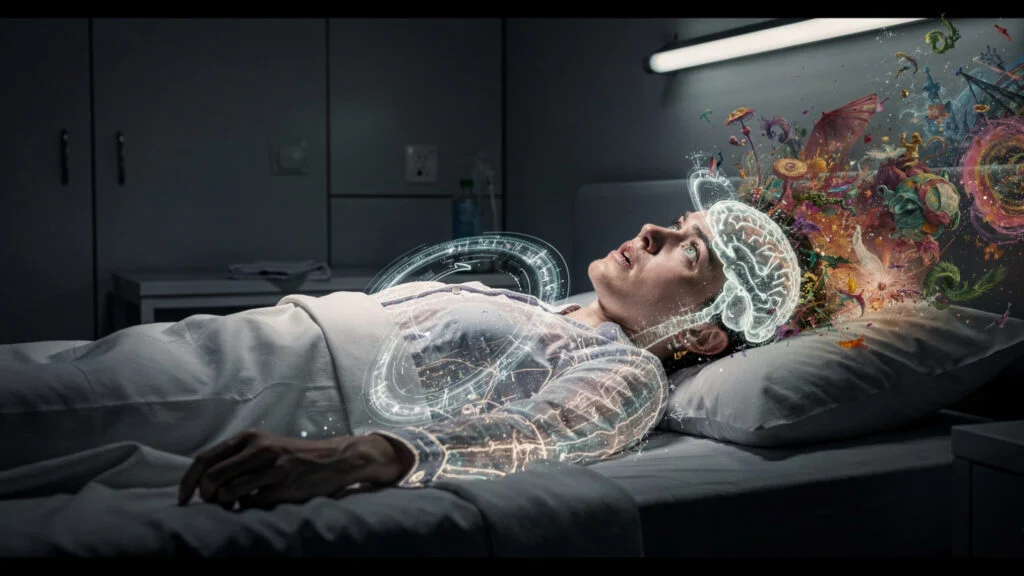
The muscle atonia of REM sleep is not incidental to the sleeping state. It is a protective mechanism. During REM sleep, the brain is highly active, producing the vivid narrative experiences we call dreams. If the body were not paralyzed during this activity, the physical enactment of dream content would be dangerous. The neural mechanism that prevents this is the activation of glycine and GABA receptors in the brainstem that inhibit the motor neurons, preventing voluntary muscle activation throughout the REM period.
When this mechanism persists after the brain has returned to waking awareness, the result is sleep paralysis: the person is conscious, aware of their environment, and completely unable to move. The typical duration is seconds to minutes. The experience feels significantly longer.
The sensory phenomena that accompany sleep paralysis are produced by the same neural mechanism that produces dream imagery during REM sleep. The brain’s visual cortex continues to generate imagery from internal sources rather than from sensory input, and this internally generated imagery intrudes into the waking perceptual field in the form of hypnagogic or hypnopompic hallucinations, occurring at sleep onset or sleep offset respectively. The terror that accompanies the experience activates the amygdala’s threat response, which amplifies the sensory phenomena and increases their salience.
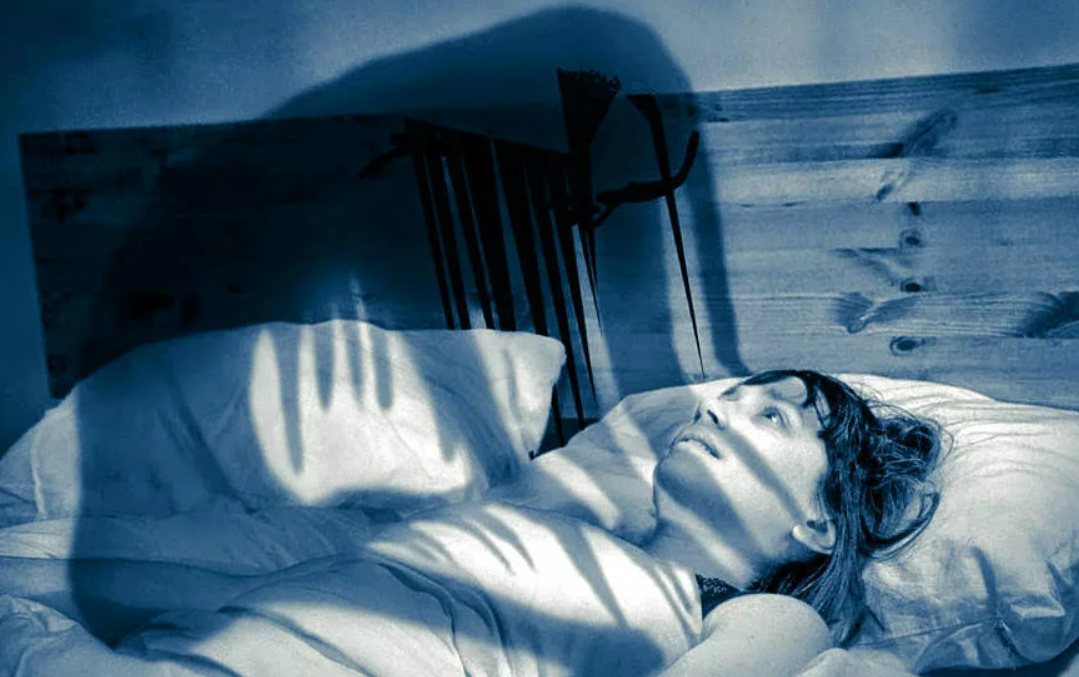
This is the established neuroscientific account of sleep paralysis. It is internally consistent, mechanistically specific, and explains the paralysis, the sensory phenomena, and the terror response through processes that appear in normal sleep physiology.
It does not explain the hat.
David Hufford and the Old Hag
In 1982, folklorist David Hufford published The Terror That Comes in the Night: An Experience-Centered Study of Supernatural Assault Traditions, an academic study of the Newfoundland tradition of the Old Hag, the local name for a sleep paralysis entity that Newfoundland residents had been reporting for generations.
Hufford’s methodological contribution was significant: he recorded Newfoundland residents’ Old Hag accounts before and independently of any exposure to the sleep science literature. The people he interviewed had no clinical framework for what they were experiencing and no cultural context that would explain the experience in neurological terms. They described what had happened to them from within their own experiential and cultural vocabulary.
Their descriptions were phenomenologically consistent with sleep paralysis as clinically defined, and their entity descriptions were phenomenologically consistent with the broader cross-cultural sleep paralysis entity tradition. The Old Hag, as described by Newfoundland residents in the 1970s and 1980s, is a dark presence that sits on the chest of the paralyzed person and produces the terror and oppression that sleep paralysis experiencers report globally.
Hufford’s conclusion was that the folk tradition reflected a genuine experience rather than a culturally transmitted story. The people reporting Old Hag encounters were describing something that had actually happened to them, something whose phenomenological structure was consistent across independent reporters, and whose structure corresponded to a well established physiological state.
Whether the entities described in these experiences are purely internally generated hallucinations produced by the hypnagogic mechanism, or whether they are encounters with something external that the hypnagogic state makes accessible, was a question Hufford approached with academic caution. His contribution was to establish that the folk tradition deserved to be taken seriously as a record of genuine human experience rather than dismissed as superstition.

The Terror That Comes in the Night is the foundational academic study of sleep paralysis phenomenology from a folklore perspective. It established the methodological standard for subsequent research in the field.
Shelley Adler and the Hmong Deaths
The most disturbing recorded consequence of sleep paralysis entity encounters appears in the case of the Hmong refugee population in the United States in the late 1970s and early 1980s.
The Hmong are an ethnic group from the highlands of Southeast Asia, primarily Laos, who came to the United States as refugees following the Vietnam War. In the period between 1977 and 1982, an anomalous pattern of sudden unexplained nocturnal deaths began occurring in the Hmong community at rates dramatically higher than in any comparable population. Young men, predominantly, died in their sleep without any identified medical cause. The phenomenon was recorded by the Centers for Disease Control, which conducted investigations without identifying a satisfactory conventional explanation.
Shelley Adler, a professor at the University of California San Francisco, spent years investigating the Hmong sudden death syndrome and published her findings in Sleep Paralysis: Night-Mares, Nocebos, and the Mind-Body Connection in 2011.
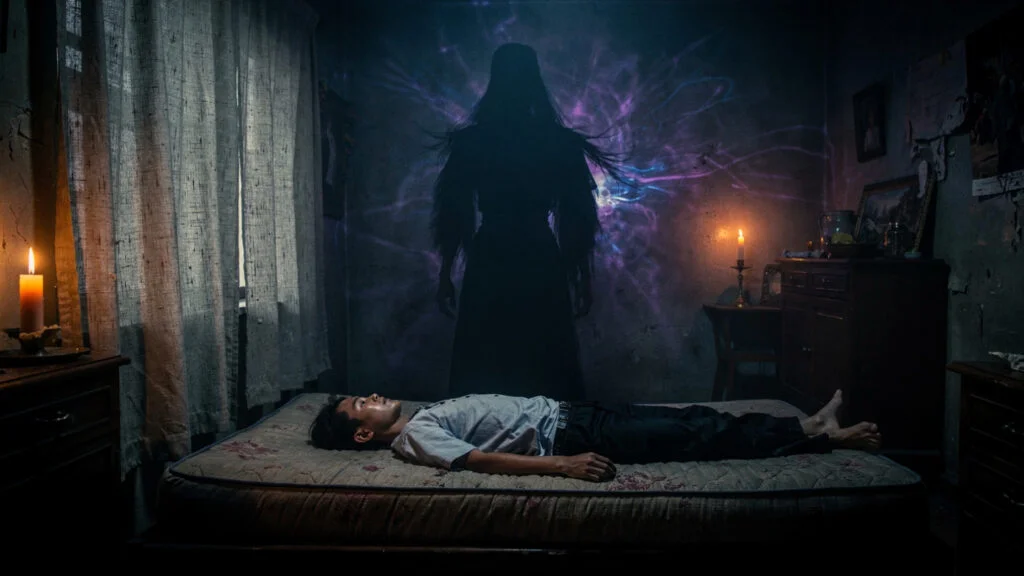
Her conclusion was that the deaths were caused by the interaction of a culturally specific sleep paralysis entity belief with the physiological mechanism of sleep paralysis itself. The Hmong tradition describes a sleep paralysis entity called the dab tsog, a malevolent spirit that sits on the chest of sleeping people and can kill them. This belief was not peripheral to Hmong cosmology. It was central, established, and genuinely feared.
When the Hmong refugees, already severely traumatized by their wartime experience and cultural displacement, encountered sleep paralysis, they encountered it within the framework of the dab tsog tradition. The terror produced by the paralysis, interpreted through the lens of a culturally established belief in a fatal entity, was sufficient to trigger fatal cardiac arrhythmia in the paralyzed state through the same mechanism that terror-induced cardiac events produce in other contexts: extreme sympathetic nervous system activation producing ventricular fibrillation in individuals with undiagnosed cardiac vulnerability.
The dab tsog killed people. Not directly, not through any external mechanism, but through the interaction of a cultural belief about a sleep paralysis entity with the physiological state that the entity was believed to inhabit.
This finding is significant in two directions simultaneously. It demonstrates that what is experienced during sleep paralysis can produce fatal physiological consequences, establishing the experience as genuinely powerful regardless of whether the entity is real in the conventional sense. And it demonstrates that the terror of the sleep paralysis experience is not simply the terror of paralysis: it is specifically the terror of the entity, enhanced to a lethal degree by the cultural framework that gives the entity maximum reality and maximum danger.
The dab tsog is not the Hat Man. But they occupy the same phenomenological space.
The Hat Man
The Hat Man is the most specifically described and most consistently recorded sleep paralysis entity in the current research record, and its phenomenological consistency across independent cultural contexts is the element that the random hypnagogic hallucination model is least equipped to explain.
The description that recurs across independent reports: a tall figure, significantly taller than a normal human, composed of or appearing as darkness, wearing a wide-brimmed hat whose style varies between reports but whose presence as a defining feature is consistent. The figure stands rather than crouches or flies. It is stationary. It watches. It does not approach. It does not speak. It is present and attending and the attention is felt as specific and directed.
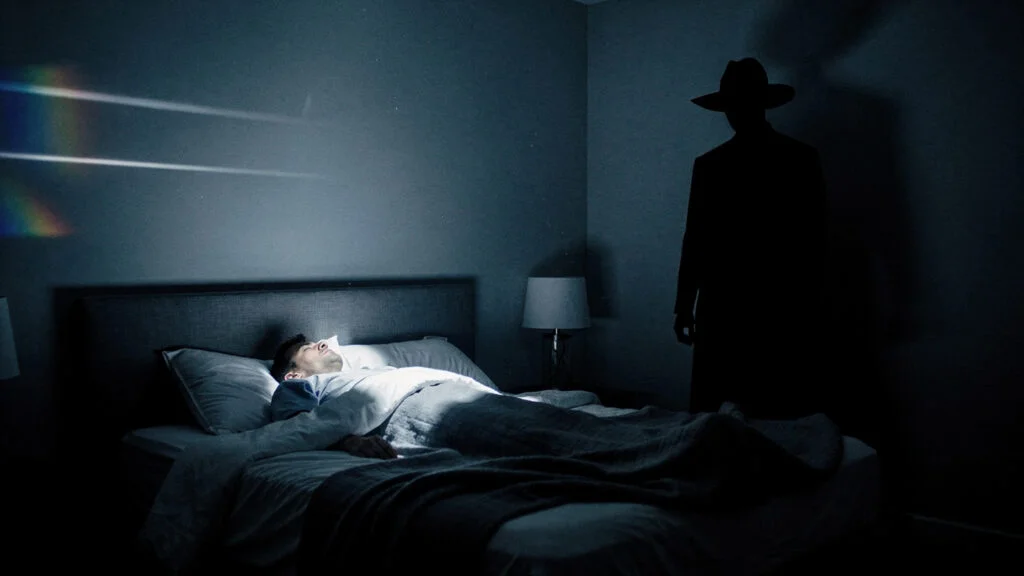
The wide-brimmed hat is the phenomenological detail that makes the Hat Man phenomenology interesting to examine against the hallucination hypothesis. The hypnagogic hallucination mechanism produces imagery from the brain’s internal visual processing. The imagery reflects the content of the sleeping brain’s visual system, drawing on stored memories, cultural imagery, and the pattern-matching tendencies of visual processing under reduced sensory input.
A wide-brimmed hat is not a universal component of stored visual memory. It is a stylistic element that appears in cultural contexts: Western films, Victorian imagery, certain religious iconography. A brain generating hypnagogic imagery from its own stored visual content should produce stylistic variation that reflects the cultural visual environment of each experiencer. The convergence on the wide-brimmed hat across experiencers in different cultural environments with different visual libraries is the anomaly.
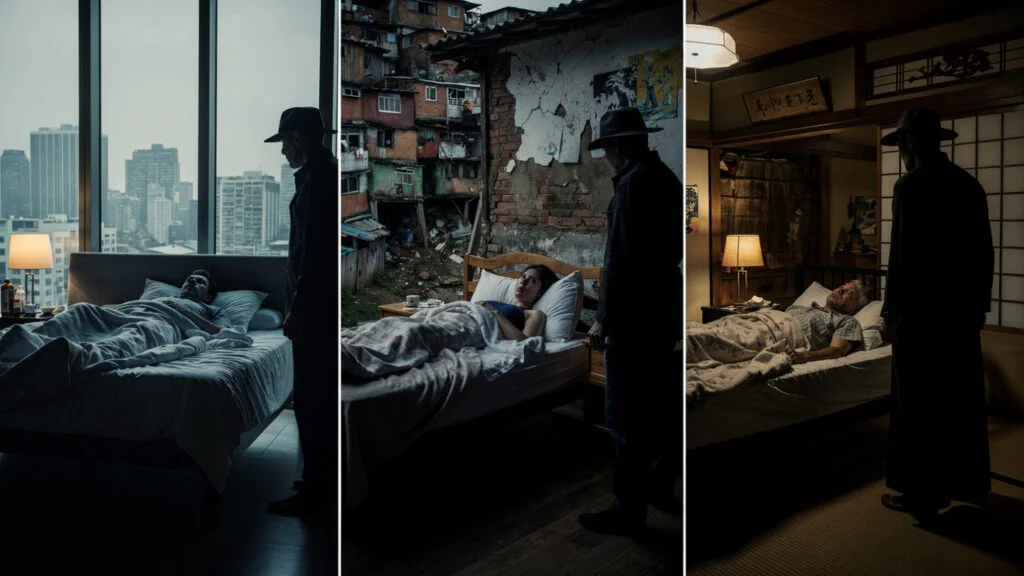
Independent sleep paralysis researchers documenting the Hat Man phenomenon across different countries report the same element: the hat. Experiencers in the United Kingdom, the United States, Australia, South America, and various other regions describe the same stylistic detail. This is where the library’s evidentiary standard requires a distinction the piece has not yet made: the Hat Man, as a specific named entity with the wide-brimmed hat as its defining feature, is a primarily post-2000s phenomenon that consolidated on internet sleep paralysis forums and communities, not a pre-internet folkloric tradition in the way the Old Hag, the jinn, or the mare are. That timing matters, because it opens an explanation the broader cross-cultural paralysis-plus-entity pattern does not have available to it: experiencers reading other people’s Hat Man accounts online before or while processing their own experience could converge on the same description through ordinary cultural transmission and suggestion, the same way any internet-era shared narrative spreads, rather than through independent discovery. This does not resolve the question, but it means the Hat Man’s specific iconographic consistency is weaker evidence for something genuinely anomalous than the older, pre-internet cross-cultural entity traditions covered earlier in this piece, and the two should not be treated as equally strong data points.
The Sleep Paralysis Project, a research initiative associated with Cambridge University that has collected thousands of sleep paralysis accounts from an international sample, has recorded the Hat Man as one of the most consistently described entities across its dataset. The project’s researchers note the cross-cultural consistency without having proposed a mechanism that accounts for it within conventional sleep science.
The Threshold and What It Accesses
The oneironaut piece in this library covers the neural state of lucid dreaming, in which the prefrontal cortex activates at its waking frequency during REM sleep, producing a state of simultaneous sleep and waking awareness. The 2009 Ursula Voss paper in Nature Neuroscience describes the gamma-band activation pattern of this state.
Sleep paralysis occupies the same general consciousness threshold from a different approach direction. The lucid dreamer reaches the threshold by maintaining waking awareness through sleep onset. The sleep paralysis experiencer reaches the same threshold by becoming aware before the sleep-wake transition completes.
The threshold consciousness state, whatever its neural correlates in terms of activation patterns, appears to be the state in which the content of experience departs most dramatically from what the conventional model predicts. The lucid dreamer accesses organized, coherent, internally consistent dream worlds that respond to their intention. The sleep paralysis experiencer encounters the entity described across independent cultural traditions.
Whether the threshold state opens access to something that ordinary waking consciousness does not reach, or whether it produces neural artifacts whose character happens to resemble something purposive and external, is the question that Hufford’s original research and the subsequent Hat Man documentation raise without resolving.
The contact literature connection is specific. A significant proportion of the initial contact experiences recorded in John Mack’s Abduction and Budd Hopkins’s Missing Time describe experiences that begin in the hypnagogic state: the experiencer becomes aware of a presence while between sleep and waking, before the full experience develops. Whether these experiences begin as sleep paralysis and develop into something else, or whether contact experiences preferentially occur at the consciousness threshold because the threshold state is specifically where contact is possible, is the interpretive question that the phenomenological evidence raises.
The remote viewing research recorded in the Stargate piece in this library trained practitioners to access an altered consciousness state described by participants as phenomenologically similar to the hypnagogic state. The viewers who produced the most consistently accurate results described the state they worked from as the edge between sleep and waking rather than as a fully waking state.
Three independent research traditions, sleep paralysis phenomenology, lucid dreaming neuroscience, and remote viewing methodology, all converge on the same consciousness threshold as the location of the most extraordinary departures from ordinary consciousness experience.
Ancient Traditions and Their Entities
The sleep paralysis entity traditions predate Western scientific sleep research by millennia and are more culturally specific in their entity descriptions than the generic hallucination hypothesis would predict.
The incubus and succubus traditions of medieval European demonology describe entities that come to sleeping people, produce paralysis, sit on the chest, and engage in interactions whose character varies by the entity’s gender in the tradition. The physical sensation of chest pressure that accompanies sleep paralysis, produced by the diaphragm’s impaired function during the atonic state, was interpreted in the medieval tradition as the weight of a demonic body.
The Islamic jinn tradition describes categories of jinn that enter sleeping people’s homes and affect them during the night in ways that correspond to sleep paralysis phenomenology. The protective practices prescribed in Islamic tradition against nocturnal jinn encounter, reciting Quranic verses before sleep, specifically target the threshold state.
The Scandinavian mare tradition describes a female entity that sits on the chests of sleeping men and produces erotic visions combined with paralysis. The English word nightmare derives from the mare of this tradition, preserving the entity’s original character in a term that has been semantically bleached to its current meaning.
The Japanese kanashibari describes the same state in Japanese cultural vocabulary, including the sensation of being bound or held down and the awareness of a presence associated with the binding.
The Brazilian Pisadeira, the Inuit Ukomiarik, and the Turkish Karabasan are additional culturally names for entities that appear in the same sleep paralysis phenomenological context across traditions with no recorded contact with each other.
The entity descriptions vary in their cultural character. The phenomenological structure, paralysis combined with entity presence combined with terror, does not.
The Question the Hat Poses
The neuroscience of sleep paralysis is well established and specific. The paralysis mechanism is understood. The hypnagogic hallucination mechanism is understood. The terror response is understood.
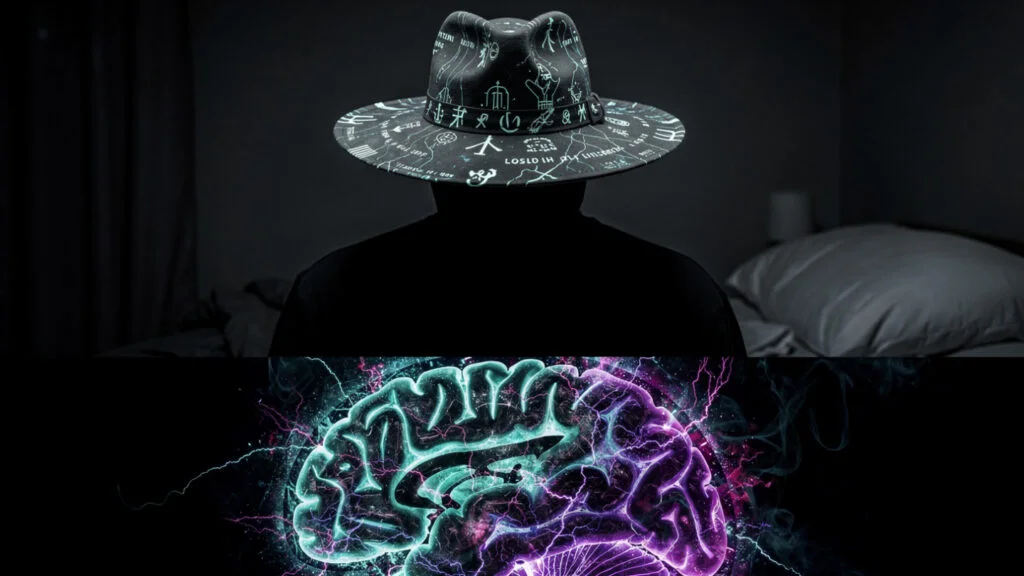
The Hat Man’s wide-brimmed hat is not accounted for in any mechanism that the neuroscience provides.
A brain generating hypnagogic imagery from its own visual memory should produce culturally specific imagery. The Hat Man should look different in different countries, different cultures, different historical periods, because the visual libraries from which the hallucination is generated are different. A Hmong experiencer’s hypnagogic imagery should draw on Southeast Asian visual culture. A British experiencer’s imagery should draw on British visual culture. A Brazilian experiencer’s imagery should draw on Brazilian visual culture.
The Hat Man wears the same hat.
Either the hat reflects a universal feature of human visual cognition that produces the same stylistic output across different cultural visual libraries, which would be a significant finding in neuroscience that has not been identified or explained. Or the hat reflects something about the entity itself rather than about the brain generating the image of it.
Hufford recorded the Old Hag’s phenomenological consistency before the experiencers had any cultural framework for explaining it. Adler documented the dab tsog’s lethal consequences for people who encountered the sleep paralysis state with a cultural belief about what the entity could do. The Sleep Paralysis Project has recorded the Hat Man’s cross-cultural consistency without producing a mechanistic explanation for the element that makes it consistent.
The threshold consciousness state that sleep paralysis occupies is also the threshold that the oneironaut tradition, the remote viewing tradition, and the contact literature all identify as the location of the most extraordinary departures from ordinary consciousness experience.

The figure stands at the foot of the bed and watches.
The neuroscience explains the paralysis and the hallucination mechanism. It does not explain why people who have never seen each other and who live in different countries and different cultures and different centuries all see the same figure in the same hat.
The watching continues. The hat is still there.