



Three strange engraved stones found in Morocco may preserve something remarkable: an ancient attempt to record a meteor in the sky. The stones are real, the researchers are real, the comparison to the witnessed 2011 Tissint meteorite fall is real, and the proposed interpretation is grounded in recognizable astronomical imagery. But there is an important qualification the sensational versions of this story tend to erase: the meteor interpretation remains a preliminary hypothesis, not an established archaeological fact.
That distinction becomes even more important when the story expands to two spectacular lakes in Morocco’s High Atlas. Isli and Tislit were once proposed as a pair of enormous impact craters produced by a prehistoric asteroid strike. That claim was published in the scientific literature. It was also challenged almost immediately, narrowed from two lakes to one, and then subjected to a detailed geological rebuttal that concluded Lake Isli formed through tectonic and karstic processes rather than a meteorite impact. Put the two stories together and the result is more revealing than the usual “cosmic mystery” version: Morocco really does preserve evidence of people watching the sky. But not every circular depression is an impact crater, and not every intriguing carving is a solved astronomical record.
The Three Stones From Ida Oukazzou

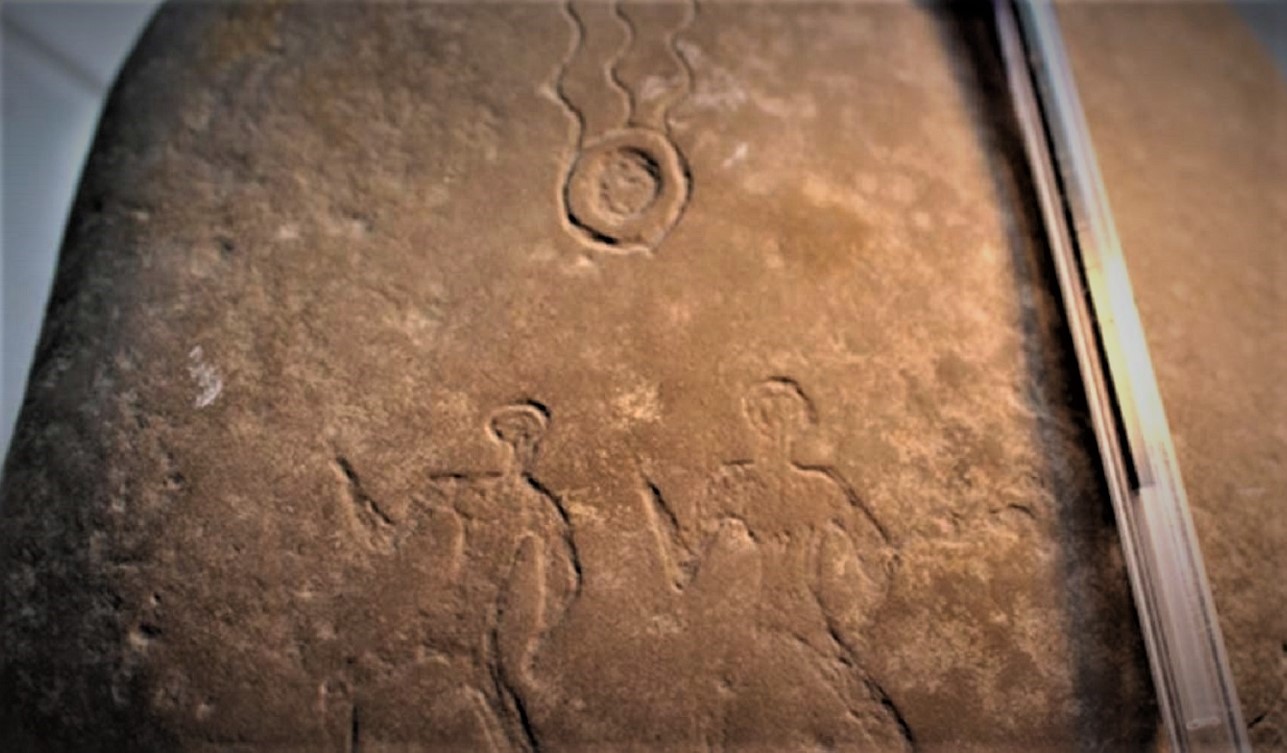
The discovery concerns three engraved sandstone and quartzitic sandstone pebbles found in the Tiwrare area of the rural commune of Ida Oukazzou, in Morocco’s Essaouira province, roughly 100 kilometres north of Agadir. The researchers designated them Ida 1, Ida 2 and Ida 3. Their published examination describes astronomical-looking circular forms connected to long, wavy lines, alongside human and animal figures. Ida 3 also contains what the authors identify as a solar symbol and two lines of Tifinagh writing. Ida 1 was interpreted as showing a man and woman reacting to a falling object, Ida 2 as an anthropomorphic figure fleeing a large fireball, and Ida 3 as a more elaborate scene involving a person, two bovine figures, the Sun and a meteor-like object, joining a broader catalog of unusual regional rock art that includes a half-mantis, half-man petroglyph found in Iran. The physical objects themselves are not the controversial part of the story. The question is what their makers intended those marks to represent.
In their 2018 paper, Abderrahmane Ibhi and colleagues compared the unusual forms with other rock-art representations interpreted as meteors, including examples from Toca do Cosmos in Brazil and Fouriesburg in South Africa. They also pointed to the long, undulating lines behind the circular forms as a possible representation of the luminous trail or smoke associated with a meteor passing through the atmosphere. Their paper is explicit about the status of the conclusion, however: it describes the work as preliminary and presents the meteor interpretation as something future research should confirm or reject. That wording matters. A scientific paper proposing an interpretation is not the same thing as an archaeological consensus establishing what an ancient artist meant.
There is another reason for keeping the wording careful. A later independent rock-art commentary questioned whether the carvings looked convincingly ancient and argued that the available photographs were insufficient to settle questions of authenticity or age. That criticism does not prove the stones are modern forgeries, either, it simply means that “three ancient stones depicting a meteor” is a stronger statement than the evidence currently permits. The responsible formulation is narrower and, in its own way, more intriguing: researchers found three engraved stones whose imagery can plausibly be interpreted as meteor observations, but the archaeological interpretation remains open to further testing.
The Meteor Used as the Comparison Is Completely Real

The strongest external anchor in the argument is the Tissint meteorite. On July 18, 2011, shortly after 2 a.m. local time, observers in the Tata region of Morocco witnessed a brilliant fireball. The official Meteoritical Bulletin records reports of the object appearing yellow, then green, illuminating the area and apparently splitting into two parts. Fragments were subsequently recovered, and the meteorite was officially classified as a Martian shergottite. Tissint is therefore not folklore, not a speculative identification and not a disputed “space rock.” It is a scientifically authenticated meteorite that was observed falling in Morocco.
That gives the petroglyph researchers something unusually useful: a modern Moroccan example of what an actual meteor appearance looked like to eyewitnesses. Their 2018 paper cites testimony that the Tissint fireball produced a continuing trail of smoke and dust, then argues that the wavy lines carved behind the circular objects on the Ida stones could represent the same visual phenomenon. It is an interesting comparative argument, but it cannot establish that an ancient artist witnessed Tissint itself. The dates obviously do not permit that. Nor can it establish that every wavy line in ancient art represents atmospheric debris. At most, it supplies a plausible visual analogy between a documented meteor event and an ancient image whose meaning remains uncertain.
The Stones Are Not Proof That an Ancient Meteorite Hit Morocco
This is where the story needs its sharpest distinction. The researchers interpret the carvings as recording a meteor or meteorite event, but that does not mean the stones themselves prove an impact occurred nearby. Seeing a fireball and documenting a crater are two completely different geological claims. A bright meteor can cross the sky hundreds of kilometres away from where fragments eventually land, and an engraving can preserve an observation without preserving the physical evidence of the event itself. The Ida stones, therefore, should not be used as independent proof of a prehistoric impact crater somewhere in the High Atlas.
Then There Are Isli and Tislit
The High Atlas contains two striking lakes known as Isli and Tislit near Imilchil. Their appearance is dramatic enough to invite speculation, and in 2013 Abderrahmane Ibhi and colleagues published a paper titled Isli and Tislit: The First Dual Impact Crater Discovered in Morocco, arguing that the two lakes were impact structures. The proposed evidence included iron meteorite fragments in the surrounding region, circular lake morphology, alleged impact breccias, shocked quartz and radial fractures. The authors proposed that the twin lakes were the result of meteorite impacts and associated the event with the Agoudal meteorite.
That was a genuine scientific claim. It was not invented by internet conspiracy culture after the fact. And that is precisely why the subsequent geological response matters.
A 2014 paper in Comptes Rendus Géoscience examined the geology of Lake Isli in detail and rejected its identification as an impact crater. Hassan Ibouh, André Michard, André Charrière and colleagues concluded that Isli formed in a tectonic setting and was subsequently modified by karst collapse in the underlying limestone. Their analysis addressed the supposed impact evidence point by point, including the meteorite fragments, breccias, fractures, sediment ages and alleged shock features. Their conclusion was unequivocal: the geological evidence did not support a meteoritic origin for Lake Isli.
There is an especially revealing detail in the history of the dispute. The original 2013 paper treated both Isli and Tislit as the proposed dual crater. By the time of later publications from the same research group, the impact interpretation had been narrowed to Lake Isli alone. The 2014 geological rebuttal then argued that even Isli belonged within the much more ordinary family of tectonic-karstic lakes found elsewhere in the Atlas Mountains. In other words, the “twin impact crater” story did not simply encounter vague skepticism on the internet. Its central geological interpretation was challenged inside the scientific literature by researchers who examined the actual structure and history of the lake.
The Agoudal Meteorite Was Real. That Doesn’t Put It Under Isli.
This is an important trap in impact-crater stories: a real meteorite fragment found in the same broad region can make an alleged crater look more convincing than it actually is. The 2014 geological analysis accepted that an iron meteorite had fallen somewhere in the wider Agoudal area and discussed evidence for a separate impact there. What it rejected was the leap from “a meteorite fell in the region” to “therefore Lake Isli is its crater.” The distinction is basic geology but easy to lose in a dramatic narrative. A genuine cosmic event can occur in the same landscape as a completely ordinary geological feature.
The Chinese Comet Manuscript Is a Better Comparison Than the Crater Story
The cross-cultural comparison with ancient Chinese astronomy is much more secure when framed modestly. The Han-era silk manuscript known as Divination by Astrological and Meteorological Phenomena, discovered at Mawangdui in 1973, contains a remarkable catalogue of comet forms. It records 29 comet configurations and associates their appearances with events such as warfare, disease and political upheaval. The manuscript is an extraordinary piece of evidence for ancient systematic observation of the sky, regardless of whether one agrees with the divinatory interpretations attached to those observations.
That makes it genuinely interesting alongside the Moroccan stones. Two distant cultures produced visual representations of unusual celestial phenomena, and both treated the sky as something worth systematically watching and interpreting. But resemblance is not proof of historical contact, and it does not establish that the Moroccan engravings depict exactly the same phenomenon as any particular Chinese illustration. Comparative archaeoastronomy becomes strongest when it asks what different societies were doing with observations of the sky, rather than turning visual similarity into evidence of a lost global astronomical system.
What We Can Actually Say About the Moroccan Stones
The evidence supports a hierarchy, and the hierarchy is much more interesting than a binary true-or-false verdict. First, three engraved stones were reported from Ida Oukazzou and studied by a named Moroccan research team. Second, the carvings contain forms that the researchers plausibly interpret as astronomical imagery, including meteor-like objects, human figures, animals and a solar symbol. Third, the researchers compared those forms with other rock-art traditions and with eyewitness descriptions of the real Tissint meteor. Fourth, their interpretation remains preliminary rather than independently established as archaeological fact. And fifth, there is no good reason to use the stones as evidence that the nearby Isli and Tislit lakes are impact craters, because that geological claim has already faced a detailed published rebuttal.
That is not a disappointing conclusion. It is the difference between a mystery and a myth. The stones may preserve an ancient observation of a meteor. They may preserve something else that only resembles one. More archaeological work, secure dating, independent examination of the surfaces and inscriptions, and broader contextual evidence could move the interpretation in either direction. What the evidence does not justify is pretending that a preliminary interpretation has already become a solved case.
What the Carvings Actually Show
There is a temptation, whenever ancient art appears to resemble something modern science recognizes, to turn the resemblance into a revelation: ancient people saw an asteroid, therefore they understood impacts, they carved a strange object, therefore they recorded a cosmic catastrophe, a nearby lake is circular, therefore it must be an impact crater. The evidence does not have to carry all of those claims at once. The Moroccan stones are interesting precisely because they sit at the boundary between observation and interpretation, where archaeology is supposed to become careful rather than sensational.
The Tissint meteorite gives us the hard ground beneath the story: a real fireball, a real witnessed fall, and a real Martian rock recovered from Moroccan soil. The Han manuscript gives us another hard fact: ancient observers really did catalogue strange appearances in the sky. The Isli geology supplies the warning: even a plausible-looking cosmic story can collapse when the physical evidence is examined closely. And the Ida stones sit between those two poles, intriguing enough to investigate, but not yet certain enough to declare solved.
That may be the most honest version of the mystery. Ancient people did watch the heavens. They noticed events dramatic enough to carve into stone, record on silk, preserve in stories and attach to the fate of kings and kingdoms. Some of those observations can still be identified today. Others remain ambiguous. The mistake is not wondering what the stones mean. The mistake is deciding they must mean more than the evidence can yet prove.
The Akure crater in Nigeria raises the same evidentiary question from the opposite direction, a geophysicist calling it a meteorite while a governor called it explosives.