

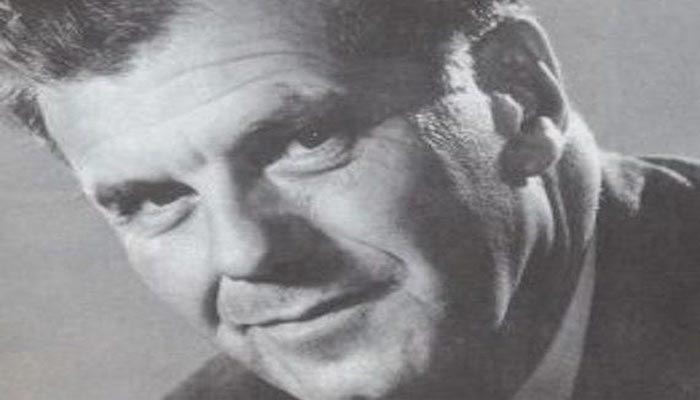
Peter Horsley’s qualifications for credibility are real and verifiable.
He served as equerry to Prince Philip, Duke of Edinburgh from 1952 to 1953, and subsequently to Queen Elizabeth II. He rose to the rank of Air Marshal in the Royal Air Force, eventually serving as Deputy Commander-in-Chief of RAF Strike Command, one of the most senior operational positions in the British military. He was appointed Companion of the Order of the Bath. His 1997 autobiography Sounds from Another Room was published by a mainstream publisher and reviewed in the British press.
When Peter Horsley described a 1954 encounter with a figure who appeared to know everything about his classified UAP research before being told, who discussed nuclear weapons and humanity’s self-destructive trajectory with impossible authority, and who disappeared without Horsley observing his departure, he was not an anonymous internet poster or a fringe researcher seeking attention. He was a former Air Marshal and royal equerry describing an encounter that had occurred four decades earlier, in the institutional context of UAP research conducted at the request of the Duke of Edinburgh.
The encounter is in the published autobiography. The autobiography is real and publicly available. Horsley’s credentials are verifiable through his military and royal household record. The encounter itself, like all single-witness accounts, cannot be independently verified.
What makes it worth examining is the combination of the witness’s institutional standing, the encounter’s content, and the broader context of what was happening in British and American military UAP research in 1954.
Horsley’s UAP Research Role
The institutional context of Horsley’s UAP research appears in his autobiography and is corroborated by the broader record of Prince Philip’s well established interest in the phenomenon.
Horsley’s autobiography describes being approached by Prince Philip to conduct systematic UAP research during his years as equerry. Whether Prince Philip’s interest was personal curiosity, institutional concern about unexplained aerial phenomena in British airspace, or something more prompted by information available to the royal household, is not established by the available record. What is established is that a senior RAF officer with direct access to the Duke of Edinburgh was conducting organized UAP witness interviews and case collection in the early 1950s.
This institutional context predates the Robertson Panel’s January 1953 recommendations and overlaps with the most intense period of classified UAP investigation in both American and British intelligence. The British Flying Saucer Working Party report of 1951, which concluded that UAP reports had conventional explanations, had been produced just three years before Horsley’s Janus encounter, in a period when the British military establishment was officially dismissive of the phenomenon while individuals including Horsley were conducting research suggesting the dismissal was premature.
Whether Horsley’s UAP research brought him to the attention of parties who wished to either recruit him, test him, or communicate with him is the question that the Janus encounter’s content motivates.
The Drawing Room and Mr. Janus
The encounter’s setting and circumstances appear in Horsley’s published account.
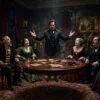
Horsley had been invited to a London drawing room to meet with a Mrs. Markham, a figure whose identity and connection to the broader circumstances Horsley does not fully explain in the published account. While waiting, a man entered the room and positioned himself in a darkened corner. He identified himself as Mr. Janus.
The conversation proceeded in a direction that Horsley found disorienting: Janus demonstrated knowledge of Horsley’s UAP research whose content had not been shared publicly or with individuals outside a small circle. He asked Horsley to describe what he knew about UAP, listened patiently to the full account, and then responded with observations that implied he was not asking for information but assessing Horsley’s knowledge against something he already possessed.
The content of what Janus then communicated, as Horsley describes it, covers several themes whose convergence is the most significant element of the encounter for the library’s framework.
Humanity’s technological trajectory. Janus expressed deep concern about the pace and direction of human technological development, specifically in terms of what was being sacrificed for it. Nature, animals, and other human beings were being treated as acceptable casualties in the pursuit of increasingly powerful machines. Whether this represented a genuine concern about environmental and social sustainability, a warning about a trajectory the speaker could see more clearly than those within it, or a philosophical position that any thoughtful observer could construct, is the question Horsley’s framing as impossible knowledge raises.
Nuclear weapons. The 1954 conversation included discussion of nuclear weapons and humanity’s increasing self-destructive capacity. The first hydrogen bomb had been tested in 1952. The Soviet Union had tested its first thermonuclear weapon in August 1953, approximately six months before Horsley’s encounter. Whether Janus’s discussion of nuclear weapons reflected awareness of the classified technical details that Horsley as an RAF officer might have been privy to, or reflected the public knowledge of the nuclear arms race that any informed person in 1954 possessed, is not established by Horsley’s account.
The dark age warning. Janus’s framing of humanity’s trajectory as approaching a dark age, rather than progressing toward the stars that both men agreed was the appropriate human destination, is the element whose resonance with the multiple civilizational warning traditions covered in this library is most direct. Whether this framing reflects genuine foreknowledge of civilizational difficulties, the standard position of any thoughtful observer of post-war Western civilization’s trajectory, or something whose content Horsley could not fully convey in published form, is the question the encounter’s own account raises.
The departure. Horsley describes that at some point during or after the conversation, Janus was no longer present. The mechanism of the departure, whether Janus left through a door while Horsley was distracted or was simply no longer in the room when Horsley next attended to his surroundings, is one of the encounter’s most discussed elements. It is consistent with both a normal departure that Horsley simply did not observe and the more anomalous interpretation that his presence in the room was not conventional.
The Name and Its Tradition
The name Janus is not a neutral choice for a pseudonym, whether the figure chose it himself or Horsley applied it in the telling.
Janus is the Roman deity of thresholds, transitions, and beginnings whose iconographic form is two faces looking simultaneously in opposite directions, toward past and future. He presided over doorways, gates, and passages between states. His dual temporal vision made him the deity invoked at the beginning of any significant undertaking or transition. January, the month of the year’s threshold, bears his name.
Whether a figure whose purpose was to communicate warnings about humanity’s future trajectory would choose the name of the deity of simultaneous past-future knowledge is the kind of symbolic detail that the encounter’s esoteric dimensions make worth noting without overstating.

The combination of a figure who appears in a liminal space, a drawing room where Horsley is waiting between two appointments, who demonstrates knowledge of past classified research and communicates warnings about future trajectories, and who departs through or at the threshold of the encounter rather than through an observed exit, is consistent with the Janus symbolism in ways that either reflect deliberate symbolic communication or coincidental convergence.
The 1954 Context
The year of Horsley’s encounter positions it in an institutional context whose broader history connects it to multiple library pieces.
1954 was the year of the Eisenhower alleged alien meeting at Edwards Air Force Base, recorded in the library’s Eisenhower piece. It was the year following the Robertson Panel’s recommendations to debunk and ridicule UAP reports while monitoring civilian UAP research organizations. It was a period when multiple Western governments were simultaneously conducting classified UAP research while publicly dismissing the phenomenon, creating the institutional tension between official denial and private investigation that Horsley’s research assignment represents.
Whether the Janus encounter was connected to this institutional context, whether the figure was a human intelligence operative using a theatrical persona to assess Horsley’s reliability and the extent of his research, whether he represented a genuine extraterrestrial contact, or whether he was a private individual with unusual knowledge whose method of departure and foreknowledge remain the encounter’s unresolved core, is the question that the 1954 institutional context makes more specifically interesting than it would be without that context.
An Air Marshal and royal equerry conducting UAP research in 1954, at the explicit request of the Duke of Edinburgh, encountering a figure with impossible knowledge in a London drawing room, was operating in the historical moment when the institutional management of UAP information was being most actively constructed.
Whether Janus was part of that management or outside it is the question that Horsley’s published account leaves permanently open.
The autobiography is published. The Air Marshal’s career is verifiable. The encounter is in the record.
What departed through the darkness of that London drawing room in 1954 has not returned to explain itself.