


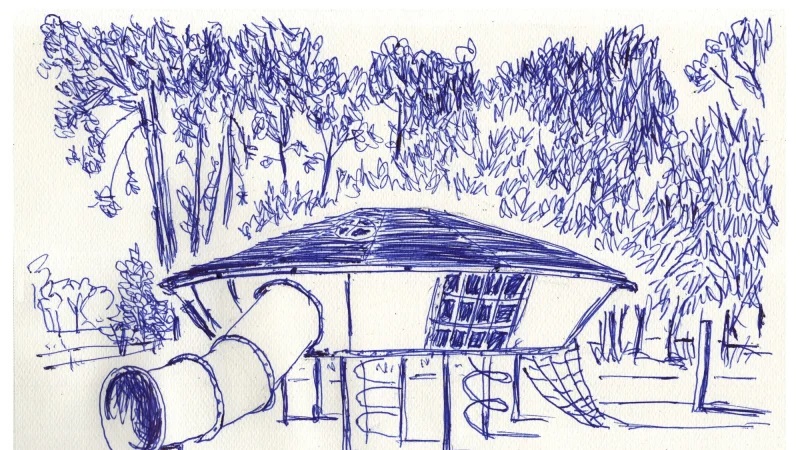
Two hundred people saw it.
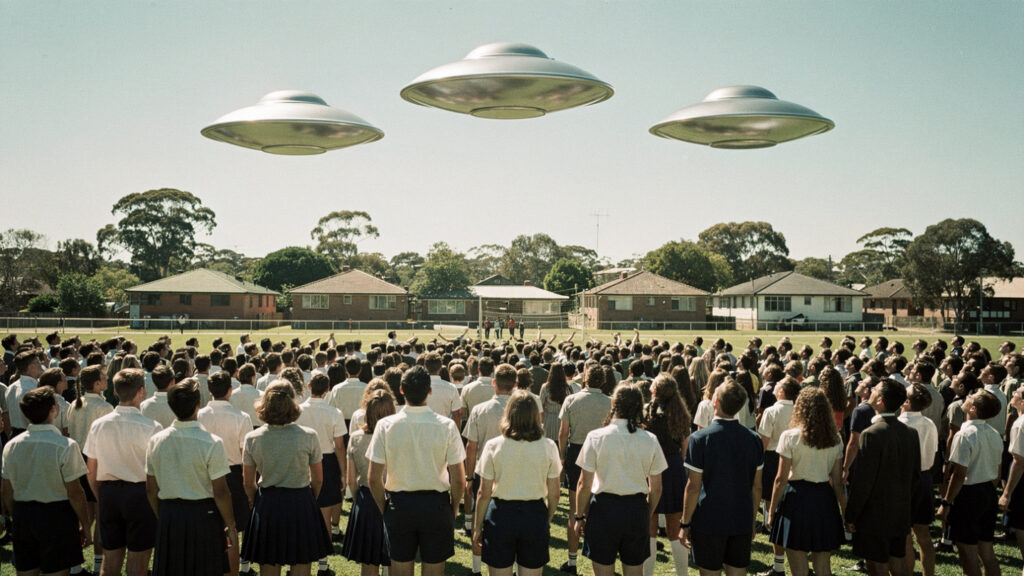
On the morning of April 6, 1966, at approximately 11 AM, students and teachers at Westall High School in Clayton South, a suburb of Melbourne, Australia, observed three metallic objects maneuvering silently through the sky above the school’s playing fields. The sighting occurred in broad daylight, in an urban suburban environment, with witnesses distributed across the school’s grounds and in the surrounding public area.
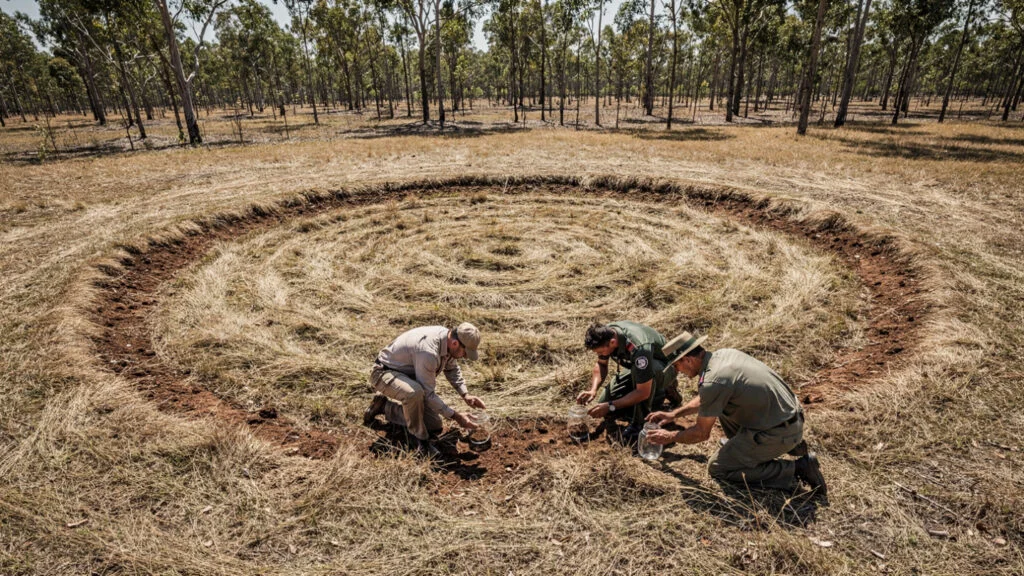
The objects descended toward a nearby open paddock called The Grange, landed or hovered at low altitude for a period that witnesses estimated between several minutes and twenty minutes, and then departed at high speed. When witnesses reached the landing area, they found circular depressions in the flattened grass with well-defined perimeter edges whose character distinguished them from the random flattening that wind or conventional aircraft downdraft would produce.
Emergency services arrived. Police arrived. Military personnel arrived. Government agents arrived and took soil samples from the depressions. The Dandenong newspaper covered the incident on its front page. Nine News broadcast the story in its 6 PM bulletin.
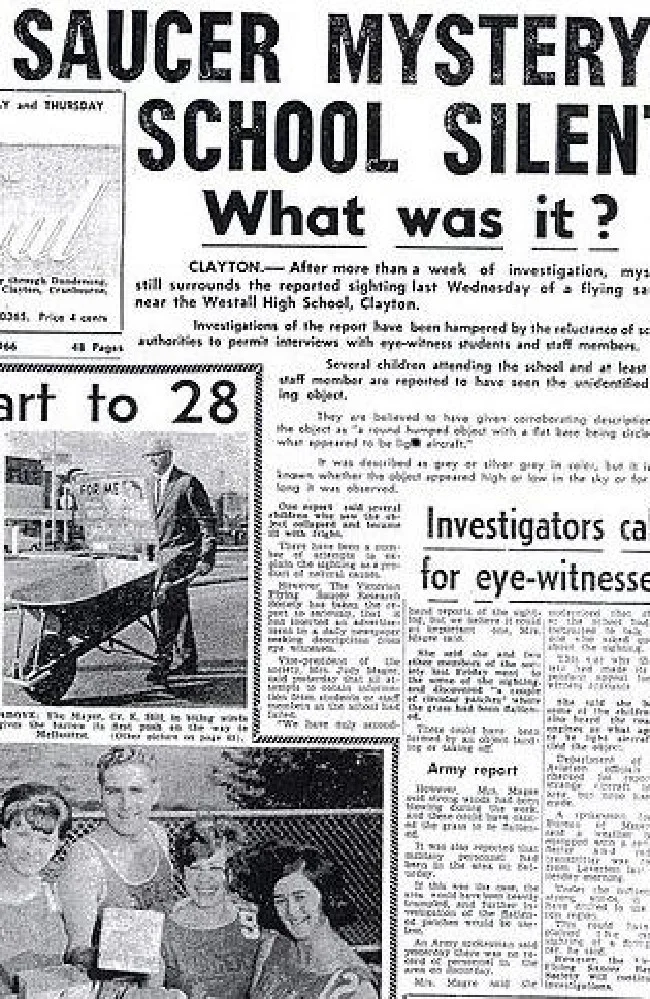
The film from the Nine News broadcast has disappeared.
The men who arrived afterward in dark suits told the students not to talk about what they had seen.
The Westall incident is recorded as the largest mass daylight UAP sighting in Australian history. More than two hundred witnesses have been recorded across Shane Ryan’s decade of investigation, including students, professional educators, and members of the public whose independent accounts show the consistency across key details that distinguishes genuine shared experience from coordinated fabrication.
The Witnesses and What They Saw
The witness accounts recorded in Ryan’s investigation and in the 2020 James Fox documentary The Phenomenon establish the Westall case’s evidentiary foundation.
Joy Clarke was twelve years old and in class when other students began running. She followed and saw three flying saucers. Her account is consistent with other student witnesses in the key details: multiple objects, metallic appearance, silent movement, and descent to low altitude before rapid departure.
Terry Peck was playing cricket in the schoolyard when he observed the object and ran after it. His account specifies a distance of approximately twenty feet from the object at its closest approach, a circular form larger than a car, and lights visible underneath. The proximity of Peck’s observation and the detail of lights underneath the object appear in his account consistently across multiple interviews.
Stephen Cairns was seven years old and walking to school with his mother when he observed a silver disk object moving at high speed before stopping directly overhead, hovering for a moment, and then departing. The behavioral sequence Cairns described, high-speed approach followed by stationary hover followed by rapid departure, is the flight profile that multiple independent witnesses described and that the HIBAL balloon hypothesis does not account for.
Hazel Edwards, an English and mathematics teacher at Westall, represents the recorded skeptical position within the witness community: she has publicly suggested that children fabricated the story and that the media engagement created sensationalism around what was not a genuine event. Whether Edwards was present at the time of the sighting and personally observed or did not observe the objects, and what her basis for the fabrication hypothesis is, is not fully established in the available record of her account.
Whether more than two hundred witnesses, including professional educators, simultaneously fabricated a consistent false account of a UAP encounter in broad daylight in an urban environment, is the evidentiary question that the fabrication hypothesis must address.
The Physical Trace Evidence
The physical trace evidence at the Westall site is the most specifically significant element of the case for the library’s framework because it connects the Westall encounter to the established physical trace research tradition and provides evidence whose existence does not depend on witness testimony alone.
The flattened grass circles with well-defined perimeter edges recorded at The Grange paddock after the objects’ departure are described consistently across multiple independent witness accounts. The character of the traces, circular with defined edges rather than irregular or random, is the pattern that physical trace researchers including Ted Phillips have recorded across multiple UAP landing sites globally and that the library’s Travis Walton soil analysis piece develops from the physical trace research tradition.
Government agents’ recorded soil sampling of the site is the institutional action that most directly establishes that the physical trace evidence was considered significant enough for scientific collection. Whether the soil samples produced results that were recorded and whether those results are in any accessible archive is not established in the current public record. The soil samples were taken. Their analysis, if conducted, has not been made public.
The comparison between the Westall physical traces and the Travis Walton site’s confirmed iron particulate anomaly is the research question that the physical trace tradition motivates: whether the Westall site, if it were sampled today using the analytical methodology that Phyllis Budinger applied to the Walton site fifty years after that event, would show chemical anomalies consistent with those recorded at other UAP physical trace sites, is a question that the available record has not addressed.
The HIBAL Hypothesis and Its Known Weakness
The 2014 discovery of files revealing the HIBAL program is the institutional disclosure that provided the first recorded official alternative explanation for the Westall encounter, and whose evidentiary limitations deserve honest assessment.
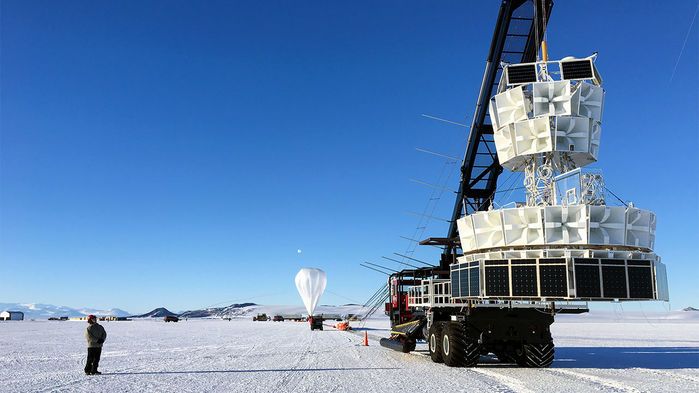
The HIBAL program was a real joint Australian-American research initiative operating between 1960 and 1969 that monitored atmospheric radiation levels using large balloons equipped with silver sensors. Each balloon carried a 180-kilogram payload and used a 12-meter diameter parachute for landing. A light aircraft followed each balloon to locate it after landing.
Keith Basterfield’s hypothesis connecting HIBAL flight 292 to the Westall incident is based on the program’s confirmed operation in the region and the color correspondence between HIBAL balloons and the objects’ described silver-white appearance. His own admission that the paperwork for the April 1966 launches, including the April 5 launch scheduled for the day before the Westall incident, appears to have been lost or destroyed, is the evidentiary gap that prevents confirmation of his hypothesis.
Whether the loss of the April 1966 HIBAL launch paperwork is a coincidence of record management or reflects the same pattern of evidence removal that multiple Westall witnesses recorded in the news film’s disappearance and the soil sample results’ non-disclosure, is the question that the convergence of missing records raises.
Ryan’s objection to the balloon hypothesis identifies the behavioral incompatibility: a HIBAL balloon descending to low altitude would deflate and would not depart at high speed, would not leave circular traces with defined edges, and would not be capable of the maneuvering that witnesses consistently described. The balloon hypothesis accounts for the object’s general appearance and its presence in the area. It does not account for the behaviors that distinguish the Westall encounter from a balloon recovery incident.
Whether a balloon recovery operation involving a light aircraft tracking a descending payload could have produced the visual impression of three maneuvering metallic objects to 200 witnesses, and whether the light aircraft’s presence explains the recorded military and emergency service response, is the question that the balloon hypothesis requires addressing without the available record providing sufficient detail to evaluate it.
The Men in Suits and the Pattern
The recorded accounts of men in dark suits warning Westall witnesses not to discuss the incident are the element of the case that most directly connects it to the library’s Men in Black framework and to the broader pattern of witness intimidation following significant UAP encounters.
Multiple Westall witnesses, recorded across Ryan’s investigation, described being approached by men in dark suits following the incident who warned them not to discuss what they had seen. Joy Clarke’s own account specifically mentions men in black interviewing other students while she and her classmates were being told they had experienced hysteria.
Whether these men were government officials conducting legitimate classification of a sensitive military or research program whose public discussion would compromise national security, private intelligence operatives acting without formal government authority, or something whose institutional identity the available record does not establish, is the question that the multiple independent accounts of their presence and their message raises.
The message, that the witnesses were experiencing hysteria and nothing had happened, is the institutional denial that multiple UAP witness intimidation cases in the library’s framework record: the combination of explicit warning against public discussion with the assertion that the witnessed event did not occur is the operational profile recorded in the Harold Dahl, Albert Bender, and Herbert Hopkins cases developed in the library’s Men in Black piece.
Whether the Westall MIB encounters reflect the Robertson Panel’s 1953 recommendations for UAP witness management being implemented at a specific Australian site in 1966, or reflect a different institutional origin whose character the available evidence does not establish, is the question that this pattern’s consistency with the Robertson Panel’s operational recommendations raises.
The Film and What Was In It
The disappearance of the Nine News footage from the April 6, 1966 broadcast is the most specifically significant institutional evidence gap in the Westall case record.
Nine News covered the Westall incident in its 6 PM bulletin on the day of the occurrence. The footage existed. Multiple witnesses confirmed that the broadcast occurred. Whether the footage showed the objects themselves, the physical trace evidence at the landing site, or the witness interviews and emergency service response whose visual character would have established the incident’s scale and character independently of subsequent witness accounts, is not established because the footage no longer exists in any accessible archive.
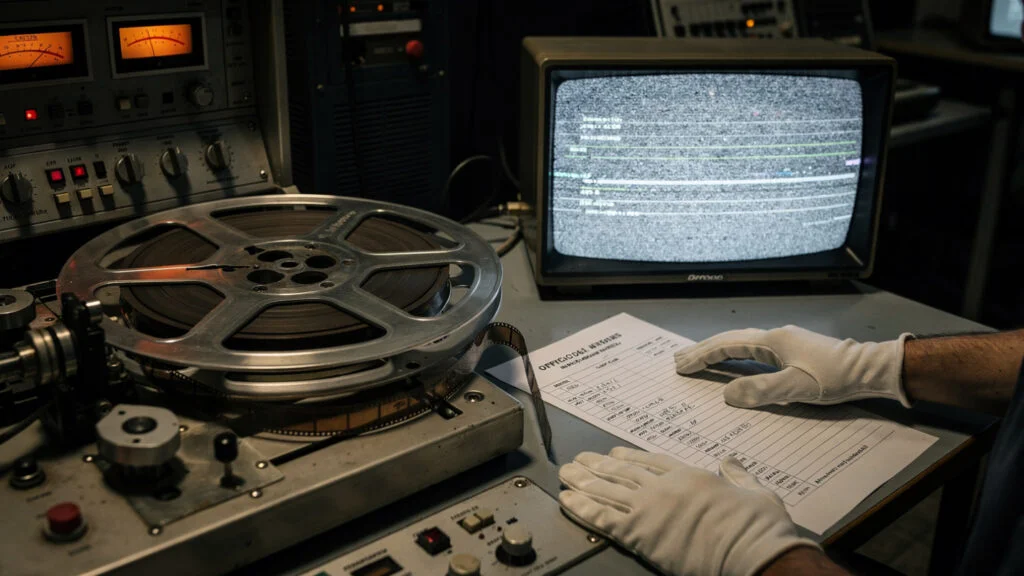
Whether the footage disappeared through the standard film archive practices of the period, which involved the well known routine destruction of broadcast footage to reclaim expensive film stock before magnetic tape became standard in Australian television production, or through a deliberate removal whose institutional authorization is not recorded, is the question that the footage’s absence raises.
The convergence of the news film’s disappearance, the HIBAL launch paperwork’s loss, and the soil sample results’ non-disclosure creates a recurring pattern of missing evidence that each individually has a plausible institutional explanation and that collectively raises the question of whether the pattern reflects systematic evidence management rather than coincidental record loss.
What the Case Establishes
The Westall encounter’s evidentiary profile, two hundred simultaneous daylight witnesses, professional educator observers, recorded physical trace evidence, government soil sampling, institutional witness intimidation, and a systematic pattern of missing records, places it in the highest tier of well attested UAP cases by the library’s evidentiary standard.
It is not the most dramatic UAP case on record. It produced no recovered materials, no hospitalized witnesses, and no institutional confirmation of non-human origin. What it produced is a combination of witness quality, physical trace evidence, and institutional response pattern whose convergence makes it one of the most difficult single cases to account for through any conventional explanation.
The HIBAL balloon hypothesis accounts for the object’s appearance. It does not account for the behavioral profile, the physical traces, or the institutional response.
The hysteria hypothesis accounts for the students’ accounts. It does not account for the professional educators’ consistent independent accounts, the physical traces, or the institutional response.
The deliberate fabrication hypothesis accounts for none of the recorded institutional response including the soil sampling, the military presence, the news coverage, or the MIB witness intimidation.
Whatever maneuvered over Westall High School on the morning of April 6, 1966, two hundred people saw it, government agents sampled the ground where it landed, men in dark suits told the witnesses they had seen nothing, and the film that showed it disappeared.
The grass circles had defined edges.
Something made them.