The man who commissioned the Georgia Guidestones used a name that was not his own. The people he claimed to represent never publicly identified themselves. He paid for a massive granite monument in rural Georgia, demanded that its message survive him, and then disappeared back into ordinary life. For forty-two years, the stones stood on a hill outside Elberton, carrying ten instructions for the civilization that might remain after catastrophe. On July 6, 2022, someone arrived before dawn and blew part of the monument apart. As of the summer of 2026, four years later, the man who built the Guidestones remains officially unidentified, the organization he claimed to represent remains unverified, and the person who destroyed the monument remains unidentified too.
That is the real Georgia Guidestones mystery. Not whether the stones were proof of the New World Order. Not whether they were secretly satanic. Not whether an ancient civilization inspired them. The harder mystery is considerably more mundane and therefore more disturbing: who had enough money, conviction and patience to construct an enormous monument whose stated purpose was to guide humanity after civilization had nearly destroyed itself? And why did that anonymous project attract such extraordinary hatred that, decades later, somebody finally decided the only solution was to destroy the stones themselves?
The Stranger Who Walked Into Elberton
In June 1979, a well-dressed stranger walked into the offices of the Elberton Granite Finishing Company in Elberton, Georgia. He introduced himself as R.C. Christian and asked about constructing a monument from enormous granite slabs. The company’s president, Joe Fendley, initially assumed the project was unrealistic. The proposed structure was larger and more elaborate than anything the company had previously undertaken, and Fendley reportedly gave the stranger an intentionally high estimate in the hope that the problem would disappear on its own.
It did not. Christian accepted the price.
He then explained the first layer of the mystery: R.C. Christian was not his real name. He said he represented a small group of Americans who wanted to remain permanently anonymous. According to the surviving accounts of the people involved, the group had contemplated the monument for years and wanted it constructed as a message for future generations.
Fendley directed Christian to Wyatt Martin, president of the local Granite City Bank. Martin agreed to act as financial intermediary, but he wanted to know who he was dealing with. Christian eventually disclosed his real identity to Martin under conditions of confidentiality. Martin later maintained that he knew who the mysterious sponsor really was, but he refused to reveal the name.
And he kept that secret for more than four decades. Martin died in 2021, a year before the monument itself was destroyed, having never revealed the name on record.
Why Georgia?
The choice of Elbert County was not arbitrary. Elberton was already famous for its granite industry, and Christian wanted the monument made from local stone. The site eventually selected was a five-acre tract north of Elberton, on one of the highest points in the county, with an unobstructed horizon that allowed the monument’s astronomical functions to work.
Christian also reportedly had a personal connection to Georgia: his great-grandmother had been a native of the state. But there was another reason for the location. The monument was supposed to stand somewhere relatively remote, away from major population centers, while still being accessible enough to construct.
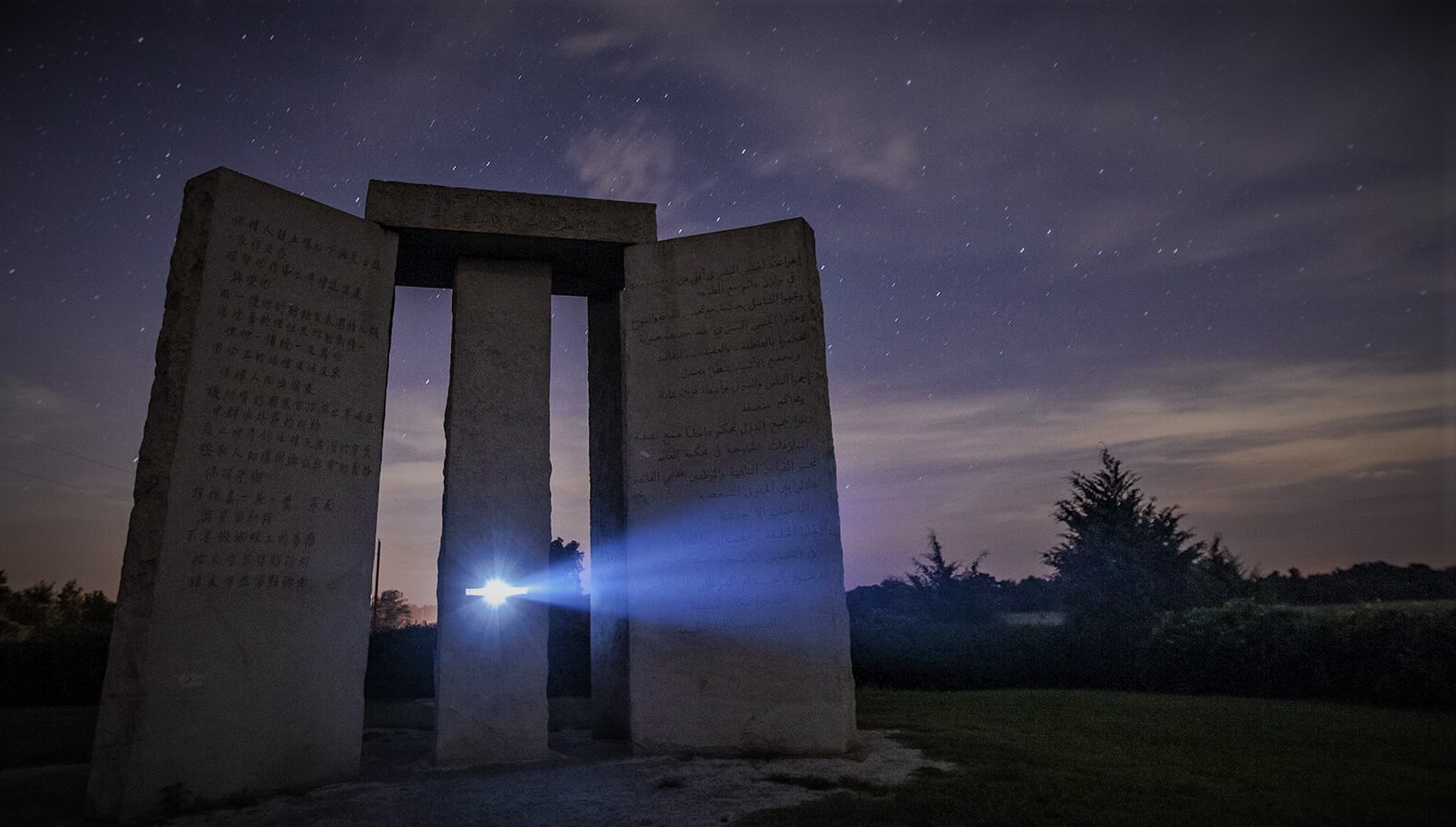
The result was not a small roadside curiosity. It was an engineered granite structure nearly twenty feet high, composed of six major stones weighing roughly 240,000 pounds in total. Five stones formed the main structure and a sixth served as the capstone. The four outer slabs were arranged around a central stone and precisely oriented to the sky.
The Monument Was Not Calling Itself a Commandment
The words carved into the stones became famous as the “Ten Commandments” of the New World Order. That description is catchy, but it was not the language of the monument’s sponsors. The Guidestones called them guides. An accompanying tablet described them as principles intended to guide humanity into an “Age of Reason.”
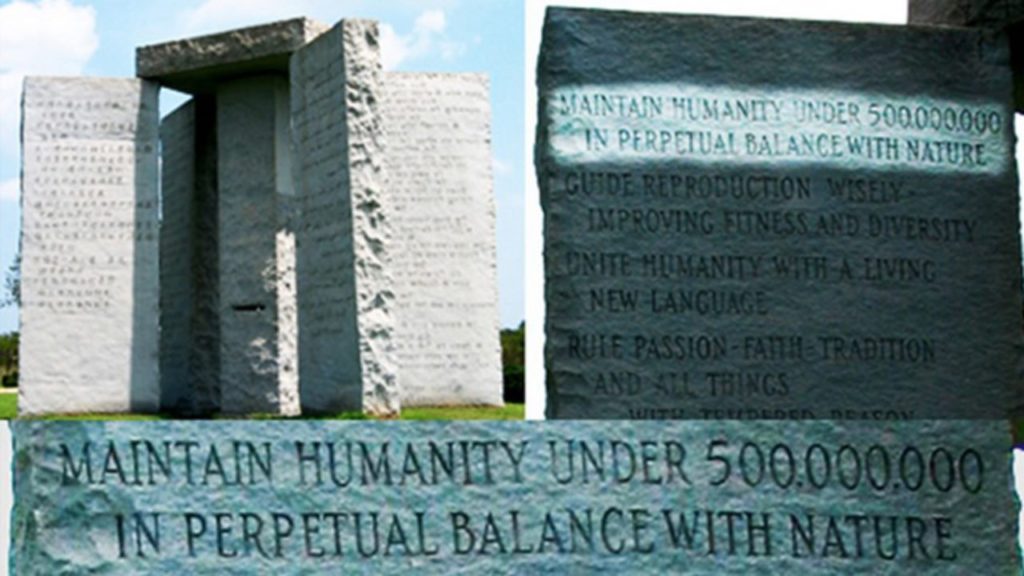
That distinction matters because the original explanatory material explicitly rejected the idea that the inscriptions were commands imposed by an authority. The surviving text presents them as propositions for future generations to consider, not laws issued by a government that already exists.
But then comes the problem: some of the propositions are genuinely radical.
The Ten Guidelines
The monument’s central message was engraved in eight modern languages: English, Spanish, Swahili, Hindi, Hebrew, Arabic, Chinese and Russian. The four major stones each carried inscriptions in two languages. The selection was deliberately international, designed to reach people across linguistic and political boundaries rather than a single national audience.
The ten principles were:
1. Maintain humanity under 500,000,000 in perpetual balance with nature.
2. Guide reproduction wisely, improving fitness and diversity.
3. Unite humanity with a living new language.
4. Rule passion, faith, tradition, and all things with tempered reason.
5. Protect people and nations with fair laws and just courts.
6. Let all nations rule internally, resolving external disputes in a world court.
7. Avoid petty laws and useless officials.
8. Balance personal rights with social duties.
9. Prize truth, beauty, love, seeking harmony with the infinite.
10. Be not a cancer on the Earth. Leave room for nature.
There is no need to exaggerate them. The first two are enough.
The Number 500 Million
In 1980, the world’s population was already around 4.4 billion. The first Guidestone therefore proposed maintaining humanity at fewer than 500 million people, a number roughly one-ninth of the population then living on Earth. That is not a minor environmental recommendation. It is an enormous demographic reduction when read literally against the world of 1980.
This is where the Guidestones became almost impossible to interpret innocently.
The sponsors did not carve a method for reaching 500 million. They did not specify forced sterilization, war, famine, abortion, contraception or any other mechanism of population reduction. Nor does the inscription itself explicitly say that the world’s existing population should be killed or rapidly reduced to reach the target. It states an eventual condition: humanity under 500 million, in perpetual balance with nature.
That ambiguity became the fuel for everything that followed.
The Second Guideline Is Even More Uncomfortable
“Guide reproduction wisely, improving fitness and diversity” sounds almost clinical. That is precisely why it attracted accusations of eugenics.
The word fitness has an unmistakable biological meaning, and “guiding reproduction” can imply deliberate control over who reproduces and which traits are considered desirable. The wording does not establish a coercive eugenic program, but neither is it unreasonable for readers to hear the language of twentieth-century population engineering in it.
The Guidestones therefore occupy an uncomfortable space. Their defenders can reasonably point to the monument’s broader language about reason, rights, justice and human unity. Their critics can reasonably point to the first two principles and ask who gets to decide what population is “in balance,” what reproduction is “wise,” and which traits count as “fitness.” The text never answers those questions.
But Eight of the Ten Guidelines Are Not Calls for Mass Murder
This is where the mythology often becomes less honest than the stone itself. The remaining principles advocate a common language, tempered reason, fair laws, international dispute resolution, fewer unnecessary officials, a balance between individual rights and social duties, truth and beauty, and leaving room for nature.
Some are authoritarian-sounding. Some are idealistic. Some are vague enough to support almost any political interpretation. But they are not instructions for extermination.
The call for a “world court,” for example, can be interpreted as a form of global governance. But international institutions and international courts were hardly alien concepts in 1980. The United Nations and the International Court of Justice already existed. The Guidestones’ language belongs to the broader twentieth-century argument over whether humanity could avoid war by developing institutions above the nation-state, the same broad category of language critics have since applied to other, entirely separate projects, a very different agenda for global governance among them.
The monument was strange enough without turning every reference to international cooperation into evidence of a secret world government.
Then There Was the Sky
The Guidestones were not merely a collection of political slogans carved into granite. They were deliberately engineered as an astronomical instrument.
A hole through the central stone was aligned with the celestial north pole, allowing Polaris to be observed through the opening. A slot in the central stone was aligned with the positions of the sun around the solstices and equinoxes. An aperture in the capstone allowed sunlight to fall onto the central stone at noon, producing a marker that could be used to track the progression of the year.
The outer stones also incorporated astronomical orientation, including the limits of the Moon’s apparent north-south movement over its cycle. The monument was therefore simultaneously a statement, a calendar and an engineered marker of the heavens. Contemporary documentation from the Elberton granite industry confirms the astronomical design and the precision with which the stones were positioned.
That creates one of the Guidestones’ most interesting contradictions. The monument was supposedly intended for humanity after catastrophe, yet it was built with knowledge that only makes sense if someone expects future survivors to recover sophisticated astronomical information from the ruins of the present.
The Ancient Languages Were Not a Code to the Past
The shorter inscription on the capstone used four ancient writing systems: Babylonian cuneiform, Classical Greek, Sanskrit and Egyptian hieroglyphics. The choice is undeniably theatrical. It places the Guidestones inside a symbolic lineage of civilizations that preserved knowledge in stone long after their political systems disappeared.
But there is an important difference between symbolic antiquity and archaeological continuity. There is no established evidence that the Guidestones were built according to an ancient Mesopotamian, Egyptian or Hindu architectural blueprint. The use of ancient scripts demonstrates that the anonymous sponsors wanted the monument to evoke civilizations whose knowledge had survived their creators. It does not demonstrate a hidden connection between those civilizations and the people who built the stones in Georgia.
So Who Was R.C. Christian?
This is the question that has generated the most speculation and the least certainty.
Wyatt Martin remains central to the story because he was the one person publicly known to have been entrusted with Christian’s real identity. Martin maintained the confidentiality for the rest of his life. He died in 2021, taking the secret with him.
That does not mean nobody else knew. Christian obviously knew. Members of the alleged sponsoring group, if the group existed as described, would have known. People involved in the financial and legal transactions would have encountered pieces of the project. But Martin was the crucial surviving witness who explicitly claimed to know the name and refused to disclose it.
And then a candidate emerged.
Herbert Hinie Kersten: A Serious Lead, Not a Solved Identity
A 2015 documentary, Dark Clouds Over Elberton, argued that R.C. Christian was Herbert Hinie Kersten, an Iowa physician who died in 2005. The case drew on biographical connections, documentary research and information associated with Wyatt Martin and the Christian correspondence.
Kersten is therefore not an invented name pulled from an anonymous internet post. He is a genuine historical candidate. But “candidate” is the word that matters.
No public document has conclusively demonstrated that Herbert Kersten was R.C. Christian. Martin did not publicly confirm the identification. The documentary’s case remains circumstantial rather than a forensic identification. Repeating “R.C. Christian was Herbert Kersten” as settled fact goes beyond the available evidence.
The distinction is particularly important because identifying Christian as one individual would radically change the story. A secret international organization would become unnecessary. The Guidestones could instead be understood as the monument of one wealthy or highly motivated individual, perhaps acting with a small circle of like-minded people, whose worldview was sufficiently unusual that he wanted it carved into granite and preserved for centuries.
That explanation is less cinematic. It may also be closer to the truth.
The Rosicrucian Clue
The initials “R.C.” have naturally attracted attention because of Christian Rosenkreuz, the legendary founder of the Rosicrucian tradition, whose life dates to roughly 1378-1484 in that movement’s own founding documents. Add the mysterious identity, the emphasis on hidden knowledge, the astronomical symbolism and the ancient languages, and the association becomes almost irresistible.
But irresistible is not the same as proven.
The name R.C. Christian may indeed have been chosen as a deliberate Rosicrucian reference. It may also have been chosen simply as a symbolic Christian pseudonym. The surviving evidence does not establish that the sponsor belonged to a Rosicrucian organization, much less that the monument was commissioned by one.
No recognized Rosicrucian organization publicly claimed responsibility for the monument. That absence does not prove that no private connection existed. It simply means the leap from “the name resembles Christian Rosenkreuz” to “the Rosicrucians built the Guidestones” is unsupported.
What Christian Actually Wanted
The surviving writings associated with the project offer a far more revealing clue than most conspiracy theories do. The sponsors described the Guidestones as something intended to preserve knowledge and principles through an age of catastrophe. The monument was supposed to remain after the systems that built it had disappeared.
That changes the interpretation of the entire structure.
The stones were not necessarily predicting the apocalypse. They were designed around the possibility that civilization might experience a catastrophe severe enough to destroy governments, institutions and much of the population. Nuclear war was an obvious fear in 1979. The Cold War was still active. The United States and Soviet Union possessed enormous nuclear arsenals. The possibility of civilizational collapse was not an eccentric concern confined to conspiracy theorists.
The Guidestones can therefore be read as a kind of message in a bottle from the late Cold War: if we destroy ourselves, here are the principles someone thinks the survivors should remember.
Why the Monument Became a Conspiracy Object
Its ingredients were almost perfectly designed to generate suspicion.
A wealthy anonymous sponsor. A secretive group. A false name. A remote location. Ancient writing systems. Astronomical alignments. Population reduction. Reproductive guidance. A world court. A mysterious financial intermediary. And a monument whose message seemed to address a future in which most of the people alive when it was built might no longer exist.
There was almost no way for the Guidestones to remain merely a piece of public art.
By the internet age, they had become a kind of physical Rorschach test. Environmentalists could see radical conservation. Humanists could see secular rationalism. Survivalists could see instructions for rebuilding civilization. Religious conservatives could see an attack on biblical morality. New World Order theorists could see an encoded declaration of global population control.
Everyone found something.
The “Satanic” Monument That Never Called Itself Satanic
Religious opposition intensified over the decades. Some critics interpreted the population and reproduction guidelines as evidence of satanic or occult intentions. Others associated the stones with Freemasonry, Rosicrucianism, the Illuminati or a supposed New World Order.
But none of those labels was established by the monument’s documented history. The stones contained no explicit invocation of Satan, no declaration from an occult organization and no authenticated document identifying the sponsors as members of a secret global government.
That does not mean the monument was ideologically neutral. It plainly was not. The first two guidelines express controversial ideas about population and reproduction. The call for a world court expresses a particular vision of international governance. The demand to balance individual rights against social obligations expresses a political philosophy. The monument was making an argument about what civilization ought to become.
It simply was not necessary to invent a secret satanic organization to make that argument controversial.
The Stones Were Vandalized Before They Were Bombed
The Guidestones did not live quietly for forty-two years. They were repeatedly vandalized, painted and targeted by people who regarded the monument as a symbol of hidden power. Graffiti transformed the clean granite into a battlefield of competing ideologies.
That history matters because the 2022 bombing did not emerge from nowhere. The monument had spent decades attracting people who believed its words were not simply strange but dangerous, including, most visibly, a sitting political candidate.
July 6, 2022
Just after 4 a.m. on July 6, 2022, an explosive device detonated at the Guidestones. Surveillance footage captured the blast and showed a person leaving the area in a gray sedan. One of the four principal slabs was destroyed and the capstone was badly damaged. District attorney Parks White stated publicly that whoever was responsible would face a minimum of twenty years in prison once identified.
Then something happened that permanently changed the investigation. Authorities demolished the remaining structure later that day, citing safety concerns. The monument that had survived decades of controversy, vandalism and weather was suddenly reduced to rubble by an act of deliberate destruction followed by an official decision to remove what remained.
That decision generated its own controversy because the remaining stones were potentially evidence as well as cultural artifacts. Once the structure was demolished, investigators and historians lost the opportunity to examine the intact monument in situ.
A fabricated news story claiming a “schizophrenic man” had been arrested and convicted circulated online within weeks. It was invented. No such arrest and no such conviction ever occurred.
What the AJC Found Four Years Later
In March 2026, the Atlanta Journal-Constitution and the production company Goat Rodeo released a six-part investigative audio series, Who Blew Up the Guidestones?, led by journalist Tyler McBrien. The investigation surfaced a real, previously under-reported thread. Five days after the bombing, a swatting call, a fake 911 report of a shooting, appeared to originate from the home of Kandiss Taylor, a 2022 Georgia gubernatorial candidate who had run on the slogan “Jesus, Guns & Babies,” publicly called the Guidestones “Satanic,” and pledged to remove them if elected. Investigators traced a possible suspect behind the swatting call to Indiana. The FBI interviewed the man, he didn’t confess, and no charges were filed. That swatting investigation closed without resolving anything about the actual bombing. Taylor has since directly denied any role in the destruction on the AJC’s own podcast.
As of the bombing’s fourth anniversary in July 2026, no suspect has been named and no arrest has been made in the explosion itself.
So the second mystery surrounding the Guidestones has the same structure as the first.
Someone knows. We do not.
The Most Extraordinary Coincidence
The Guidestones were designed to survive catastrophe. Their sponsor wanted future people to find them after the institutions of the present had failed. The monument’s entire philosophy assumed that granite could preserve an idea longer than governments could preserve themselves.
It survived for forty-two years.
Then a person with explosives destroyed it in less than a minute.
There is something almost perfectly symbolic about that ending. The anonymous sponsor feared the destruction of civilization by forces on a historical scale: nuclear war, social collapse, ecological catastrophe. The monument was built as an answer to the end of the world.
But its actual end was much smaller.
One person. One device. One vehicle. One early morning.
The Organization Behind R.C. Christian
This may be the greatest unresolved question of all.
Christian said he represented a group of Americans who wanted to remain anonymous. There is evidence that money and planning were real. The monument was unquestionably commissioned and paid for. But no independently verified public record has established the full membership, structure or continuing existence of that group.
Perhaps it was a genuine organization. Perhaps it was a small circle of wealthy friends. Perhaps Christian was speaking for little more than himself and used “the group” to create distance between his personal identity and the monument. Perhaps there were other people whose names will never surface.
The evidence does not allow us to choose confidently among those possibilities.
What the Guidestones Were Actually Saying
Remove the mythology and the message becomes stranger, not simpler.
The anonymous sponsors believed humanity needed to think beyond the political boundaries of the present. They believed nature required protection. They believed reproduction should somehow be guided. They believed population should be drastically lower. They believed humanity might require a common language and a mechanism for resolving disputes at a global level. They believed reason should restrain passion and tradition. They believed the monument should survive long enough to speak to people who might live centuries after its creators were forgotten.
Those ideas contain utopianism, environmentalism, technocracy, internationalism and unmistakable echoes of population-control thinking. Some are admirable. Some are deeply troubling. Some are vague enough that their meaning depends almost entirely on who is interpreting them.
But there is one thing the evidence does not establish. It does not establish that the Guidestones were an official manifesto of the Illuminati, the United Nations, the Freemasons, the Rosicrucians or a secret New World Order.
The monument was mysterious because its authors wanted to remain mysterious. Everything else grew in the vacuum that secrecy created.
The Granite Is Gone. The Argument Isn’t.
Today the original Georgia Guidestones no longer stand on that hill in Elbert County. The granite monument is gone. The astronomical alignments are gone. The physical object that attracted pilgrims, skeptics, conspiracy theorists, journalists and vandals for four decades is gone.
But the questions survived.
Who was R.C. Christian? Was Herbert Hinie Kersten really the man behind the pseudonym, or merely the strongest candidate ever proposed? Did the mysterious “group of Americans” actually exist as an organized body? Why did an anonymous sponsor spend enormous sums of money constructing a monument designed to speak to people who might not exist for centuries? And who decided, forty-two years later, that the stones should not be allowed to speak anymore?
The first mystery may eventually be solved by a document, a surviving letter, a financial record or a confession. The second may eventually be solved by forensic evidence, surveillance footage or an arrest, and a real, ongoing investigative effort, the AJC’s own podcast among them, is still actively trying. But for now both mysteries have the same ending: the person who could answer the question is somewhere outside the historical record, and the people who might have known are either silent or dead.
R.C. Christian built the Georgia Guidestones so that humanity might remember something after the old world was gone. Someone else made sure the stones themselves would not be there to remember it.