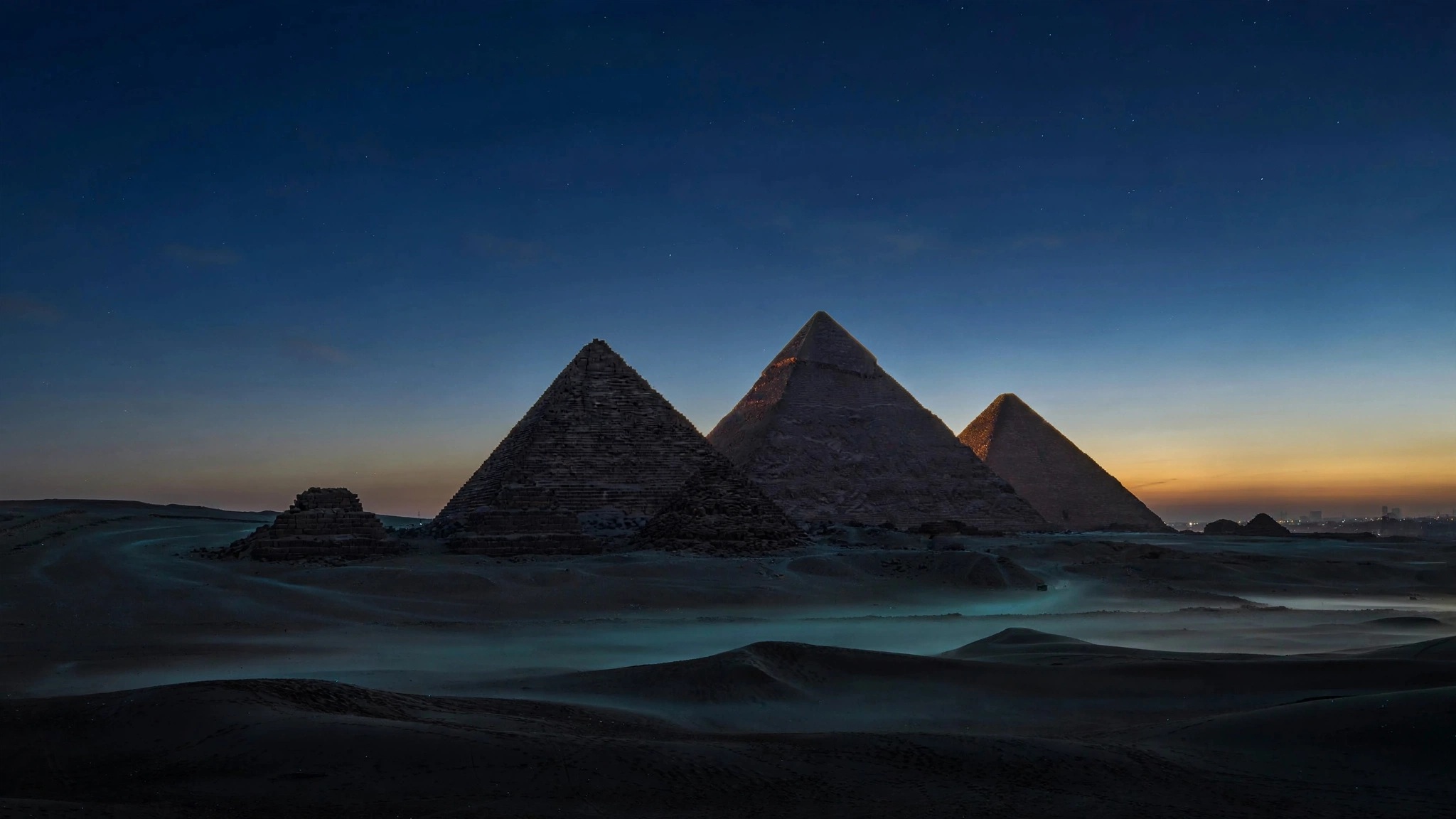
In the fifth century BC, the Greek traveller Herodotus stood at the foot of the Great Pyramid and asked the priests how it had been built. They gave him numbers. A hundred thousand men, working in shifts of three months. Ten years to build the causeway for hauling the stone, and twenty more to raise the pyramid itself. Herodotus wrote it all down, and the pyramid was already two thousand years old when he did.
Egypt has been producing questions like that ever since, and answers to match: some carved in stone by the people who were there, some written down by visitors centuries later, and some invented last week and shared a million times. The difference between those three kinds of answer is what Monkey & Elf exists to find.
This page gathers our Egypt case files into one path, in the order history happened. Each file traces a claim back to the earliest record we could find, the excavation report, the papyrus, the inscription or the original survey, and each one ends with a verdict. Some of Egypt’s mysteries collapse the moment you check the source. Others are stranger than the legends built on top of them. A few are still open, and we say so.
Before the Pharaohs
Long before anyone wore a crown, the Nile valley was full of villages burying their dead with care, and the beliefs that became Egyptian religion were forming in those graves. The story of the first kings begins there, in cemeteries and in the first scratched signs of writing.
The Adaima tombs. A 2025 study of more than five hundred burials at Adaima, in Upper Egypt, traces the roots of Egyptian religion to ordinary villagers, centuries before the pharaohs. One grave holds a teenage girl whose right hand was removed after death.
The decorated ostrich egg. The triangles on a predynastic egg from near Aswan were said to show the Giza pyramids, a thousand years before they were built. The real story leads to the tomb of the Scorpion King and some of the oldest writing in the world.
Narmer, the first pharaoh. A stone palette from a temple of Horus shows a king in the white crown of the south and the red crown of the north. Seals from the royal tombs at Abydos put his name first. The Egyptians themselves remembered a founder called Meni, and who he was is still argued over.
Giza and the Pyramid Builders
The Great Pyramid is the most measured building on Earth, and every measurement has produced a theory. What is less well known is how much the builders left behind about themselves: their marks, their logbooks and the names of their work gangs. In 2013, at Wadi al-Jarf on the Red Sea coast, archaeologists found the papyrus logbook of an official named Merer, who recorded shipping limestone to Giza for Khufu’s pyramid. It is the oldest inscribed papyrus ever found.
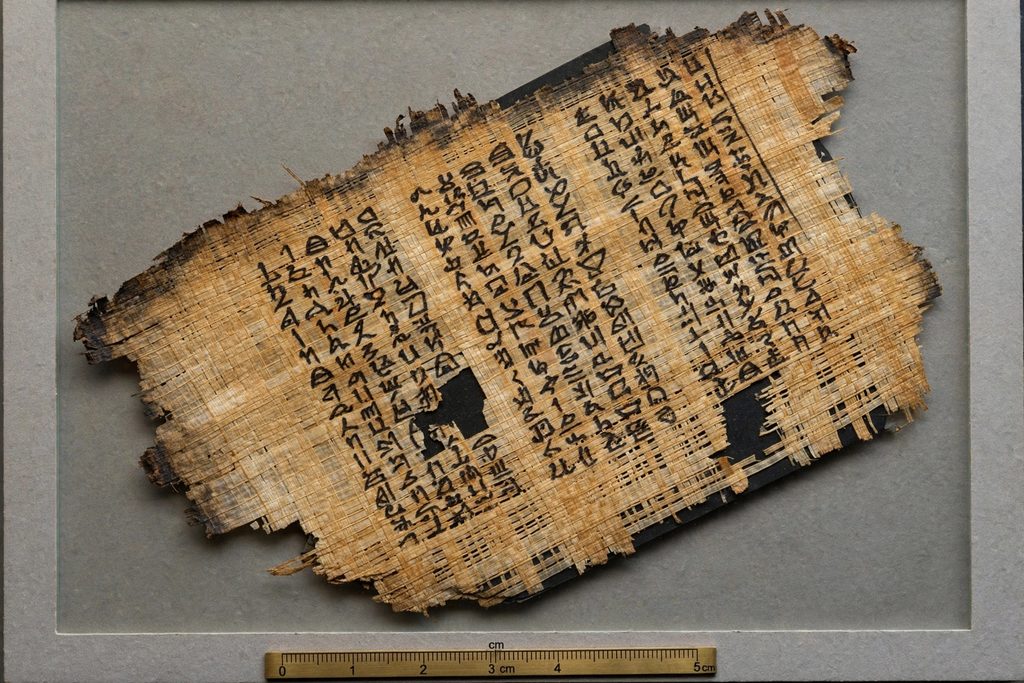
The painted marks inside the Great Pyramid. The Great Pyramid is often called a building without a single word inside it. In 1837 Richard Vyse found the painted quarry marks of the work gangs in the chambers above the King’s Chamber, with Khufu’s name among them. They are why we can attribute the pyramid to him.
The pyramid and the number pi. Divide the base perimeter of the Great Pyramid by twice its height and you get a number very close to pi. A message encoded on purpose, or a side effect of the way the builders measured?
The pyramid that focuses radio waves. In 2018 physicists at ITMO University in St. Petersburg published a computer model in the Journal of Applied Physics showing that the pyramid concentrates certain radio-wave energy in its chambers and below its base. The study is real. What it means is a separate question.
The fourth pyramid of Giza. In 1737 the Danish naval officer Frederick Norden, sent to record Egypt’s monuments for his king, counted four great pyramids at Giza. Only three stand there today, and nobody has found the fourth.
What Ibn Battuta wrote about the pyramids. The fourteenth-century traveller is quoted in stories about a pyramid that “woke up”. His own words, from his Rihla, say something much plainer, and arguably more honest.
Tesla and the pyramids. In 1905 Tesla calculated a resonance of the Earth close to one that would only be measured decades later. How that became a legend about pyramid power plants is a lesson in how true facts get stitched into false stories.
The speed of light at Giza. The Great Pyramid’s latitude, 29.9792 degrees north, matches the first digits of the speed of light. So, it turns out, do about two thousand other places on Earth.
The beetle that could fly. A respected Soviet entomologist claimed that beetle wing-cases let him float above Siberia, and his story was later tied to Khepri, the scarab god of the rising sun, and to the building of the pyramids. Where the naturalist ends and the myth begins.
Newton and the Great Pyramid. Isaac Newton studied the pyramid’s dimensions to recover the ancient cubit, as part of research he never published. Legend says his dog knocked over a candle and burned the rest.
The Sphinx
The Great Sphinx has no inscription of its own, no builder’s name and no date. That silence is why it attracts more theories than any other statue in the world, and why the files below need to be read together.
The Sphinx without a name. The Sphinx is usually credited to Khafre, but no contemporary text says so. The case for Khafre rests on its position beside his pyramid and causeway, and some early experts thought it older.
The chamber beneath the paws. A seismic survey in the early 1990s recorded a rectangular cavity in the rock beneath the Sphinx’s paws. Then the permits for that kind of work stopped.
The three tunnels in the Sphinx. There really are tunnels in the Sphinx: a hole drilled into its back in 1837, a passage at its rump and a shaft in its head. Mark Lehner and Zahi Hawass mapped all three, and none of them leads where the prophecies said.
Edgar Cayce’s Hall of Records. In the 1930s, Cayce said a hall of records lay beneath the Sphinx’s paw. In 1996 a survey found a void in roughly that place. Coincidence, or something more? The file separates what was found from what was foretold.
The Sphinx and the star Regulus. A North Carolina contractor’s 2007 encounter led, by his account, to NASA and to intelligence briefings, and to Regulus, the star that rises in line with the Sphinx’s gaze.
Beneath the Sand
Egypt’s most persistent modern legends are about what lies underground: sealed chambers, lost labyrinths, whole cities under the plateau. Some of the underground structures are real and still not fully explained. Others exist only in press releases.
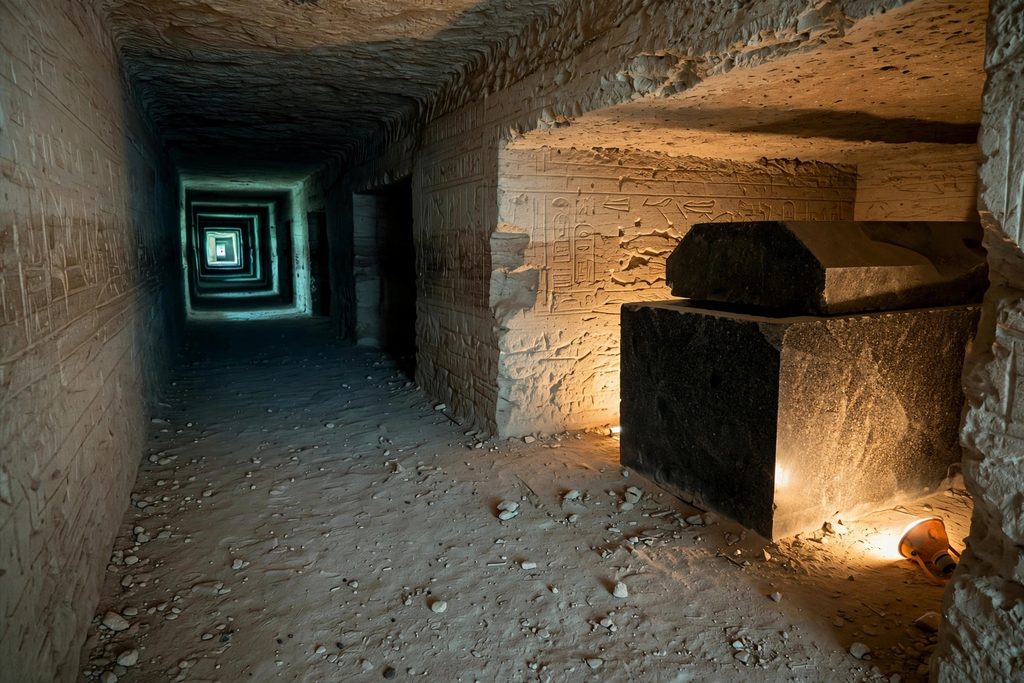
The Osiris Shaft. A shaft cut through three levels of rock beneath the Giza plateau, with granite sarcophagi on its lowest floor and water around them, cleared by Zahi Hawass’s team in 1999.
The Serapeum of Saqqara. Auguste Mariette broke into it in 1850: a gallery cut into the bedrock with twenty-four stone boxes weighing up to seventy tons each, made, by the standard account, for the sacred Apis bulls. How they were moved into those narrow tunnels is still argued over.
The labyrinth at Hawara. Herodotus described a labyrinth of three thousand rooms, greater than the pyramids. A 2008 survey found structures under the sand, and its full results were never published. The reason is less dramatic than a cover-up.
Zawyet el-Aryan. Six kilometres south of Giza lies a vast unfinished pit, excavated in the early 1900s and now inside a military zone. What was found there, and why nobody has been allowed back in.
The “city” under Khafre’s pyramid. In March 2025 a team announced shafts and halls kilometres deep beneath the second pyramid. Zahi Hawass called it fake news, and the journal Remote Sensing later retracted an earlier paper by two of the same researchers.
The radar behind the claim. The satellite Doppler tomography behind the Khafre announcement, what the team said it saw, and why it was presented at press conferences instead of in a peer-reviewed journal.
Kings, Queens and Physicians
Behind the monuments were people, and some of their stories have been bent out of shape by retelling. These files go back to the bodies, the tombs and the objects.
Akhenaten. The pharaoh who replaced the gods with the sun disk had himself portrayed with a long face, a swollen belly and strange proportions, which inspired a hundred theories. Whose body lies in tomb KV55 is still debated, even after DNA testing.
Tutankhamun’s pectoral. Among the more than three thousand objects in the boy king’s tomb is a gold breastplate showing a scarab, a solar boat and a crescent moon. What its symbols meant to the people who made it.
Queen Henut. A viral story about a Saqqara queen and a supernova borrowed the name of a real woman, a minor wife of Amenhotep III. Meanwhile the real discoveries of queens at Saqqara are stranger than the invented one.
Tetinebefou, the pharaoh’s physician. In January 2025 a French-Swiss team announced the 4,100-year-old tomb of a royal doctor at Saqqara. It needed no curse to be remarkable.
Cocaine in the mummies. In 1992 a German toxicologist reported traces of cocaine and nicotine in Egyptian mummies, substances thought to come only from the Americas. The file follows the result, and the old newspaper legend of an Egyptian colony in the Grand Canyon that it gets tangled up with.
Gods, Stars and Secret Books
The Egyptians built their temples to line up with the sky and wrote down the lives of their gods. Later centuries added secret books and lost wisdom of their own invention. These files sort one from the other.
The gods who grew old. In Egyptian myth the sun god Ra ruled Egypt as its first king and grew old and weak, and Osiris was killed and cut to pieces. These were not timeless gods, and the texts describe them in strangely physical terms.
The sun at Abu Simbel. Twice a year, on 22 February and 22 October, the rising sun shines sixty-five metres into the rock-cut temple of Ramesses II and lights three of the four statues in the sanctuary. The fourth, Ptah, stays in darkness.
The Book of Thoth and the Tarot. In 1781 a French scholar declared that tarot cards were the lost Book of Thoth. Tarot was really invented in fifteenth-century Italy, but his idea went on to shape two centuries of occultism.
The Tulli Papyrus. A papyrus said to describe fiery discs over Egypt in the reign of Thutmose III is the cornerstone of “ancient UFO” claims. Nobody has ever been able to produce the original.
How to Read the Files
Every case file carries a verdict, and they are not all the same. Documented means the claim holds up against the primary record. Disputed means serious evidence points in more than one direction. Debunked means the story does not survive its own sources. Unresolved means the record runs out before the question does. Read the stamp on each file before you read the file. Egypt is not a single mystery, it is hundreds of them, each with its own paper trail.
If you are new here, start where Egypt started, with Narmer and the Scorpion King. If you came for the pyramids, begin with the painted marks Vyse found above the King’s Chamber, the closest thing the builders left to a signature. And if you came for the chambers under the sand, read the Osiris Shaft and the Khafre “city” side by side. One is a real hole in the rock. The other was a headline. Learning to tell them apart is the whole game.