




Edgar Cayce, a historical figure known as the “Sleeping Prophet,” predicted in a 1930s trance reading that a Hall of Records lay beneath the Sphinx’s paw. In 1996, a geophysical survey found a void in roughly that location.
What follows covers what’s actually established about that coincidence in detail, and separates it clearly from Cayce’s much more elaborate, unverified vision of golden sphinxes, sunken sarcophagi, and a talking statue of Thoth.
Who Edgar Cayce Was
Edgar Cayce (1877-1945) was an American who claimed to enter trance states and deliver psychic readings on health, history, and spirituality, dictated to a stenographer and later archived by the organization he founded, the Association for Research and Enlightenment. Among his thousands of recorded readings, several from the 1930s describe a “Hall of Records” containing the history of Atlantis, located beneath the Sphinx’s paw, to be discovered as humanity approached a new spiritual age. This material is preserved in the ARE’s own archives, not a later invention attached to his name.
The 1980 Excavation
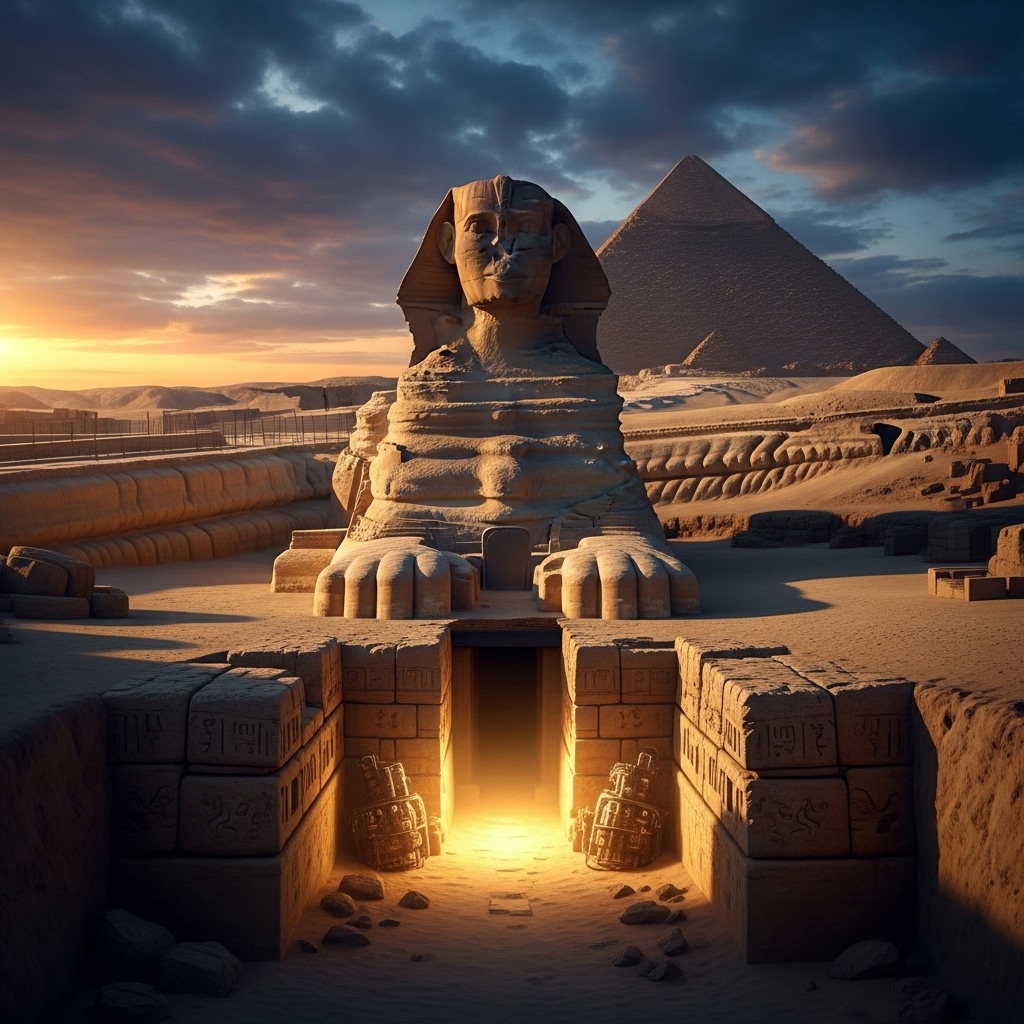
In 1980, Egyptologists Mark Lehner and Zahi Hawass, both credentialed archaeologists who would go on to become leading authorities on the Sphinx, excavated a passage at the rear of the Sphinx, based on testimony from elderly workers who recalled seeing it during an earlier 1926 clearing. This is worth reporting precisely, since retellings often exaggerate it: the tunnel descended roughly five meters and led simply to the water table beneath the monument. Lehner and Hawass’s own published account is direct about the result: it was, in their words, simply a tunnel, with no connected chambers, tombs, or additional structures found. This excavation did not reveal the “hall with columns” or vindicate the broader claims some retellings attach to it. It found an empty passage.
Edgar Cayce’s Full Vision
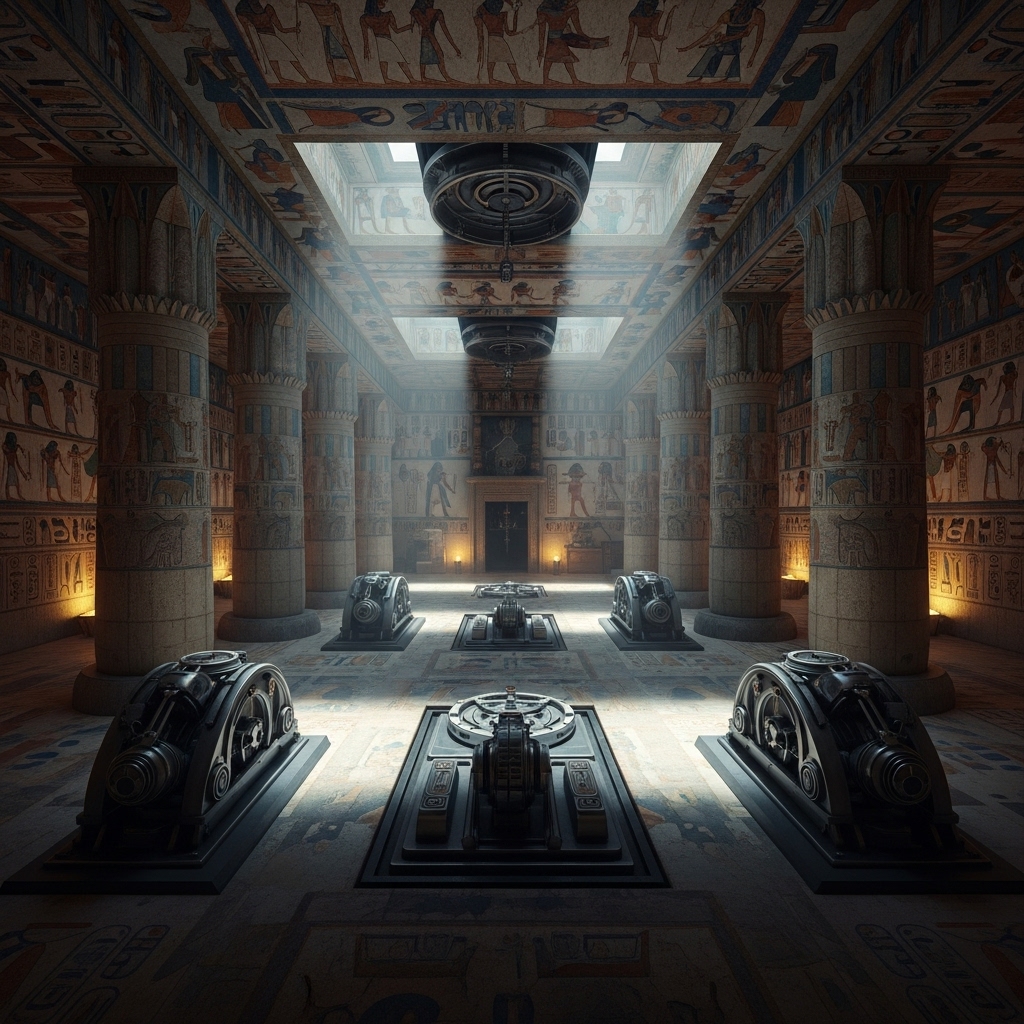
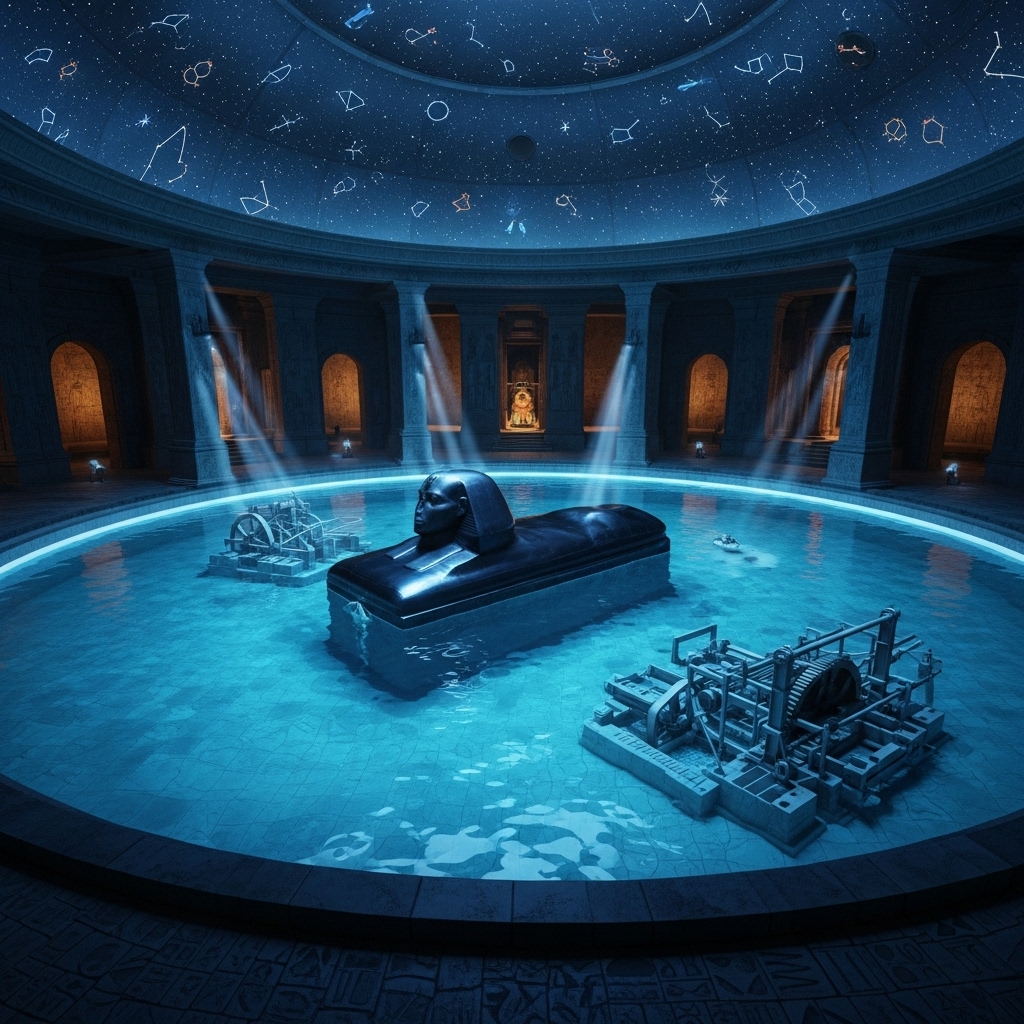
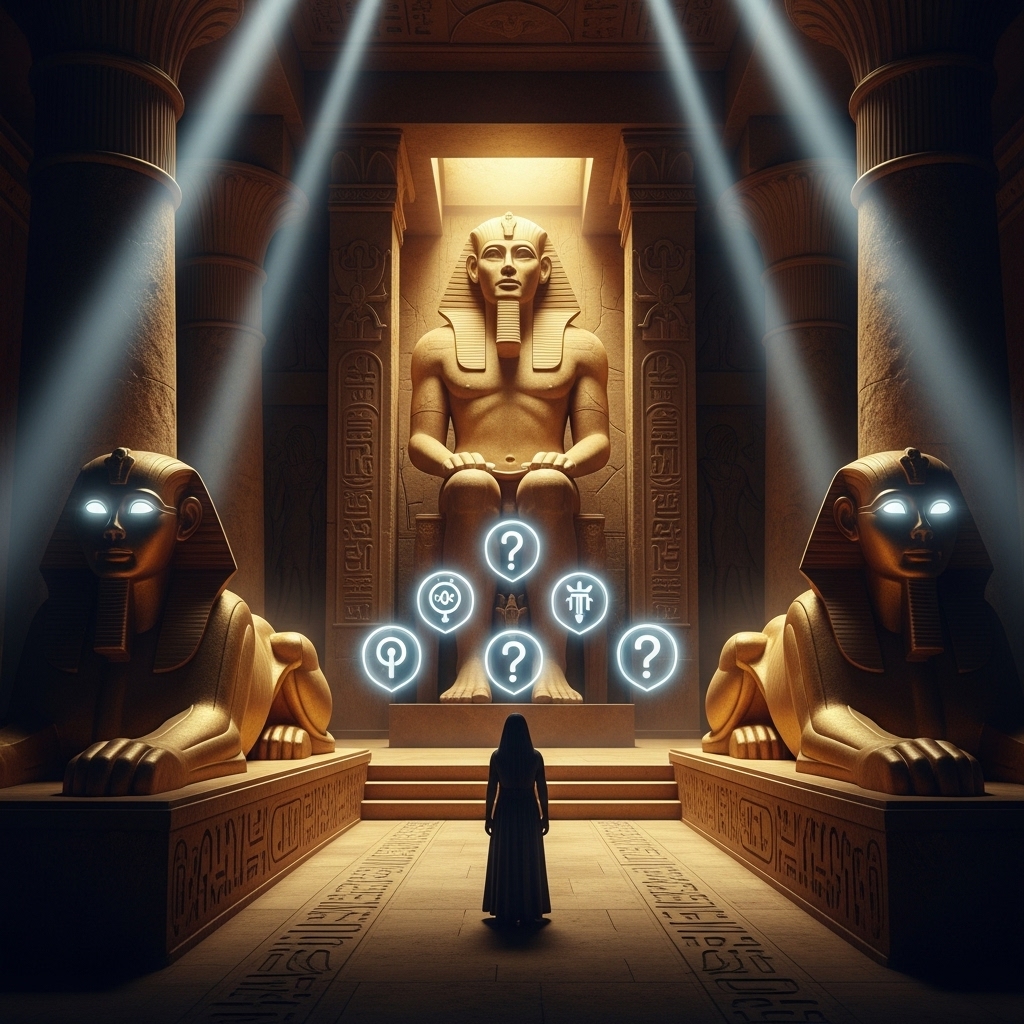
Cayce’s actual readings described considerably more than a simple hall. According to the trance material, three separate underground chambers exist: a Hall of Columns secured by mechanisms requiring specific knowledge to unlock, a second chamber described as a vast water-filled basin beneath a star-mapped ceiling, containing a floating sarcophagus and requiring the retrieval of relics timed to a celestial alignment, and a third, most sacred hall guarded by golden sphinx statues and a sculpture of the god Thoth that would pose seven questions to anyone attempting entry. This is elaborate, specific psychic material, and it deserves to be reported as exactly what it is: Cayce’s trance-state vision, never independently corroborated by any archaeological, textual, or physical evidence beyond the coincidence addressed below.
The 1996 Radar Finding
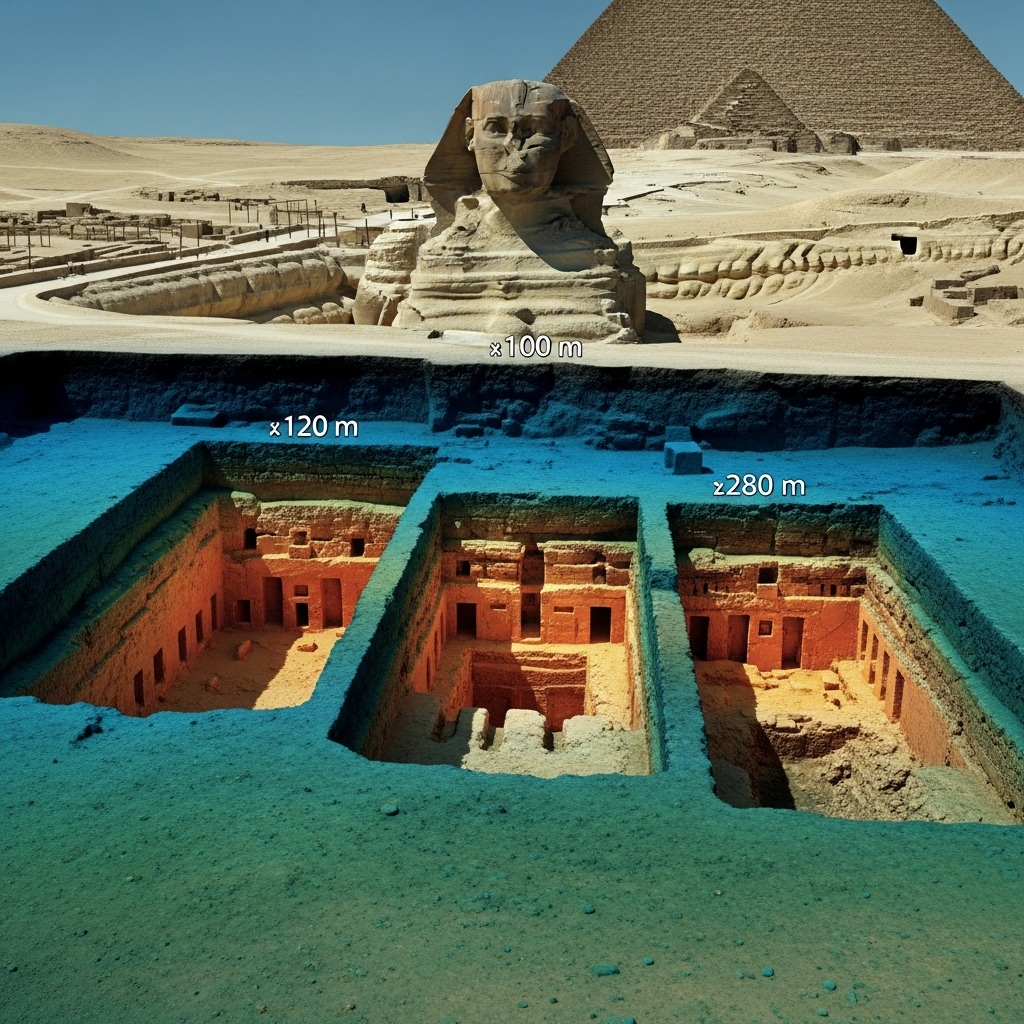
This is the most interesting detail here, and it deserves accurate, careful reporting. In 1996, a Florida State University research team conducted ground-penetrating radar surveys at the Sphinx, primarily for geological research purposes rather than to test Cayce’s claims specifically. Their instruments detected a rectangular void roughly 12 by 9 meters, approximately 25 feet beneath the Sphinx’s paw, a location that does roughly correspond to where Cayce’s readings placed the Hall of Records decades earlier. This is a striking coincidence worth taking seriously as exactly that and nothing more: a coincidence between a specific claimed location and a geophysical anomaly, not confirmation of what that anomaly actually contains. No excavation of this specific void has been permitted, and its nature, natural cavity or constructed chamber, remains undetermined.
Why Excavation Has Been Refused
Egyptian authorities’ consistent refusal to permit excavation deserves a more precise explanation than tourism economics alone. The stated, official reasoning centers on structural conservation: the Sphinx is a fragile, roughly 4,500-year-old limestone monument that has already undergone at least five recorded major restoration efforts since ancient times, and any excavation beneath or around it carries well understood risk of destabilizing the structure above. This is a standard, legitimate archaeological conservation principle applied to fragile ancient monuments generally, not a justification unique to suppressing Sphinx-related findings specifically. Egyptologists including Lehner and Hawass, who have devoted entire careers to studying this specific monument, have both publicly supported this conservative approach, which complicates the framing that conservation caution is purely a cover story invented to protect tourism revenue.
The Current Controversy
This is a live, ongoing story worth following accurately as it develops. In 2025, Italian researcher Filippo Bondi and the Khafre Project combined ground-penetrating radar with muon tomography, the same particle-detection technique used in the credible 2017 discovery of a void above the Great Pyramid’s Grand Gallery, to conduct new scans at Giza. This produced a public exchange when podcast host Joe Rogan directly questioned Zahi Hawass about the findings, with Hawass maintaining his long-held position that no Hall of Records exists and that any detected anomalies are natural cavities rather than constructed chambers. This is worth reporting exactly as the unresolved, actively contested scientific and institutional debate it currently is, with researchers and Egypt’s own leading Egyptological authority holding opposing interpretations of the same new data, rather than as a settled case of either confirmation or debunked fantasy.
Why Cayce’s Predictions Attract This Kind of Attention
Cayce’s Sphinx prediction specifically has retained credibility with some researchers for nearly a century, when the overwhelming majority of his other readings, including detailed medical diagnoses and predictions about geological catastrophes that never occurred, have not held up under scrutiny. Cayce made thousands of readings across his lifetime, covering an enormous range of topics, and by ordinary statistical probability alone, a large enough body of specific predictions will occasionally produce apparent hits purely by chance, particularly when the prediction is broad enough, an underground chamber somewhere beneath a massive, only partially excavated ancient monument, to have a real possibility of loosely matching some future finding. This is worth stating plainly rather than glossing over: evaluating any single prediction in isolation, without accounting for the much larger set of predictions that didn’t pan out, risks overstating the significance of the ones that appear to have.
What Muon Tomography Can Tell Us
The technique behind the most credible current excitement is impressive on its own terms without requiring exaggeration. Muon tomography works by detecting cosmic ray particles called muons that constantly rain down through Earth’s atmosphere and pass through solid rock at predictable rates, with denser material absorbing more muons than open space does. By placing detectors beneath or around a structure and measuring the pattern of muons passing through, researchers can build a three-dimensional map of density variations inside solid stone without any physical excavation at all. This is credible, peer-reviewed physics, the same general technique that produced the confirmed 2017 discovery of a void above the Great Pyramid’s Grand Gallery, published in the journal Nature. Its application to the Sphinx by the Khafre Project is a legitimate extension of an already-validated method, which is exactly why the current findings deserve serious attention even as their ultimate interpretation, natural cavity or constructed chamber, remains unresolved pending physical access.
The Debate Over What “Hall of Records” Even Means
A terminological confusion muddies much of the public conversation around this topic. Egyptologists use the term “Hall of Records” in an entirely different, well established sense from Cayce’s usage: ancient Egyptian temples, including a physically confirmed example at the Temple of Edfu, contained rooms called per-medjat, or “houses of records,” which held administrative papyri, religious texts, and temple inventories, an unremarkable feature of ancient Egyptian temple architecture with nothing supernatural about it. When mainstream Egyptologists dismiss “Hall of Records” claims specifically connected to the Sphinx, they are generally dismissing Cayce’s specific mystical version, an antediluvian Atlantean archive, not disputing that record-keeping rooms existed in ancient Egyptian religious architecture generally, which they readily acknowledge. Conflating the two, a mundane architectural feature attested at other sites, and Cayce’s specific, unverified claim about the Sphinx, has contributed to some of the confusion in how this topic gets discussed and understood by the wider public.
A Useful Comparison | The Osiris Shaft
Comparing this case to the Osiris Shaft, an excavated three-level underground structure beneath the Giza plateau, covered in detail elsewhere in this library, is useful for how it illustrates something about how archaeological mysteries actually get resolved. The Osiris Shaft was fully excavated, its granite sarcophagus was physically examined, and its still partially unexplained engineering puzzles, how blocks of that size were maneuvered into a chamber of that shape, remain open specifically because excavation happened and produced physical evidence that raised new, legitimate questions. The Sphinx voids remain a fundamentally different kind of case: geophysically detected but never excavated, meaning the nature of what’s down there, whether natural cavity, ancient storage room, or something else entirely, simply isn’t known yet in the way the Osiris Shaft’s contents are known. This is worth being precise about, since “unexcavated anomaly” and “excavated but still mysterious” are different evidentiary situations, even though both get discussed under the broad heading of Giza’s unsolved mysteries.
A Claim That Can’t Be Verified
The claim that two independent researchers were declared persona non grata and banned from Egypt following a satellite scan of the Sphinx voids could not be matched to any specific, named, verifiable case in the available historical and journalistic record. Given how well established the 1996 FSU survey, the 1980 excavation, and the 2025 Khafre Project controversy all are by comparison, each with named researchers, published findings, and press coverage, the absence of any comparable documentation for this specific claim is notable. It should be treated as unverified rather than repeated as an established fact until a specific, named source can be identified.
What Would Settle the Question
What a resolution would actually require is more modest than either side of the current debate sometimes implies. A definitive answer needs a permitted excavation, or at minimum a physical probe, of the specific 1996 FSU void, conducted with full transparency and independent oversight, with any findings published through standard peer review rather than announced first through podcasts or social media. Egypt’s Supreme Council of Antiquities has the sole legal authority to grant this kind of access, and its repeated refusals, whatever their underlying mix of conservation caution and institutional reluctance, mean this specific question is likely to remain unresolved for the foreseeable future, regardless of how many additional non-invasive scans any research team conducts.
Where This Leaves Cayce’s Prediction
The honest summary is more interesting than either a full confirmation or a full dismissal. Cayce’s specific, general prediction of a hidden chamber beneath the Sphinx’s paw does correspond, in a striking way, to a geophysical anomaly independently detected by a university research team six decades after his death. That correspondence remains unexplained and untested, since no excavation of the 1996 void has occurred. What the archaeological record does not support is the far more elaborate content Cayce attached to that location, golden sphinxes, a talking statue of Thoth, a submerged sarcophagus, none of which any excavation, survey, or scan has found any evidence for. An unexplained void is not the same as a confirmed antediluvian library, and treating the location coincidence as confirmation of the entire, considerably more fantastical vision overstates what the evidence shows. Until an excavation is permitted and the void’s contents, if any, are physically examined, the most honest position available is that the coincidence itself is real, worth further investigation through legitimate archaeological means, and still, after nearly thirty years, entirely unresolved. That question of access connects to a broader pattern: Egypt formally restricted geological survey work around the Sphinx in 1993, shortly after this same radar anomaly was first identified.