For over a century, astronomers searched for a planet that doesn’t exist, using rigorous methodology, functioning telescopes, and careful mathematical calculation.
The story of Vulcan is well established history, one of the more interesting episodes in the development of modern physics, and it has a satisfying ending that doesn’t require reviving the planet to make the story worth telling.
The Birth of Vulcan | An Equation That Didn’t Add Up
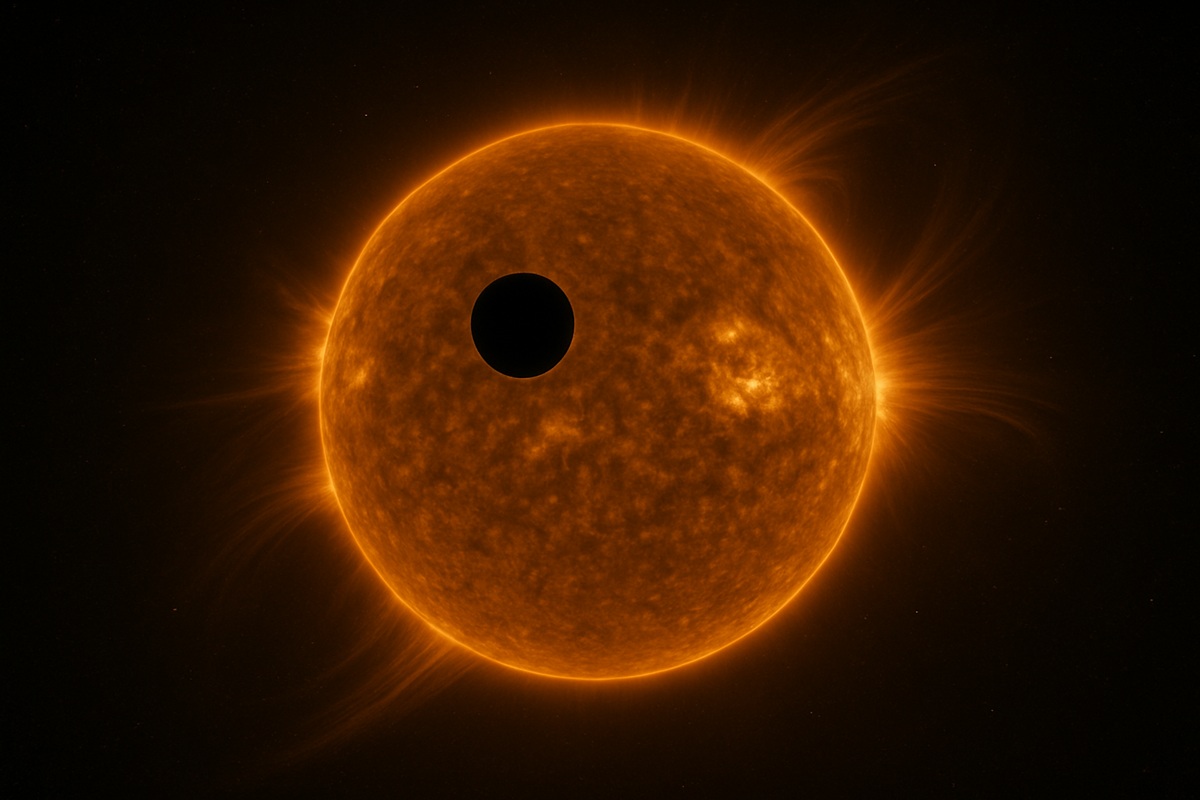
In the 1840s, French astronomer and mathematician Urbain Le Verrier, who had already achieved international fame by predicting the existence and position of Neptune through pure mathematical calculation before anyone observed it directly, turned his attention to a persistent problem with Mercury’s orbit. By 1859, after painstaking calculations, Le Verrier had determined that Mercury’s perihelion, the point in its orbit closest to the Sun, was precessing, gradually shifting position, at a rate that Newtonian gravitational theory using only the known planets could not fully account for. The discrepancy was small, roughly 43 arcseconds per century beyond what Newtonian physics predicted, but it was measured carefully and stubbornly persistent across repeated independent observations.

Given his spectacular success predicting Neptune from a similar orbital anomaly, Le Verrier reasoned that an undiscovered planet, orbiting between Mercury and the Sun, could be exerting the additional gravitational pull needed to explain the precession. He named this hypothetical world Vulcan, after the Roman god of fire, fitting for a planet that would need to withstand extreme proximity to the Sun.
A Planet That Couldn’t Be Found
For decades following Le Verrier’s hypothesis, astronomers across Europe and North America searched for Vulcan. Some reported seeing it transiting the solar disk. Others claimed sightings during solar eclipses, the only time observers could safely scan the area immediately around the Sun without the glare overwhelming any small object nearby. A French amateur astronomer named Edmond Lescarbault claimed a sighting in 1859 that briefly excited the professional astronomical community, including Le Verrier himself, who traveled to interview him personally, but no subsequent observer could ever reliably confirm the sighting. Every reported sighting over the following decades met the same fate: brief enthusiasm followed by failure to reproduce the observation.
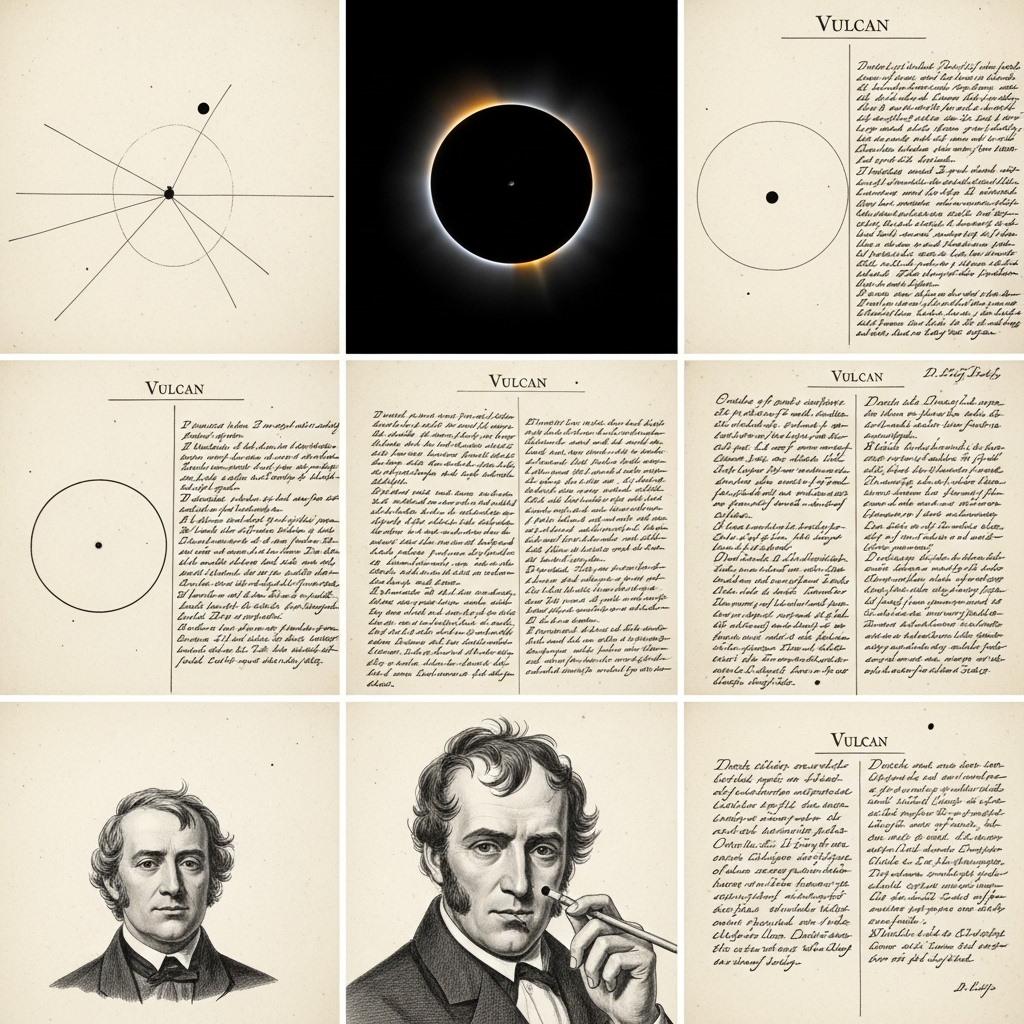
The hypothesis also evolved into the idea of Vulcanoids, a population of small asteroid-like bodies occupying a stable orbital zone inside Mercury’s orbit, whose combined gravitational influence might collectively explain the anomaly without requiring a single planet-sized object. This remains, even today, a technically open question in solar system astronomy, since the region close to the Sun is genuinely difficult to survey due to solar glare, and no dedicated, conclusive search has definitively ruled out small Vulcanoid bodies. What’s important is that even this weaker, more modest version of the hypothesis has never produced a single confirmed detection despite numerous searches, and it was never the actual explanation for Mercury’s precession regardless.
How Einstein Actually Solved It
In 1915, Albert Einstein’s General Theory of Relativity provided the complete, precisely quantitative resolution to Mercury’s perihelion problem, and this deserves to be stated as the settled science it actually is rather than as one competing theory among others. General relativity demonstrated that gravity is not a force acting instantaneously at a distance, as Newtonian physics assumed, but a curvature of spacetime itself caused by mass. Near an object as massive as the Sun, this curvature produces exactly the kind of orbital precession Mercury exhibits, and when Einstein worked through the actual calculation using his new field equations, the number that emerged matched the observed 43 arcseconds per century discrepancy essentially exactly, without requiring any additional unseen mass at all. This was one of general relativity’s very first and most striking successful predictions, confirmed using data that had already puzzled astronomers for over fifty years, and it remains one of the most historically significant confirmations of Einstein’s theory.
With that calculation, Vulcan became entirely unnecessary as an explanation. The precession that originally motivated its existence had a precise, mathematically confirmed cause that required no undiscovered planet whatsoever.
What STEREO Actually Shows
NASA’s STEREO mission, launched in 2006, uses twin spacecraft positioned ahead of and behind Earth in its orbit to capture stereoscopic, three-dimensional images of the Sun and its corona, a valuable tool for studying coronal mass ejections and space weather. This needs a direct correction, though: NASA’s own solar physics team has extensively studied and publicly explained the specific kinds of imaging artifacts that produce exactly this “persistent object” appearance, and these explanations come directly from NASA’s Science division, not from outside skeptics.

NASA’s own published materials on solar imager artifacts describe several well understood, recurring causes. Bright astronomical objects like Venus passing through a coronagraph’s field of view can produce diffraction artifacts, distinctive shapes caused by light bending around the instrument’s internal occulting stem, that look distinctly unlike the object itself. Energetic particles, including solar protons, regularly strike the camera’s CCD sensor directly and produce bright streaks or dots. Solar physicist Karl Battams has specifically addressed this exact category of viral “object near the sun” claim, noting that these particle-impact artifacts are consistent with what appears in nearly every image the instrument captures, and critically, that these artifacts do not persist from one image to the next, which is exactly how they’re distinguished from an actual physical object. NASA’s STEREO Science Center has also identified specific, individual hardware defects, including a small fiber physically lodged on one camera’s CCD surface, that create a fixed-position artifact appearing repeatedly in images from that instrument, exactly the kind of “persistent, recurring shape” that can be, and has been, mistaken for an orbiting object before its actual cause was identified and explained.
This is worth stating plainly: NASA has directly and publicly addressed this specific category of claim, with named scientists explaining named, specific mechanisms, rather than leaving it as an open mystery independent researchers are pursuing without institutional engagement. The “persistent object” claims attached to STEREO imagery do not represent an active, unresolved scientific controversy within heliophysics.
The Ongoing Search for Vulcanoids
It’s worth expanding on the legitimate scientific question that survives from the original Vulcan hypothesis, since it’s an actively studied area distinct from the debunked planetary anomaly claims. The zone inside Mercury’s orbit is genuinely one of the least explored regions of the solar system, not because it’s forbidden or hidden, but because it’s observationally difficult: any survey has to look extremely close to the Sun’s blinding glare, which rules out most conventional ground-based telescopes and limits observation windows to specific conditions like solar eclipses or specially designed space-based coronagraphs. Dedicated searches, including a 2002 survey using a modified F-18 fighter jet to observe during a total solar eclipse, and subsequent searches using data from the STEREO and MESSENGER missions, have progressively ruled out Vulcanoid bodies larger than a certain size threshold, currently placing meaningful constraints on how large any undiscovered body in this zone could possibly be without having already been detected. This is legitimate, ongoing, peer-reviewed astronomical research, conducted by credentialed scientists using established survey methodology, entirely separate from the STEREO “artifact” claims addressed above.
Le Verrier’s Actual Legacy
It’s worth giving Le Verrier’s actual scientific legacy its full due, since the Vulcan episode is often the only part of his career that gets remembered, when his actual achievements were considerably more significant. His 1846 prediction of Neptune’s existence and position, based purely on analyzing irregularities in Uranus’s orbit using Newtonian celestial mechanics, remains one of the most celebrated triumphs in the history of astronomy, and German astronomer Johann Galle found Neptune within a single night of searching at the exact coordinates Le Verrier had calculated from his desk, having never personally observed the planet through a telescope before confirming its existence. Le Verrier went on to become director of the Paris Observatory and made numerous other lasting contributions to celestial mechanics and the mathematical modeling of planetary orbits that remain foundational to the field. His Vulcan hypothesis wasn’t a departure from sound scientific method, it followed exactly the same reasoning that had worked spectacularly with Neptune. What makes the story genuinely instructive rather than embarrassing for him is that the same rigorous methodology that succeeds in one case can still point toward a wrong answer in another, when the underlying physical theory has a limitation nobody has yet discovered, and that’s a valuable lesson about the nature of scientific progress rather than a mark against his considerable accomplishments.
Why a Sun-Orbiting Moon Doesn’t Work Physically
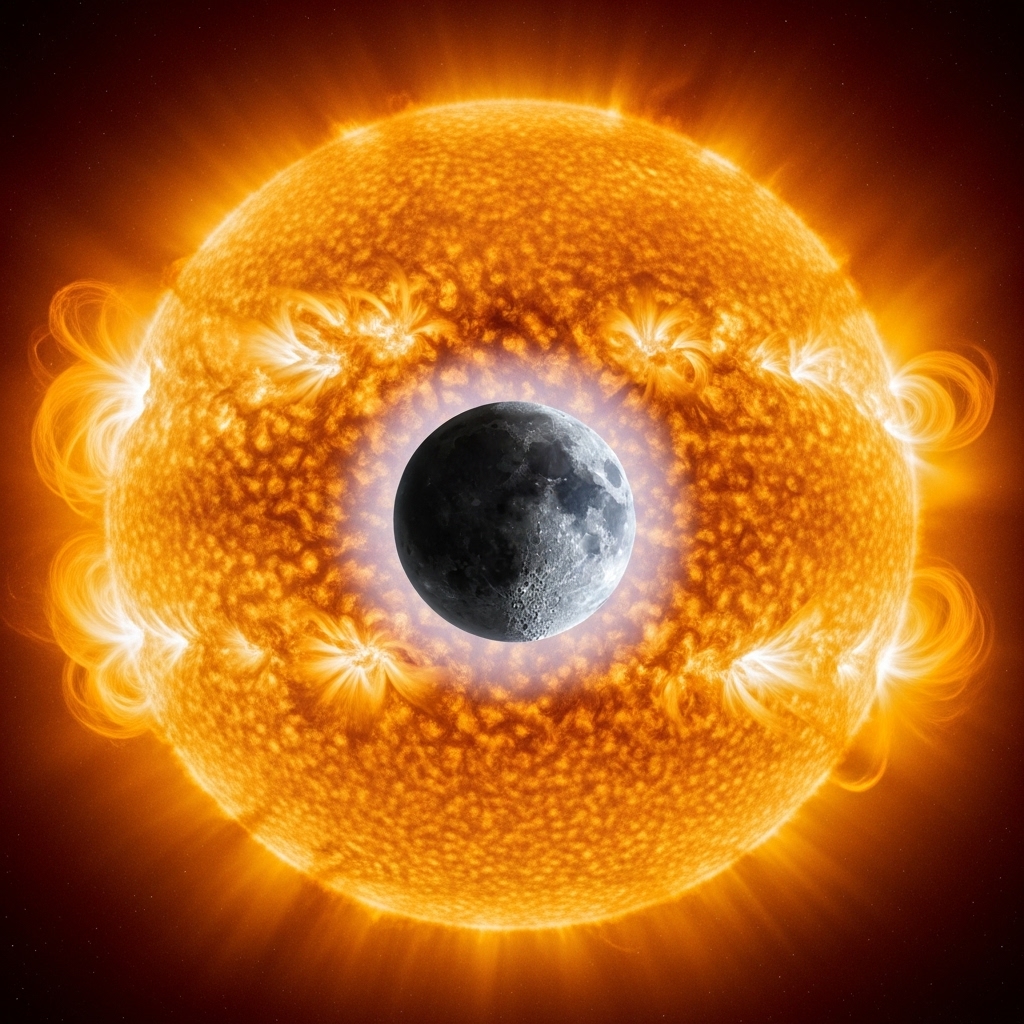
It’s also worth addressing the underlying physical premise directly. A stable, sustained orbit within the Sun’s corona, at the temperatures and radiation levels actually present in that environment, is not a matter of finding the right orbital geometry. The solar corona reaches temperatures of over a million degrees Celsius, driven by processes solar physicists are still working to fully characterize, and any solid object entering that environment would be rapidly ablated and ionized by the intense heat and particle flux, regardless of its orbital stability. This isn’t a question current science “cannot yet explain.” It’s a well understood consequence of basic thermodynamics and material science that applies regardless of whether the hypothetical object is natural or, as some retellings speculate, artificial.
What an Actual Unsolved Case Looks Like
It’s worth contrasting the resolved Vulcan case with what genuinely still-open astronomical mysteries actually look like, since the difference is instructive. An unresolved case, like the ongoing search for a possible ninth planet in the outer solar system based on orbital clustering among distant Kuiper Belt objects, is characterized by credentialed researchers publishing competing peer-reviewed papers, actively proposed and funded survey missions designed to test specific predictions, and open acknowledgment from the scientific community that the question remains genuinely undecided. The Vulcan case, by contrast, has a complete, precise, mathematically verified answer that has stood for over a century without serious challenge from any credentialed physicist, and the STEREO imagery specifically has a named, published, institutional explanation from NASA’s own scientists. Recognizing this difference, between a question science hasn’t yet answered and a question science has already answered clearly, is genuinely useful for navigating any claim of this kind, not just this specific one.
Why Vulcan’s Story Still Matters
None of this makes Vulcan’s history less worth telling. It’s an excellent case study in how science is actually supposed to work: a measured anomaly, a reasonable hypothesis based on the best available physics at the time, decades of honest but ultimately unsuccessful searching, and finally a complete, precise, and mathematically verified resolution that didn’t require the original hypothesis to be true. Le Verrier’s Vulcan prediction, unlike his correct Neptune prediction, turned out to be wrong, and that’s an instructive part of the story too: the same brilliant methodology that found an actual planet also, in a different case, pointed toward a planet that didn’t exist, because the underlying theory it was built on, while extraordinarily successful in general, had a genuine limitation near extremely massive objects that only a deeper theory of gravity could reveal decades later.
That’s a better, truer story than a still-unsolved mystery, and it doesn’t require an ambiguous camera artifact from a 2006 spacecraft to stay interesting. It requires only the actual history: a talented astronomer, a measured anomaly, a wrong guess, and one of the most elegant confirmations in the history of physics closing the case for good in 1915, over a century ago, with a precision that has never once needed revisiting since.