Antoine Court de Gébelin was wrong about where the Tarot came from. He was right about what it contains.
Court de Gébelin was an eighteenth-century French antiquarian and Freemason who encountered a Tarot deck being played at a card game in Paris in approximately 1781 and immediately recognized in its imagery what he believed to be the encoded wisdom of ancient Egypt. He published his analysis in his eight-volume work Le Monde Primitif, proposing that the twenty-two trump cards of the Tarot, the Major Arcana, were the surviving pages of the ancient Egyptian Book of Thoth, encoded in pictorial form to preserve their wisdom through the destruction of the Library of Alexandria and the subsequent suppression of pagan knowledge.
His historical claim was incorrect. The established history of the Tarot deck places its origin in northern Italy in approximately 1430 to 1450 CE, where wealthy aristocratic families commissioned painted card decks for games and entertainment. The Visconti-Sforza deck, dating to approximately 1450 and currently divided between the Pierpont Morgan Library in New York, the Accademia Carrara in Bergamo, and private collections, is the earliest substantially complete Tarot deck in existence. Its imagery is Italian Renaissance in character, its figures dressed in medieval Italian costume, its symbolism drawn from the Christian, classical, and courtly traditions of fifteenth-century northern Italy.
There are no ancient Egyptian Tarot decks. The Tarot did not emerge from Egypt. Court de Gébelin was wrong.
But what he identified as Egyptian was real. The encoded wisdom he recognized in the Tarot was there. He had simply misidentified its origin.
What he was looking at was not ancient Egypt. It was Western esotericism’s accumulated synthesis of ancient Egyptian, Neoplatonic, Kabbalistic, and Hermetic knowledge that had been developing since the Alexandrian period and that had reached, by the late medieval period, a sufficient degree of organizational coherence that it could be encoded in a card deck and recognized by a trained eye.
The wisdom was genuine. The Egyptian origin was invented. The transmission chain that produced the wisdom was one of the most extraordinary in intellectual history.
The Book of Thoth That Actually Existed
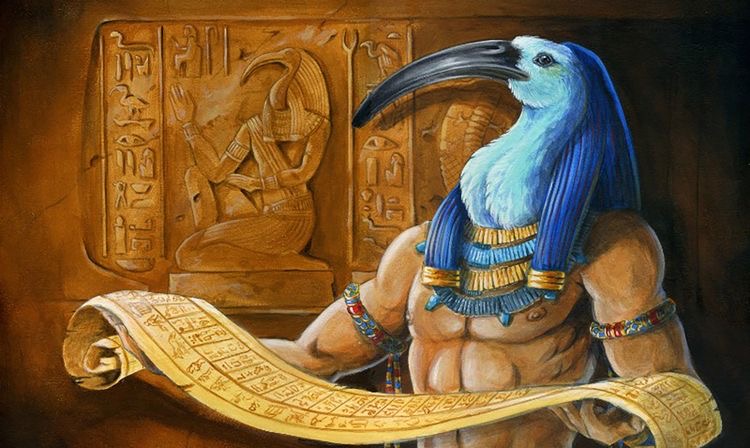
Before Court de Gébelin’s invention of the Tarot’s Egyptian origin, there was a genuine Book of Thoth in the ancient Egyptian record.
The Setne Khamwas cycle, preserved in Demotic papyri from approximately 300 BCE to 200 CE, is the primary surviving narrative in which the Book of Thoth appears as a dangerous object with properties. The cycle’s first tale describes Prince Setne Khamwas, a son of Ramesses II famous in the historical record as a high priest of Ptah and an antiquarian who studied ancient monuments, seeking and finding the Book of Thoth in the tomb of a long-dead prince named Naneferkaptah.
The book’s described contents are specific: it contains two spells. The first allows the reader to enchant the sky, the earth, the underworld, the mountains, and the waters, and to understand all the birds and all the reptiles and fish. The second allows the reader, when dead, to take on their earthly form again and to see the sun rising in the sky with its full retinue of gods, and the moon in its form.
The first spell is the ability to communicate with all living creatures and to understand the fundamental forces of nature. The second spell is the ability to perceive the divine order directly, bypassing the limitations of ordinary mortal consciousness.
Whether these descriptions encode genuine ancient Egyptian understanding of states of expanded consciousness achievable through practices, or are narrative elaborations of the general concept of divine wisdom, is the question that the Setne cycle’s detail makes genuinely interesting. The reference to seeing the sun’s divine retinue, the beings that accompany the solar disk in its daily journey across the sky, connects to the Ezekiel chariot vision’s description of divine beings surrounding the divine presence, recorded in the angelic hierarchy piece in this library.
The Book of Thoth in the Setne cycle is explicitly dangerous. Naneferkaptah, who stole the book from Thoth’s own guardianship and copied it, died for his transgression, along with his wife and son. Their ka, their life force, was taken as payment. The book in this story is not simply a collection of information. It is an object whose power is real and whose unauthorized access carries real consequences.
This characteristic, the genuine danger of unauthorized access to advanced knowledge, is consistent across Western esotericism from the Book of Thoth through the Picatrix through the Enochian system to Qliphothic initiatory practice: the knowledge contained in these systems is treated as genuinely transformative and genuinely dangerous rather than as symbolic theology without operational content.
Hermes Trismegistus and the Hermetic Corpus
The Gnostic Transmission piece in this library covers the Hermetic Corpus and its transmission chain in detail. The element of the Book of Thoth story that the Hermetic piece does not fully develop is the identification of Thoth-Hermes as a historical figure rather than a deity.
The Hermetic Corpus texts, composed in Greek in Alexandria between approximately 200 BCE and 400 CE, claim to record the teachings of Hermes Trismegistus, Hermes the Thrice-Greatest, described in the texts as an ancient sage rather than as a deity. The identification of this figure with the Egyptian god Thoth appears in the texts themselves and reflects the Greco-Egyptian cultural synthesis that Alexandria’s unique intellectual environment produced.

Whether Hermes Trismegistus was a genuine historical figure, a mythological construction that encoded the accumulated wisdom of the Egyptian priesthood, or a literary device that allowed the anonymous Alexandrian authors to attribute their philosophical synthesis to an ancient authority, is a question that the scholarship has not definitively resolved and that the texts themselves do not clarify.
What the texts contain is well established and significant: the Poimandres, the first text of the Corpus, describes a visionary encounter with a being of light who transmits cosmological knowledge about the structure of reality, the descent of the human soul into matter, and the path of its return to the divine source. The content of this transmission, the emanation structure of reality, the imprisonment of divine consciousness in material form, and the liberation available through knowledge, is structurally identical to the Gnostic Archon cosmology documented in the dedicated piece and to the Kabbalistic framework recorded in the Qliphoth piece.
Marsilio Ficino’s translation of the Corpus Hermeticum for Cosimo de’ Medici in 1463, recorded in the Gnostic Transmission piece, introduced this material to the Renaissance European intellectual world at exactly the moment when European esotericism was developing the synthesis that would eventually produce the Tarot’s fully elaborated symbolic system.
Eliphas Lévi and the Kabbalistic Synthesis
The moment at which the Tarot became the encoded summary of Western esotericism rather than simply an Italian card game with striking imagery is dated with precision: 1855, when Alphonse Louis Constant, writing under the name Eliphas Lévi, published Dogme et Rituel de la Haute Magie.
Lévi was a French occultist whose intellectual contribution to Western esotericism was the systematic alignment of the twenty-two Major Arcana of the Tarot with the twenty-two letters of the Hebrew alphabet and the twenty-two paths of the Kabbalistic Tree of Life. This alignment transformed the Tarot from a collection of powerful images into a systematic map of the Kabbalistic cosmological framework: each card became the visual representation of a Kabbalistic principle, a Hebrew letter, and an astrological or elemental attribution within the integrated system.
Whether Lévi invented this alignment or discovered it in existing esoteric writing is the question whose answer the scholarship has not definitively established. He claimed to have recovered an ancient secret, which is the standard rhetorical gesture within esoteric writing generally. Whether the alignment was ancient or was his creation, its internal coherence and its fertility as a system for organizing and transmitting esoteric knowledge made it immediately influential.
The Golden Dawn magical order, founded in London in 1888 by William Wynn Westcott and Samuel Liddell Mathers, adopted Lévi’s Tarot-Kabbalah alignment as a foundational element of its initiatory curriculum. The Golden Dawn’s elaboration of the system, adding astrological attributions, color scales, divine names, and meditative and ritual applications for each card, produced the most comprehensive single synthesis of Western esotericism in the modern period.
The Golden Dawn’s membership included William Butler Yeats, Aleister Crowley, and Arthur Edward Waite, each of whom subsequently produced their own Tarot interpretations. The divergence between Waite’s Rider-Waite-Smith deck of 1909 and Crowley’s Thoth deck of 1943 reflects the two branches of post-Golden Dawn esoteric practice rather than two independent interpretations of an ancient source.
The Thoth Tarot and Its Structure
Aleister Crowley’s collaboration with the painter Frieda Harris between 1938 and 1943 produced the Thoth Tarot deck whose publication by the Ordo Templi Orientis was accompanied by Crowley’s Book of Thoth in 1944, his most systematic treatment of Western esotericism’s integrated symbolic system.
Harris was a student of Rudolf Steiner’s anthroposophy and brought to the collaboration a geometric system called projective geometry whose principles she applied to the visual construction of the cards. The visual effect of Harris’s technique, figures and environments constructed from overlapping geometric planes whose perspective is dynamically ambiguous, produces images whose visual depth and symbolic density significantly exceed the conventional illustrated card format.
Crowley’s Book of Thoth is the most systematic published treatment of the Tarot as an integrated system connecting Egyptian mythology, Kabbalistic cosmology, Western astrology, alchemy, the I Ching, and the Enochian magical system covered in this library’s dedicated piece. Whether his claimed access to this material through his Aiwass reception, recorded in the Enochian piece, gave him genuine insight into the ancient system’s content or produced an elaborate personal mythology in Hermetic vocabulary, the Book of Thoth‘s internal coherence and the Thoth deck’s visual power have made them the most widely used Tarot system in the contemporary esoteric community.
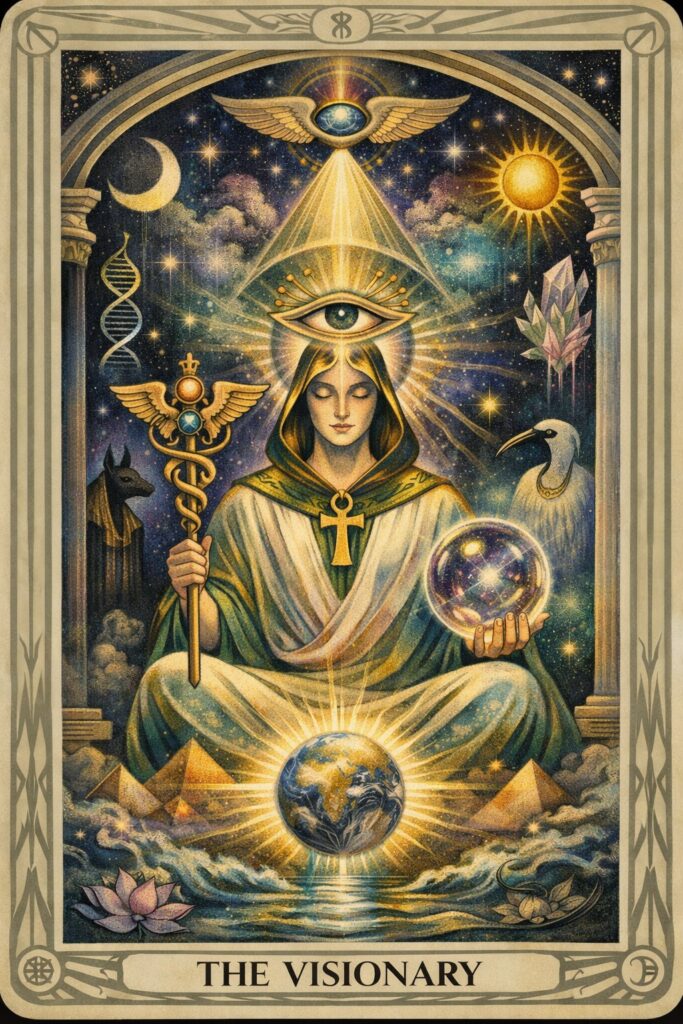
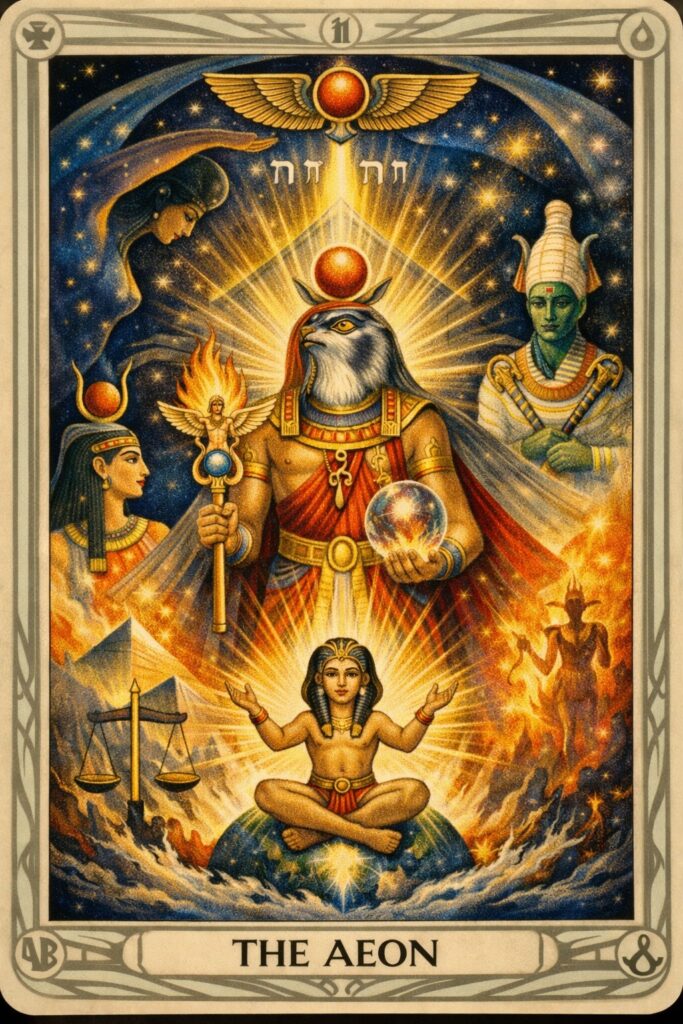
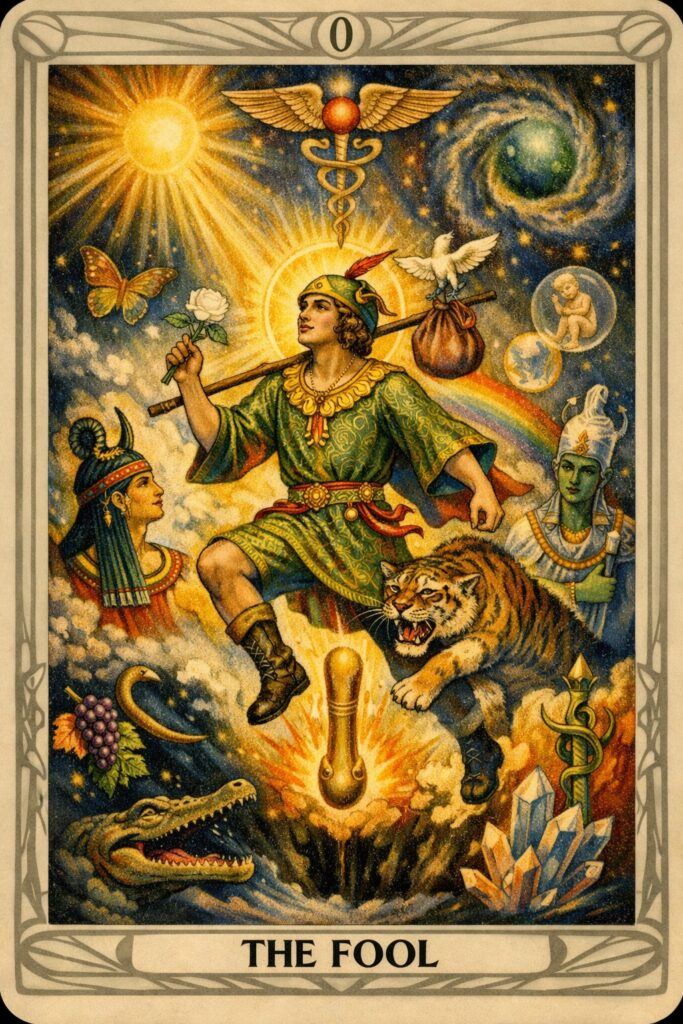
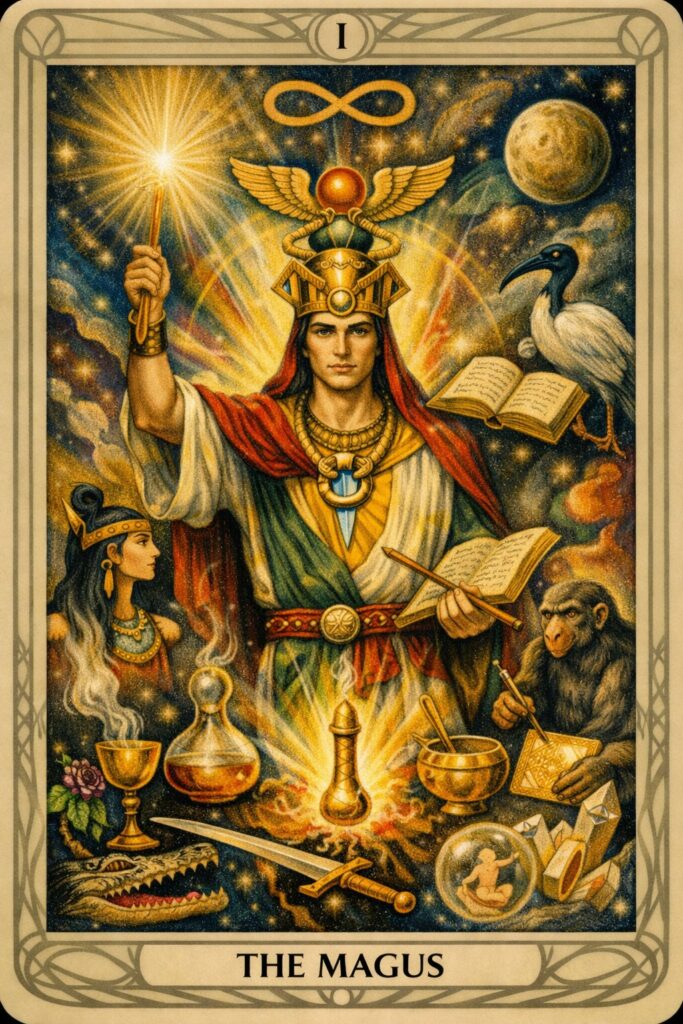
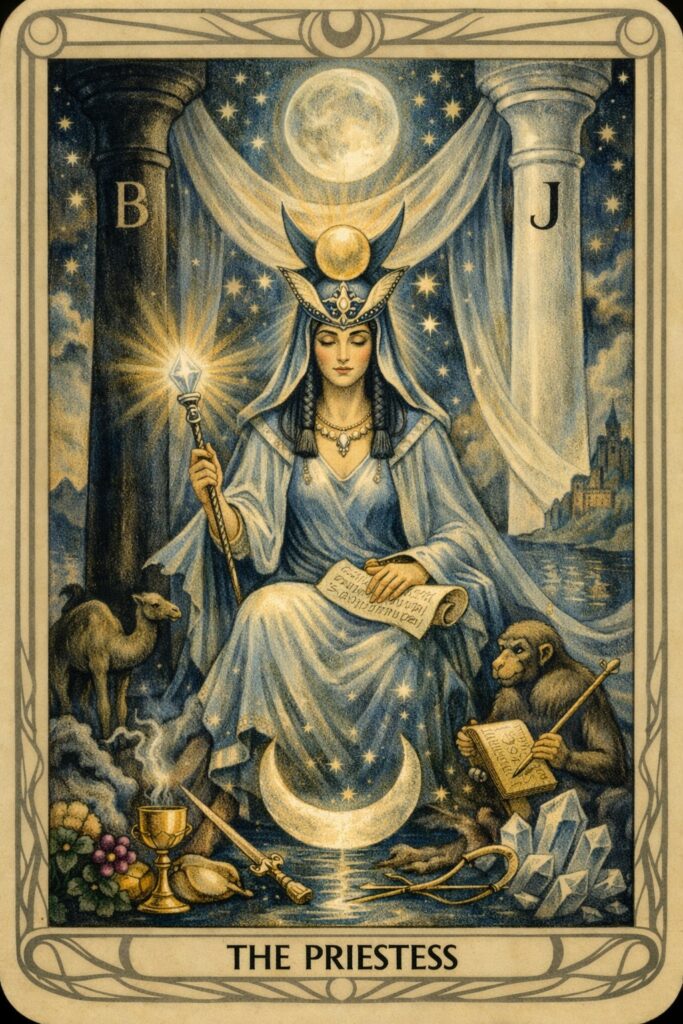
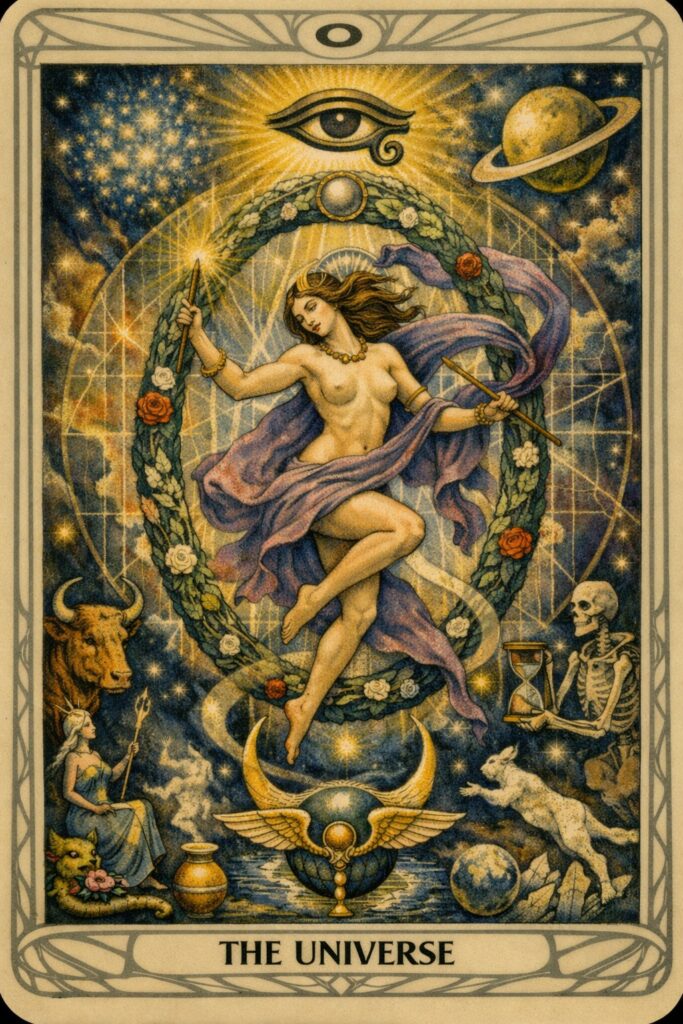
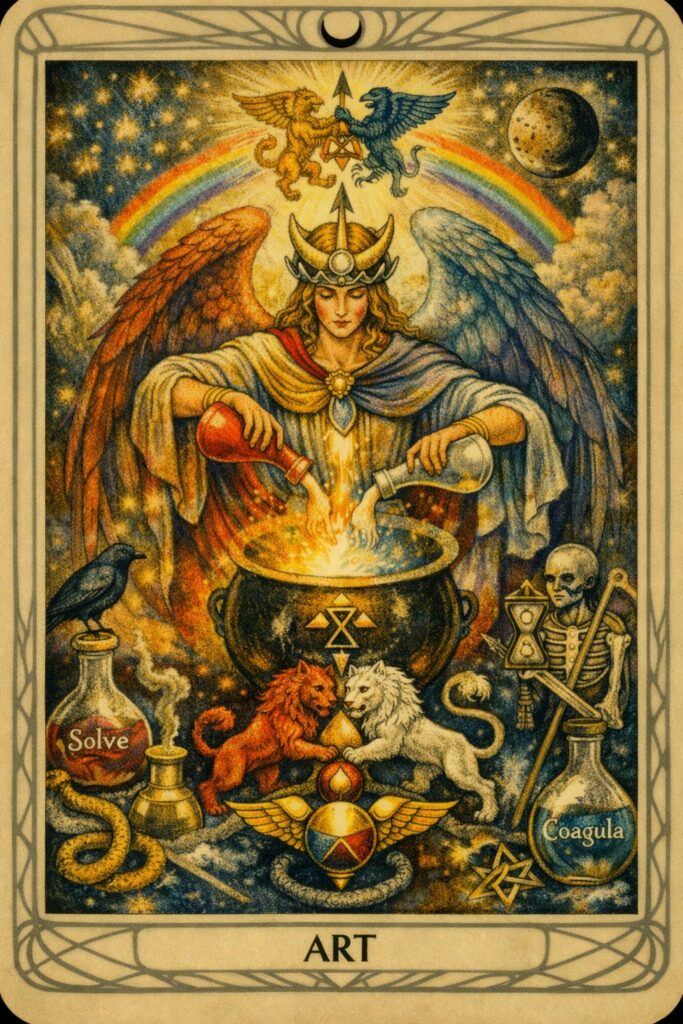
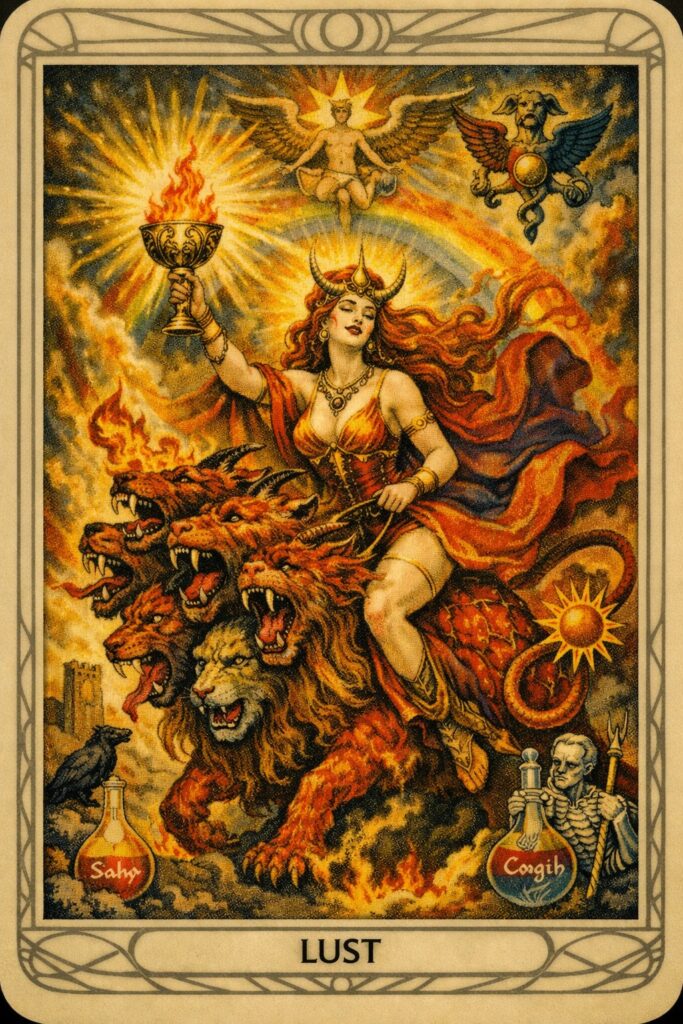
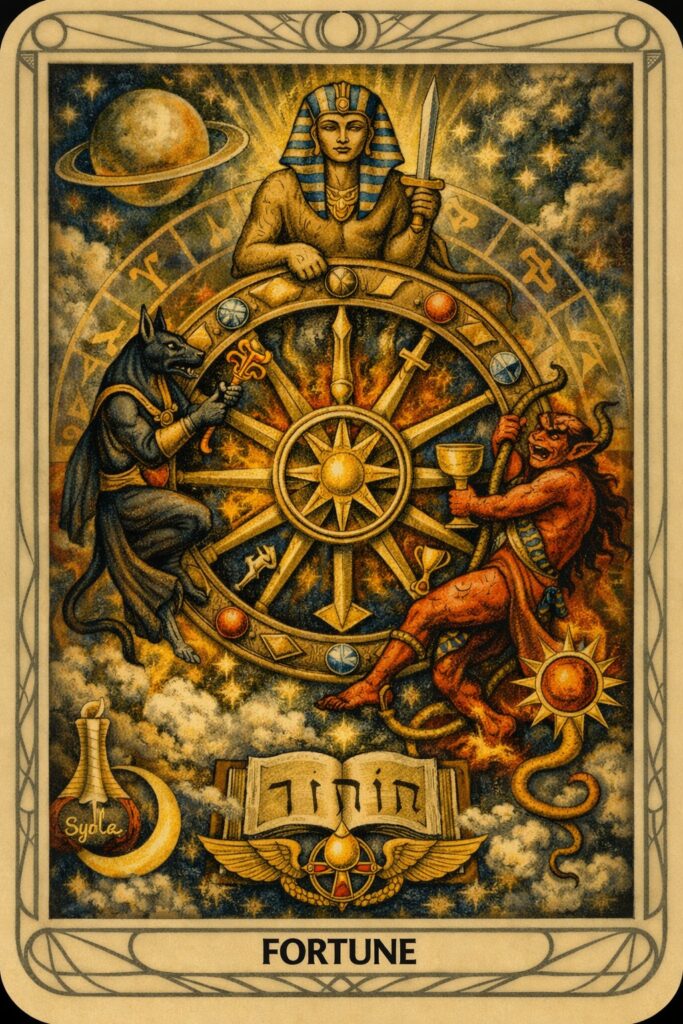
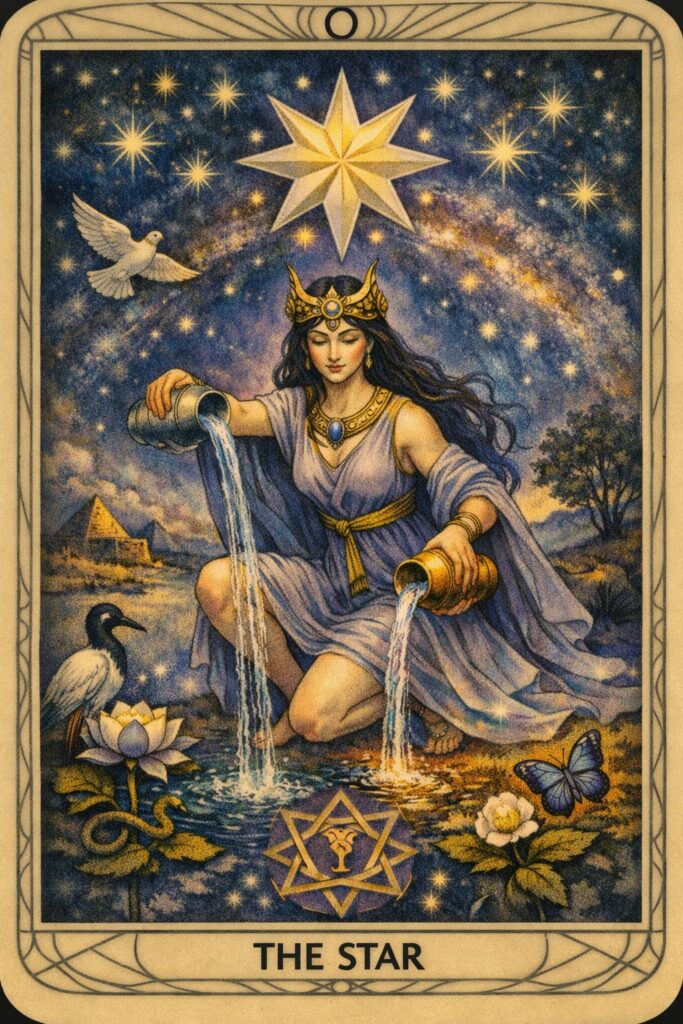
The connection Crowley drew between his Thoth Tarot and the ancient Book of Thoth is explicit in his naming choices: the deck title, the book title, and the Egyptian iconographic elements distributed through the card designs, all position the work as a recovery and continuation of Thoth-Hermes wisdom rather than as an independent modern creation.
Whether this positioning reflects genuine transmission, the kind of inspired synthesis that draws on genuinely ancient sources through esotericism’s documented transmission chain, or creative mythology in that same vocabulary, is the question that the broader Hermetic transmission history makes impossible to resolve with certainty and unnecessary to resolve to evaluate the system’s content.
What the Major Arcana Maps
The twenty-two Major Arcana, regardless of their historical origin, constitute a cosmological map whose elements correspond to the major frameworks covered across this library.
The Fool, numbered zero or unnumbered, represents the divine consciousness before its descent into the forms of the remaining twenty-one cards. Its correspondence in the Kabbalistic framework is the Ain Soph, the infinite divine before the first emanation. Its correspondence in the Gnostic framework is the Pleroma before the disruption that produced the Demiurge. Its correspondence in the Monroe Loosh framework is the undifferentiated consciousness before its investment in the Earth system.
The High Priestess, numbered two, represents the gateway between the conscious and the unconscious, the Kabbalistic veil between the manifest and the unmanifest, and in Egyptian iconography the guardian of the threshold between ordinary and non-ordinary knowledge. Her position at the threshold between the two pillars of the Temple corresponds precisely to the threshold function recorded in the Aghori cremation ground piece and the sleep paralysis Hat Man piece: the point where ordinary consciousness meets what lies beyond its normal boundaries.
The Tower, numbered sixteen, represents the catastrophic disruption that destroys a structure built on false foundations. Its Kabbalistic correspondence is Mars-Geburah, divine severity operating without divine mercy’s balance. Its visual content, the lightning bolt destroying the tower, corresponds structurally to the divine punishment of civilizations that have exceeded their appropriate development covered across this library’s Lost Civilizations and Prophecy clusters.
Whether the Major Arcana was designed by ancient Egyptian priests as Court de Gébelin believed, compiled by medieval Kabbalists as some accounts propose, or constructed through the recorded transmission chain from Alexandria through the Renaissance to the Golden Dawn synthesizers, the map it produces is the same map.
The wisdom is the same wisdom whether it came from Egypt or from Ficino’s study or from Lévi’s library. What it transmits is the same integrated understanding of consciousness, cosmos, and the human situation that every authentic transmission of ancient knowledge transmits.
The Book of Thoth may be the Setne cycle’s dangerous double-spell text. It may be the Hermetic Corpus’s emanation cosmology. It may be the Golden Dawn’s synthesized initiatory system. It may be Crowley’s Book of Thoth published in 1944.
Or it may be, as the source’s final speculation suggests, not a physical book at all but the state of consciousness that all these systems are mapping, accessible only from the inside, from the place where the Fool stands before taking the step that begins the twenty-two-card journey.
The map is not the territory. But if the map is accurate, it points at the same place from twenty-two different directions.