



Ancient historians who visited or wrote about the Hawara region described a labyrinth larger than the pyramids. A 2008 geophysical survey did find structural anomalies beneath the sand.
What happened after that survey, and why its full findings still haven’t been published, is a considerably more mundane story than “Egypt is hiding the greatest wonder of the ancient world,” and it deserves to be told accurately rather than as a cover-up.
What the Ancient Sources Actually Say
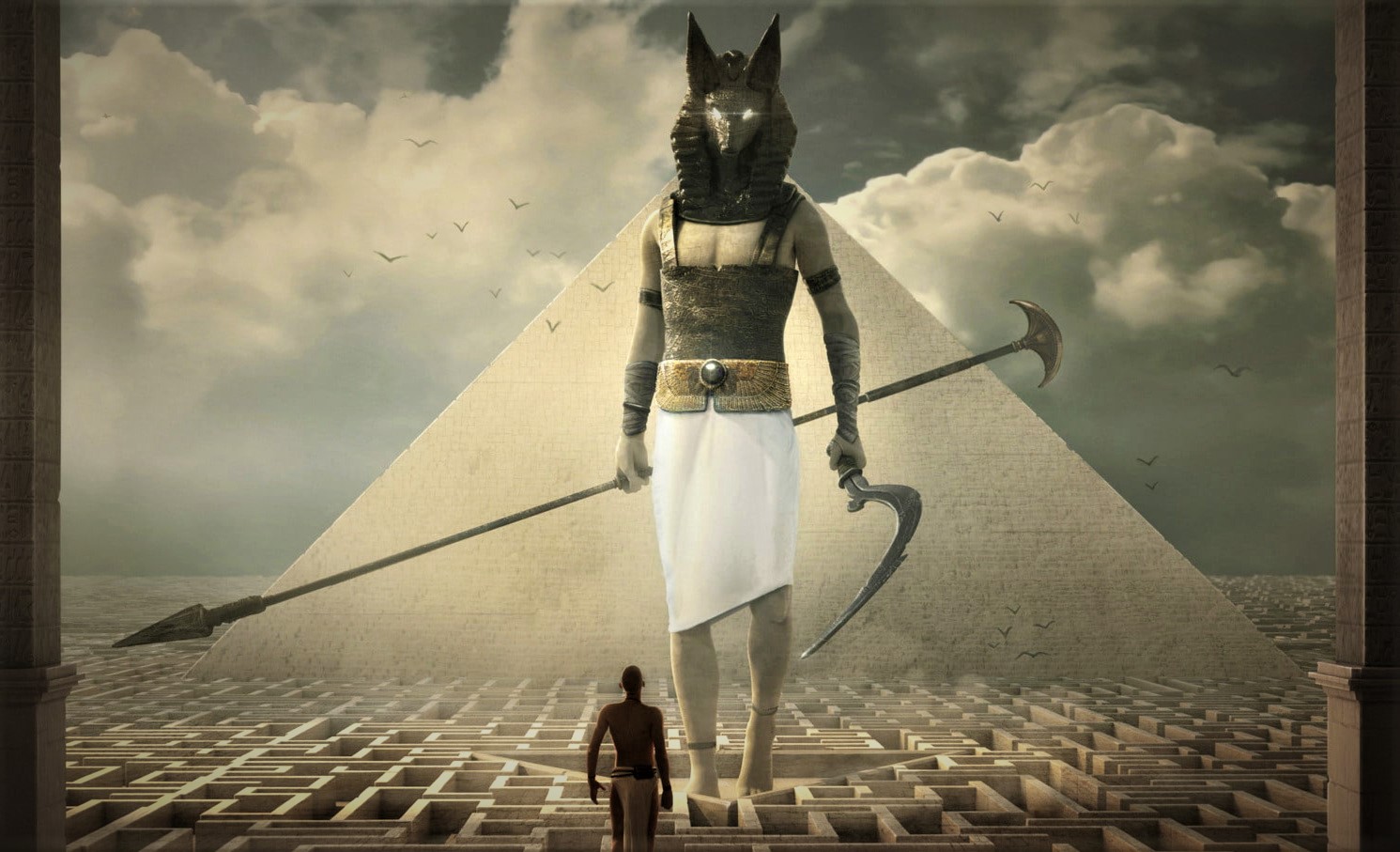
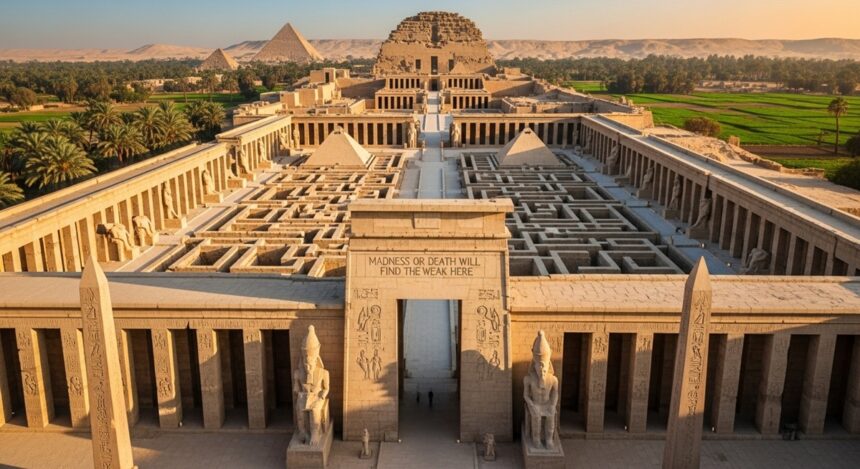
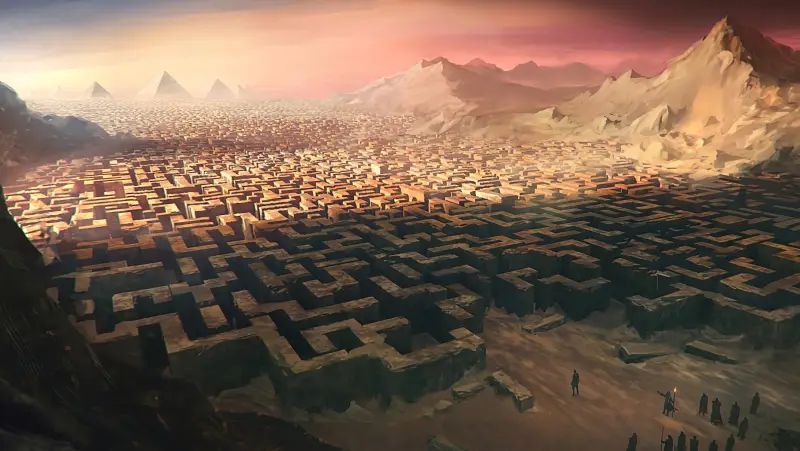
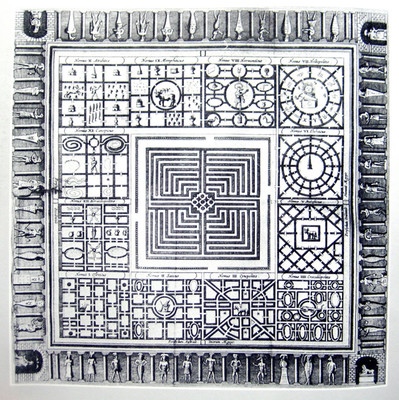
The Egyptian Labyrinth is documented ancient testimony, not a modern invention. Herodotus, writing in the 5th century BCE and claiming to have visited the site personally, described a structure of 3,000 chambers, half above ground and half below, connected by intricate passages, and called it more impressive than the pyramids themselves. Strabo, writing centuries later in his Geography, described the same general location and referenced a warning inscription at its entrance. Manetho, a 3rd-century BCE Egyptian priest, attributed the structure to Pharaoh Amenemhat III of the 12th Dynasty and associated it with his tomb. Diodorus Siculus and Pliny the Elder both added further detail, including claims about the structure’s navigational complexity and its unusual doors. These are independently attested classical sources, and they place the Labyrinth near Amenemhat III’s pyramid at Hawara, in Egypt’s Fayum oasis roughly 80 kilometers south of Cairo.
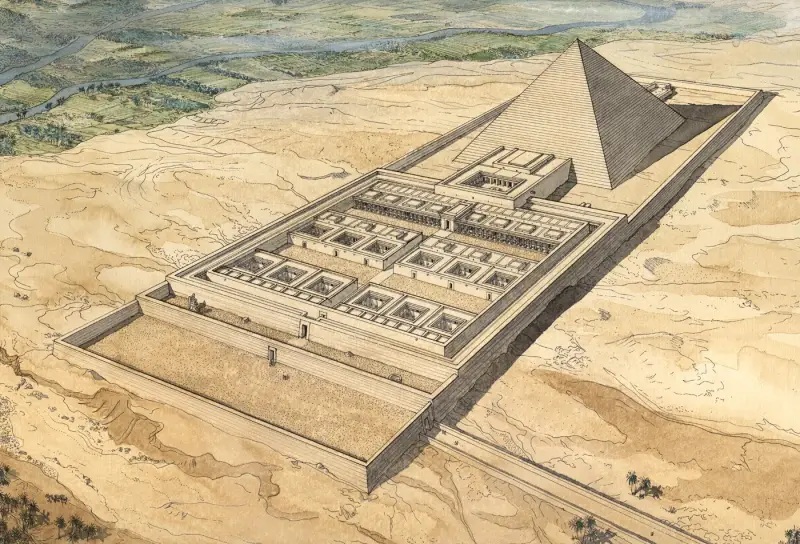
By the time of later classical and modern visitors, most of the structure described by Herodotus had vanished, generally attributed to stone quarrying during the later Ptolemaic and Roman periods, when the site’s cut limestone would have been a valuable, reusable building material. For centuries, many scholars treated Herodotus’s account as exaggerated travel writing rather than literal description.
Flinders Petrie’s 1888 Excavation
The first serious modern archaeological work at the site came from Flinders Petrie, one of the founding figures of scientific Egyptology, who excavated beneath Amenemhat III’s pyramid at Hawara in 1888. Petrie identified a large stone feature he interpreted as the structure’s foundation and, separately, a passage he described as a dead end, a “blind passage.” This is documented, peer-reviewed 19th-century archaeology, and it established the baseline that later researchers would return to more than a century afterward.
The 2008 Mataha Expedition
In February and March 2008, a geophysical survey, the Mataha Expedition, was conducted at Hawara with official permission from Egypt’s Supreme Council of Antiquities, then headed by Dr. Zahi Hawass. The team combined Egypt’s National Research Institute of Astronomy and Geophysics, Ghent University in Belgium, and Belgian artist Louis De Cordier, who coordinated and later publicized the project. Using ground-penetrating radar and electrical resistivity tomography, the team reported evidence of a grid of substantial vertical walls at depths of 8 to 12 meters, suggesting Petrie’s stone feature might be a roof or ceiling rather than a foundation, meaning intact structure could remain beneath it. The initial results were presented at a public lecture at Ghent University in October 2008.
What happened next is the actual origin of this story’s “suppression” narrative, and it deserves to be reported precisely. Shortly after the October 2008 presentation, the Secretary General of the Supreme Council of Antiquities restricted further public communication of the findings, reportedly citing national security sanctions, a stated reason that has never been independently verified or explained in any published source. De Cordier has said he waited roughly two years for the Council to release the full findings before concluding, by 2010, that they had no intention of doing so, at which point he began publishing his own account of the project independently.
This is worth being precise about: a government body restricting an expedition’s public communications is documented fact. It is not the same as a comprehensive, ongoing 17-year ban on all archaeological access to the site, and no independent, credentialed Egyptological or geophysical body has published a peer-reviewed confirmation or refutation of the Mataha Expedition’s specific structural claims in the years since. The claims remain, at this point, effectively a single research team’s unpublished internal findings, publicized primarily through De Cordier’s own website and writing rather than through standard peer review.
“Dippy” and the 2015 Merlin Burrows Scans
A separate, later claim comes from a 2015 satellite and radar survey conducted by MerlinBurrows, a private British company, led by Timothy Akers, a former Royal Air Force officer. This team claims to have identified a roughly 40-meter object nicknamed “Dippy,” shaped like the ancient Egyptian shen ring, surrounded by a matching omega-shaped moat. This needs a direct and honest credibility assessment rather than repetition: this specific claim has not been embraced by mainstream archaeology, and even researchers otherwise sympathetic to the broader Hawara story have noted that the Dippy interpretation “lacks physical evidence” and that it “strains the team behind the Burrows scans’ credibility.” No independent verification, publication, or peer review of the raw scan data has been made available.

Why this specific 2015 data stayed unpublished for a decade also deserves precision, since it’s frequently folded into the same “government cover-up” narrative as the 2008 findings, when the actual explanation is different and more mundane: everyone present at the 2015 briefing, according to accounts from participants including De Cordier himself, signed a ten-year non-disclosure agreement with MerlinBurrows, a private company. A private commercial NDA between a company and its own briefing attendees is not evidence of a government ban, and conflating the two significantly overstates what either piece of evidence actually shows.
Claims Worth Naming as Unverified
Two further stories circulate alongside the Hawara narrative that deserve to be named plainly as unverified rather than presented as parallel evidence. A rumored 1942 German expedition, said to have searched Hawara for a library belonging to the architect Imhotep supposedly connected to Atlantis, has no supporting documentation of any kind. A separate story involving a 1940 French expedition finding a metal box of papyri at the Siwa oasis, which then vanished during transport in 1942, is similarly uncorroborated. Both stories function as atmosphere rather than evidence, and repeating them without this caveat lends them a credibility the historical record doesn’t support.

Why Hawara Is Restricted Today
Since 2012, Hawara has held a “closed zone” designation, officially justified on the grounds of protecting Amenemhat III’s pyramid and site stability. This is worth taking at face value rather than assuming a hidden motive: the region’s groundwater, fed partly by the nearby Bahr-Wahbi Canal, is genuinely saline and poses a well documented threat to any exposed artifacts or structures, and the roughly 16 meters of sand covering the site does function as a stabilizing preservative layer. Excavating without a complete structural model, which the limited and largely unpublished survey data doesn’t currently provide, carries a documented risk of collapse in any deep underground cavity, a legitimate archaeological conservation concern that applies to many fragile sites worldwide, not a justification unique to Hawara or invented to conceal a controversial discovery.
Who Louis De Cordier Actually Is
The primary source behind most of the Hawara story’s continued public circulation deserves precision, since his role gets flattened in most retellings into simply “the expedition.” Louis De Cordier is a Belgian visual artist by training and profession, not a professional archaeologist, Egyptologist, or geophysicist. He coordinated and helped fund the 2008 survey and has, in the years since, run his own website and publishing platform, Labyrinth of Egypt, dedicated to promoting the expedition’s findings and advocating for further excavation. This doesn’t automatically make his account false. De Cordier has consistently described the project’s actual scientific data collection as a collaboration with Egypt’s National Research Institute of Astronomy and Geophysics, a credentialed institution founded in 1839. But it does mean the version of the story that reaches most readers passes through one interested, non-independent advocate’s framing and website, rather than through a peer-reviewed publication in an archaeological or geophysical journal, and that distinction matters for how much weight any single specific claim should be given.
This is a common pattern in stories about withheld or suppressed archaeological findings, worth naming because it recurs across many similar stories, not just this one: a credentialed institution conducts a documented survey, produces genuinely interesting preliminary results, and then a restriction on official publication, whether from institutional caution, bureaucratic delay, national security posturing, or a simple lack of funding to complete the work, creates an information vacuum. That vacuum then gets filled by the most invested, least independent voice available, who has every reason to present the findings as more conclusive and more suppressed than the institutional record actually supports, not necessarily out of dishonesty, but because sustained advocacy naturally shades toward certainty over time.
The Saqqara Comparison
A separate claim sometimes connected to Hawara involves the Pyramid of Djoser at Saqqara, where Japanese researchers reportedly used muon tomography in 2020 to identify tunnel-like voids roughly 150 meters underground, findings supposedly classified by Egyptian authorities. This connection should be treated with caution rather than presented as corroborating evidence. Muon tomography has genuinely been used at multiple Egyptian sites, most credibly and verifiably in the well documented 2017 ScanPyramids project’s discovery of a confirmed void above the Grand Gallery in the Great Pyramid of Giza, a finding published in the peer-reviewed journal Nature and independently confirmed by multiple detector teams. Whether a comparable, verified, peer-reviewed muon study exists specifically for Saqqara at the depth and scale described is considerably less well established in any source that could be independently verified here, and it should not be cited as confirmed corroboration for the separate, unrelated claims at Hawara.
What Genuinely Remains Unresolved
None of the corrections above mean there’s nothing left to learn at Hawara. Whether Petrie’s 1888 stone feature is a foundation or a ceiling remains an unresolved archaeological question that a proper, independently verified, peer-reviewed excavation could settle. Whether the 2008 Mataha survey’s reported wall grid reflects intact structure, natural geological features, or measurement artifacts from a research team that never published its full methodology and raw data for outside review is also genuinely unresolved. What isn’t credible, based on everything currently available, is the specific “Dippy” metallic megastructure claim, which even sympathetic researchers acknowledge lacks supporting physical evidence.
The honest state of this story is an ancient structure, attested by credible classical sources, partially investigated by archaeologists and geophysicists using established technology, whose full picture remains incomplete not because of a coordinated government conspiracy to hide advanced ancient technology, but because of a specific 2008 disclosure restriction that has never been fully explained, a private company’s decade-long NDA, and the simple fact that no comprehensive, properly funded, peer-reviewed excavation has yet been permitted or completed. That’s a frustrating gap in the historical record. It doesn’t require inventing a metallic omega-shaped megastructure to be worth continuing to ask about.
What would actually resolve this, in the way genuine archaeological mysteries get resolved elsewhere, is straightforward even if it isn’t easy: a properly funded, internationally supervised excavation, with full data transparency and independent peer review at every stage, conducted by credentialed Egyptologists and geophysicists working openly rather than through a single advocate’s personal platform or a private company’s non-disclosure agreement. Herodotus’s account has waited over two thousand years for confirmation or correction. Whatever actually lies beneath Hawara’s sand, it will keep for the years it takes to investigate it properly, and it deserves an investigation conducted in the open rather than pieced together, as this story has been for over a decade now, from restricted briefings, unpublished field data, and one artist’s enthusiastic but non-independent advocacy. It isn’t the only Egyptian site where access has been quietly restricted following an anomalous survey result, the Sphinx saw the same pattern in 1993