



Eight kings ruled before the Flood, according to the oldest surviving copy of the Sumerian King List. Six of their eight reign lengths divide evenly by 72, the number of years it takes Earth’s axis to precess one degree against the background stars. Two do not. A later Hellenistic retelling of the same tradition, filtered through a Babylonian priest writing in Greek for a Greek audience two thousand years after the cuneiform original, gives ten kings instead of eight, and every single one divides evenly by 72, summing to exactly 432,000, a number that also appears, with uncanny precision, in a Hindu text written on the other side of Asia and in an Icelandic poem written a continent away.
This is what that pattern actually is, what it isn’t, and why the honest answer is more interesting than either a confirmed ancient secret or a dismissible coincidence.
The List Itself
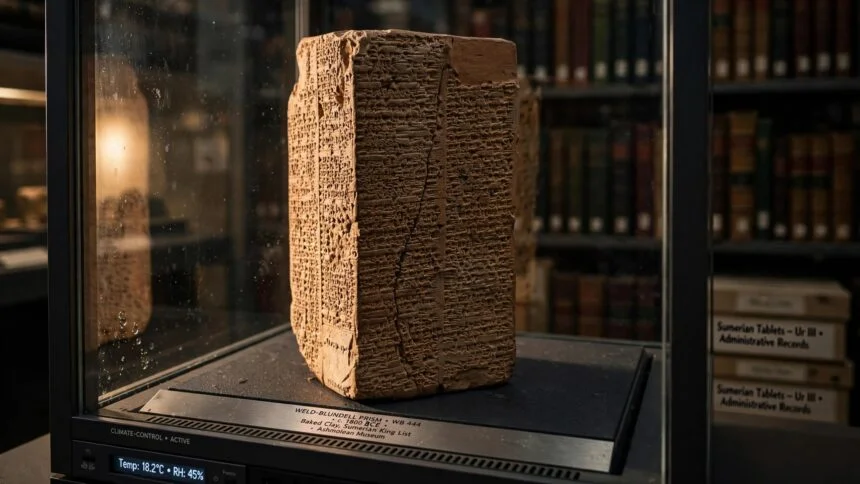
The Sumerian King List survives in multiple cuneiform exemplars, the fullest and most frequently cited being the Weld-Blundell Prism, catalogued as WB 444, held at Oxford’s Ashmolean Museum and dated to roughly 1800 BCE, itself a copy of a tradition considerably older than the physical object. The list opens with a line that Assyriologists have translated consistently across a century of scholarship: “After the kingship descended from heaven, the kingship was in Eridu.” What follows is a sequence of eight kings ruling across five cities, Eridu, Bad-tibira, Larak, Sippar, and Shuruppak, before the list breaks with a second famous line: “Then the Flood swept over.” The eight antediluvian reign lengths, as given in the standard WB 444 text, are these: Alulim of Eridu, 28,800 years. Alalngar, also of Eridu, 36,000 years. En-men-lu-ana of Bad-tibira, 43,200 years. En-men-gal-ana, also of Bad-tibira, 28,800 years. Dumuzid of Bad-tibira, 36,000 years. En-sipad-zid-ana of Larak, 28,800 years. En-men-dur-ana of Sippar, 21,000 years. Ubara-Tutu of Shuruppak, 18,600 years. Summed together, these eight reigns total 241,200 years of pre-Flood kingship, a figure no historian treats as a literal chronology and no Assyriologist has ever proposed reading as such.
Doing the Actual Arithmetic
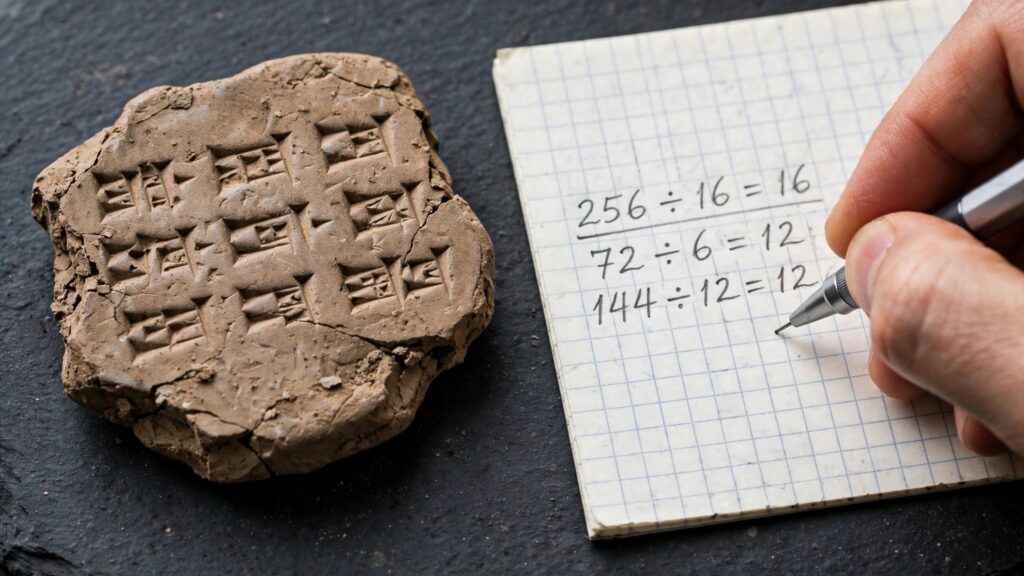
The claim that these numbers are “multiples of 72” deserves to be checked directly rather than repeated, since the whole discussion depends on whether it’s true. Divide each figure by 72 and the pattern is real, but it is not complete. Alulim’s 28,800 divides to exactly 400. Alalngar’s 36,000 divides to exactly 500. En-men-lu-ana’s 43,200 divides to exactly 600. En-men-gal-ana’s 28,800 divides to 400. Dumuzid’s 36,000 divides to 500. En-sipad-zid-ana’s 28,800 divides to 400. That is six kings, six clean divisions, no remainder in any of them. Then the pattern breaks. En-men-dur-ana’s 21,000 divides to 291.67, a fraction, not a whole number. Ubara-Tutu’s 18,600 divides to 258.33, also a fraction. Two of the eight antediluvian reigns, the two shortest ones, the two immediately preceding the Flood itself, do not fit the pattern the other six establish so cleanly. The total of all eight figures, 241,200, does happen to divide evenly by 72, landing on exactly 3,350, a fact that is either meaningful or is simply what happens when six clean multiples of 72 are added to two numbers that, while not multiples of 72 themselves, are still built from the same underlying base-60 numerical vocabulary. Both possibilities deserve to stay on the table, and neither should be quietly dropped to make the pattern look cleaner than the primary text actually supports.
Why Sumerian Numbers Behave This Way
Understanding why six of eight numbers land on such suspiciously round multiples requires understanding the number system that produced them in the first place. Sumerian and later Babylonian mathematics was sexagesimal, built on a base of 60 rather than the base-10 system inherited by most of the modern world, and this is not speculation but a well established fact confirmed by thousands of surviving cuneiform mathematical and administrative tablets. The system’s foundational large unit was the šár, equal to 3,600, itself simply 60 multiplied by 60. A šár of šárs, 216,000, and half a šár, 1,800, along with related units like the ner at 600, formed a nested vocabulary of “round” numbers within this base-60 world in exactly the way that 10, 100, and 1,000 form a nested vocabulary of round numbers within a base-10 world. Every one of the six clean antediluvian figures, 28,800, 36,000, 43,200, is a whole-number multiple of 3,600, the šár itself. And here is the arithmetic fact that does the real explanatory work: 3,600 divided by 72 equals exactly 50. Any number built as a whole multiple of 3,600, which is to say any number a Sumerian scribe would have recognized as simply “a round figure” in his own numerical vocabulary, is automatically also a whole multiple of 72, with no additional astronomical intention required at all. This is the honest, unglamorous mathematical explanation sitting underneath the pattern, and it deserves equal billing with the more dramatic reading, because six-eighths of the puzzle may already be solved by it.
The Two Numbers That Don’t Fit
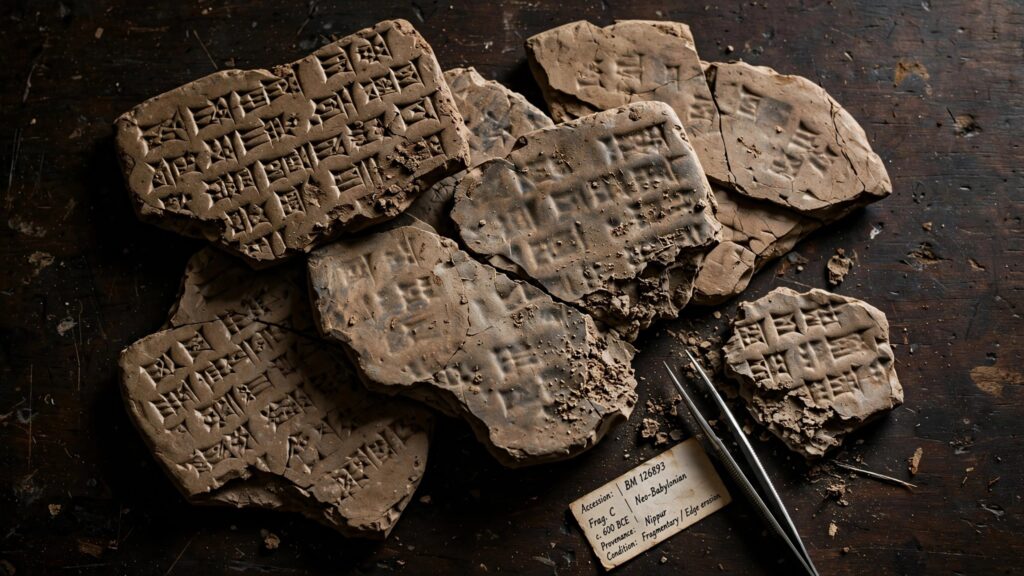
The šár explanation, however, does not fully account for the two numbers that break the 72-divisibility pattern, and intellectual honesty requires sitting with that gap rather than explaining it away. 21,000 is not a multiple of 3,600. Neither is 18,600. Both are still recognizably “round” by Sumerian standards, built from combinations of 600 and smaller sexagesimal units rather than pure šár multiples, which suggests these two final reigns before the Flood may simply belong to a different, looser numerical tradition than the six that precede them, or may reflect scribal transmission variance across the centuries separating the events the list claims to describe from the physical tablet that survives. It’s also worth noting directly that WB 444 is not the only surviving King List exemplar, and other cuneiform copies give some antediluvian figures differently, a genuine manuscript variance that further complicates any claim of a single, perfectly preserved numerical code. A pattern that holds for three-quarters of the data and breaks for the final quarter, precisely the quarter closest to the catastrophe the list is building toward, is a real finding worth reporting exactly as it is: suggestive, substantial, and incomplete.
Berossus and the Perfect Version
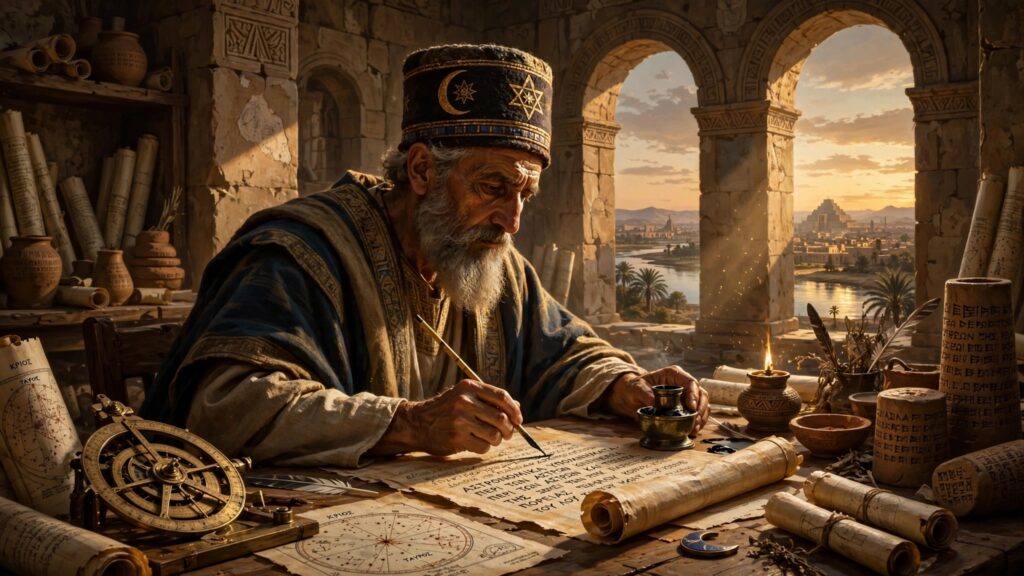
The most striking evidence for a deliberate 72-based numerical structure doesn’t come from the Sumerian cuneiform tradition at all. It comes from Berossus, a Babylonian priest of Marduk writing in Greek in the early third century BCE, whose Babyloniaca survives only in fragments quoted by later authors, most substantially by the Christian chronicler Eusebius and the Byzantine historian Syncellus. Berossus’s own antediluvian king list differs from the Sumerian original in a checkable way: it names ten kings rather than eight, and every single one of their reign lengths divides evenly by 72 with no exception. Alorus, 36,000 years. Alaparus, 10,800. Amelon, 46,800. Ammenon, 43,200. Megalarus, 64,800. Daonus, 36,000. Euedoreschus, 64,800. Amempsinus, 36,000. Otiartes, 28,800. Xisuthros, the flood-hero figure corresponding to Sumerian Ziusudra, 64,800. Every figure divides cleanly. And the total across all ten reigns lands on exactly 432,000 years, a number with no remainder, no rounding, no ambiguity in the arithmetic at all.
Why 432,000 Matters
The number 432,000 is not confined to Berossus. It appears, independently attested, in the Hindu tradition’s Kali Yuga, the current and final age in the four-age Mahayuga cycle, given in surviving Sanskrit texts as lasting exactly 432,000 years, with the full Mahayuga cycle itself calculated as ten times that figure, 4,320,000 years. It appears again, considerably more obliquely, in Norse tradition: the Grímnismál, part of the Poetic Edda, states that 800 einherjar warriors will march out through each of Valhalla’s 540 doors on the day of Ragnarök, and 800 multiplied by 540 equals exactly 432,000. Three literary traditions, Mesopotamian, Vedic, and Norse, with no established direct line of transmission connecting Iron Age Scandinavia to Hellenistic Babylon to classical India, converge on the identical figure. This convergence is real, checkable arithmetic, not an invented coincidence, and it is the single strongest piece of evidence in the entire discussion, considerably stronger than the imperfect Sumerian cuneiform pattern on its own.
What Precession Actually Is, Measured Accurately

Axial precession is real, well established, modern astrophysics, not a fringe claim requiring any defense. Earth’s rotational axis traces a slow circle against the background of fixed stars over a period modern instruments measure at approximately 25,772 years, caused by the gravitational tug of the Sun and Moon on Earth’s equatorial bulge, first rigorously described in the Western tradition by the Greek astronomer Hipparchus in the second century BCE, working from centuries of accumulated Babylonian observational records. Dividing 25,772 by 360 degrees gives a precise modern figure of 71.59 years per degree of axial drift. The ancient approximation of exactly 72 years per degree, when multiplied back out across a full 360-degree cycle, yields a “Great Year” of exactly 25,920 years, differing from the modern measured figure by only about 148 years, an error of roughly half a percent. This is a genuinely remarkable degree of accuracy for observations made without telescopes, and it means 72 was not an arbitrary number for any ancient tradition capable of tracking the slow, centuries-long drift of heliacal star risings against the calendar. It was, within the limits of naked-eye observation sustained across many human generations, a real, working astronomical constant.
Hamlet’s Mill | What the Book Actually Argues
Giorgio de Santillana, a historian of science at MIT, and Hertha von Dechend, a historian of science at Goethe University Frankfurt, published Hamlet’s Mill in 1969, subtitled An Essay Investigating the Origins of Human Knowledge and Its Transmission Through Myth. Both were credentialed academics, and the book itself is a real, published, seriously argued work, not an anonymous internet claim. Its central thesis holds that a body of extraordinarily ancient astronomical knowledge concerning axial precession, far older than the Hipparchus-credited “discovery” in the second century BCE, was encoded across an enormous range of unrelated world mythologies, using a shared, non-literal vocabulary of numbers, gods, and cosmic catastrophes, precisely because oral and early literate cultures lacked the mathematical notation to record the concept directly and instead embedded it in the only durable transmission technology available to them: story. The book is genuinely erudite, drawing on sources from Norse, Finnish, Greek, Vedic, Polynesian, and Mesoamerican material, and it has never been accepted by mainstream historians of astronomy or comparative mythologists as an established account of the ancient world. The most consistent scholarly criticism, repeated across decades of review, is methodological: the book assembles echoes and numerical resonances across cultures separated by vast distances and centuries without establishing lines of actual historical transmission between them, and a sufficiently large, sufficiently flexible search across the world’s mythological corpus will always turn up some numbers that appear to rhyme with 72 or its multiples, simply because human storytelling traditions favor round, symbolically weighted numbers in the first place.
What Hamlet’s Mill Never Actually Did With the King List
It’s worth being precise about what de Santillana and von Dechend actually wrote, since their book is frequently invoked more expansively than its text supports. Hamlet’s Mill discusses Berossus and the 432,000 figure, correctly identifying its cross-cultural resonance with the Hindu Kali Yuga. It does not, anywhere in its roughly 500 pages, perform a king-by-king divisibility analysis of the eight individual Sumerian cuneiform reign lengths against a 72-year precessional constant. That exercise, dividing each of Alulim’s, Alalngar’s, and En-men-lu-ana’s individual figures by 72 and checking the remainder, is not present in the book that is most often cited as its authority. This means the numerical exercise carried out above in this piece is a genuinely original extension of the Hamlet’s Mill framework applied directly to the primary cuneiform text, not a repetition of an existing, published academic finding, and it should be presented to readers with that distinction clearly stated rather than implied to already carry the book’s authority behind it.
What Mainstream Assyriology Says These Numbers Mean
Credentialed Assyriologists who have studied the King List directly, including Thorkild Jacobsen, whose 1939 critical edition and translation remains a foundational reference in the field, have generally read the antediluvian reign lengths as symbolic expressions of divine kingship’s cosmic weight rather than as either literal chronology or hidden astronomy. The reigns shrink dramatically once the list resumes after the Flood, with post-diluvian kings ruling for spans of decades or low centuries rather than tens of thousands of years, a structural feature scholars read as the list marking a clear, intentional transition from a mythic, cosmically-scaled age of divine kingship to an ordinary, human-scaled historical age. Under this reading, large round sexagesimal numbers were the natural vocabulary available to Sumerian scribes for expressing “vast, cosmically significant span” the same way a modern writer might reach for “eons” or “time immemorial,” without requiring any individual figure to encode its own retrievable calendar. This mainstream account does not require the 72-pattern to be meaningless. It simply offers a more conservative, better-evidenced explanation for why so many of the numbers turn out to be round: they were built from the same base-60 “round number” vocabulary Sumerian scribes used for everything from grain accounts to temple dedications, a vocabulary that happens to make 72-divisibility close to automatic for any sufficiently round large figure.
Holding Both Readings at Once
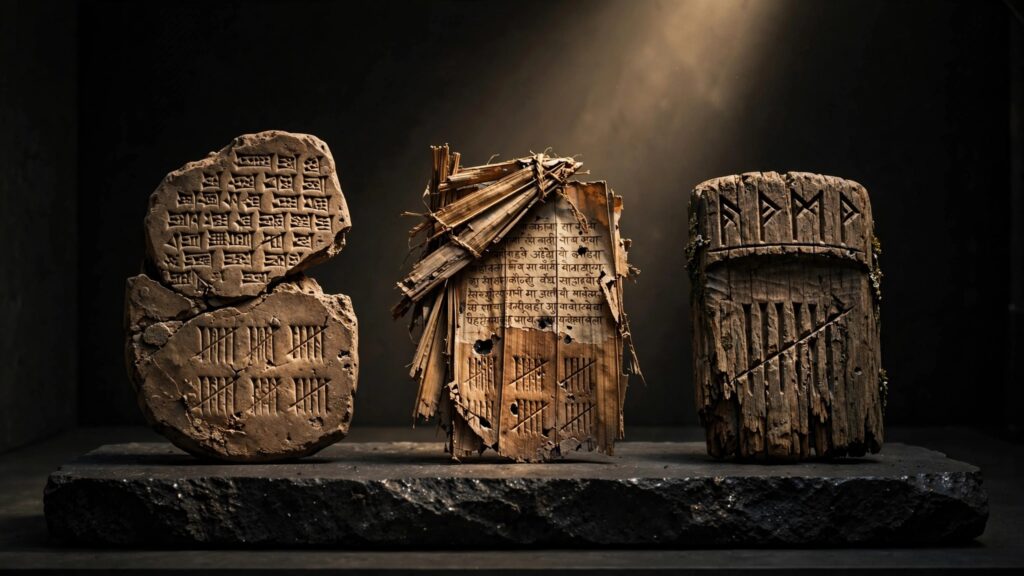
The honest position sits between the two extremes this topic usually gets pulled toward. It is not accurate to say the antediluvian reign lengths are simply meaningless round numbers with nothing further to explain, since that reading struggles to account for why Berossus’s later, independently transmitted retelling converges so precisely on 432,000, a figure that separately, demonstrably appears in Vedic and Norse sources with no obvious channel of direct transmission between them. It is equally not accurate to say the King List has been shown to encode a precise, deliberate precessional calendar, since the earliest and most authoritative cuneiform version of the tradition breaks the pattern on exactly two of its eight figures, and the scholarly work most often cited as establishing the astronomical reading never actually performed this exact test against this exact text. What can be said with confidence: Sumerian base-60 numerical convention makes 72-divisibility a probable, low-cost byproduct of any sufficiently round large figure, which explains most but not all of the pattern in the earliest surviving version. The 432,000 convergence across Berossus, Hindu, and Norse sources is a separate, stronger, and considerably harder-to-explain-away phenomenon that deserves to be taken seriously as either a real trace of shared ancient astronomical knowledge, a shared numerological convention travelling along trade and cultural contact routes historians have not yet fully traced, or an extraordinary coincidence built from the fact that 72, 60, and their multiples were simply the most symbolically loaded round numbers available to numerate ancient societies working in base 60.
Reading Base-60 the Way a Sumerian Scribe Did
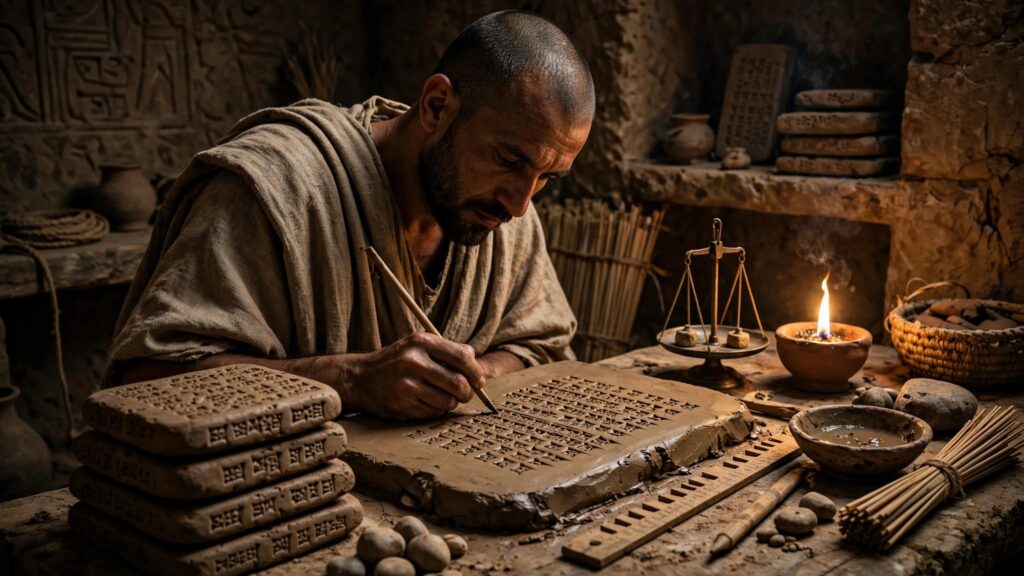
It helps to sit inside the numerical world these scribes actually worked in, since base-60 arithmetic can look arbitrary from the outside and feels considerably less so once its internal logic is visible. Sixty was chosen, most historians of mathematics agree, precisely because it divides so cleanly by so many smaller numbers, 2, 3, 4, 5, 6, 10, 12, 15, 20, and 30 all divide 60 with no remainder, making it unusually convenient for the fractional bookkeeping, weights, and calendar arithmetic that administered a large agricultural bureaucracy. Cuneiform tablets recording grain rations, land allotments, and interest calculations from across the third and second millennia BCE show scribes routinely working in 60s, 600s, and 3,600s the way a modern accountant works in 10s, 100s, and 1,000s. Seen against this backdrop, a scribe reaching for 28,800 or 36,000 as an antediluvian reign length wasn’t necessarily reaching for anything astronomical at all. He was reaching for the biggest, roundest, most cosmically weighty numbers his own number system made available, in the same reflexive way a modern writer describing an ancient event might reach for “a thousand years” without doing any underlying calculation, simply because round numbers in base 10 carry rhetorical weight for us the way round numbers in base 60 carried it for him.
How This Pattern Gets Misused Online

It’s worth naming directly how a genuinely interesting numerical pattern like this one typically gets handled once it leaves academic discussion and enters wider circulation, since the distortion follows a recognizable shape. The 6-of-8 pattern in the cuneiform King List quietly becomes “all,” the acknowledgment that Hamlet’s Mill never actually performed this specific analysis quietly disappears, and the considerable distance between “an interesting, partial numerical pattern worth investigating” and “proof of a lost astronomical civilization” gets closed in a single confident sentence with no supporting arithmetic shown. This isn’t unique to the King List. It’s a general pattern worth recognizing across this entire genre of numerology-adjacent claim: a real, checkable partial pattern exists, gets rounded up to a complete one in the retelling, and the rounding itself becomes invisible once enough retellings have passed the claim along. Readers encountering a version of this claim online are well served by doing exactly what this piece has done, opening a primary source, dividing the actual numbers, and checking whether “all” really means all before accepting the conclusion built on top of it.
Jacobsen’s Case for a Mundane Origin

Thorkild Jacobsen’s 1939 study, The Sumerian King List, remains the single most influential piece of Assyriological scholarship on this text, and his own argument deserves to be represented on its own terms rather than folded generically into “mainstream scholars disagree.” Jacobsen proposed that the King List’s core function was political rather than commemorative or cosmological: a tool used by later Mesopotamian rulers, particularly under the Third Dynasty of Ur around 2100 BCE, to construct an unbroken, singular line of legitimate kingship extending backward through time, even though the underlying historical reality almost certainly involved multiple competing city-states ruling simultaneously rather than in the tidy, sequential succession the list presents. Under Jacobsen’s reading, the antediluvian section functions as a kind of cosmological preamble, establishing that kingship itself is a gift from the gods that predates human history altogether, with the individual numbers serving to communicate scale and divine sanction rather than encoding any retrievable data, astronomical or otherwise. This is a serious, closely argued, alternative explanation for why the numbers are so large and so round, and it deserves to sit alongside the 72-pattern discussion rather than be waved past on the way to a more exciting conclusion.
What Would Actually Settle This

It’s worth being concrete about what kind of evidence would move this question meaningfully closer to resolution in either direction, since naming that standard is more useful than leaving the question permanently open-ended. A discovery of additional, independently transmitted antediluvian king lists from cultures with no plausible contact route to Mesopotamia, also converging on 432,000 or clean 72-multiples, would substantially strengthen the astronomical reading beyond what Berossus and the Vedic and Norse parallels currently support on their own. Conversely, a demonstrated, well-documented case of a separate ancient bureaucratic tradition producing comparably large numbers of round figures through ordinary administrative rounding, with no plausible connection to precessional observation at all, would strengthen the base-60 coincidence reading. Cuneiform scholarship continues actively publishing newly translated administrative and literary tablets each year, and it remains genuinely possible that evidence bearing directly on this question exists in an unpublished or under-studied tablet somewhere in a museum collection. Until then, the honest position is the one this piece has tried to model throughout: state exactly what the arithmetic shows, state exactly what it doesn’t, and resist the pull toward whichever conclusion feels more satisfying to land on.
What This Piece Does and Doesn’t Claim
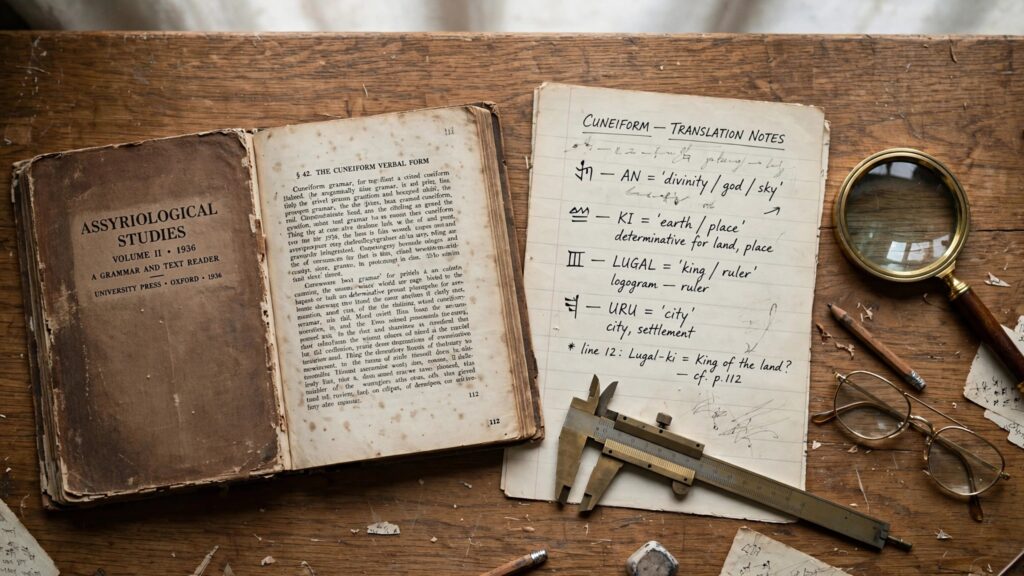
This piece does not conclude that the Sumerian King List is secretly a precessional calendar rather than a historical or symbolic king list, because the arithmetic performed directly against the primary cuneiform text does not fully support that conclusion, two of eight numbers break cleanly, and no published academic source has established the astronomical reading against this text with this degree of rigor. What this piece does conclude is that the pattern is real enough, and the cross-cultural 432,000 convergence sharp enough, to deserve serious, continued, honestly-reported investigation rather than either credulous acceptance or reflexive dismissal. The eight kings who ruled before the Flood, whatever they actually represent to the scribes who first wrote them down, left behind a set of numbers that still don’t fully resolve into either pure coincidence or confirmed ancient science nearly four thousand years later, and that unresolved status is, itself, the most honest and most interesting thing this piece can report.