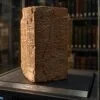
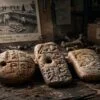
The clay tablet was already two thousand years old when the Greeks wrote the Persephone myth.
The Descent of Inanna, preserved in cuneiform on clay tablets whose oldest versions date to approximately 1750 BCE but whose composition scholars trace to the late third millennium BCE, is the earliest complete narrative of a deity’s voluntary descent into the underworld, death, and resurrection in any surviving literary tradition. Its 415 Sumerian verses describe a journey whose structural elements, the seven successive thresholds, the progressive stripping of divine identity, the death at the center, and the conditional resurrection, appear in the Greek Persephone tradition, in the Orphic underworld mythology, in the Kabbalistic Qliphothic descent covered in this library’s dedicated piece, and in the initiatory traditions of every serious mystery school in the Western tradition.
Whether this structural convergence reflects cultural transmission from the Sumerian original through the Greek and subsequent traditions, independent human discovery of a genuine cosmological structure that the initiatory traditions are mapping, or both simultaneously, is the question that the Descent of Inanna’s antiquity and the later traditions’ correspondence make impossible to dismiss as coincidental.
The poem’s opening lines, preserved in Samuel Noah Kramer’s translation: from the great heaven she set her eyes on the great below. The intentionality is specific. Inanna does not fall into the underworld, is not abducted into it, and is not sent there. She looks at it from heaven and chooses to descend. The entire subsequent narrative flows from this voluntary choice, whose motivation the poem encodes in multiple interpretations simultaneously: political ambition, the desire to expand her power to the limits of existence, grief for her brother-in-law Gugalanna the Celestial Bull, and something the poem does not fully articulate but whose presence the narrative’s shape implies: the desire to know the one domain she has not yet known.
The Seven Gates
The descent’s structural mechanism is the seven gates.
Between the upper world and the underworld of Ereshkigal, the poem places seven successive gates whose gatekeeper Neti refuses passage without compliance with the underworld’s laws. At each gate, Inanna must surrender a piece of her divine regalia. The sequence appears in the text:
At the first gate she surrenders the crown of the steppe, her sovereignty over the earthly realm. At the second gate she surrenders the measuring rod and line, her power of measurement and divine order. At the third gate she surrenders the small lapis lazuli stones at her neck, her beauty and sexual power. At the fourth gate she surrenders the sparkling stones at her breast, her capacity for pleasure and abundance. At the fifth gate she surrenders the gold ring on her wrist, her authority and social power. At the sixth gate she surrenders the breastplate called Come Man Come, her protection and capacity for battle. At the seventh gate she surrenders the royal robe, her last identity marker, and arrives at the underworld’s center naked and bowed low.
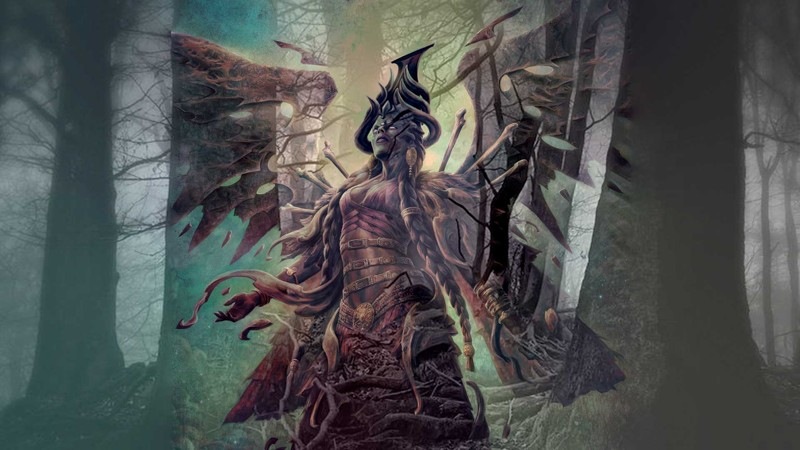
The sequence of what is surrendered at each gate is a precise theological statement about the structure of the self. The crown, the measuring rod, the beauty stones, the pleasure stones, the authority ring, the protective breastplate, and the royal robe are not arbitrary inventory. They are the external markers of divine identity, from the most cosmic to the most personal, surrendered in order from most external to most intimate.
What arrives at the underworld’s center after these seven surrenders is Inanna without any of the attributes that define her as Inanna. Whether what remains at that point is the essential divine consciousness stripped of its expressions, or nothing at all, is the theological question that the poem answers by killing her.
Ereshkigal turns the eye of death on her, speaks the word of wrath, utters the cry of guilt, and Inanna is turned into a corpse and hung on a hook.
The death is total. The poem does not soften it. The goddess of heaven, love, and war is hanging on a hook in the underworld, dead.
Ereshkigal and the Shadow
The relationship between Inanna and Ereshkigal is the most psychologically sophisticated element of the poem and the one that the Jungian analytical tradition has engaged with most extensively in the modern period.
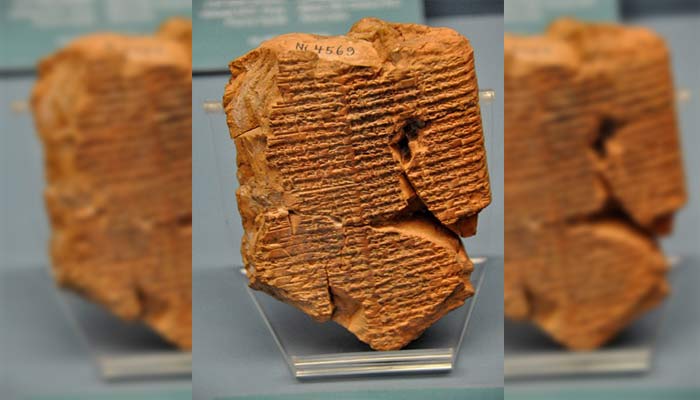
Ereshkigal is Inanna’s sister. In the cosmological framework of the poem, Inanna governs the upper world and Ereshkigal governs the lower world. They are the two halves of the same reality, the divine feminine expressed in its two fundamental aspects: the Inanna of generation, fertility, love, and war, and the Ereshkigal of death, dissolution, and the return to formlessness.
Inanna’s descent is therefore not an invasion of foreign territory but a confrontation with the other half of herself. The underworld is not simply the realm of the dead. It is the realm of everything in reality that Inanna’s upper world existence does not contain. The darkness, the dissolution, the absence of all identity markers, are not merely opposed to her upper world nature but are its necessary complement.
The Qliphothic tradition covered in this library’s dedicated piece describes exactly this structure in its Kabbalistic vocabulary: the Qliphothic Tree is the shadow dimension of the Sephirothic Tree, accessible through the hidden Sephira Daath, containing the unmediated excess of the divine qualities that the organized Sephirothic Tree expresses in balanced form. The Kabbalistic initiate who descends through the Qliphothic spheres is replicating Inanna’s journey: the voluntary stripping of constructed identity, the encounter with the unmediated divine in its most overwhelming form, the death of the constructed self, and the conditional resurrection.
Whether the Kabbalistic initiatory tradition consciously drew on the Sumerian Descent narrative in its formulation, absorbed it through the transmission channels recorded in the Gnostic Transmission piece’s account of the prisca sapientia tradition, or independently arrived at the same cosmological structure through a different investigative path, is a question the transmission history of the relevant traditions partially and not definitively answers.
The Resurrection Technology
The mechanism by which Inanna is resurrected is the most specific and most anomalous element of the poem for the library’s framework.
Before descending, Inanna instructs her assistant Ninshubur: if I do not return within three days, go to the gods and beg them to save me. Ninshubur executes this plan, and when Inanna does not return, she goes to Enlil, to Nanna the moon god, and finally to Enki, the god of wisdom and the sweet underground waters.
Enlil and Nanna refuse to intervene, saying that Inanna chose the laws of the underworld of her own will and must abide by them. Enki alone acts. His method is specific: he takes the dirt from under his fingernail and creates two beings, the kurgarra and the galatura, who are explicitly neither male nor female. He gives them the food of life and the water of life to carry to the underworld and instructs them to sprinkle these on Inanna’s corpse sixty times.
The kurgarra and galatura descend, find Ereshkigal in the agony of her own grief for Gugalanna, offer her sympathy rather than opposition, and receive Inanna’s corpse as a gift. They apply the food and water of life sixty times and Inanna rises.
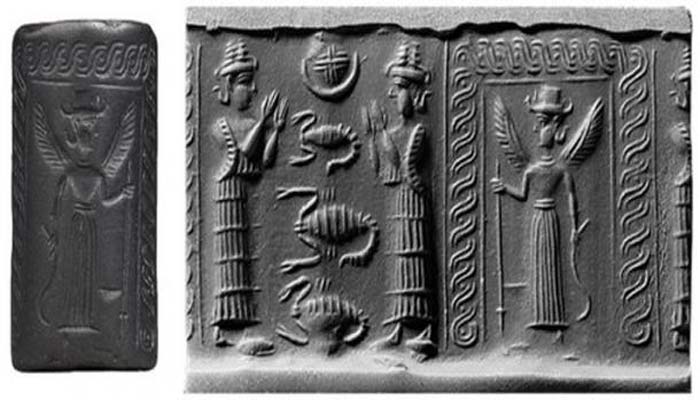
The elements of this resurrection technology deserve examination: the beings who carry out the resurrection are specifically androgynous or non-binary, which the text marks as significant by stating it explicitly. They succeed where Enlil and Nanna fail by offering empathy to Ereshkigal rather than demanding or forcing Inanna’s release. And the physical mechanism is specific: food and water applied sixty times to the corpse.
Whether this represents: a theological narrative encoding the principle that resurrection requires the integration of the shadow sister’s reality rather than its conquest, a genuine technological description of a revivification process using substances whose symbolic names, food of life and water of life, encode their actual physical character, or something between these interpretations that the poem’s detail makes worth examining, is the question that the resurrection mechanism’s specificity raises.
The number sixty is not incidental in Sumerian numerology: sixty is the base of the Sumerian sexagesimal number system, the mathematical foundation of their astronomy and their measurement of time. Whether sixty applications is a theologically significant number in the Sumerian numerical framework or a narrative convention is not established.
The Conditional Return
Inanna’s return from the underworld is conditional. The underworld’s law is specific: no one who enters may leave without providing a substitute.
Inanna returns to the upper world accompanied by the galla, the underworld demons who will take whoever she designates as her substitute. She passes through her city and sees her loyal servants mourning her supposed death. She stays the galla’s hands. She passes through the second city and sees the same. She stays their hands again.
When she reaches her own home and finds her husband Dumuzi sitting on her throne in royal clothing, apparently not mourning, she turns the eye of death on him and points.
The galla take Dumuzi. His sister Geshtinanna volunteers to share his fate, and the divine council decides that each will spend half the year in the underworld. The seasonal myth is complete.
The moral theology of the ending is the element that makes the Descent of Inanna most theologically sophisticated: the descent, death, and resurrection produce a fundamental change in the returning deity’s relationship to the underworld. Inanna emerges from the underworld not simply restored but transformed: she now carries the underworld’s authority within her, and she exercises it on her return by designating her substitute with the same lethal look that Ereshkigal turned on her.
The transformation that the initiatory death-and-rebirth produces is not the recovery of the pre-initiation state. It is the integration of the shadow dimension’s reality into the previously partial upper-world consciousness. The goddess who descends and the goddess who returns are the same goddess, but the returning goddess contains both Inanna and something of Ereshkigal.
This theological point, that the genuine initiatory descent changes the initiate’s relationship to the shadow dimension permanently rather than restoring them to their original condition, is the point that the Qliphoth piece covers in Kabbalistic vocabulary and the Aghori piece covers in Hindu tantra vocabulary. The Descent of Inanna makes the same point in the oldest surviving literary form.
The Transmission
The Descent of Inanna’s narrative structure appears in the Greek Persephone tradition, the Orphic katabasis, the Egyptian Osirian resurrection narrative, and the Christian resurrection narrative with a consistency that the independent invention hypothesis does not easily account for.
The Persephone parallel is the most directly comparable: a young goddess is taken to the underworld, a mother’s grief causes the upper world to die, a negotiated return is arranged that produces the seasonal cycle. The structural elements are the same and the temporal precedence of the Sumerian version by at least a thousand years is well established.
The Osirian parallel is the most theologically specific: Osiris is killed by Set, his body is reassembled by Isis, and he is resurrected through a ritual technology applied by Anubis and Thoth, the gods of the underworld and of wisdom respectively. The parallel to Enki’s kurgarra and galatura applying the food and water of life is the structural correspondence that comparative mythology has noted.
The Christian resurrection narrative’s parallel, a divine being who voluntarily descends into death, spends three days in the underworld, and returns transformed, was noted by the Church Fathers themselves, who attributed the pagan parallels to demonic anticipation of the genuine Christian event. Whether this attribution is correct or whether the Christian narrative draws on the established mythology of divine descent and resurrection that had been transmitted through the ancient Near Eastern tradition for three thousand years before the Common Era, is the question that the transmission history and the structural parallel make genuinely interesting.
What the poem establishes is that the structure, voluntary descent, progressive stripping of identity, death at the center, conditional resurrection, and return with integrated shadow knowledge, was articulated in human literary form at least five thousand years ago.
Whatever that structure encodes, it has been transmitted continuously from the clay tablets of ancient Sumer to the present initiatory traditions.
Inanna is still descending. The gates are still there. The gatekeeper is still asking for the crown.