



What happens to consciousness when the biological system that produces, or carries, it stops? Every human being eventually encounters this question, not metaphorically, not philosophically, but physically. There is a moment when the heart stops. A moment when breathing stops. A moment when the brain ceases to sustain the coordinated activity associated with ordinary waking consciousness. Medicine can describe these transitions with increasing precision. Biology can tell us what happens to cells when oxygen disappears. Neuroscience can map correlations between brain activity and experience. But then the question changes, because knowing what happens to the body is not necessarily knowing what happens to the person.
And that distinction opens one of the oldest and most difficult questions human beings have ever asked: does consciousness end when the organism ends? The obvious answer is yes. The problem is that the word consciousness is doing an enormous amount of work inside that answer. If consciousness is nothing more than an activity generated by a functioning brain, then death should be the end of experience. When the machinery stops, the experience stops. There is no observer left to observe anything. That position is coherent. It is also not the end of the investigation.
Because there are people who report experiences occurring under conditions in which ordinary consciousness should have been severely impaired. There are people who report memories of lives they never apparently lived. There are traditions separated by geography and centuries that describe consciousness as something capable of surviving bodily death. There are philosophers who argue that the subjective fact of experience cannot be reduced as easily as the physical mechanisms correlated with it. And there is one question underneath all of them: what exactly would have to survive for a person to survive? That is the Death Boundary.
The Boundary Is Not Where We Think It Is
Death is often imagined as a single event: life, then death. But biology does not actually work that way. The organism passes through a sequence of increasingly irreversible transitions. Circulation stops. Oxygen delivery collapses. Different tissues fail at different rates. Electrical and metabolic processes change. Some cells remain viable after others have already ceased functioning. Medical definitions of death exist precisely because the boundary has to be operationally identified rather than simply pointed to as one instantaneous physical event.
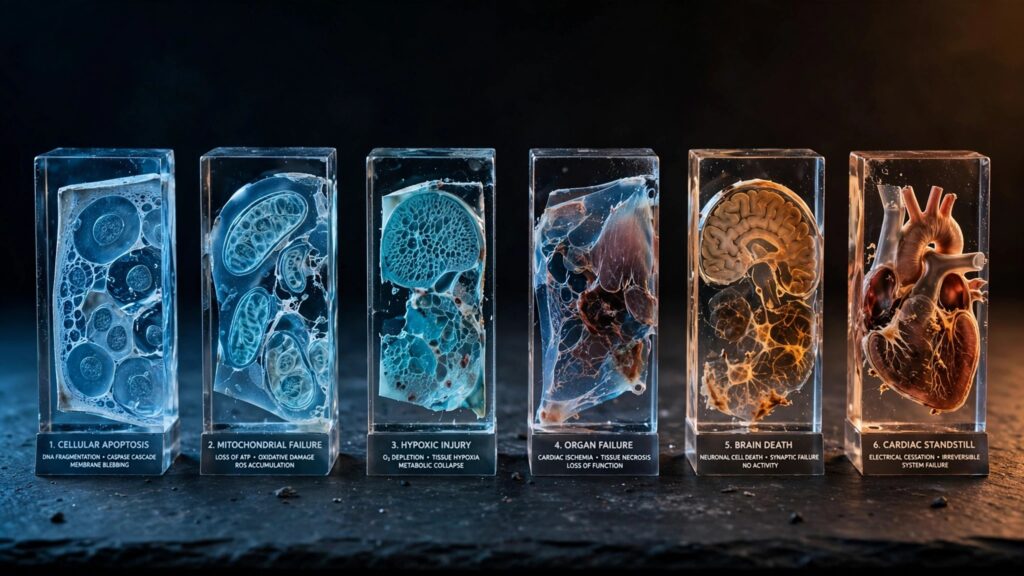
This matters philosophically, because when someone asks, “When did the person die?”, there are several different questions hiding inside the sentence. When did the heart stop? When did the brain stop functioning? When did recovery become impossible? When did the organism cease to be biologically integrated? Or: when did the conscious subject cease to exist? Those are not necessarily identical questions, and medicine can answer some of them much more confidently than it can answer the last.
The Brain Problem
Modern neuroscience gives us an extraordinary amount of information about the relationship between brain activity and conscious experience. Damage particular systems and particular aspects of consciousness can disappear. Alter the chemistry of the brain and perception changes. Change neural activity and memory, emotion, identity, attention, language, and self-awareness can change with it. This is powerful evidence for a deep relationship between the brain and the contents of consciousness. But a relationship is not automatically an explanation.
The brain problem is not simply which part of the brain produces consciousness. It is the deeper question: why is there subjective experience at all? A brain can be described in terms of electrical activity, chemical gradients, networks, information processing, and biological function. But none of those descriptions, by themselves, contains the actual experience of being that brain. A neuroscientist can describe the neural correlates of pain. The description is not the pain. A brain scan can reveal patterns associated with seeing red. The pattern is not the experience of red. A neurological account can become extraordinarily detailed without eliminating the strange fact that somewhere inside this physical process there appears to be someone experiencing it.

This is the problem that makes death so difficult. If consciousness is simply an emergent property of sufficiently organized biological matter, then death should terminate it. But if the brain is instead a carrier, filter, interface, receiver, or transformation mechanism for something more fundamental, then destroying the biological system might change consciousness without necessarily destroying consciousness itself. Those are radically different models, and at present, the question cannot simply be settled by declaring one of them true.
The Near-Death Question
Near-death experiences occupy the most controversial territory at the boundary. People who undergo cardiac arrest, extreme physiological crisis, severe trauma, or other life-threatening conditions sometimes report experiences containing recurring elements: a sense of separation from the body, an unusual clarity or expansion of awareness, movement through darkness or toward light, encounters with deceased relatives or other figures, a panoramic review of one’s life, a profound alteration in the perception of time, an overwhelming sense of familiarity, unity, love, or significance, and sometimes the conviction that the experience was more real than ordinary reality.
The most substantial attempt to study this systematically is physician Sam Parnia’s real AWARE study, published in the journal Resuscitation in 2014 after four years tracking 2,060 cardiac arrest cases across fifteen hospitals in the US, UK, and Austria. Of the patients who survived and could be interviewed, only a minority reported anything at all: about 9 percent described experiences compatible with the classic near-death pattern, and roughly 2 percent reported detailed awareness compatible with genuine perception during the period their hearts had stopped. A larger share, 46 percent among those who reported anything, described experiences that didn’t fit the familiar template cleanly, including frightening or persecutory content rarely mentioned in popular accounts. A follow-up study, AWARE-II, published in 2023, extended the same rigorous approach to 567 additional cardiac arrest patients. Neither study proved that consciousness survives cardiac arrest. What both established is that the experience itself, whatever produces it, is real, measurable, and considerably stranger and more varied than the tunnel-and-light version most people have heard of.

That final feature, the conviction of having been more lucid than usual, matters. The person is not merely saying “I had a strange dream while unconscious.” Many experiencers describe something categorically different from dreaming: lucidity, continuity of identity, memory, an environment, other beings, and the conviction that consciousness was present while their ordinary relationship with the body had been radically disrupted. That does not establish that consciousness left the body. But it establishes something smaller and more defensible: human beings can experience extraordinarily structured states of consciousness during extreme physiological conditions. The next question is whether those experiences can be explained entirely by what the brain is doing. That is where the argument becomes difficult.
The Reductionist Explanation
There are plausible neurological explanations for many components of near-death experience. Oxygen deprivation can alter perception. Changes in carbon dioxide levels can affect consciousness. Neurochemical disruption can produce vivid imagery. Temporal-lobe activity has been associated with unusual perceptual and spiritual experiences. Memory reconstruction can occur after the event. The brain under extreme stress does not operate like an ordinary waking brain. None of this should be dismissed.
But there is a subtle danger in the opposite direction. Explaining a possible mechanism for an experience is not necessarily the same thing as explaining every feature of the experience. If a particular neural state can produce a sense of leaving the body, that establishes that the brain can generate such a sensation. It does not automatically establish that every reported out-of-body experience is therefore nothing but a hallucination. A mechanism for producing an experience is not necessarily proof that the content of every instance of that experience is false.
The Harder Cases
This is where the Death Boundary becomes genuinely interesting. Some near-death accounts contain claims about perceptions allegedly acquired during periods when the experiencer was unconscious or otherwise unable to perceive normally. These reports have generated decades of debate. Some appear to involve ordinary information that could have been encountered before or after the critical event. Some are retrospective reconstructions. Some contain embellishment. Some are difficult to date precisely. And some remain difficult to explain cleanly from the available record.
That last category is the one that attracts the most attention, but it needs to be handled carefully. Difficult to explain is not the same as impossible to explain, and not yet explained is not evidence of survival after death. At the same time, the reverse statement is equally important: a plausible neurological mechanism is not automatically proof that consciousness cannot exist independently of the brain. The honest position lives in that narrow space. The evidence does not justify pretending the mystery has been solved.
The Reincarnation Problem
Near-death experiences ask whether consciousness might continue beyond bodily crisis. Reincarnation claims ask a different question: could some aspect of one person’s identity appear to continue into another biological life? This is a much stranger proposition. Across cultures, people have reported memories of previous lives. Children sometimes make statements about supposed previous identities, places, families, occupations, or deaths.
The most sustained academic effort to investigate this systematically began at the University of Virginia in 1966, when psychiatrist Ian Stevenson published Twenty Cases Suggestive of Reincarnation and went on to found the university’s Division of Perceptual Studies the following year. Over four decades, Stevenson and his colleagues compiled more than 2,500 cases, primarily from regions where reincarnation is a widely accepted belief, though a growing number now come from Western families with no prior interest in the subject. His successor, Jim Tucker, continues the work today, and has developed a scoring system that specifically weights whether a child’s statements were recorded before the deceased person they describe was identified, precisely to rule out cases where memory or expectation reshaped the story after the fact. A recurring, genuinely striking pattern across the strongest cases: roughly 70 percent involve an unnatural death in the remembered life, and about 30 percent involve a birthmark or birth defect the family says corresponds to a wound from that death.

Some cases contain details that proponents regard as difficult to explain through ordinary information transfer. Other cases are weakened by suggestibility, cultural expectations, family influence, incomplete documentation, retrospective matching, or ordinary opportunities for information acquisition. The evidentiary landscape is therefore genuinely mixed, even within a research program built specifically to guard against the weakest versions of these problems. But the philosophical question is extraordinary even before the evidence is judged. Suppose a child accurately remembers the life of a person who died before the child was born. What exactly has survived? The personality? The memories? The information? A stream of consciousness? A soul? A pattern? Or merely information that somehow became accessible to a new brain? Those possibilities are not equivalent, and they force us to separate something we normally treat as a single thing: consciousness and identity.
What Makes a Person the Same Person?
Suppose a person loses every autobiographical memory they possess, through injury or illness. They still speak. They still recognize objects. Their brain still functions. But they no longer remember their childhood, their relationships, their accomplishments, their failures, their name, or the story they have always told themselves about who they are. Are they still themselves? Most people hesitate.

Now change the thought experiment. Suppose the memories remain, but the personality changes completely. Still the same person? Suppose the personality remains, but every cell in the body is gradually replaced over decades. Still the same person? Suppose a brain is scanned perfectly and that informational structure is reproduced somewhere else. Is the copy the same person? Suppose the original is then destroyed. Did the original continue, or did someone merely appear who possesses everything the original possessed? These aren’t science-fiction distractions from the Death Boundary. They are the Death Boundary, because the question of survival depends entirely on what the self actually is.
Memory Is Not Identity
People instinctively identify themselves with memory: I am the person who remembers being me. But memory itself is unstable. It changes. It disappears. It can be distorted. It can be reconstructed. People with neurological damage can lose enormous portions of autobiographical memory while remaining recognizably themselves. So memory cannot be the entire explanation of identity. But if memory is not enough, what is? Continuity of consciousness? Of the body? Of the brain? Of personality? Of information? Of a soul? Or is personal identity something the human mind constructs after the fact by linking experiences into a continuous narrative?
This question becomes unavoidable when considering death. If the self is a narrative process, death might mean the end of the narrative. If the self is an informational pattern, perhaps the pattern could theoretically persist. If the self is a biological process, perhaps it ends when the process ends. If the self is something more fundamental than biology, death might be a transformation rather than an annihilation. The competing models cannot all be true in the same sense.
The Information Question
Modern civilization increasingly describes reality in informational terms. Genes encode information. Brains process information. Computers store information. This has generated a seductive possibility: perhaps what we call a person is fundamentally an informational structure, and perhaps survival does not require preserving the original matter, only the pattern.

But this immediately produces a problem. Suppose an exact informational duplicate of a person is created, with their memories, personality, preferences, fears, childhood, and sense of humor. It opens its eyes and says, “I’m the same person.” Is it? And more importantly, is the original now experiencing life through its eyes? Most people intuitively distinguish the two. The copy may be indistinguishable from the original. But the original’s first-person experience does not obviously jump from one location to another. This reveals something profound: there is a difference between preserving information about a person and preserving the person’s subjective continuity. That distinction may be one of the most important in the entire death problem.
The Mystical Traditions
Long before neuroscience, civilizations developed elaborate theories of what happens when the body dies. The traditions disagree enormously in their details. Some describe reincarnation. Some describe judgment. Some describe heavens and hells. Some describe liberation from cycles of embodiment. Some describe ancestral continuation. Some describe dissolution into a larger consciousness. Some insist that what we ordinarily call the self is itself an illusion.
The differences matter, but so do the similarities. Again and again, human traditions distinguish between the biological organism and something they regard as more fundamental, sometimes called soul, sometimes spirit, sometimes consciousness, sometimes simply the true self. The vocabulary changes. The intuition remains: the thing a person experiences themselves to be may not be identical to the body they ordinarily mistake themselves for. That intuition is ancient. It is not proof. But its persistence across civilizations is itself a fact worth understanding.
The Buddhist Challenge
One of the most interesting challenges to the entire survival question comes from traditions that reject the premise of a permanent self. If there is no permanent, independent “I,” then asking whether “I” survive death may already contain a conceptual mistake. What continues? Not an eternal ego. Not necessarily an immortal personality. Instead, some traditions describe continuity as a causal process, one state giving rise to another, like a flame lighting another flame. There is continuity without identity.
This creates an extraordinary possibility: perhaps survival does not require a permanent entity traveling from one body to another. Perhaps what continues is a process, a pattern of causes, a stream, a structure of consequence. And suddenly the question changes, not “Does my soul survive?” but “What kind of continuity is necessary for one conscious existence to genuinely give rise to another?” That is a much harder question.
The Materialist Challenge
Materialism offers a simpler answer. The self is what the brain does. Consciousness is dependent upon the physical organization of the nervous system. When that organization irreversibly ceases, consciousness ceases. No surviving observer, no hidden passenger, no disembodied memory, no continuation. From this perspective, death is not a transition to another state of consciousness. It is the termination of the process that constituted consciousness.
The appeal of this model is its parsimony. It requires no additional entity, no soul, no invisible realm, no cosmic memory field, no metaphysical continuity. But materialism inherits the original mystery: it can describe extraordinarily well what the brain does when consciousness occurs. It still confronts the deeper question of why those physical processes are accompanied by subjective experience at all. The explanatory gap does not prove an afterlife. But neither does the existence of the brain, by itself, logically demonstrate that subjective experience is reducible to matter in the strongest possible sense. The two questions are often collapsed. They shouldn’t be.
The Filter Hypothesis
There is another possibility: that the brain does not create consciousness in the way a generator creates electricity, but filters it. The most influential early statement of this idea is real and specific. William James, delivering the Ingersoll Lecture at Harvard in 1897, published as Human Immortality the following year, argued that calling thought “a function of the brain” doesn’t require assuming a productive function, the way a kettle produces steam. It could instead be a transmissive function, more like a prism directing light already present. As James put it directly: “Consciousness in this process does not have to be generated de novo in a vast number of places. It exists already, behind the scenes, coeval with the world.” A century later, this exact framing, receiver rather than generator, remains the standard reference point for anyone proposing that ordinary consciousness represents not the full extent of awareness but the portion accessible through a particular biological system.

Under this model, death would be the destruction of the filter, not necessarily the destruction of consciousness. This is an elegant hypothesis. It is also extremely difficult to demonstrate, and this is where intellectual discipline matters: a beautiful model is not evidence. A model can organize anomalies without being true. The filter hypothesis therefore belongs in the investigation not because it has been established, but because it changes the question being asked. Instead of “How does the brain create consciousness?” the question becomes “Could the brain be constraining something more fundamental?” That is a legitimate question. It is not yet an established answer.
The First-Person Problem
There is something else death reveals that almost every theory struggles with: nobody experiences their own nonexistence. People experience fear of death, imagine death, watch other people die, infer their future absence. But the actual state of being dead is not something the living subject can directly experience. This creates an unusual asymmetry. A person can experience pain, sleep, dreaming, unconsciousness, anesthesia, confusion, memory loss, ego dissolution. But not their own permanent nonexistence, followed by a return to describe it. If death is absolute cessation, there is no observer left to report the cessation. If something continues, the continuing subject may report it. The asymmetry makes the question almost impossible to approach from first-person evidence alone.
What Does Brain Death Mean for the Self?
The phrase “brain death” sounds philosophically definitive. But what it actually tells us is specific: the brain has undergone catastrophic and irreversible loss of function under the relevant medical criteria. That tells us something profound about the biological conditions necessary for ordinary human life. It does not, by itself, settle every metaphysical question about consciousness. If consciousness is generated by the brain, irreversible brain death ends consciousness. If consciousness is mediated by the brain but not wholly generated by it, the conclusion could be different. If consciousness is fundamental to reality, biological death might represent a change in access rather than annihilation. The medical fact remains the same. The metaphysical interpretation does not. This distinction should never be blurred.
The Most Difficult Possibility
There is a possibility stranger than either “nothing survives” or “the soul goes somewhere.” Perhaps what survives is not the self in the way a person ordinarily imagines it. Perhaps consciousness continues while personal identity dissolves. Imagine waking from a dream and realizing that the person one was in the dream was never a permanent entity. The dream happened. The experiences were real as experiences. But the dream-self was temporary. Some mystical traditions describe ordinary life in a similar way: death does not preserve the ego. It dissolves the mistaken identification with the ego. From that perspective, asking whether “I” survive is almost like asking whether the character in a novel survives when the chapter ends. Something continues. But not necessarily the character as the character understood itself. This is simultaneously unsettling and, for some, genuinely freeing.

The Memory Problem
Suppose consciousness survives death but memory does not. Would that count as survival? Most people instinctively say no, waking somewhere with no memories, no recognizable personality, no relationships, no sense of personal history doesn’t feel like meaningful continuation. Now reverse it: suppose the memories survive perfectly but the body does not. Enough on its own? What if personality changes too? What if only the deepest emotional dispositions survive, or only information? At what point does continuity stop being continuity?
This is why the question “Is there an afterlife?” is actually too crude. The more precise question is: which properties of a conscious person would have to persist for us to legitimately call the resulting existence the survival of that person? That question has no universally accepted answer. And until it’s answered, it isn’t even clear exactly what “survival” would mean.
The Death Boundary as an Experiment
Death cannot currently be treated as an experiment in the ordinary sense. The subject cannot return from permanent death to report the result. But the boundary can be investigated indirectly, through cardiac arrest, anesthesia, extreme physiological stress, neurological injury, memory and identity research, carefully documented reincarnation claims, comparative study of mystical traditions, and reports of terminal lucidity and perception during profound unconsciousness. The more precise questions become genuinely testable, even where the largest one isn’t: what conditions are necessary for consciousness? For memory? For personal identity? Can consciousness exist without ordinary sensory input? Can information about a person persist independently of the biological system? Can subjective continuity be meaningfully separated from biological continuity? What evidence would distinguish survival from reconstruction? Those questions are harder to answer than the grand question, and also, unlike the grand question, genuinely answerable.
The Evidence Hierarchy
The Death Boundary demands an unusual discipline because the subject is emotionally loaded. A person’s sincere experience is evidence that the person experienced something. It is not automatically evidence for the interpretation placed upon that experience. A child sincerely reporting a previous life is evidence that the child reported those memories. It is not automatically evidence that reincarnation occurred. A near-death experiencer sincerely reporting an encounter with deceased relatives is evidence of the experience. It is not automatically evidence that the deceased relatives objectively appeared. A mystical tradition preserving a doctrine for two thousand years is evidence of the persistence of that doctrine. It is not automatically evidence that the doctrine’s metaphysical claims are true. And a neuroscientific explanation for an experience is evidence that the experience may have a neurological component. It is not automatically proof that every aspect of the experience is therefore explained. The correct discipline is symmetrical: don’t promote an anomaly into proof, but also don’t promote a plausible mechanism into disproof. Both are forms of premature closure.
What Exactly Would Have to Survive?
This is the question at the center of the Foundation. Not “Do ghosts exist?” Not “Is heaven real?” Not “Can reincarnation be proven?” Not even “Is consciousness immortal?” The deeper question is: what exactly would have to survive for a person to survive? Their body? Brain? Memories? Personality? Relationships? Information? Point of view? Capacity to experience? Continuity through time? Soul? Or something more fundamental than all of these?
If memories disappear but awareness remains, is that still the same person? If personality disappears but memories remain? If every physical component of the brain is replaced but the pattern remains continuous? If an exact copy appears somewhere else, which one is the original? If consciousness continues but the individual self dissolves, did anything survive in the sense that matters? And if death destroys every trace of subjective continuity, what exactly was the thing that existed for a lifetime and called itself “I”? These are not merely questions about death. They are questions about identity, about consciousness, about information, about what reality is allowed to contain. And ultimately, they return to the strangest fact of all: before asking whether consciousness survives death, it’s necessary to understand what consciousness is while alive.
The Boundary Does Not Answer the Question

Perhaps that is why every civilization eventually builds stories around death. The boundary is absolute from the perspective of the living. But its meaning is not. Some traditions interpret it as judgment, some as reincarnation, some as liberation, some as reunion, some as dissolution, some as nothingness. Science can increasingly describe the biological process of dying. Philosophy can expose the assumptions hidden inside the concept of personal identity. Neuroscience can map the relationship between brain and experience. Psychology can examine how human beings construct continuity. The real, credentialed research examined throughout this piece, Parnia’s cardiac arrest studies, Stevenson and Tucker’s decades of case documentation, can report what practitioners and experiencers claim, and can rule some explanations out even where it can’t rule a single one in. None of these alone settles the entire question. That is precisely why the question deserves its place here.
The Death Boundary is not a monument to the afterlife. It is a boundary around our ignorance. It marks the point where the confidence of ordinary language begins to fail. We say “I am alive.” We say “I will die.” But between those two statements lies an entire universe of unanswered questions. What is the thing that lives? What is the thing that dies? And what, if anything, is left when the distinction between them disappears?
The Last Question Before Return
There is one final possibility. Perhaps the most important discovery at the Death Boundary is not what happens after death, but what death reveals about life. If consciousness is temporary, then experience is unimaginably precious. If consciousness continues, then the present life may be one chapter in something larger. If identity is constructed, then perhaps it’s worth holding the ego more lightly.

If memory is not the whole self, then perhaps a person is more than their personal history. If consciousness is fundamentally mysterious, then perhaps certainty about its ultimate nature is less justified than humility.

And if nobody can yet establish what happens beyond the boundary, one fact remains completely unavoidable: a person is here now, conscious now, experiencing something now, with a finite interval in which to decide what to do with that fact. That brings the Pantheon back to the beginning. Not toward apocalypse. Not toward certainty. Not toward a promised escape from the world. Toward the only question that can follow an honest encounter with uncertainty: given that we are here, what should we do with this life?

That is where the Death Boundary ends. And where The Return begins.
Thomas Edison’s own late-life attempt to build a device that could detect consciousness after death sits in exactly this uncertain territory, a serious inventor’s serious effort that never produced a working answer either way.