The account was written in 1896 by William Scott-Elliott, drawing on clairvoyant investigation conducted by Charles Leadbeater, a prominent figure in the Theosophical Society whose claimed capacity for astral perception allowed him access to what Theosophy called the Akashic Record, the complete stored memory of everything that had ever occurred in the history of the planet, accessible to sufficiently developed psychic faculties.
The claims Leadbeater transmitted and Scott-Elliott published in The Story of Atlantis describe a civilizational history extending approximately one million years, organized around six successive subrace populations of declining stature as the planet’s atmosphere thinned and its distance from the Sun increased through a sequence of catastrophic events. The account identifies causes for these catastrophes: thermonuclear warfare by extraterrestrial parties, the impact of a minor planet, the misuse of an energy technology called the Tuaoi Stone or Firestone, and the arrival of the Moon as a captured satellite from the destroyed planetary system that formerly occupied the asteroid belt.
Whether Leadbeater was accessing genuine ancient information through a faculty that the mainstream scientific framework has no category for, or whether he was constructing a detailed mythology drawn from his reading of contemporary geology, archaeology, and comparative religion, the claims he made in 1896 can now be evaluated against subsequent scientific findings that were not available to him at the time he made them.
Some of them correspond to what the science subsequently found. Some do not. The correspondence is the most interesting thing about the account.
What Theosophy Claims to Preserve
The Theosophical Society, founded in New York in 1875 by Helena Blavatsky and Henry Steel Olcott, positioned itself explicitly as the custodian of ancient esoteric knowledge whose origins predated any existing religion or civilization. Blavatsky’s foundational texts, Isis Unveiled in 1877 and The Secret Doctrine in 1888, claimed to draw on a body of knowledge transmitted through what she called Masters or Mahatmas, advanced beings who had retained continuity with pre-deluge civilization and who were using the Theosophical Society as a vehicle for reintroducing knowledge into the modern world.
The esoteric transmission chain recorded in the Gnostic Transmission piece on this site runs from Alexandria through the Neoplatonists, the Islamic preservation period, Ficino’s Corpus Hermeticum translation, the Templars, the Rosicrucians, and Freemasonry. Theosophy’s claimed transmission chain runs through the same Hermetic-Platonic lineage and extends it backward to a pre-Platonic source in Himalayan esoteric belief.

Whether this claimed transmission chain is historically accurate, whether Blavatsky and Leadbeater were in genuine contact with Masters who preserved ancient knowledge, or whether they were synthesizing the available esoteric literature of their period into a new coherent system, is a question that cannot be resolved from the outside. What is documentable is the content of what they transmitted and whether subsequent discovery has corroborated or contradicted it.

The six-subrace framework for Atlantis is the most detailed claim in the Theosophical account of pre-deluge civilization. Its elements can be evaluated individually.
The Continent and Its Submersion
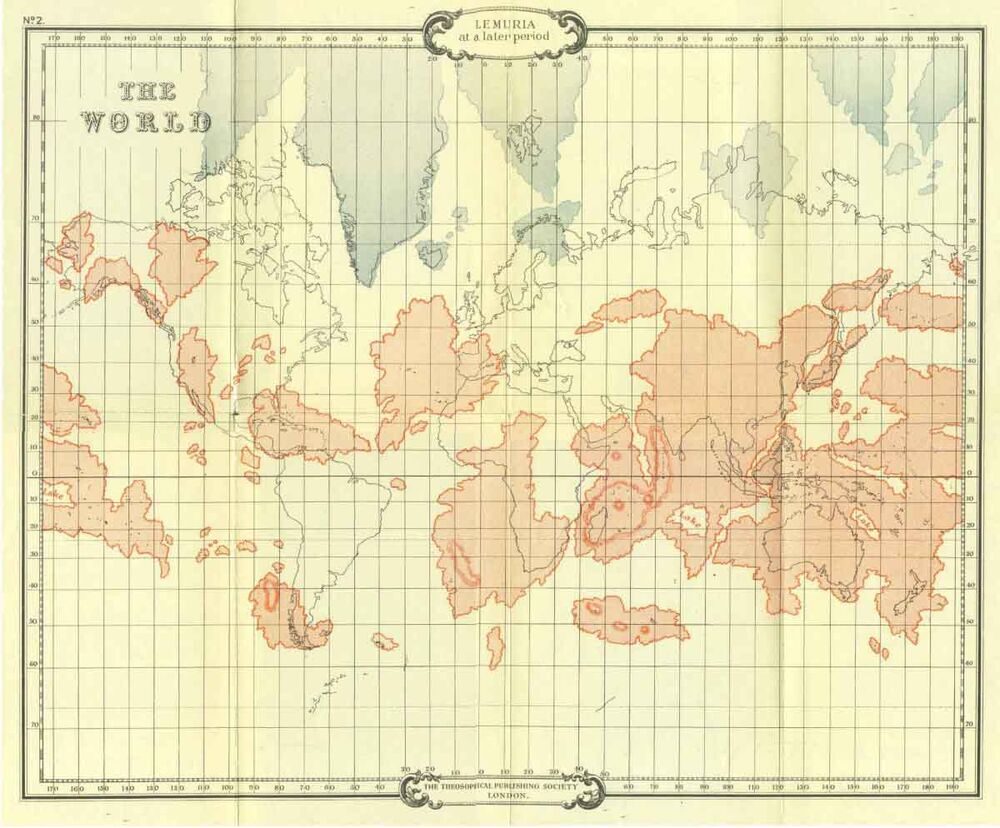
The Theosophical account describes a large landmass occupying most of the current Atlantic Ocean basin that underwent progressive submersion through a series of catastrophic events over approximately one million years, with the final remnant, described as a relatively small island matching Plato’s Poseidonis, sinking approximately 10,700 years ago.
The geological record of the Atlantic basin does not support the existence of a continent-sized landmass in the recent geological past. The Mid-Atlantic Ridge is a divergent plate boundary where new oceanic crust is continuously generated. The oceanic crust of the Atlantic basin is geologically young by continental standards, no older than approximately 180 million years in the oldest parts. A continent-scale landmass in the Atlantic at any point in the past million years is inconsistent with the plate tectonic record.

What the geology does support is the existence of elevated landmasses in the Atlantic basin that were above sea level during glacial maxima when global sea levels were significantly lower. The Azores and Canary Islands are the exposed peaks of volcanic structures that extend significantly below the current sea surface. The Azores platform, the broad volcanic plateau from which the Azores islands rise, was partially above sea level during the last glacial maximum when sea levels were approximately 120 meters lower than at present.
Plato’s description of Poseidonis in Timaeus and Critias, an island in the Atlantic beyond the Pillars of Hercules that sank approximately 9,000 years before Solon’s time, is consistent with the submersion of elevated Atlantic volcanic structures during the post-glacial sea level rise. The date Plato gives, approximately 9600 BCE in conventional reckoning, corresponds closely to the period of most rapid post-glacial sea level rise.
The Theosophical account’s claim that the final Atlantean island sank approximately 10,700 years ago is consistent with Plato’s date and with the geological record of Atlantic sea level rise. The framework of a progressively submerging Atlantic civilizational territory, whatever its detail, is not inconsistent with what the geology of the Atlantic basin and the sea level record of the post-glacial period shows.
The Catastrophic Events and Their Planetary Effects
The Theosophical account describes multiple catastrophic events that progressively altered the Earth’s orbital characteristics: throwing the planet into a more distant orbit from the Sun, lengthening the year, and changing the direction of solar rising. These claims connect to several documented areas of planetary science.
The Late Heavy Bombardment period, approximately 4.1 to 3.8 billion years ago, is a real, well recorded period of intense asteroid and comet impacts across the inner solar system that significantly altered the orbital and surface characteristics of the terrestrial planets. It needs to be stated plainly that this cannot be the event the Theosophical account is describing, and not simply because the dates are older than the conventional human timeline allows. The Late Heavy Bombardment predates the origin of life on Earth by hundreds of millions of years and predates any form of complex multicellular life, let alone a technological civilization, by billions of years. There was no ocean stability, no atmosphere capable of supporting life as currently understood, and no biology at all on Earth during this period. Citing the Late Heavy Bombardment as physical support for a civilizational catastrophe is not a matter of extending a timeline. It is citing an event from a period when the planet could not have supported any civilization to be destroyed. If asteroid impacts are the correct general physical framework for a real catastrophe the Theosophical account is dimly recalling, it would have to be a vastly more recent impact event, not this one.
Geomagnetic pole reversal is documented. The paleomagnetic record preserved in volcanic rocks shows that the Earth’s magnetic poles have reversed multiple times over geological history, most recently approximately 780,000 years ago in the Brunhes-Matuyama reversal. The reversal does not change the geographic poles. The Theosophical account’s description of changes in sunrise direction is more specifically consistent with true polar wander, the movement of the Earth’s rotational axis relative to its crust, which is a recorded phenomenon occurring on geological timescales.
The claim that thermonuclear warfare by extraterrestrial parties was responsible for one of the early catastrophes corresponds to the Mohenjo-Daro vitrification evidence recorded in the Kailash and Out of Place Artifacts pieces in this library, and to the Sanskrit texts’ descriptions of brahmastra weapons in the general period the Theosophical account associates with advanced pre-deluge civilization.
The claim about the Moon’s origin as the former satellite of Phaeton, the hypothetical planet whose destruction created the asteroid belt, connects directly to the Hollow Moon piece in this library and to the documented Exploded Planet hypothesis advanced by Tom Van Flandern and others. The asteroid belt’s composition is consistent with the debris of a former planetary body. The claim that the Moon was formerly associated with this body rather than with the Earth is the non-mainstream interpretation of lunar origin that the Hollow Moon piece treats as deserving examination.
The Tuaoi Stone
Theosophical teaching describes the Tuaoi Stone or Firestone as the technological achievement of the Toltec subrace whose misuse by subsequent subraces produced catastrophic results. The Firestone functioned as an energy amplifier and focus, drawing power from the surrounding environment and releasing it in directed form at scales that could produce what the account describes as the division of the Atlantic continent.
Edgar Cayce, the American mystic who conducted psychic readings between 1901 and 1945 and whose material on Atlantis has been recorded in the Association for Research and Enlightenment archives in Virginia Beach, described the same technology under the same name. Cayce’s Atlantean readings, conducted independently of Theosophy and producing descriptions that overlap with it in ways without obvious derivation from it, describe the Tuaoi Stone as a crystal or crystalline structure that concentrated solar and cosmic energy.
The two independent clairvoyant sources, Leadbeater’s Theosophical account and Cayce’s independent reading series, converging on the same name and the same functional description for the same technology in the same civilizational context, is a correspondence that deserves the same treatment the site applies to other independent convergences: not confirmation, but a pattern worth noting.
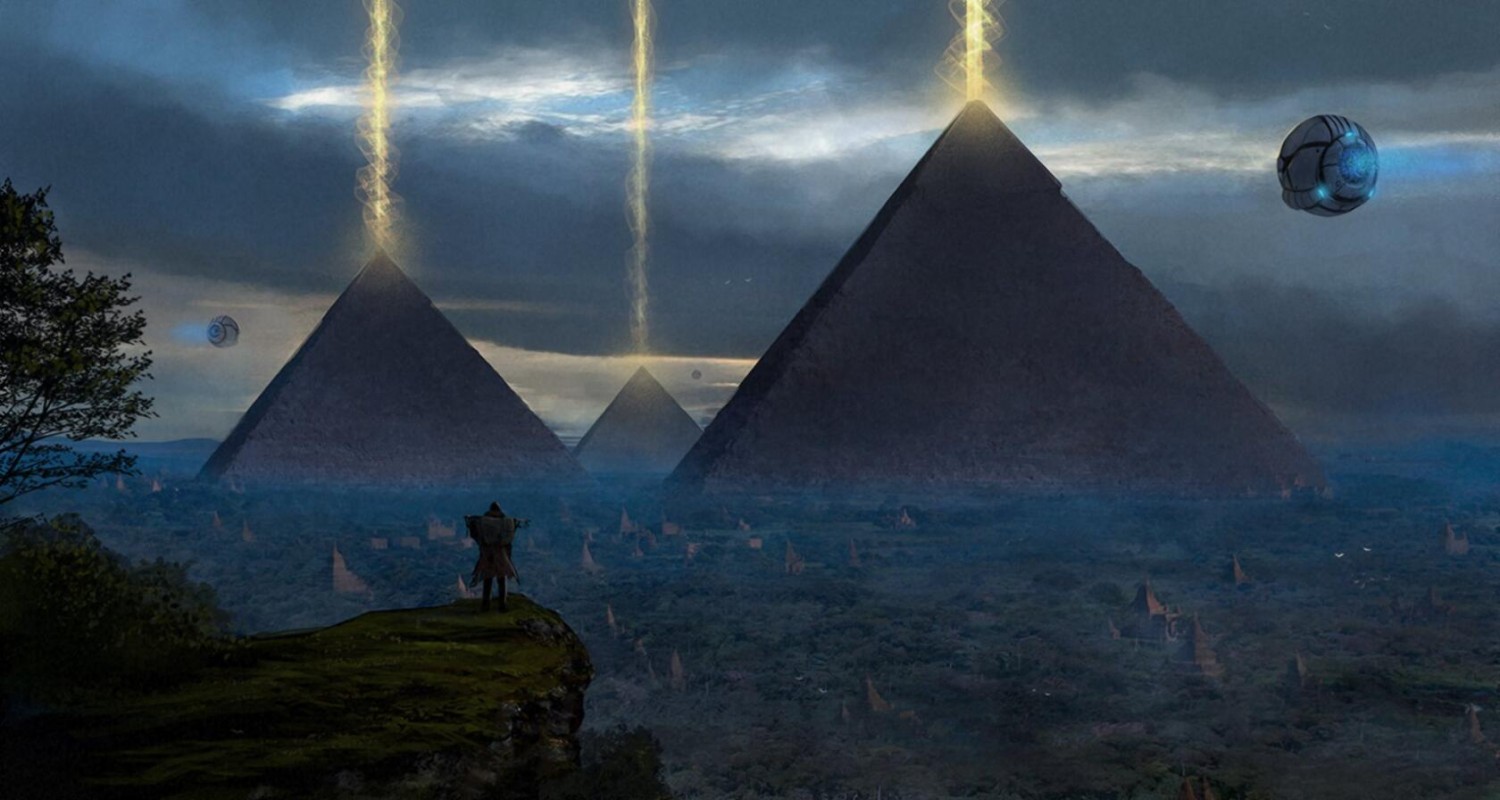
The Giza pieces in this library document the acoustic and electromagnetic properties of the Great Pyramid’s construction materials and the hypothesis that the structure functioned as an energy transducer. The Tuaoi Stone’s described function, concentration and directional release of environmental energy at large scale, is the operational principle that the Dunn pyramid power plant thesis and the Tesla free energy framework in this library describe from different investigative angles.
Three frameworks, one Theosophical, one psychic-mediumistic, and one engineering-analytical, pointing at the same technology in the same general pre-deluge civilizational context.
The Emerald Tablets and the Atlantean Priest
Theosophy is not the only esoteric source claiming direct transmission from Atlantean civilization. A separate textual lineage, whose claimed origin is even more specific, has circulated in the Western esoteric community since the early twentieth century under the title The Emerald Tablets of Thoth the Atlantean.
The texts claim to have been written by Thoth, an Atlantean priest-scientist who escaped the destruction of Atlantis and subsequently traveled to Egypt, where he built the pyramids of Giza and established the mystery school lineage that became the foundation of Egyptian religious and philosophical culture. Thoth in this account is identified with the Egyptian deity Thoth and with the later Greco-Egyptian figure of Hermes Trismegistus, the supposed author of the Hermetic Corpus recorded in the Gnostic Transmission piece in this library.
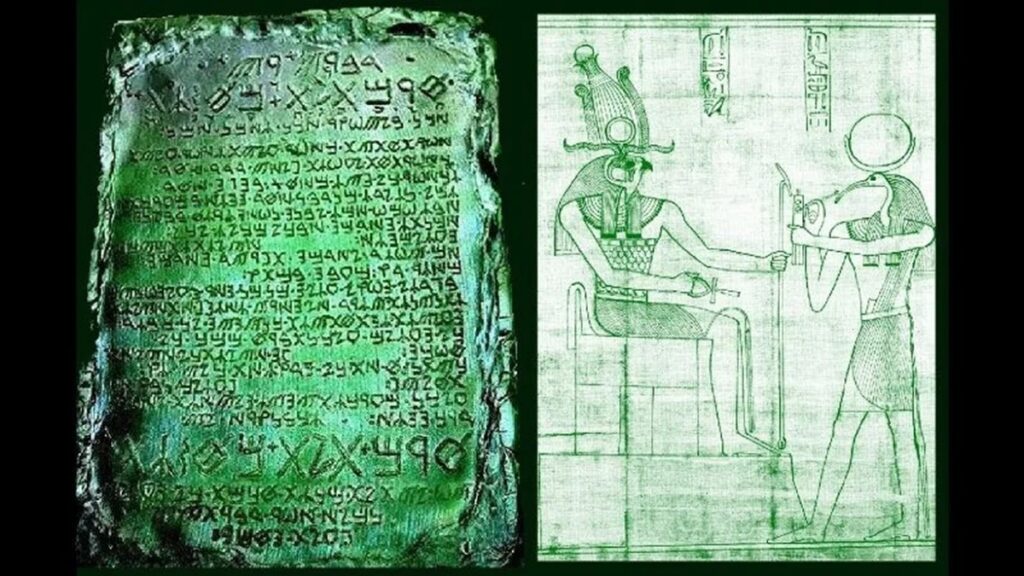
The claims appear in the tablet texts themselves, which were published in 1925 by Maurice Doreal, the founder of the Brotherhood of the White Temple in Colorado. Doreal claimed to have translated the tablets from an original written in a pre-dynastic form of Atlantean script, which he described as having been discovered in the Great Pyramid and subsequently relocated to a hidden vault for safekeeping.
Whether Doreal’s translation is genuine, in the sense of accurately representing an ancient source text, or is a modern composition drawing on Theosophical Atlantis material and presenting it in a channeled-revelation format, is a question the available evidence does not definitively resolve. The tablets have not been produced for independent scholarly examination. The original script they were purportedly translated from has not been made available.
What is documented is the tablets’ content and its relationship to the broader Hermetic and Gnostic material whose documented history the library’s existing pieces trace. The tablets describe a cosmological framework that is consistent with the Neoplatonic emanation hierarchy, the Kabbalistic Sefirot structure, and the Gnostic Archon cosmology in its claims about the nature of consciousness, the structure of reality, and the mechanisms of spiritual liberation.
The claim that Thoth the Atlantean built the Great Pyramid connects the tablets to the Egypt cluster’s documented debates about the Pyramid’s age and purpose. The claim that Thoth transmitted the foundation of Egyptian civilization echoes the Oannes account recorded in the fish-people piece and the Anunnaki creation story’s account of civilizational teachers arriving from outside the indigenous human population.
Whether the Emerald Tablets represent genuine transmitted knowledge from a pre-historical civilization, a modern synthetic composition drawing on multiple ancient and modern esoteric sources, or something between these two interpretations, the text’s framework places it in the documented lineage of transmission that the Gnostic Transmission piece traces from Alexandria through the Renaissance to the present Western esoteric world.
The priest who escaped Atlantis and built the pyramids may or may not have existed. The belief that claims his transmission has been shaping the Western esoteric worldview since at least the Hermetic texts of the first three centuries CE, and possibly since the mystery school lineage that Plato documented as his own source for the Atlantis account.
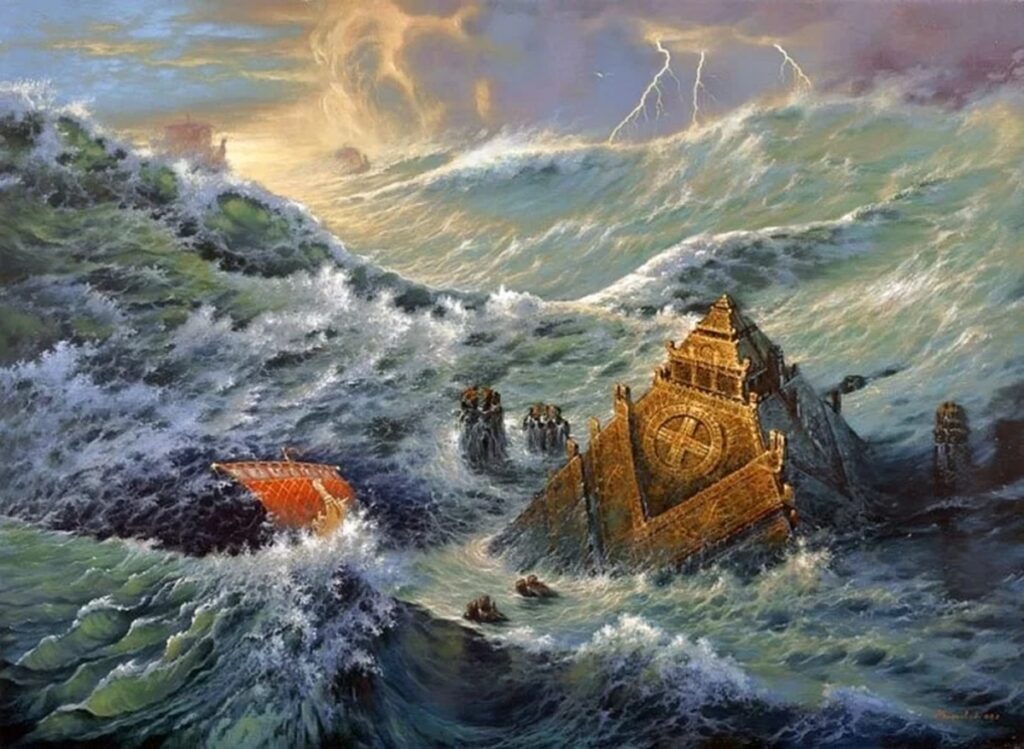
The tablets claim to preserve what Atlantis knew. Whether Atlantis knew it first is the question that this convergence with documented ancient sources makes impossible to resolve from this side of the flood that took it down.
The Sizes and What They Require
The Theosophical account’s size claims for the Atlantean subraces, ranging from six meters for the Rmohals down to approximately two meters for the Akkadians, correspond to a physical argument this account makes about the relationship between atmospheric density, centrifugal force, and biological scale.
The argument is internally consistent. A denser atmosphere and faster planetary rotation would change the conditions under which biological organisms evolved, potentially supporting larger body masses. The physics is not simply wrong: atmospheric density affects oxygen availability, pressure supports tissue, and reduced effective gravity from centrifugal force affects weight. Whether these factors could produce the size ranges claimed, or whether they would have the effects on biological scale claimed, is a question that the current state of relevant biology and physics could in principle address.
The fossil record does not support seven-meter hominids. The largest documented members of the Homo lineage were approximately two meters tall. But the anomalous skeletal finds recorded in the previous piece in this library, including the Paracas specimens and the claims of oversized skeletal remains across multiple continents, correspond to the broader claims of large-bodied pre-modern populations that the Theosophical account places in the Atlantean period.
The Nephilim material recorded in the Watchers pieces gives heights of three to six meters for the Nephilim offspring of the Watcher-human unions. The Theosophical account gives heights in the same range for the Atlantean subraces. These esoteric sources are consistent with each other. The physical fossil record is not consistent with either. The anomalous skeletal claims exist in the gap between them and the mainstream fossil record, producing a contested middle ground whose resolution the institutional framework has not provided.
What This Cosmology Is Doing
The Theosophical Atlantean history is not primarily a factual account of geological and civilizational events. It is a cosmological framework for understanding human history as a directed process of spiritual evolution, organized through successive root races and subraces that each represent a stage in consciousness development.

The six Atlantean subraces in this framework are not simply different populations. They are stages in the development of human consciousness toward the current fifth root race, which Theosophy identifies as the current human civilization. The physical characteristics of each subrace, their sizes, their psychic abilities, their technological achievements and failures, reflect their stage of spiritual development.

The framework’s purpose is explanatory in a theological sense rather than evidential in an archaeological sense. It explains why civilizations rise and fall, why technical achievement without spiritual development produces catastrophe, and why the current human civilization inherited both the achievements and the destructive potential of its predecessors.
One further piece of context belongs here, stated directly rather than left out. Blavatsky’s root race framework, of which the Atlantean subraces are one segment, ranks races in a developmental hierarchy that places what she called the Aryan root race at the most spiritually advanced position. That hierarchical racial framework has a documented and serious afterlife: historian Nicholas Goodrick-Clarke’s academic study The Occult Roots of Nazism traces how early twentieth-century Ariosophist writers in Austria and Germany, including Guido von List and Jörg Lanz von Liebenfels, drew directly on Theosophical root race material and developed it into explicitly racist and antisemitic ideology that fed into later Nazi occultism. This does not mean Blavatsky’s own project was a Nazi project, and Theosophy as a movement has taken many different directions since, including ones explicitly opposed to racism. It does mean the specific vocabulary of racially ranked root races carries a real historical weight beyond its use as an internal cosmological metaphor, and readers engaging with this material seriously should know that history rather than encounter the framework as though it were racially neutral.

This theological purpose does not make the physical claims false. It means that the physical claims are embedded in a larger framework whose primary function is cosmological rather than historical. The question of whether the physical claims correspond to real historical events cannot be answered from within the framework. It requires external corroboration.

The external corroboration exists for some of the framework’s claims: continental submersion, catastrophic impacts, pole shifts, the Moon’s anomalous origin, pre-deluge civilization at levels of sophistication the conventional timeline does not accommodate. It does not exist for others: the subrace heights, the precise dates, the atmospheric density calculations, the orbital mechanics.
What survives here is a mixture of transmitted historical memory in cosmological encoding and speculative elaboration. The proportion of each in any given claim is not determinable from the current state of the evidence.
What Blavatsky Got Right
The element of the Theosophical account that is most difficult to explain as contemporary speculation rather than ancient transmitted knowledge is its treatment of the Moon.
Blavatsky described the Moon in The Secret Doctrine as a dead world, the former parent of the Earth in a sense, older than the Earth and having transferred its vital principle to the Earth in a process that left it a lifeless shell. She described it as hollow and as artificially maintained in its current orbit.
The Hollow Moon piece in this library covers the seismic evidence from the Apollo missions, the Vasin-Shcherbakov Soviet Academy paper, the crater depth anomaly, and the pre-lunar accounts across multiple cultures. This needs the same caveat given elsewhere in this library: the seismic ringing most often cited as evidence has a mundane explanation in the Moon’s extremely dry, porous surface material, and the hollow-shell interpretation is a minority position rather than the leading explanation among lunar scientists.
Blavatsky’s description of the Moon as a dead hollow body in an artificially maintained orbit, published in 1888, predates the Apollo seismic findings by eighty years. She attributed this knowledge to the Masters whose teaching she was transmitting. Whether her account reflects genuine transmitted knowledge or an inspired synthesis of the available astronomical speculation of her period is not determinable from the current evidence.
What is determinable is that she described the Moon in 1888 in terms that the subsequent physical evidence has partially corroborated. The partial corroboration does not validate the entire Theosophical system. It establishes that the system contains elements whose accuracy the subsequent evidence has confirmed.
This material is worth examining as a transmission rather than dismissing as fabrication. The examination does not require accepting it as literal history. It requires asking which parts of what it transmitted correspond to what we have subsequently discovered, and whether those correspondences are sufficient to treat the non-corroborated parts as potentially transmitted knowledge rather than as pure invention.
The Theosophical account of Atlantis says six civilizational cycles produced and destroyed a major Atlantic civilization across approximately one million years. The geology says the Atlantic basin was different. The archaeology says pre-conventional-timeline civilization existed. The stories across every culture that bordered the Atlantic say the same continent sank.
The subrace heights and orbital mechanics are claims without corroboration. The general framework is a claim with more corroboration than the institutions managing the official history have found it useful to acknowledge.