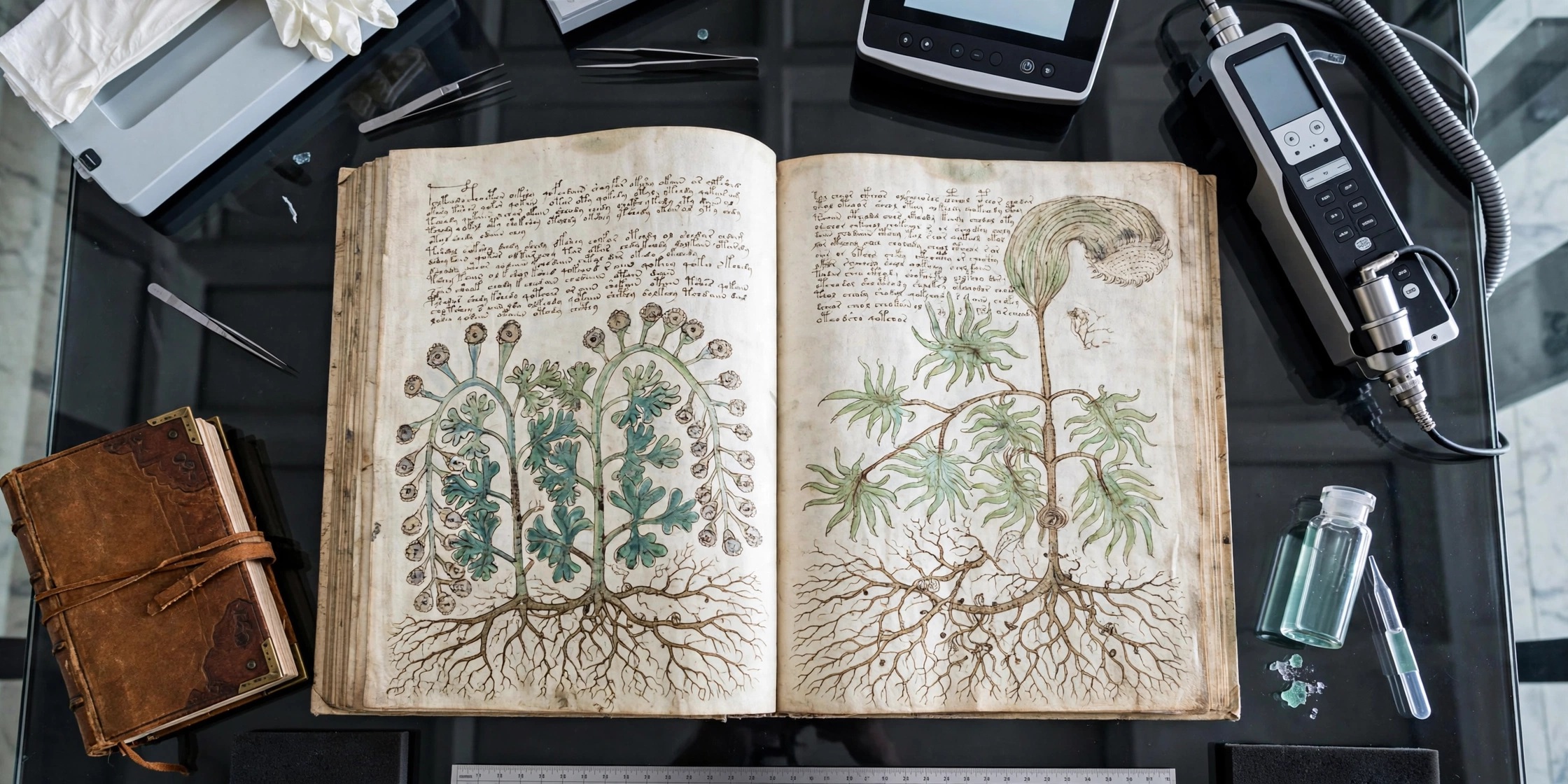
The Voynich Manuscript has been studied by codebreakers who defeated the Enigma machine, by cryptographers with access to classified NSA tools, and, in the past decade, by machine learning systems trained on hundreds of the world’s languages. All of them have failed to read a single confirmed sentence.
What follows is not another attempt to decipher it, but an attempt to take the failure itself seriously, as data, and to walk through what the manuscript’s actual statistical properties tell us about what kind of object it is, independent of what it says.
What the Manuscript Actually Is
The Voynich Manuscript is a real, physical object, catalogued as MS 408 and held at Yale University’s Beinecke Rare Book and Manuscript Library, where it has resided since 1969. It is a vellum codex of roughly 240 surviving pages, filled with continuous text in an unknown script alongside detailed illustrations of unidentified plants, astronomical and cosmological diagrams, and small human figures bathing in interconnected pools and tubes, sections informally referred to by researchers as herbal, astronomical, and balneological respectively.
In 2009, a team at the University of Arizona, using accelerator mass spectrometry radiocarbon dating on four separate vellum samples, dated the manuscript’s parchment to between 1404 and 1438 CE with 95 percent confidence, placing its physical creation firmly in the early 15th century. Chemical analysis of the ink and pigments by McCrone Associates found materials consistent with that period, ruling out the possibility that the vellum was old but the text was added centuries later. This is a well established early 15th-century artifact, not a later forgery on antique parchment, a possibility that had been seriously entertained before the dating was completed.
Its recorded modern history begins in 1912, when Wilfrid Voynich, a Polish-American antiquarian book dealer, acquired it, reportedly from the Jesuit college at Villa Mondragone near Rome, though the manuscript’s whereabouts for the roughly 470 years between its creation and Voynich’s acquisition remain only partially reconstructed through a handful of historical letters and inscriptions referencing earlier owners, including a claimed connection to Rudolf II, Holy Roman Emperor, in the late 16th century.
Who Has Already Failed
The list of people who have attempted to decipher the manuscript and failed is itself a meaningful piece of evidence, because it establishes what kind of failure this is. William Friedman, one of the most accomplished cryptanalysts in American history, who led the team that broke Japan’s PURPLE cipher during the Second World War, studied the Voynich Manuscript for decades without producing a confirmed solution, ultimately concluding it was most likely an attempt at a constructed, artificial language rather than an encoded natural one. Codebreakers connected to Britain’s Bletchley Park, the same institution that housed Alan Turing’s work against the Enigma cipher, also examined it without success. The National Security Agency has studied it as a training exercise for cryptanalysts, again without a confirmed result.
This matters because these are not amateur attempts. Military and intelligence cryptanalysis represents some of the most sophisticated code-breaking expertise that has existed, applied against a text whose full content, all roughly 38,000 words of it, has been available for study since the manuscript’s rediscovery. A text that resists this level of sustained, expert attention is either an extraordinarily well-constructed cipher, a language sufficiently unlike any other studied language to defeat comparative methods, or something that isn’t encoding meaningful content in the way a cipher or natural language would.
The Structure of Voynichese
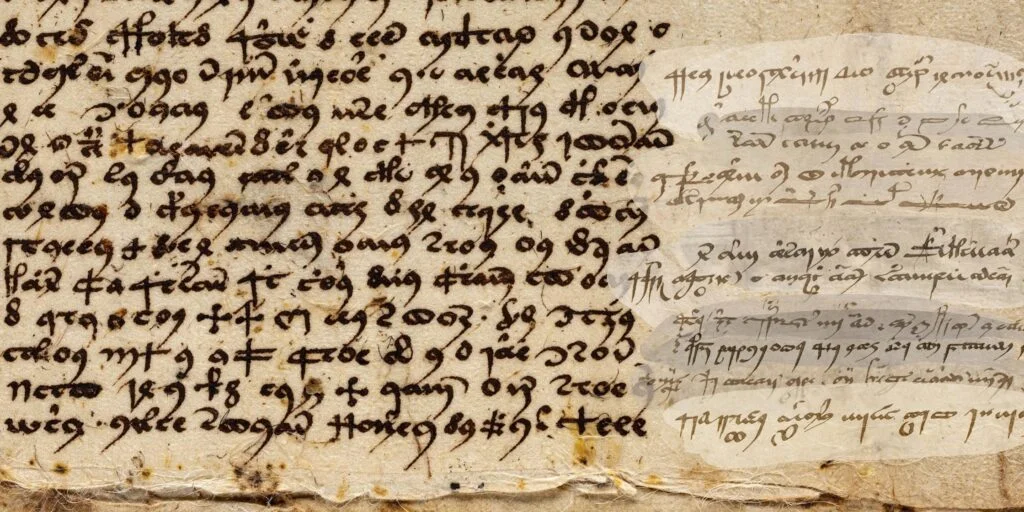
The script itself, usually called Voynichese by researchers, uses an alphabet of roughly 20 to 30 distinct characters, none of which correspond directly to any known historical alphabet, though several individual glyphs bear a loose resemblance to Latin, Greek, or Arabic numerals and letters. In 1976, Prescott Currier, an NSA cryptographer working on the manuscript independently of his classified work, identified what has become one of the most durable findings in Voynich scholarship: the text divides statistically into at least two distinct dialects or writing systems, now called Currier A and Currier B, distinguished by differing character frequencies and word-formation patterns, and correlating loosely, though not perfectly, with which sections of the manuscript they appear in.
In 2020, Lisa Fagin Davis, a manuscript scholar specializing in medieval paleography, published an analysis in the journal Manuscript Studies identifying at least five distinct scribal hands responsible for writing the manuscript, based on subtle, consistent variations in letterforms across different sections, the same kind of handwriting analysis used to distinguish scribes in any medieval manuscript. This finding carries real weight for any theory of the manuscript’s origin: if it is a hoax or an invented, meaningless script, it was not the work of one eccentric individual working alone, but appears to reflect a coordinated effort by multiple people who had all learned and could consistently reproduce the same complex writing system. Whatever Voynichese is, it was taught, learned, and executed consistently by at least five different people.
The 2018 Hebrew Claim
In January 2018, Greg Kondrak, a natural language processing researcher at the University of Alberta, and his graduate student Bradley Hauer published a study in the journal Transactions of the Association for Computational Linguistics applying machine learning language identification to the Voynich text. Their method trained an algorithm on 400 translations of the Universal Declaration of Human Rights across different languages, then applied the resulting statistical model to Voynichese. The algorithm’s output identified Hebrew as the most statistically likely source language, with the researchers reporting that, after assuming letters within words had been systematically reordered, roughly 80 percent of resulting character strings matched entries in a Hebrew dictionary.
This needs to be reported with the caveats the researchers themselves attached to it, because press coverage at the time frequently dropped them. Kondrak and Hauer explicitly stated their result should be read as “tantalizing clues,” not a decipherment, and when they ran their decoded opening sentence through Google Translate rather than consulting a Hebrew linguist directly, the result, “She made recommendations to the priest, man of the house and me and people,” was not coherent Hebrew grammar. Damian Fleming, a medievalist at Indiana University-Purdue University Fort Wayne, was among several specialists who publicly criticized the reliance on Google Translate rather than expert consultation. Kondrak himself acknowledged the traditional Voynich research community’s reception was “cool,” and the paper’s own stated conclusion was that its findings “could be interpreted either as tantalizing clues for Hebrew as the source language of the VMS, or simply as artifacts of the combinatorial power of anagramming and language models,” an unusually honest acknowledgment that the method might simply be finding false patterns rather than a true one.
The 2019 Bristol Claim, and Why It Doesn’t Hold Up
In May 2019, Dr. Gerard Cheshire, a research associate at the University of Bristol, published a paper in the journal Romance Studies titled “The Language and Writing System of MS408 (Voynich) Explained,” claiming to have fully deciphered the manuscript in a two-week period, identifying its language as an otherwise unattested “proto-Romance” language and the text itself as a women’s health and herbal reference compiled for a specific historical figure. The University of Bristol’s own press office initially promoted the finding, and it received wide international media coverage.
What followed deserves to be reported as clearly as the initial claim, because it’s rarely covered with the same prominence. Within days, linguists and medievalists identified serious methodological problems with Cheshire’s approach, including translations that combined multiple unrelated languages inconsistently and grammatical constructions that didn’t function coherently in any of the source languages claimed. The University of Bristol itself subsequently issued a public statement clarifying that the research was “entirely the author’s own work” and “not affiliated with the University of Bristol, the Faculty of Arts or the Centre for Medieval Studies,” explicitly noting that “concerns have been raised about the validity of this research from academics in the fields of linguistics and medieval studies.” This is a case where an institution’s own communications office distanced itself from a claim it had initially promoted, which is an unusually telling institutional response, and it means Cheshire’s decipherment should not be treated as an accepted or credible academic finding, regardless of how it continues to circulate in less careful retellings.
The Real Statistical Debate: Is It Language at All?
Set aside decipherment attempts entirely, and a more fundamental, still unresolved question remains: do the statistical properties of Voynichese even resemble those of a real language, constructed or natural, at all? This question has produced one of the most interesting developments in the manuscript’s recent research history, because the same primary researcher has published serious, credentialed work on both sides of it.
In 2021, Claire Bowern, a linguistics professor at Yale, and Luke Lindemann published a comprehensive review in the Annual Review of Linguistics titled “The Linguistics of the Voynich Manuscript,” arguing that the text should be treated as encoding an actual natural language rather than a hoax or meaningless gibberish. Their case drew on multiple independent statistical properties. The text’s word-frequency distribution follows Zipf’s Law, the well established pattern in real human languages where the most common word appears roughly twice as often as the second most common, three times as often as the third, and so on in a predictable mathematical curve, a pattern that random or naively generated gibberish text typically fails to reproduce accurately. Different sections of the manuscript, corresponding to the herbal, astronomical, and other subject-matter divisions researchers have identified from the illustrations, show distinct, internally consistent vocabulary distributions, exactly the pattern one would expect from a real book whose different chapters focus on different topics, which Bowern and Lindemann noted as a point favoring meaningful content.
Then, in 2022, the same Claire Bowern co-authored a different paper with Daniel Gaskell, presented at the International Conference on the Voynich Manuscript at the University of Malta, titled “Gibberish after all? Voynichese is statistically similar to human-produced samples of meaningless text.” This paper proposed what researchers call the self-citation hypothesis: that the text was generated through a process of iterative copying and modification of previously written words and word-fragments, a pattern the authors describe as the intuitive, natural human strategy people fall into when asked to produce meaningless text longer than roughly 100 words without any real linguistic content behind it. Gaskell and Bowern’s analysis found that Voynichese shows a single, densely interconnected network of similar-looking words spanning the entire manuscript, a strong statistical correlation between how frequently a word appears and how many similar variant forms of it exist, and an asymmetric pattern in how that vocabulary evolves across the text, all properties their research argued are naturally explained by scribes generating new “words” by lightly modifying words they had recently written, rather than drawing from a stable, consistent vocabulary the way an actual language user would.
This is worth sitting with directly: a leading Voynich linguist published a rigorous case for actual language in 2021 and co-authored a rigorous case against it in 2022. That isn’t a contradiction to paper over. It’s exactly what honest, ongoing science looks like when a stubbornly difficult empirical question hasn’t been settled, and it should be reported as such rather than picking whichever paper supports a predetermined conclusion.
What the Entropy Numbers Actually Show
A separate line of statistical research, going back to computer scientist William Bennett’s 1976 entropy measurements and refined by numerous subsequent studies, including a 2013 information-theoretic analysis published in PLOS ONE by Marcelo Montemurro and Diego Zanette, has consistently found that Voynichese has unusually low second-order conditional entropy compared to real, known languages, meaning the text is more predictable, in a specific statistical sense, character-to-character and word-to-word, than actual human languages typically are. Montemurro and Zanette’s information-theoretic analysis specifically found “organizational structures compatible with a ciphered version of a real language,” making a pure random fabrication less likely, while also noting the text’s specific statistical fingerprint doesn’t cleanly match any single known language family either.
This unusually low entropy is itself a significant clue, because it cuts against several competing theories simultaneously. Purely random gibberish, strung together without any underlying system, would be expected to show high entropy, close to maximal unpredictability, which Voynichese does not show. But entropy this low is also lower than most real natural languages exhibit, which is part of why researchers like Bowern and Lindemann have proposed that Voynichese may use an abjad or similar writing system, of the kind used historically for Hebrew and Arabic, where vowels are frequently omitted or only partially represented, a structural feature that would naturally suppress apparent entropy without requiring the underlying content to be meaningless.

The Mechanical Hoax Hypothesis
A serious alternative to both the language and gibberish framings comes from Gordon Rugg, a researcher who proposed in the early 2000s that the manuscript could have been produced using a Cardan grille, a table-and-grille encoding tool known to have existed in the mid-16th century, which Rugg argued could mechanically generate word-like strings with statistical properties resembling those found in the Voynich text, including a rough approximation of Zipf’s Law distribution, without any of the individual “words” needing to carry actual linguistic meaning. This hypothesis has the advantage of being independently testable and falsifiable in principle, and Rugg’s own experiments produced text with some statistically similar properties to Voynichese, though critics have pointed out that the specific grille table Rugg used was itself constructed with foreknowledge of the target statistics he was trying to reproduce, making it harder to establish that a 15th-century author, working roughly a century before Cardan grilles are known to have existed, would have had access to an equivalent method.
The Botanical Mystery
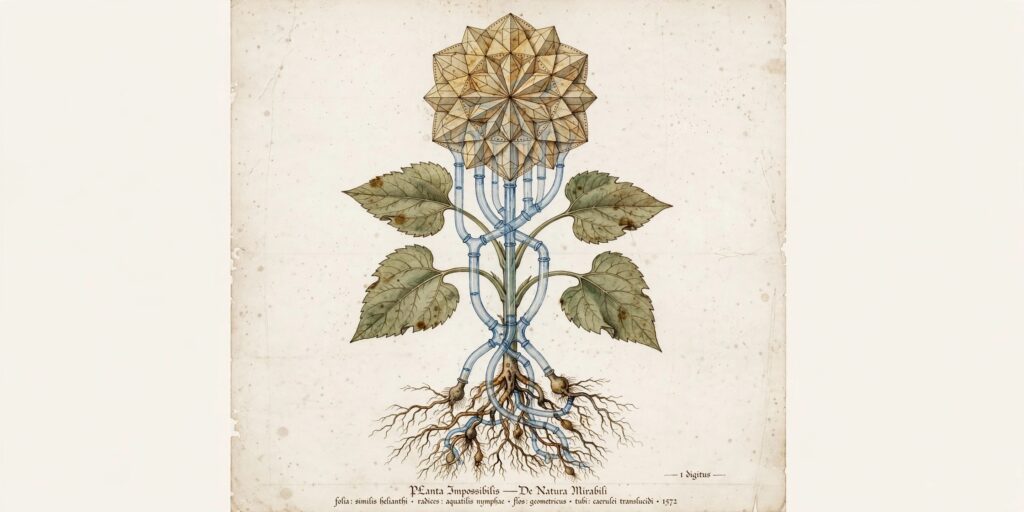
The manuscript’s herbal section, its largest by page count, presents a real puzzle independent of the text itself: roughly 130 detailed plant illustrations, most of which do not correspond cleanly to any known plant species, historical or modern. Some show a partial resemblance to real plants, sunflowers, water lilies, and various herbs among the more frequently proposed identifications, but botanists who have studied the images systematically have generally concluded that many combine features from multiple unrelated real plants into a single impossible composite, or depict roots, leaves, and flowers in combinations that don’t occur together in nature. This has been read in sharply different ways by different researchers: as evidence the manuscript encodes real, specialized botanical knowledge using an artistic convention modern viewers simply don’t recognize, as evidence supporting a hoax, since invented plants would fit a text with no real content to illustrate, or, in a more recent and less examined proposal, as evidence the illustrations reflect specific New World flora encountered after 1492, a dating that would directly conflict with the 1404-1438 radiocarbon results and has not gained traction for that reason among mainstream researchers.
The Provenance Chain
Separately from the radiocarbon-dated creation of the manuscript itself, its ownership history after the 15th century is well documented, if incompletely, through surviving correspondence. A cover letter found tucked inside the manuscript, dated 1665 or 1666 and written by Johannes Marcus Marci, rector of the University of Prague, to the Jesuit scholar Athanasius Kircher in Rome, states that the manuscript had previously belonged to Rudolf II, Holy Roman Emperor, who reportedly purchased it for 600 gold ducats in the belief it was the work of the medieval English friar and scientist Roger Bacon. Marci’s letter also references an earlier owner, Jacobus Horcicky de Tepenecz, whose name appears to have once been inscribed on the manuscript’s opening page, though the signature has since faded and is only reconstructable through earlier scholarly transcriptions and ultraviolet imaging.
The Roger Bacon attribution, while a real part of the manuscript’s recorded 17th-century reputation, is definitively ruled out by the radiocarbon dating: Bacon died in 1292, more than a century before the manuscript’s vellum was produced. This is worth stating plainly because the Bacon connection still circulates in less careful popular accounts of the manuscript’s history. What the Marci letter does establish reliably is that the manuscript was already considered a serious, valuable curiosity by the mid-17th century, changing hands among credentialed scholars and a Holy Roman Emperor, rather than surfacing from obscurity only in the 20th century as some retellings imply.

The Kelley and Dee Theory
One recurring authorship theory connects the manuscript to Edward Kelley, an English alchemist and self-described spirit medium who worked for a period at Rudolf II’s court in Prague alongside the more famous mathematician and astrologer John Dee, in the years shortly before Rudolf is recorded to have acquired the manuscript. The theory proposes that Kelley, known independently for producing the Enochian angelic language material he claimed to receive through spiritual communication with Dee acting as scribe, may have fabricated the Voynich Manuscript as an elaborate confidence scheme intended to be sold to Rudolf, whose documented, well established interest in alchemy, the occult, and unusual curiosities made him a plausible target for exactly this kind of fabrication.
This theory has substantial circumstantial support: Kelley’s confirmed presence in Prague, his well established history of fabricating spiritual communications for profit, including the real, extensively studied Enochian material, and Rudolf’s own well attested willingness to pay large sums for exactly this kind of curiosity all fit together plausibly. What the theory cannot currently explain is the radiocarbon dating placing the vellum’s creation between 1404 and 1438, roughly 150 years before Kelley’s confirmed presence in Prague in the 1580s and 1590s. Proponents of the Kelley theory have suggested he may have acquired authentically old, blank vellum, either from an existing damaged manuscript or old stock, specifically to make a fabrication appear convincingly ancient, which remains possible but is not independently confirmed by any specific evidence, and represents exactly the kind of foundational premise a persuasive origin theory needs but doesn’t currently have.
What the Failure Actually Tells Us
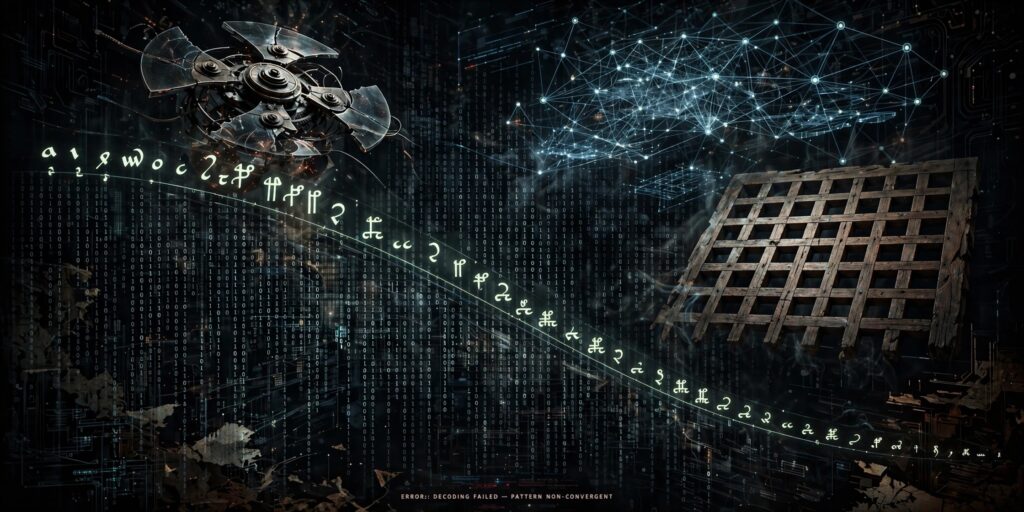
Taken together, more than a century of sustained expert attention, spanning military cryptanalysts who broke real wartime ciphers, credentialed linguists using modern statistical methods, and machine learning systems trained on hundreds of languages, has produced a specific, informative kind of failure. It has not failed to find any pattern at all, which would be the expected outcome for pure noise. It has repeatedly found real, statistically significant structure: Zipf’s Law compliance, the Currier A and B dialect distinction, consistent five-scribe production, topic-correlated vocabulary shifts between sections, and unusually low but non-random entropy. And it has repeatedly failed to convert that structure into meaning, with every specific decipherment claim either walking back its own certainty on publication, as Kondrak and Hauer did, or collapsing under scrutiny from the specialist community and the researcher’s own institution, as happened to Cheshire’s claim.
The most intellectually honest current position, reflected in the actual, ongoing disagreement between serious researchers including the same scholar arguing both sides across consecutive years, is that the Voynich Manuscript’s statistical properties are consistent with several different explanations that current methods cannot yet fully distinguish between: an enciphered natural language using an unusual system that resists standard cryptanalytic techniques, a deliberately constructed artificial language whose grammar and vocabulary were invented but internally consistent, or an elaborate, systematically generated text that mimics the surface statistics of language without encoding stable semantic content, produced by scribes following a shared but non-linguistic generative procedure. What the manuscript is not, based on everything the actual statistical evidence shows, is simple, meaningless noise dashed off carelessly by a single medieval con artist. Whoever produced it, and whatever they intended by it, they built something with real, reproducible internal structure, taught it to at least four other people, and left behind a document that has now outlasted every attempt made to unlock it by a margin of well over a century.
The Kolbrin manuscript raises an almost identical question from a different fire, a real medieval blaze wrapped around a 3,600 year old text whose age has never been independently proven.