George Orwell wrote the definitive 20th-century novel about a state that watches its citizens. His own government watched him for over two decades. That’s a well established, genuinely ironic piece of history, and it’s a far more interesting story than the fabricated version that sometimes circulates about his life and death.
Some retellings claim Orwell was a Freemason with deep intelligence connections, that his 1949 novel 1984 was an insider’s leaked instruction manual, and that his 1950 death from tuberculosis was actually an assassination to silence him. None of this holds up against the extensively researched historical record, which this piece covers directly and in detail, because the true story is both more accurate and, in its own way, more remarkable than the invented one.
Who George Orwell Actually Was
Orwell, born Eric Arthur Blair in 1903, served five years as a colonial police officer in Burma before resigning, disillusioned with what he later called imperialism’s essential injustice, a decision he wrote about with unflinching self-criticism in his essay “Shooting an Elephant,” which examines his own complicity in a system he came to despise. He spent time destitute in Paris and London, recounted in his early book Down and Out in Paris and London, developed into a committed democratic socialist, and fought against Franco’s forces in the Spanish Civil War, an experience that permanently hardened his opposition to Stalinism after he witnessed Soviet-aligned communists turn on their own allies within the Republican coalition.
There is no credible biographical evidence that Orwell was ever a Freemason. This claim does not appear in any of the major, extensively researched biographies of his life, including Bernard Crick’s and D.J. Taylor’s standard works, nor in the declassified government records covering his adult life in detail. It should be treated as fabricated rather than as a disputed historical footnote.
The Actual Surveillance Story
What actually happened is a genuinely remarkable historical irony: Orwell was placed under surveillance by British intelligence services starting in 1929, when he was living in Paris and offered to become the correspondent for a British communist newspaper. Special Branch and MI5 tracked his activities, associations, and even his choice of clothing for the next two decades. His declassified MI5 personnel file, released to the public in 2007, shows officers repeatedly puzzling over how to categorize him: one 1942 report described him as holding “advanced communist views,” while internal MI5 assessments concluded he “didn’t hold with the Communist Party nor they with him.” Scotland Yard’s Special Branch monitored him while he worked at the BBC during the Second World War, at one point noting he dressed “in a bohemian fashion both at his office and in his leisure hours.”
This is publicly released government material, not speculation. The man who wrote the century’s defining novel about a surveillance state was, for most of his adult life, an actual subject of state surveillance himself, not because he was secretly working with the intelligence establishment, but because his open, principled anti-Stalinist socialism made him difficult for a nervous, Cold-War-adjacent security apparatus to categorize.
The Complicated 1949 Episode
There is one well established complication worth covering honestly rather than ignoring, since it’s more nuanced than either a simple hero or villain narrative. In 1949, shortly before his death, a dying Orwell provided a list of writers and public figures he considered unsuitable as anti-communist propagandists, due to what he saw as their Soviet sympathies, to a friend working at the Information Research Department, a then-secret British Foreign Office unit engaged in Cold War anti-communist propaganda. This episode has been the subject of genuine, serious historical debate and criticism for decades, some historians and Orwell’s own biographers have treated it as a limited, contextually understandable wartime-adjacent judgment call by a dying man. Others have criticized it more sharply. This is a legitimate historical controversy worth knowing about. It is a different story entirely from the fabricated claim that Orwell was a lifelong Masonic intelligence insider.
How Orwell Actually Died
Orwell died on January 21, 1950, of a pulmonary hemorrhage caused by tuberculosis, a disease he had battled for years, worsened by the significant physical hardships of his earlier life, including a serious injury from being shot through the throat while fighting in Spain, and by the poor wartime and postwar conditions in Britain during the years he wrote his major works. This is thoroughly established in contemporaneous medical records and multiple biographies. There is no credible evidence of foul play, and no reputable historian treats his death as suspicious. Tuberculosis was a leading cause of death in Britain well into the mid-20th century, and Orwell’s specific medical decline, including a serious collapse in 1949 that hospitalized him for the final months of his life, is extensively recorded by people who were present.
What 1984 Actually Warns About
1984, published in 1949, remains genuinely, seriously relevant to real, ongoing debates about state and corporate surveillance, and that relevance doesn’t require any fabricated biographical backstory to be true. Orwell wrote the novel drawing directly on actual totalitarian regimes he had studied and, in the case of Franco’s Spain and Stalin’s purges, witnessed firsthand: Stalinist show trials and historical revisionism, Nazi propaganda techniques, and the wartime British Ministry of Information’s own censorship apparatus, where his wife Eileen worked, all genuinely informed the novel’s Ministry of Truth and its mechanisms of control. Scholars and journalists across the political spectrum have continued to find the novel’s concepts, doublethink, thoughtcrime, the memory hole, genuinely useful for analyzing contemporary developments in state surveillance, algorithmic content curation, and information control, and this is legitimate, serious, widely practiced literary and political analysis, not a fringe reading requiring a hidden conspiracy to justify it.
What this piece will not do is attach that legitimate relevance to unfounded claims about a specific “globalist” or Masonic elite orchestrating world events, including specific pandemic-era policies, as a deliberate, coordinated conspiracy. Legitimate debates exist about the proportionality and civil-liberties implications of pandemic-era public health measures in various countries, and those are worth having on their own factual terms, with actual evidence and named policies, rather than folded into an unfalsifiable narrative about a secret ruling cabal engineering crises for its own benefit. That framing doesn’t sharpen Orwell’s actual insights. It replaces them with something considerably less rigorous than what he was actually doing.
The Cold War Context Behind the Novel
It’s worth explaining the actual historical moment Orwell was writing in, since it explains why he reached for the specific mechanisms he did rather than requiring any hidden fraternal-order backstory. By 1948, when Orwell finished the manuscript, the Soviet Union had already demonstrated, in full public view, the specific techniques the novel dramatizes: the show trials of the 1930s, in which defendants publicly confessed to fabricated crimes after coordinated psychological pressure, the systematic falsification of official photographs and historical records to erase purged officials from the historical record, entirely, retroactively, as though they had never existed, and the state’s total control over the press and permitted vocabulary of political discourse. Orwell had also lived through and studied Nazi Germany’s propaganda apparatus and Franco’s wartime censorship in Spain, which he experienced directly as a combatant and as a journalist whose own reporting on the Spanish Civil War’s internal political betrayals was suppressed by sympathetic left-wing publishers back in Britain who didn’t want to publish material critical of the Soviet-aligned faction. Every mechanism in 1984, the rewriting of history, the manufactured wars, the compulsory public language, has a direct, traceable antecedent Orwell had personally researched or witnessed. This is a far more solid foundation for the novel’s power than any invented secret-society backstory could provide.
Why the Fabricated Version Persists
It’s worth briefly noting why a fabricated, conspiratorial version of Orwell’s biography holds appeal despite the actual story being, if anything, more interesting. A writer who was secretly an intelligence insider all along offers a tidy, singular explanation: someone on the inside chose to warn us. The actual story is messier and, in an important way, more useful: an independent, principled writer, watched suspiciously by his own government for two decades precisely because he refused to fit into either Cold War camp cleanly, produced his warning about surveillance and thought control not because he had privileged access to a secret plan, but because he paid close, disciplined attention to the propaganda techniques openly on display in the world around him and had the clarity to name what he saw. That’s a harder story to compress into a single dramatic reveal. It’s also the one that’s actually true, and it gives Orwell’s actual achievement, turning careful observation into enduring political insight, the credit it deserves rather than outsourcing it to a hidden hand.
Orwell’s Own Standard for Political Language
There’s a genuine irony worth sitting with, given how this piece began: Orwell himself wrote one of the most influential essays in the English language specifically warning against the kind of vague, unfalsifiable political language that fabricated conspiracy narratives depend on. In his 1946 essay “Politics and the English Language,” written a few years before 1984, Orwell argued that political writing had become “largely the defense of the indefensible,” full of euphemism, question-begging, and vagueness designed to make cruelty and dishonesty sound respectable, or in his memorable phrase, to give “an appearance of solidity to pure wind.” He specifically criticized language that names no verifiable agent, that describes a mechanism, “printing money,” “engineered scarcity,” “an elite,” without ever specifying who, exactly, did what, when, and how it can be checked.
This is exactly the standard a responsible account of Orwell’s life and work should be held to, and it’s exactly what a fabricated narrative about hidden Masonic plans and unnamed globalist elites fails to meet. Orwell’s actual writing named names, cited specific historical events, and invited readers to check his claims against the documented record. A conspiracy account that can absorb any counter-evidence, that treats his very ordinariness, working at the BBC, dying of a common disease of his era, as itself proof of a cover-up, is doing precisely the kind of unfalsifiable political writing Orwell spent his career warning readers to distrust. The most faithful way to honor his actual legacy isn’t to wrap it in exactly the vocabulary he criticized. It’s to describe what actually happened, as precisely and checkably as he tried to.
The Actual Legacy
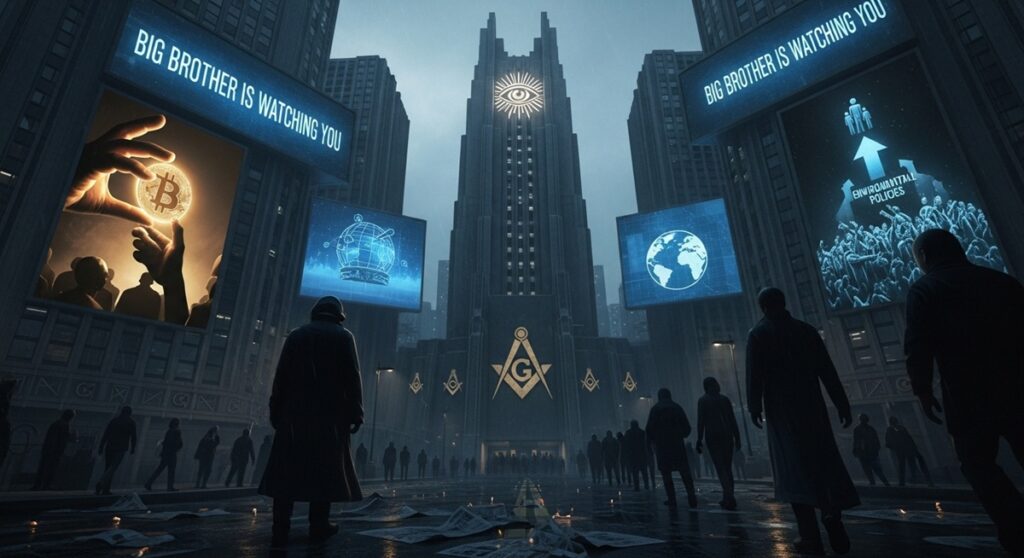
1984 has sold tens of millions of copies and given the English language an entire vocabulary, Big Brother, doublethink, thoughtcrime, Orwellian itself, for describing exactly the kind of state overreach and information control it depicts. That’s a genuine, earned literary and political legacy, built by a writer whose actual life, an anti-imperialist colonial police officer turned democratic socialist, wounded fighting fascism in Spain, surveilled for two decades by his own government while writing the century’s sharpest warning against surveillance states, is more compelling as documented history than as invented conspiracy. Orwell spent his career insisting on precision, on saying plainly and accurately what he actually meant rather than reaching for comfortable, unfalsifiable narratives. The honest version of his story is the one that actually honors that habit, and it doesn’t require a single invented detail to remain one of the more remarkable writer’s lives of the twentieth century: a man watched by his own state for the crime of thinking independently, who spent his final working years turning that experience into the century’s most durable warning about what happens when independent thought becomes a crime everywhere, not just for him.
The wider story of government secrecy, from MKULTRA to Area 51, is gathered in our secret government programs case files.