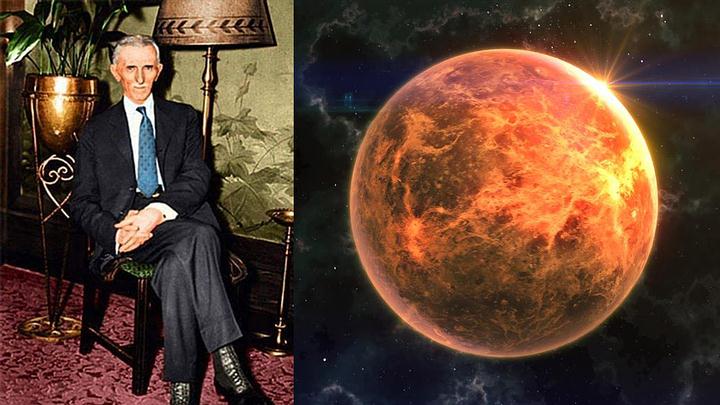
Nikola Tesla died alone.
On January 7, 1943, the Serbian-American inventor was found in Room 3327 of the New Yorker Hotel in Manhattan, where he had lived for the last decade of his life in increasing isolation, poverty, and obsession with pigeons. He was eighty-six years old. The immediate cause of death was coronary thrombosis. The New York City medical examiner found nothing suspicious.
The federal government did not wait for the body to cool.
Within hours of Tesla’s death being reported, two institutional responses were set in motion simultaneously whose intersection would, over the following decades, produce one of the most durable and least accurately understood conspiracy traditions in American technological history.
The first response was legitimate, urgent, and classified.
The second was a mystic from Washington DC who believed Tesla had been delivered to Yugoslavia as a Venusian infant in 1856.
What happened when the FBI’s bureaucratic thoroughness put both responses in the same file is a case study in how raw intelligence gathering absorbs public mythology, how wartime institutional paranoia creates permanent narrative raw material, and how a government document can simultaneously document a fact and generate a legend whose relationship to that fact is purely accidental.
The Legitimate Emergency
The institutional concern that drove the federal government’s response to Tesla’s death was not philosophical. It was a weapons program.
Tesla had spent the final years of his life claiming to have developed what he variously called a death ray, a teleforce weapon, or a particle beam projector: a directed energy system capable, he claimed, of destroying aircraft at distances of hundreds of miles by projecting a focused beam of charged particles through the atmosphere. He had sought funding for the system from multiple governments including the United States, Great Britain, and the Soviet Union. He had described its specifications in sufficient detail in public statements and private correspondence that military engineers could not simply dismiss the claims without investigation.
Whether Tesla’s teleforce weapon was a genuine technological breakthrough, an advanced theoretical proposal whose implementation he had not completed, or the product of an aging inventor’s increasingly disconnected relationship with the practical limitations of electrical engineering, was the question that the federal government needed to answer before anyone else did.
The Soviet Union was an ally in January 1943 but would become the primary adversary within two years. Nazi Germany was the active enemy. Both had intelligence services operating in New York with interest in advanced weapons technology. Tesla’s papers, his notebooks, his correspondence, and whatever physical components of the teleforce system he had assembled or described, were in the New Yorker Hotel in trunks whose content the federal government did not know and could not allow to remain unsecured.
The Office of Alien Property Custodian was the instrument the federal government used. The Custodian’s office had been established under the Trading With the Enemy Act and had broad authority to seize the property of enemy aliens or of individuals whose property was considered at risk of falling into enemy hands. Tesla, despite his American naturalization in 1891, was classified as an enemy alien under the wartime administrative categories of the period because he was born in what was now Axis-occupied Yugoslavia.
This classification was legally convenient rather than genuinely hostile. The government’s goal was to secure the papers before anyone else could access them. The enemy alien classification provided the legal mechanism.
John G. Trump, an MIT electrical engineer who was working for the National Defense Research Committee and who was the uncle of the future American president Donald Trump, was assigned to examine the seized papers and evaluate their significance. His documented assessment, submitted after several days of examination, concluded that Tesla’s papers contained no practical weapons technology of immediate military value, that the teleforce concept was theoretically coherent but practically unrealized, and that the papers did not represent a security threat of the magnitude the seizure operation had anticipated.
Whether Trump’s assessment was complete, accurate, and conducted with access to all the materials that were ultimately seized is the question that subsequent researchers have raised. The documented assessment is what it is. What was in the trunks whose content Trump did not assess, or what was in the papers whose technical content the National Defense Research Committee considered above Trump’s clearance level, is not established in the available declassified record.
The seized materials were eventually transferred to the Tesla Museum in Belgrade, with exceptions whose documented character has been a subject of research and dispute in the Tesla scholarly community for decades.
Margaret Storm and the Cosmic Informant
Margaret Storm was a Washington DC mystic and esotericist whose fascination with Tesla led her to write Return of the Dove, published in 1959, sixteen years after Tesla’s death and six years after the FBI’s post-death file on Tesla had been compiled.
The book is a documented publication whose content is exactly what the piece describes: a mixture of genuine biographical information about Tesla drawn from published sources, theosophical cosmological frameworks involving cosmic hierarchies and planetary civilizations, and claims about Tesla’s extraterrestrial origin that Storm attributed to communication received through what she described as a radio device Tesla had invented in 1938 for interplanetary communication.
Storm’s claim, documented in the book and reproduced in the FBI file: people from space have visited Tesla’s engineers many times, and they have told us that Tesla was a Venusian, brought to this planet as a baby, in 1856, and left with Mr. and Mrs. Tesla in a remote mountainous province of what is now Yugoslavia.
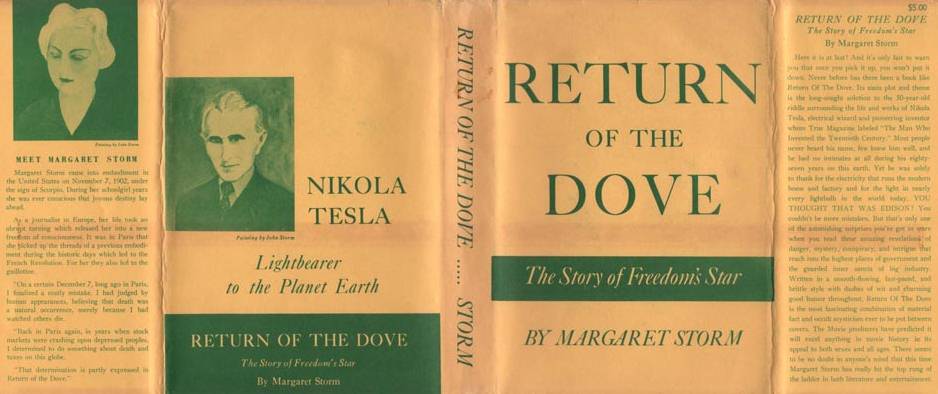
The claim is in its absurdity and revealing in its cultural context. 1959 was four years after the first contactee books had made the Nordic Venusian visitor a standard feature of the American UFO mythology. George Adamski’s documented claims of contact with a Venusian named Orthon had been published in 1953 and had generated sufficient cultural resonance that the benevolent blonde Venusian was an established narrative figure in the American alternative spirituality community by the time Storm was writing.
Whether Storm genuinely believed what she was writing, was constructing a theosophical allegory whose literal reading she did not intend, or was producing deliberate fiction dressed in spiritual language for a audience, is a question that her documented biography and correspondence would address but that the available public record does not fully resolve.
What is documented is that she wrote it, that it was published, and that it ended up in an FBI file.
Why It Ended Up in the FBI File: The Bureaucratic Anatomy
The reason that Margaret Storm’s Venusian claims appear in an official FBI dossier on Nikola Tesla is not that the FBI found them credible. It is that the FBI’s institutional methodology for compiling a subject file involved collecting everything.
The FBI’s post-death file on Tesla was compiled in the context of the wartime seizure operation and its aftermath. The file’s documented purpose was to establish a comprehensive record of everything known or claimed about Tesla and his work, specifically to support the government’s assessment of what the seized papers contained and what additional security measures might be necessary.
This purpose required comprehensiveness rather than selectivity. An FBI file compiled to assess whether dangerous technology exists in the public domain must document everything that is being claimed about the technology, including the implausible claims, because the implausible claims might contain fragments of genuine information, might indicate unauthorized access to classified material wrapped in a covering story, or might represent disinformation operations by hostile intelligence services using spiritual channels as cover.
The Robertson Panel’s documented 1953 recommendations, covered in the library’s dedicated piece, explicitly described how intelligence agencies should monitor civilian organizations discussing anomalous technology because those organizations might receive genuine leaked information presented in alternative framing. Whether the FBI applied similar logic to Storm’s Venusian claims, considering whether her interplanetary radio communication narrative might represent a cover story for genuine access to Tesla’s ideas through channels the government was not monitoring, is the question that the file inclusion motivates.
Whether this is what happened, or whether the FBI file compiler simply included Storm’s book because comprehensive documentation means comprehensive documentation, is a distinction whose answer requires access to the internal guidance under which the file was compiled.

The result either way is the same: an official government document contains a claim that Tesla was a Venusian infant delivered to Yugoslavia in 1856. The document does not endorse the claim. The document’s existence as the carrier of the claim is sufficient to generate the legend that the document endorses the claim, because most people who hear about the document do not read it.
The Colorado Springs Signal and What Tesla Actually Claimed
The genuine anomalous element in Tesla’s documented record that the Venusian mythology obscures is worth recovering from the legend that has accumulated around it.
In 1899, Tesla was operating his Colorado Springs experimental station, a facility he had built specifically to investigate the transmission of electrical power through the Earth and atmosphere at large scale. The station’s equipment included a massive Tesla coil capable of generating millions of volts and a sensitive receiving apparatus designed to detect atmospheric electrical phenomena at distances far greater than any contemporary technology could achieve.
During these experiments, Tesla documented receiving a series of regular, patterned electrical signals whose character he described as unlike any natural atmospheric phenomenon he had previously observed. The signals showed what he described as the regularity of a counting sequence: one, then two, then three, repeating with a precision that atmospheric noise does not produce.
His documented public statement about the signals, published in Electrical World and Engineer in 1901, is careful and specific: I have obtained positive evidence of transmission from Mars, but whether this is the correct interpretation I am unable to say with certainty. He proposed Mars rather than Venus as the origin because the signals’ characteristics seemed consistent with what an advanced civilization on the nearer planet might transmit.
The mainstream scientific explanation for what Tesla received is documented: regular electrical signals matching the description of Tesla’s experience are produced by atmospheric lightning discharges from Jupiter, whose powerful magnetic field accelerates charged particles that produce distinctive electromagnetic pulses receivable at Earth during alignments. Whether this explanation fully accounts for the regularity Tesla described is a question that the complete technical documentation of what he received, if it exists in the seized papers, would address.
Whether Tesla received natural atmospheric electrical phenomena and interpreted them through the cognitive framework of an inventor whose imagination was operating at the extreme edge of what his technology could detect, or received something whose character the conventional explanation does not fully accommodate, is the question that his documented claim leaves genuinely open without the available evidence resolving.
What is established is that a technological claim, regularly patterned signals received at Colorado Springs in 1899, predates the modern UAP and extraterrestrial intelligence research tradition by decades and comes from a documented primary source of unquestionable technical competence.
The Death Ray and What Trump Found
The content of John G. Trump’s documented assessment of Tesla’s seized papers is the institutional record whose meaning the subsequent mythology has consistently distorted in both directions.
Trump’s documented conclusion was that the papers contained extensive theoretical work on high-voltage electrical systems, wireless transmission, and particle beam technology, but that the teleforce weapon system Tesla had claimed to have developed existed in the papers primarily as theoretical and speculative material rather than as engineering specifications ready for immediate implementation.
Whether this assessment was complete is the question that the gaps in the declassified record motivate. The documented record shows that Trump examined a set of papers over a number of days. Whether the full inventory of Tesla’s seized materials was available to Trump or whether components were segregated before his examination is not established in the available declassified documents.
The institutional behavior pattern documented across this library’s treatment of classified technology, from the Robertson Panel’s management of UAP evidence to the DTIC’s version of the Condon Report missing the astronaut sightings chapter, is relevant context: government assessments of sensitive material are not always conducted on the complete material, and the conclusions of those assessments reflect what the assessor was given access to rather than necessarily what existed.
Whether Tesla’s teleforce weapon was a genuine technological breakthrough whose operational details remain in classified archives, a theoretical proposal whose practical implementation Tesla did not complete before his death, or a combination of genuine innovation and increasingly speculative extrapolation from a brilliant but aging mind, is the question that the available declassified record establishes as genuinely open rather than settled.
What is not open is the Venusian infant delivery. That is Margaret Storm’s documented claim, reproduced in an FBI file as part of comprehensive documentation, not as institutional endorsement.
The Inkblot Test That the Dossier Became
The mechanism by which the Tesla FBI file became the foundation for the Venusian origin conspiracy theory is the documented mechanism of selective quotation from official documents combined with the cognitive bias toward institutional endorsement.
The logic is simple and documentably flawed: if the FBI included it, the FBI must have considered it credible; if the FBI considered it credible, it must have some basis in fact; therefore the FBI’s file is evidence for Tesla’s Venusian origin.
Each step of this logic is documented as incorrect. The FBI included it because the FBI was compiling everything. Comprehensive documentation is not the same as credibility assessment. The file’s existence as a carrier of the claim does not transform the claim’s evidentiary status.
The Tesla dossier became a type of inkblot test for institutional mythology because it combined several elements whose combination is unusually generative for conspiracy tradition: a genuinely brilliant inventor whose documented achievements were real, a genuine wartime institutional operation whose secrecy was real, a genuine classified seizure of materials whose content remains partially unknown, and a genuine FBI document containing a claim that the document’s compilers did not endorse but that the document’s subsequent readers could present as official endorsement.
The mythology the file generated is more interesting than the file itself because of what the mythology reveals about the psychological needs that genius mythology addresses. The move from Tesla was extraordinarily talented to Tesla could not have been human is the move that the myth-making mechanism performs when it encounters achievement that exceeds comfortable comprehension.
The genius is real. The talent is documented. The inventions, the alternating current system, the radio patents, the rotating magnetic field, the fluorescent light, are documented as genuine contributions to human technological development whose importance the subsequent century has confirmed.
The Venusian delivery is what happens when the genius is too large to accommodate within the conventional human framework and the mythology-making mechanism proposes an origin story proportionate to the achievement rather than to the documented facts.
What the Dossier Actually Establishes
The Tesla FBI file’s genuine significance for the library’s framework is not the Venusian reference. It is the documented intersection of three genuinely significant elements whose convergence the file preserves in institutional form.
The first is the documented federal government’s wartime concern about Tesla’s weapons research being sufficiently real and sufficiently advanced to require a classified seizure operation whose scope exceeded what a purely theoretical body of work would have motivated.
The second is the documented existence of publicly circulating mythology around Tesla that was sophisticated enough, and enough about technical claims, that the FBI’s comprehensive file compilation procedure collected it alongside legitimate intelligence.
The third is the documented gap between Trump’s assessment and the complete seizure inventory, which the available declassified record does not close, and which the institutional behavior patterns documented across this library’s treatment of classified technology make genuinely interesting rather than trivially explainable.
Tesla died alone in the New Yorker Hotel. The government arrived within hours. The mystic arrived sixteen years later in print. The FBI file collected them both without distinguishing between them.
Whatever was in the trunks that Trump did not fully assess, whatever papers remain in the classified portion of the seizure inventory, and whatever the Colorado Springs signals actually were, are the questions that the dossier preserves without answering.
The Venusian infant is Margaret Storm’s documented invention. The death ray concern was the federal government’s documented reality. The FBI file contains both, filed together in the same institutional record, indistinguishable in format if not in evidentiary weight.
That is the mechanism by which mythology is born from institutional thoroughness. Not endorsement. Not conspiracy. Just the federal government’s documented habit of writing everything down.