



The egg was in a tomb for five thousand years before anyone tried to read it.
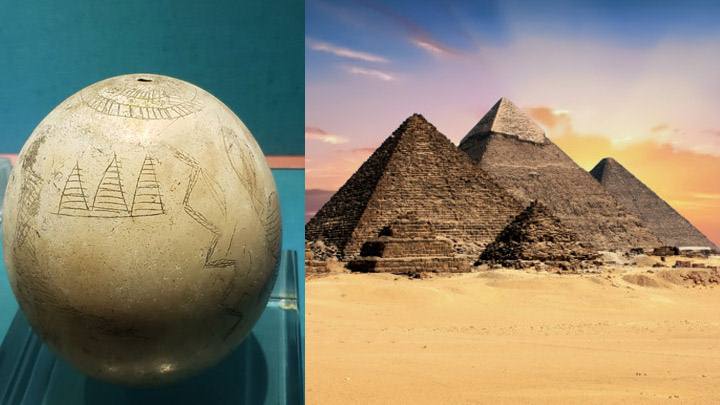
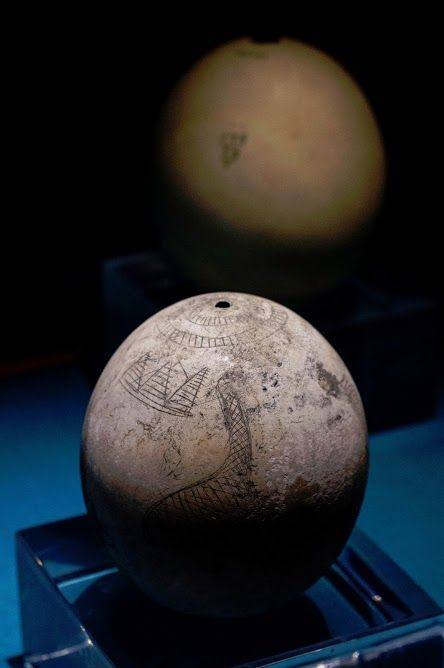
The decorated ostrich egg from a Naqada I burial near Aswan, now in the Nubian Museum, was created by a culture whose specific relationship to the civilization that would later build the Giza pyramids is one of the foundational questions of Egyptological research. The Naqada I period, dated to approximately 3900-3500 BCE, represents the transition between prehistoric Egypt’s scattered Neolithic communities and the organized state that would produce the Old Kingdom’s monumental architecture.
The egg’s decoration includes triangular forms whose specific visual resemblance to pyramid silhouettes generated attention among alternative Egyptologists and online researchers who noted that if the egg dates to approximately 3500 BCE and the Giza pyramids were not built until approximately 2560-2490 BCE in the conventional chronology, the egg would be depicting monuments that did not yet exist. Whether this represented evidence for a significantly earlier construction date for the Giza pyramids, evidence that the pyramids preserved or rebuilt even older monuments, or a misidentification of what the triangular symbols actually represented, was the question that made the egg’s documentation worth pursuing.
The answer came not from Giza but from Abydos, approximately 150 kilometers upstream, where a German archaeologist was looking for the tomb of a king that conventional Egyptology had classified as mythological.
Günter Dreyer and Tomb U-j
Günter Dreyer began excavating at Abydos in the 1970s as part of the German Archaeological Institute in Cairo’s long-running investigation of Egypt’s earliest royal cemetery. The Abydos site had been excavated by multiple expeditions since the nineteenth century, but systematic scientific excavation of the predynastic and early dynastic levels had not been completed when Dreyer began his work.
In 1988, following the specific excavation strategy of earlier pioneers including Flinders Petrie whose nineteenth-century Abydos work established the basic site stratigraphy, Dreyer’s team located a previously unexcavated tomb complex in the area designated Cemetery U, in the section known as U-j. The tomb was large by predynastic standards, twelve chambers whose specific layout resembled the multiroom tombs of the first dynasty pharaohs that the site’s later levels contained.
The burial goods identified the tomb’s occupant as a ruler of significant power: ivory scepters, hundreds of ceramic vessels including imported Palestinian wine jars whose origins were confirmed by chemical analysis, and specific artifacts whose scale and quality were consistent with a ruler of the entire Nile valley rather than a local chieftain.
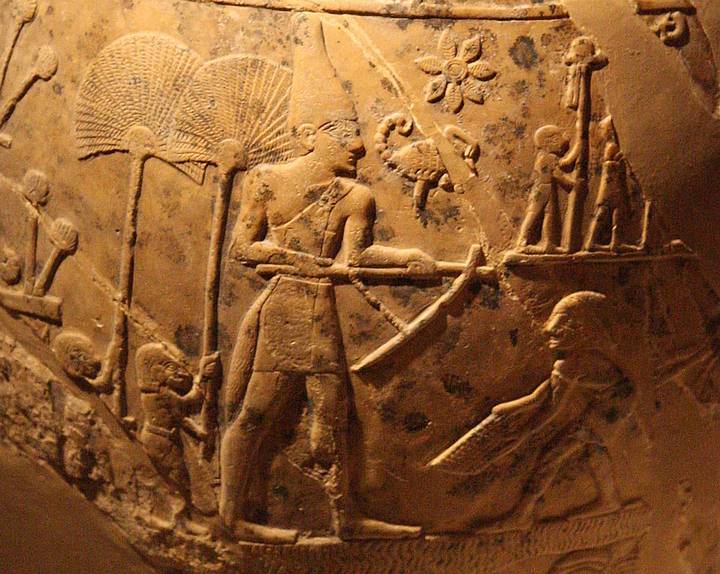
The specific identification of the tomb’s occupant as Scorpion, the predynastic ruler depicted on the ceremonial macehead in the Ashmolean Museum in Oxford, is Dreyer’s proposed attribution. The Scorpion macehead shows a ruler wearing the white crown of Upper Egypt engaged in what appears to be an irrigation ceremony, surrounded by officials and captives in a composition whose specific iconographic vocabulary connects it to the first dynasty Narmer Palette’s depiction of early state power.
Whether Scorpion was a real historical figure or a later mythological construction imposed on an actual but anonymous predynastic ruler’s tomb is the question that Dreyer’s Tomb U-j discovery resolved: the tomb existed, it dated to approximately 3150-3250 BCE by the ceramic parallels and context, and whoever occupied it exercised the kind of central authority that only a state, not a tribal confederation, could produce.
The piece’s note that Scorpion I conquered Naqada, the culture that produced the ostrich egg, connects the tomb’s occupant directly to the egg’s cultural origin: the Scorpion ruler whose tomb Dreyer discovered was the specific historical figure who brought the Naqada I tradition, including its decorative conventions, into the emerging Egyptian state.
The 160 Labels and the Writing Problem
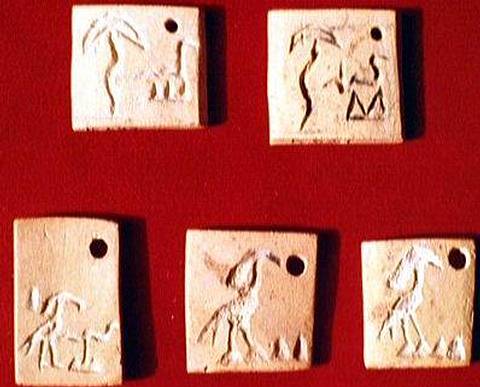
The most significant finding in Tomb U-j was not the ivory scepters or the Palestinian wine jars but 160 small tags made of ivory and bone, each approximately the size of a postage stamp, each with a hole for attachment and each carved with a simple figure.
The tags were attached to goods in the tomb as administrative labels, the Naqada I equivalent of a shipping manifest: each container’s origin and contents identified by the tag attached to it. The specific content of the figures, mountains, birds, snakes, plants, scorpions, and geometric forms, looked at first glance like the standard vocabulary of prehistoric pictographic decoration found on contemporary ceramic vessels across the Near East.
Dreyer’s specific contribution was establishing that these figures were not pictographic decoration but phonetic symbols, and that the system they constituted was the earliest known complete writing system in the world.
The specific demonstration of phoneticism, as the piece documents, was the combination of symbols to produce place names: the elephant figure representing the sound Ab and the mountain figure representing the sound Yu combine to produce Abu, the ancient Egyptian name for Elephantine Island near Aswan. The same logic applied to other label combinations produces identifiable place names from the geography of early Egypt.
This is not pictography, where the image of a bird means bird. This is the specific cognitive leap that makes writing a representational rather than depictive system: the image of an elephant is used not because the place has elephants but because the sound of the word elephant matches the sound needed to construct the place name.
The Sumerian cuneiform writing system, whose earliest examples from Uruk are dated to approximately 3100-3200 BCE, had previously been considered the world’s oldest writing. Whether Dreyer’s Abydos labels, dated to approximately 3150-3250 BCE, predate the Uruk tablets by a significant margin or fall within the same approximate period is a question whose answer depends on the precision of the respective dating methods and the definition of complete writing versus administrative notation.
The scholarly response to Dreyer’s claims was documented and contested. Sumerian scholars and some Egyptologists challenged the interpretation of the labels as genuine phonetic writing rather than administrative notation. Dreyer’s specific published responses to these challenges are documented in the Egyptological literature. Whether the debate has been definitively resolved depends on which Egyptological authority one consults, but the weight of the subsequent literature has moved toward accepting Dreyer’s basic argument.
The Mountain Sign and the Ostrich Egg
With the Abydos label system established, the ostrich egg’s triangular symbols resolve without requiring any revision of Giza’s construction date.
The mountain determinative in the developing Egyptian writing system is a triangle or group of triangles representing the rocky hills that border the Nile valley on both sides. In the Naqada I decorative and proto-writing tradition, from which the Egyptian hieroglyphic system subsequently developed, the triangular mountain sign carries specific phonetic and semantic content: the sound dyu and the meaning mountain, west, or the place where the sun sets.
The specific combination of three triangles with a curved line above them, which the ostrich egg’s decoration shows, is documented in the Abydos labels as representing the phrase from the mountains of darkness, meaning from the west. Whether the label was on a wine jar or another product, the translation is equivalent to from the western highlands.
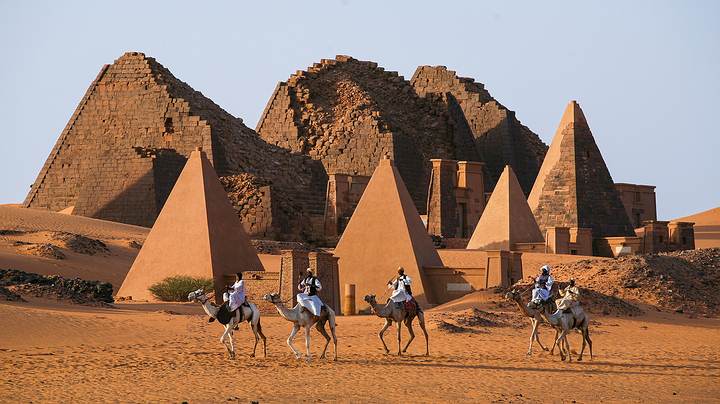
The triangles were not showing the pyramids. They were showing the mountains. The decorated egg is a five-thousand-year-old administrative label documenting the geographic origin of a product, using a symbol system that would evolve into the Egyptian hieroglyphic tradition.
The visual resemblance to pyramids, which prompted the alternative Egyptological excitement, reflects the specific geometric convergence between the Egyptian mountain hieroglyph and the profile of a pyramid: both are triangles. Whether the Giza pyramid builders were influenced by or consciously referenced the mountain hieroglyph in their architectural form is a question the resolution of the ostrich egg mystery raises without answering.
What the Discovery Establishes
The Naqada I ostrich egg does not show the Giza pyramids. The triangular symbols are mountain determinatives in the developing Egyptian proto-writing system documented by Dreyer’s Abydos excavations.
The alternative reading was based on a genuine visual similarity that reflects the geometric relationship between mountain hieroglyphs and pyramid profiles, not on documentary evidence for pre-construction awareness of the Giza monuments.
What the resolution establishes is more significant than the mystery. The Abydos labels from Tomb U-j are the earliest documented complete writing system whose specific phonetic character distinguishes them from the administrative notation systems of earlier periods. Whether they predate or coincide with Sumerian cuneiform is a chronological question whose resolution depends on ongoing refinement of the dating evidence.
The Scorpion King whose tomb contained the labels is a documented historical figure whose existence Dreyer’s excavation established from the earlier mythological category into which conventional Egyptology had placed him.
The conquered Naqada culture whose decorative tradition produced the ostrich egg was absorbed into the emerging Egyptian state by the specific ruler whose administrative documents solved the puzzle.
The mountain symbols on the egg and the mountain symbols in the tomb belonged to the same cultural tradition at the specific moment of its transformation into the first writing system in the world.
Neither the Giza pyramids nor the Naqada I ostriches were necessary for this story. Both appear at its edges as incidental details in a development that mattered more than either of them: the specific moment when human beings first encoded sound rather than image in permanent symbolic form.