



The microbes are already up there.
A series of rocket experiments conducted by Fred Hoyle and Chandra Wickramasinghe’s research group in the 1970s recovered bacterial colonies from the upper atmosphere at altitudes above forty kilometers, well above the stratospheric ozone layer and in the region where solar ultraviolet radiation is intense enough to destroy most biological material rapidly. The bacteria recovered were not simply atmospheric contaminants blown up from lower altitudes: their adaptations to radiation stress and their presence at altitudes where ordinary convective transport would not carry them suggested a population that had been living and reproducing in the upper atmosphere rather than one that had been transported there from below.
Whether those 1970s results are fully reliable is a question that subsequent researchers have debated: the rocket sampling methodology and the contamination controls of that period do not meet current standards, and the biological case for a permanent upper atmosphere microbial community remains contested in the astrobiology literature. What is not contested is that some bacteria can survive the radiation environment of the upper atmosphere in dormant forms, that bacterial spores have been recovered from stratospheric samples in multiple subsequent studies, and that the upper atmosphere is not the sterile environment it was assumed to be before systematic sampling began.
Amir Siraj and Avi Loeb’s 2021 paper in the International Journal of Astrobiology starts from this documented upper atmosphere biology and asks a question that nobody had asked in this precise form before: how many times in Earth’s history has a large comet passed through the upper atmosphere at the right altitude and speed to pick up living microbes and carry them out of the solar system?
Their calculation produced an answer: between one and several dozen times. At least once, probably more, Earth has loaded living organisms aboard an interstellar vehicle and sent them to another star system.
Siraj and Loeb
Amir Siraj is the Harvard undergraduate student who, working with Avi Loeb in 2019, analyzed the trajectory data of the 2014 fireball that would later be confirmed by the US Space Command as the interstellar meteor IM1. The IM1 identification and the subsequent Pacific floor expedition covered in this library’s dedicated piece are Siraj’s most extensively covered work in the alternative research community. The interstellar panspermia paper represents a different direction in the same general research program: rather than asking what came here from outside the solar system, asking what left here for outside the solar system.
Loeb’s involvement in both projects reflects the intellectual program he developed through the Galileo Project: systematic application of rigorous scientific methodology to questions about the movement of material and potentially life between star systems. Whether the movement is inbound, as in the IM1 case, or outbound, as in the panspermia calculation, the physical mechanisms are the same: cometary and asteroidal bodies crossing the boundary between star systems and carrying whatever they collected in the process.
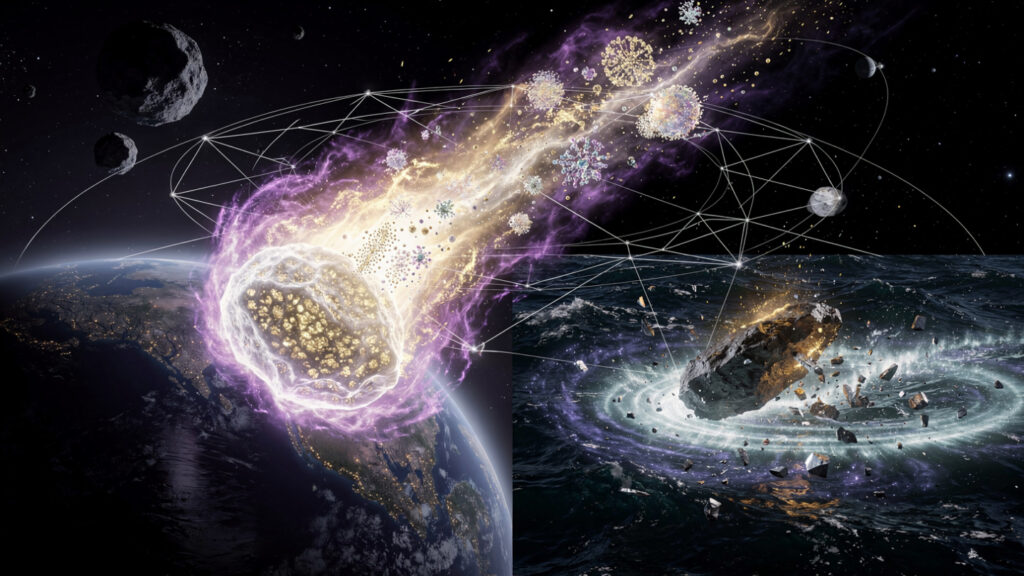
The mechanism Siraj and Loeb calculated for outbound panspermia requires a comet that enters the solar system from interstellar space, makes a close approach to the Sun, and during that approach passes through Earth’s upper atmosphere at an altitude low enough to collect atmospheric material but high enough to decelerate only slightly before continuing its trajectory out of the solar system.

This is not a hypothetical mechanism. Comets on highly eccentric orbits make close approaches to the Sun regularly, and the geometry of Earth’s orbit means that some of these comets pass through the region of Earth’s atmosphere at the relevant altitudes. Siraj and Loeb’s contribution was to calculate the probability of this geometric encounter happening over the history of the solar system, combined with estimates of the upper atmosphere’s microbial density, the comet’s surface porosity, and the ability of entrained microbes to survive within the comet’s subsurface material during the subsequent interstellar transit.
The Mechanism in Detail
The chain of events that the Siraj-Loeb mechanism requires has multiple steps, each with its own probability that compounds with the others to produce the overall estimate.
Step one: a large comet on a hyperbolic or highly eccentric orbit enters the inner solar system and makes a close approach to the Sun.
Step two: during the comet’s approach to or departure from the Sun, it passes through the region of Earth’s orbit at a time when Earth is in the relevant geometric position.
Step three: the comet passes through Earth’s upper atmosphere at an altitude between approximately sixty and a hundred kilometers, low enough to be slowed slightly by atmospheric drag and to sweep up atmospheric material, but high enough that the comet does not decelerate enough to remain in Earth’s gravitational influence.
Step four: microbes present in the upper atmosphere at the relevant altitudes are entrained in the comet’s surface material through a combination of aerodynamic effects and the comet’s porous surface structure capturing atmospheric gas carrying microbial spores.
Step five: entrained microbes work their way into the comet’s subsurface structure, where they are shielded from the interstellar radiation environment by overlying material.
Step six: the comet travels through interstellar space to another star system, arriving after thousands to millions of years.
Step seven: the comet encounters a planet with conditions compatible with the entrained life, deposits the microbes in an impact or atmospheric interaction, and the microbes establish a presence in the new environment.

Steps one through three are calculable from orbital mechanics and the documented population of long-period comets. Siraj and Loeb’s calculation focuses on these steps, using the known distribution of comet orbital parameters to estimate the frequency of the required close approach geometry. Their estimate of one to several dozen such events in Earth’s history is the output of this calculation.
Steps four through seven involve biological and physical processes whose uncertainty is significantly larger than the orbital mechanics uncertainty. Whether microbes can actually be entrained in comet surface material during an atmospheric grazing event, whether they can survive the subsequent radiation environment in the comet’s subsurface, and whether the transit time to another star system is compatible with any organism’s survival, are the questions that make the full panspermia chain uncertain rather than probable.
The Survival Question
The biological challenge at the center of the Siraj-Loeb mechanism’s full realization is the survival time question. The nearest star system to Earth, Alpha Centauri at approximately 4.37 light-years, would require approximately thirty thousand years for a comet traveling at typical solar system escape velocities to reach it. More distant star systems require millions of years.
Whether any microorganism can survive millions of years in the subsurface of a comet traveling through interstellar space is the question that the available experimental and observational evidence cannot definitively answer because no direct test has been conducted on the relevant timescale.
The indirect evidence for long-term microbial survival in extreme conditions is more extensive than popular accounts of the question typically acknowledge. Bacteria recovered from salt crystals in the Salado Formation of New Mexico were reported in 2000 to have been revived after approximately two hundred and fifty million years of dormancy, though subsequent independent verification of this result has been mixed. Bacterial spores have survived exposure to simulated interstellar conditions in laboratory experiments for periods of up to several years with viable fractions remaining. Tardigrades, the extremely radiation-resistant microscopic animals that are routinely cited in this context, have survived vacuum and radiation conditions in low Earth orbit in multiple experimental deployments.
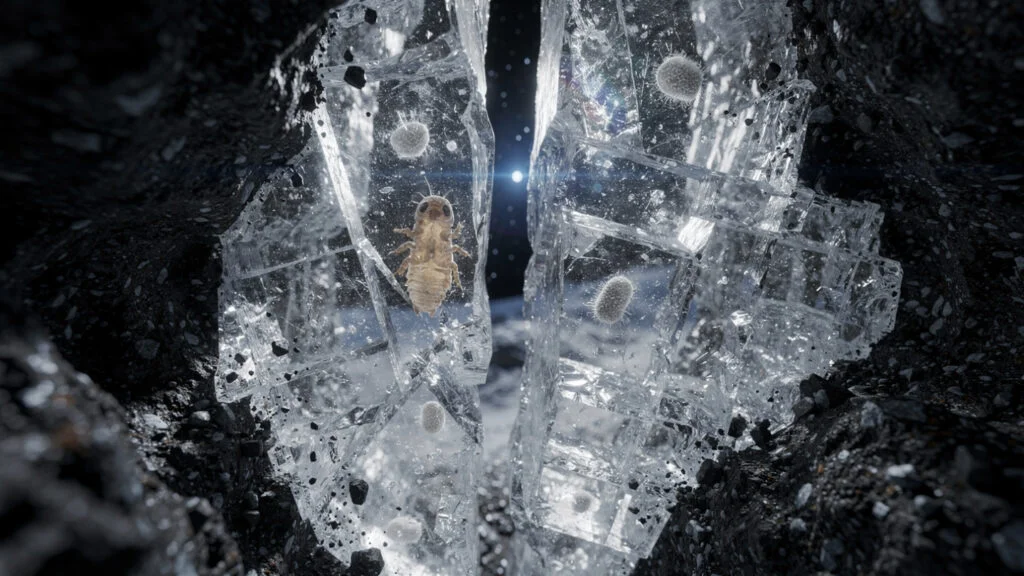
None of these results establishes million-year survival. The extrapolation from years-long experiments to million-year survival requires accepting that the mechanisms protecting organisms from radiation and chemical degradation continue to operate indefinitely, which the available evidence does not confirm.
The Wickramasinghe panspermia tradition, recorded in the Directed Panspermia piece in this library, maintains that the evidence for long-duration survival is sufficient to make interstellar panspermia plausible. The mainstream astrobiology community’s skepticism is concentrated precisely on this step: the transit time problem is the strongest objection to the full panspermia hypothesis regardless of the mechanism proposed for getting organisms off a planet and onto a departing comet.
The Inbound-Outbound Symmetry
The intellectual significance of the Siraj-Loeb calculation for this library’s framework is its relationship to the inbound panspermia question that the Directed Panspermia and IM1 pieces address.
If Earth has exported life to other star systems via the comet grazing mechanism, and if the mechanism works in the inbound direction as well, then the solar system is embedded in a biological network whose distribution mechanism is the comet and asteroid traffic between star systems. Life does not evolve independently on each habitable planet from local abiogenesis. It is distributed by the physical transport of biological material between systems, with the distribution pattern determined by the geometry of comet and asteroid orbital families that connect different stellar neighborhoods.
This is the version of the panspermia hypothesis that the IM1 piece’s physical evidence most directly connects to: if IM1’s BeLaU composition reflects material from a different stellar nucleosynthesis history, and if IM1’s structural strength exceeds known iron meteorites, then the question of whether IM1 was carrying biological material when it impacted the Pacific in 2014 is not obviously answered in the negative by the available evidence.
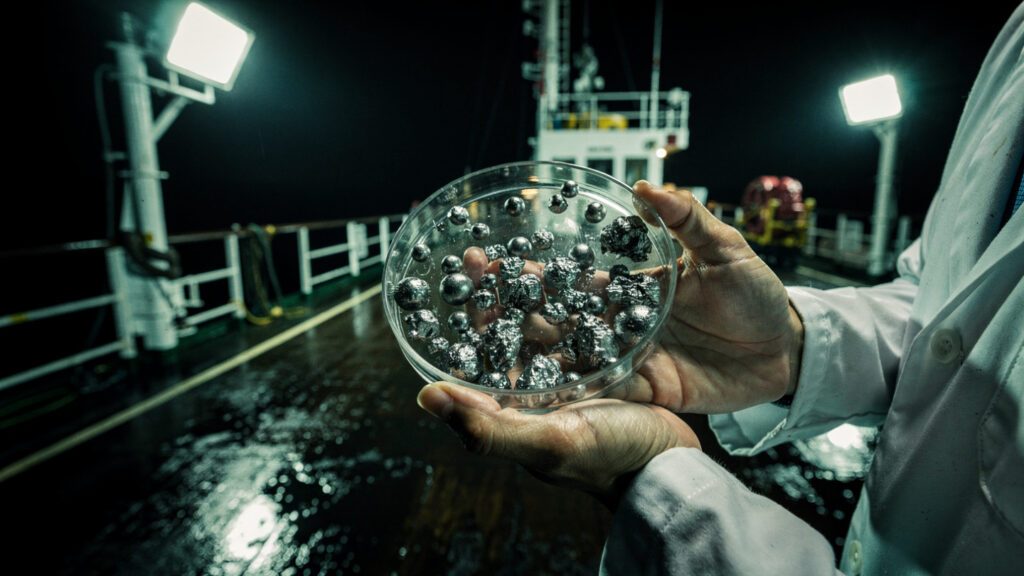
Loeb’s Pacific floor expedition recovered spherules whose composition does not match any solar system material. Whether those spherules contain any biological signatures is not established by the compositional analysis that has been published. Whether the Galileo Project’s next phase of work on the recovered material will include biological analysis has not been publicly announced.
The inbound question, did IM1 bring something from outside, and the outbound question, has Earth sent life out on comets, are the same question approached from different directions. The same researcher is working on both.
The Upper Atmosphere Biology
The biological status of Earth’s upper atmosphere is the empirical question whose resolution would most directly advance the Siraj-Loeb mechanism’s overall plausibility. If the upper atmosphere contains a robust and diverse microbial community, the probability that a grazing comet would entrain viable organisms is significantly higher than if the upper atmosphere is sparsely populated with dormant spores blown up from lower altitudes.
The most systematic recent assessment of upper atmosphere biology is the work conducted by the Indian Space Research Organization using high-altitude balloons reaching approximately forty-one kilometers altitude in 2001, which recovered bacterial and fungal species that the researchers argued could not have been transported from lower altitudes on the timescale of the recovery. This result was published in the refereed literature but has been contested on the grounds of possible contamination during the sampling process.
The technical challenges of sampling the upper atmosphere without contamination are severe: any sampling device must be carried through the lower atmosphere’s dense microbial population to reach the upper atmosphere, creating opportunities for contamination at every stage of the ascent and the sample recovery. Establishing that organisms recovered from upper atmosphere samples were genuinely there rather than being contamination from the lower atmosphere requires experimental protocols whose implementation has been contested in essentially every study that has attempted it.
The question of the upper atmosphere’s biological composition is therefore genuinely open in the peer-reviewed literature, not resolved in the direction of a sparse environment, not resolved in the direction of a rich biological community. The Siraj-Loeb calculation’s uncertainty about the microbial density available to be entrained by a grazing comet reflects this genuine openness.
What the Calculation Establishes
Setting aside the biological uncertainties about survival and entrainment, the orbital mechanics calculation at the center of the Siraj-Loeb paper establishes a result that is more robust than the full panspermia chain.
Large comets on hyperbolic or highly eccentric orbits have been grazing Earth’s upper atmosphere since the solar system formed. The rate of such events, calculated from the known distribution of long-period and hyperbolic comets, is consistent with at least one and possibly several dozen events having occurred in Earth’s history, with the highest frequency in the early solar system when the comet population was larger and comet-planet encounters more common.
Whatever was in Earth’s upper atmosphere during these events was exposed to the physical interaction with these comets. Whether that exposure resulted in viable organisms being transported off Earth is the biological question. But the physical mechanism, the comet graze, happened. The opportunity for biological export was present. The calculation puts a number on how often the opportunity was present.
Whether that opportunity was realized depends on biology that current science cannot definitively assess. But the opportunity was not zero. It was calculable. The calculation was published by the researcher who found the first confirmed interstellar meteorite in the same year that he was organizing the expedition to recover its fragments from the Pacific floor.
If IM1 could come in from outside the solar system, the same mechanism in reverse could send something out. The question is not whether the traffic exists. The orbital mechanics confirm it does. The question is what was riding on it.