



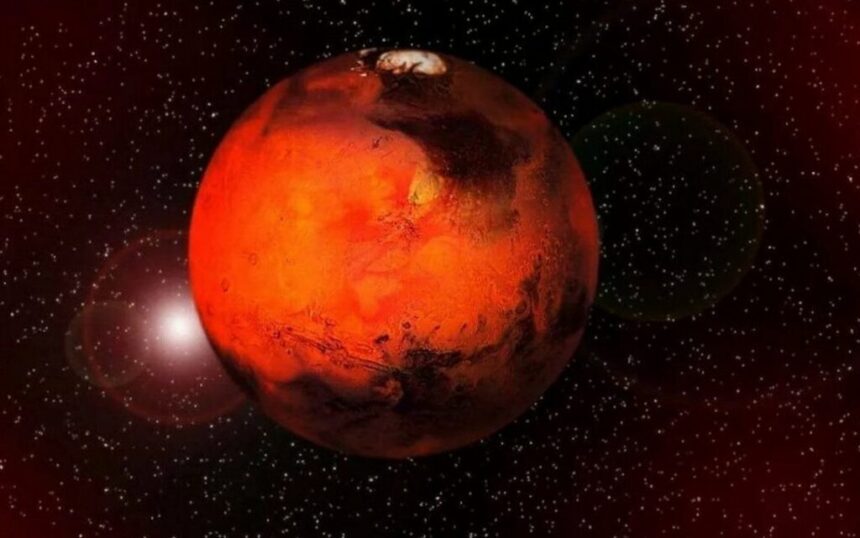
John Brandenburg really did propose that Mars was devastated by enormous thermonuclear explosions. He did not invent the hypothesis after the fact, and the observations he cites are not imaginary: Mars really does have unusual xenon and argon isotope ratios, real concentrations of uranium and thorium, real glass deposits, and real landscapes that once inspired claims of artificial ruins. The problem is what happens when those observations are followed all the way back to the underlying data. The strongest evidence does not require a nuclear war, and the supposed archaeological evidence becomes ordinary geology when Mars is viewed at the resolution modern spacecraft can actually provide.
That distinction matters. Brandenburg’s hypothesis is a genuine scientific claim in the narrow sense that it has been written down, published, argued from measurements, and revised over time. His 2014 paper proposed that two enormous thermonuclear explosions occurred in the northern Martian plains, while his later work developed the idea into what he calls a Large Planetary Climate Altering R-process Event, or LPARE. The question is not whether Brandenburg believes it. The question is whether Mars requires it. So far, the answer is no.
The “Ruins” Disappear When Mars Comes Into Focus
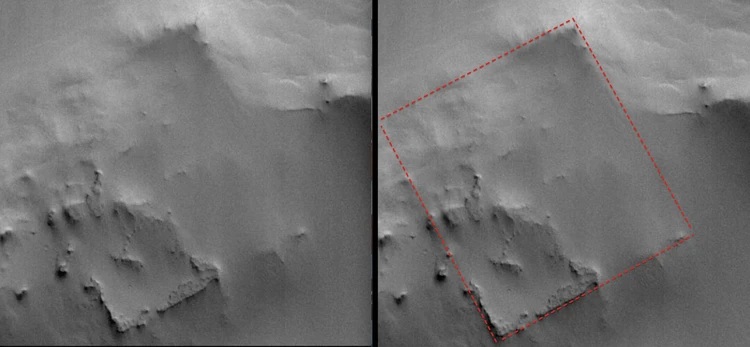
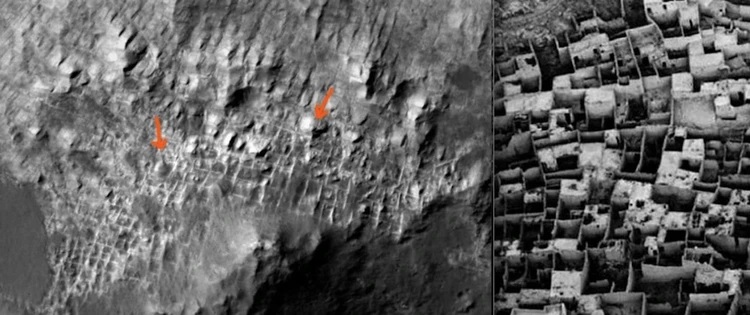
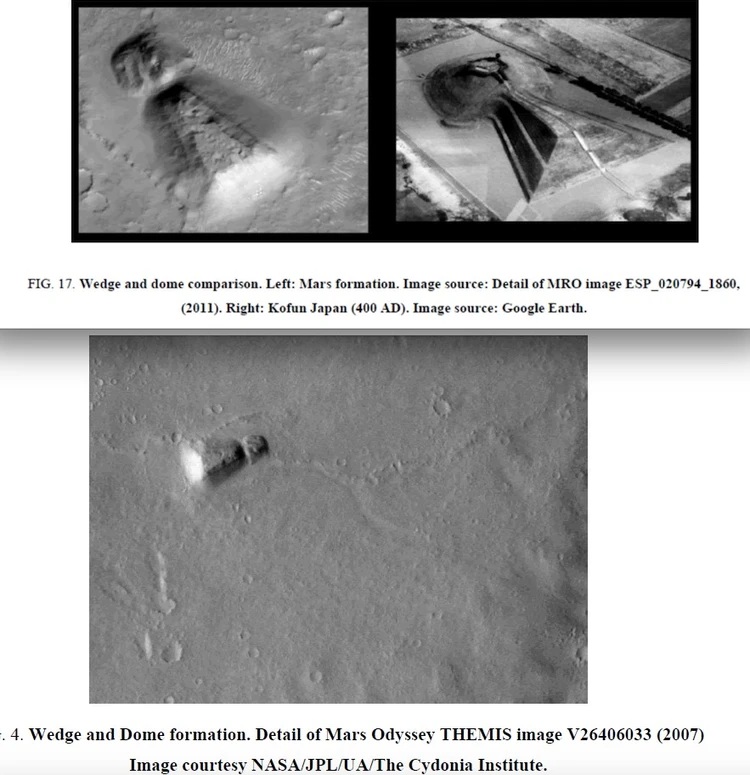
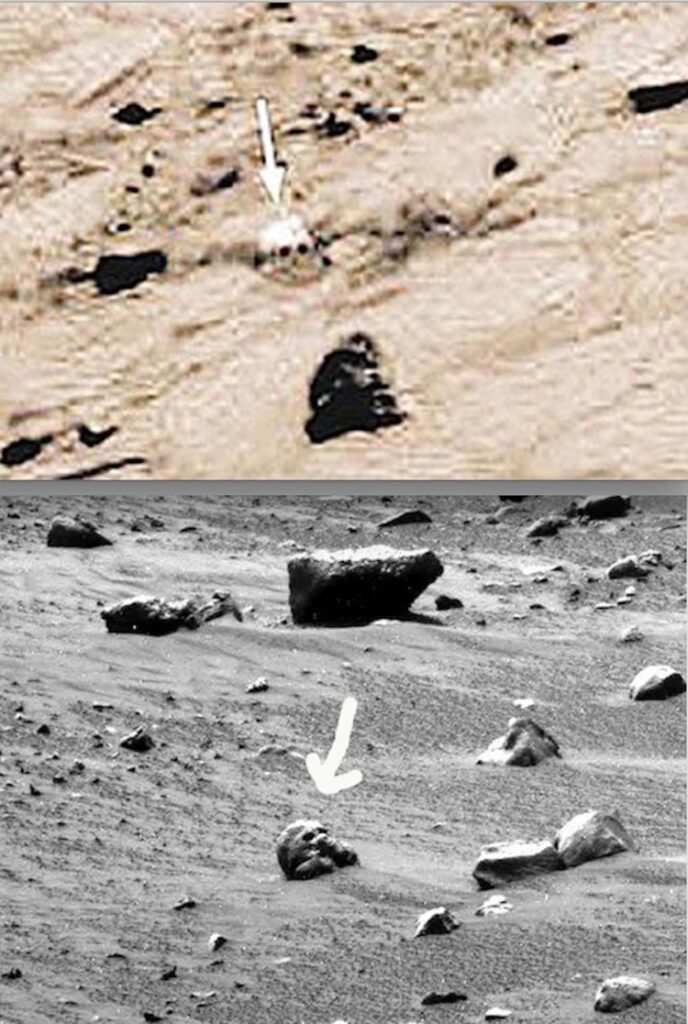
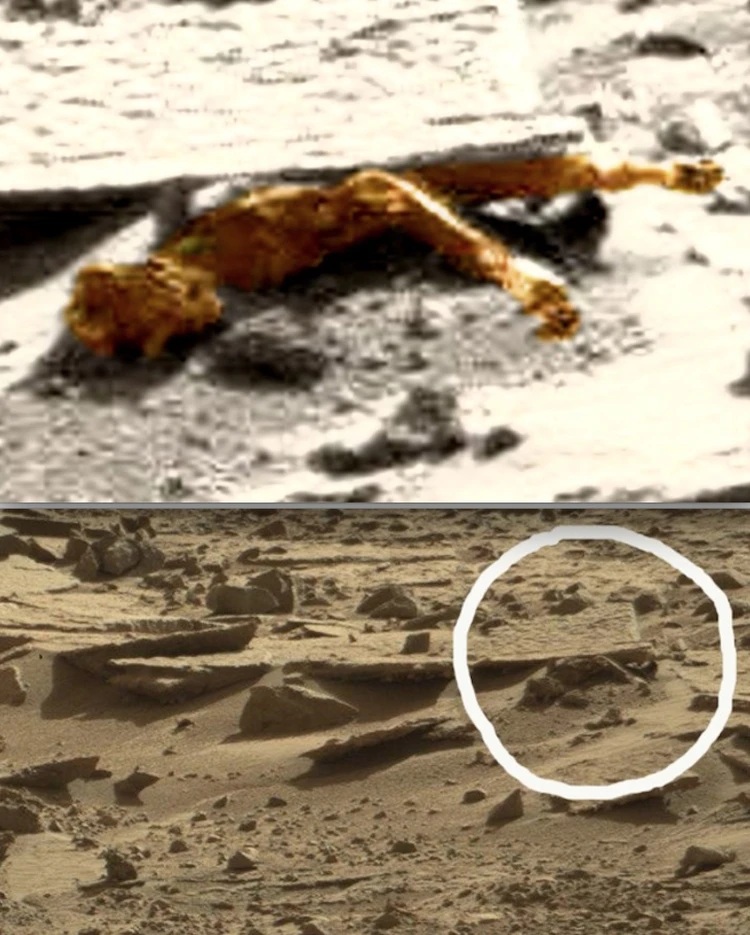
The visual case for an ancient Martian civilization has always been the easiest part of the theory to recognize and the hardest part to sustain. Arabia Terra formations have been presented as rectangles, Libya Montes as a Japanese-style burial mound, Atlantis Chaos as a ruined cityscape, and isolated rocks photographed by rovers as skulls, faces, or other familiar objects. But photographs are not archaeological surveys, and a resemblance is not a structure. On Mars, wind erosion, sedimentary layering, impact processes, shadows, viewing angle and enormous expanses of fractured terrain repeatedly produce shapes that look meaningful when isolated from their geological surroundings.
The famous Cydonia “Face” is the decisive example because it was once presented as the strongest visual evidence of all. NASA’s original Viking image really did show a feature resembling a human face, and the resemblance was striking enough to become one of the most enduring Martian mysteries in popular culture. But higher-resolution observations changed the evidentiary picture. NASA’s Mars Global Surveyor obtained imagery at roughly 2 metres per pixel, and subsequent observations showed the feature to be a normal mesa with slopes, ridges and resistant layers shaped by erosion. NASA’s own descriptions explicitly identify the apparent face as a geological formation, while broader infrared imagery shows numerous nearby knobs and mesas with similarly suggestive shapes.
Brandenburg’s Nuclear Hypothesis Is Real. Its Evidence Is the Problem.
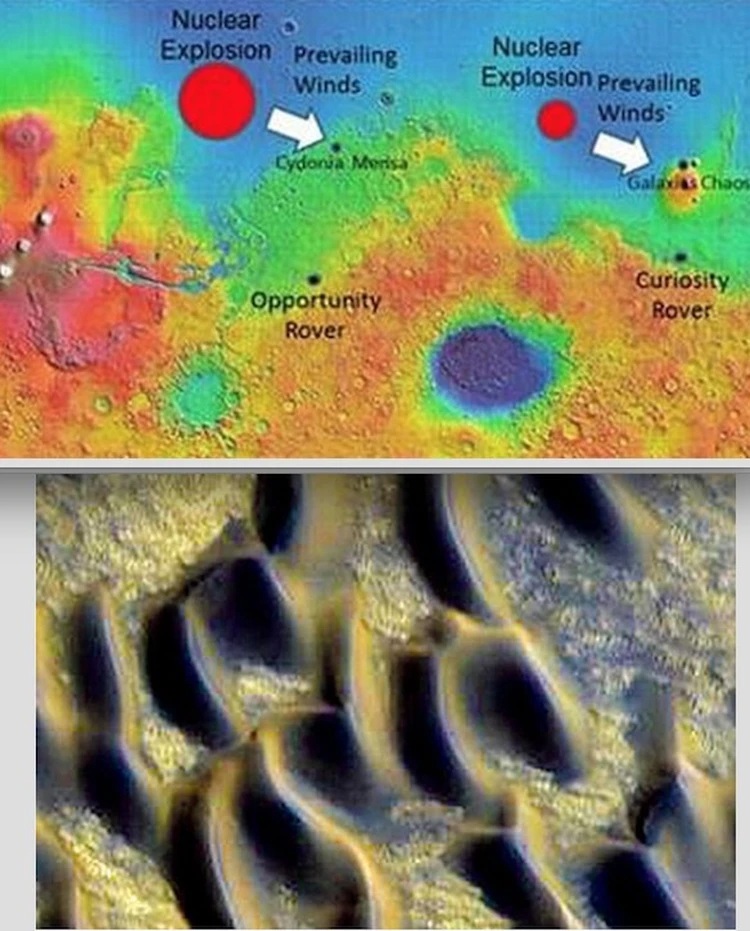
Brandenburg’s original argument deserves to be stated accurately rather than caricatured. He pointed to the elevated 129Xe/132Xe ratio in the Martian atmosphere, unusual krypton measurements, surface concentrations of uranium and thorium, and other isotope patterns. In his 2014 paper he argued that these observations could be explained by two enormous thermonuclear explosions centered near Cydonia and Utopia Planum. His later 2023 LPARE paper expanded the proposal, arguing that two massive events roughly half a billion years ago could explain several apparently contradictory isotope measurements and the loss of a once-thicker atmosphere.
But an isotope anomaly is not the same thing as a nuclear detonation. The crucial scientific question is whether the observed isotope pattern uniquely points to Brandenburg’s mechanism or whether known planetary processes can produce it. They can. Martian atmospheric xenon has been studied since the Viking missions, and 129Xe has long been understood in the context of the radioactive decay of extinct 129I, planetary differentiation, atmospheric evolution and loss processes. Reviews of Martian noble gases describe multiple mechanisms capable of shaping the present isotope inventory, while later Curiosity measurements showed that interactions between the Martian crust, regolith and atmosphere can also modify xenon and krypton isotope abundances.
The same problem appears with argon. Mars really does have an unusually high 40Ar/36Ar ratio, but 40Ar is a normal radiogenic product of 40K decay in the crust and mantle. Published planetary models treat the atmospheric abundance of 40Ar as the combined result of radioactive production, volcanic outgassing, erosion and atmospheric escape. That is not a speculative rescue invented to defeat Brandenburg; it is established planetary geochemistry that predates his nuclear-war hypothesis by decades.
The Missing Piece Is Not “Scientists Don’t Like It”
This is where the original controversy is often framed badly. It isn’t enough to say that “mainstream scientists rejected Brandenburg” as though a committee simply voted against the idea. Science doesn’t work that way. A more serious objection is that Brandenburg’s interpretation has not displaced the competing explanations with independent evidence that uniquely identifies a nuclear event. His own later paper acknowledges that there is no plausible explanation for what caused the proposed nuclear events and identifies future tests, including searches for related nuclear products, that could potentially test the hypothesis. In other words, even the hypothesis itself points toward evidence that would need to exist before the extraordinary interpretation could become compelling.
There is another important asymmetry. A natural explanation does not have to explain every remaining uncertainty perfectly before it becomes preferable to a vastly more extraordinary one. Planetary science contains genuine unresolved problems: how Mars lost its atmosphere, how its volatile reservoirs evolved, exactly how its isotope inventories were assembled, and how its ancient climate changed. Those questions remain active research. But “we do not yet have a complete model” does not logically become “therefore two thermonuclear explosions occurred.” A gap in one explanation is not positive evidence for another.
The Glass Is Real. The Nuclear-War Interpretation Isn’t Established.
Another piece of the argument concerns glass. Mars genuinely contains glass, and this is not a trivial observation. NASA’s Mars Reconnaissance Orbiter detected impact glass preserved inside Martian craters, while research by Briony Horgan and James Bell identified extensive glass-rich sediments in the northern lowlands and proposed an explosive volcanic origin for those widespread deposits. In other words, planetary scientists have found exactly the sort of unusual material that makes Mars worth investigating—but they have also identified ordinary planetary mechanisms capable of producing it.
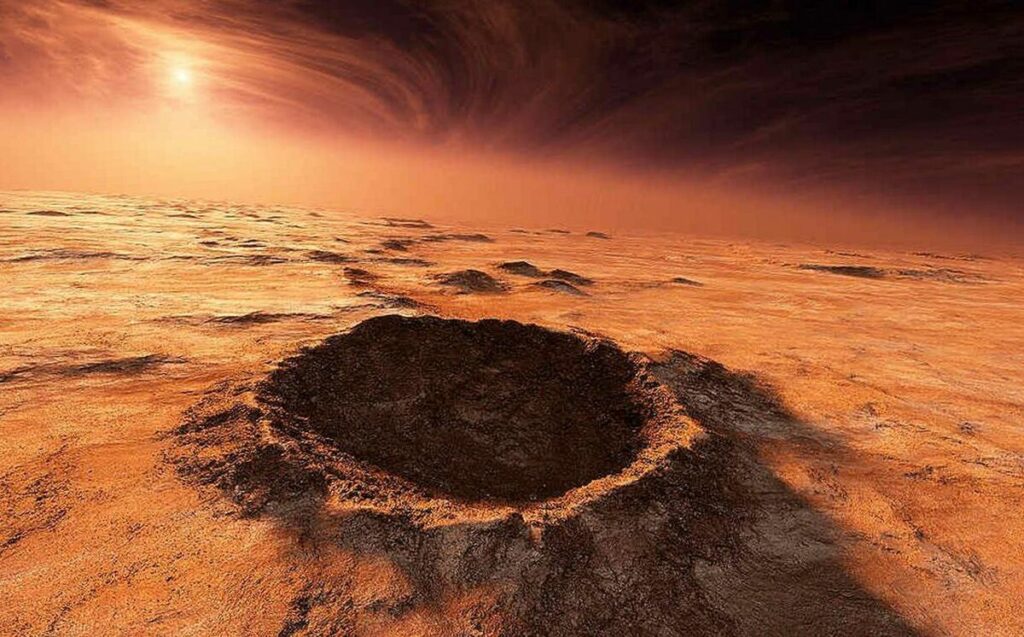
That distinction is critical because “glass exists” and “glass was produced by a thermonuclear explosion” are two completely different propositions. Impact energy can melt rock. Volcanic eruptions can produce glass-rich deposits. Mars has experienced both impacts and enormous volcanic activity. The existence of glass therefore does not independently identify the mechanism that produced it. NASA’s impact-glass work even emphasizes that such deposits may be valuable precisely because they can preserve evidence of ancient environments and potentially ancient life. The interesting scientific question is what the glass records—not whether the word “glass” can be made to sound like “trinitite.”
Ancient Water Is Evidence of a Different Mars
One of the most important things Brandenburg’s broader narrative gets right is also one of the least controversial: ancient Mars was dramatically different from the planet we see today. The channels, valley networks, altered minerals, sedimentary deposits and other geological evidence show that liquid water once played a major role at the Martian surface. The ancient atmosphere was also substantially different from today’s thin envelope. Viking-era measurements already showed that the present atmosphere represents only a fraction of the volatile inventory Mars once outgassed, while decades of orbital and rover observations have progressively reconstructed a planet with a much wetter and more dynamically active past.
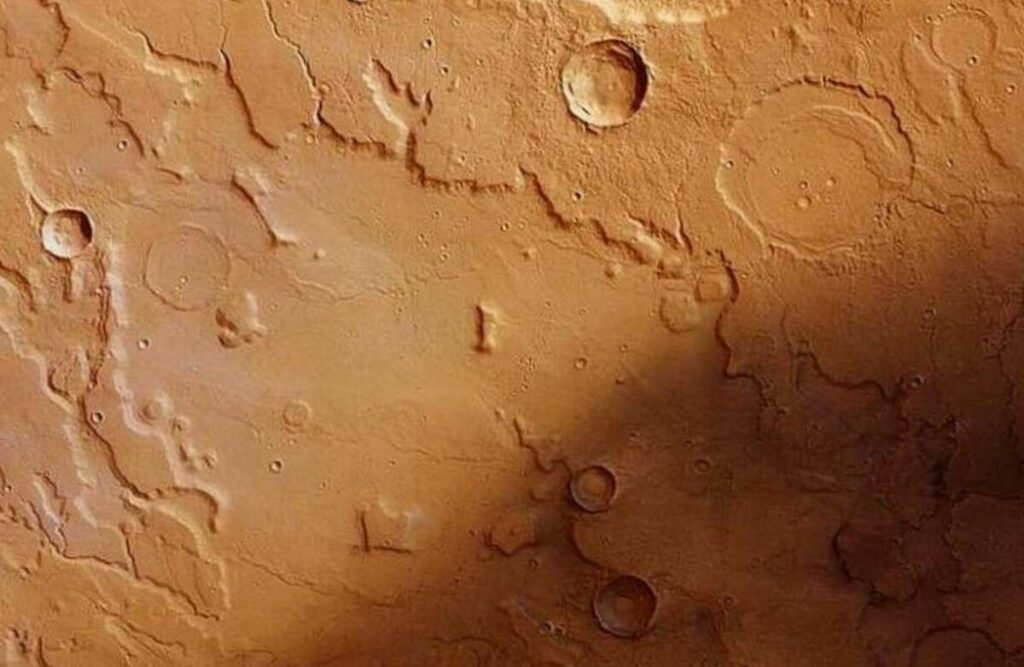
That does not make an ancient civilization more likely. It makes ancient Mars more interesting. A planet with persistent water, changing atmospheric pressure, volcanism, impacts and long-lived geological activity provides many natural processes capable of leaving complicated chemical and morphological signatures. The scientific challenge is therefore not to find a sufficiently dramatic event to explain every mystery at once. It is to determine which process actually produced each signature.
Phaethon Was a Hypothesis About a Planet, Not the Missing Ancestor of Humanity
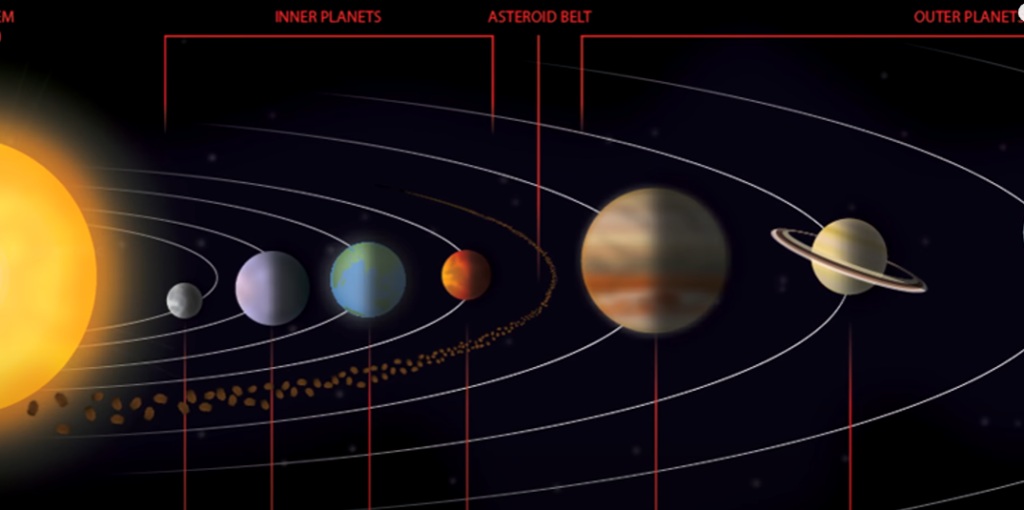
The article’s Phaethon detour belongs to a different historical story. Astronomers really did search for a missing planet between Mars and Jupiter after the discovery of the pattern later known as the asteroid belt. The belt, however, is not generally interpreted as the shattered remains of a former Earth-like planet. Jupiter’s gravity prevented the material from efficiently accreting into a single planet, leaving a population of smaller bodies instead.
There is consequently no scientific chain running from a hypothetical destroyed Phaethon to human physiology, joint structure, circadian rhythms or the evolutionary history of Homo sapiens. Human evolution is supported by an enormous independent record of fossils, comparative anatomy, genetics and ancient DNA. Whatever unanswered questions remain about our past, they do not require a vanished planet to supply the missing pieces.
Phobos Really Is Strange. It Just Isn’t an Airship.
Phobos provides another useful lesson in how a real scientific uncertainty can be transformed into something much larger than the evidence supports. Measurements from Mars Express show that the moon has a remarkably low bulk density and substantial internal porosity. ESA has described it as broadly consistent with a rubble-pile structure, although its exact internal architecture and origin remain active questions. More recent research continues to debate whether Phobos is best described as a rubble pile, a moderately porous aggregate, or another internally heterogeneous structure.
That is genuinely fascinating. It does not, however, turn Phobos into a hollow spacecraft. Its low density tells researchers something about its internal structure; it does not provide evidence of engines, hydrogen lift systems, passenger compartments or artificial construction. The moon’s eventual fate is equally real: tidal interaction with Mars is driving its orbit inward, and NASA estimates that Phobos will eventually either collide with Mars or break apart into a ring on a timescale of tens of millions of years.
What Would Actually Change the Case?
This is the question a serious investigation should end with. What would make Brandenburg’s hypothesis worth reconsidering? Not another photograph that resembles a building. Not another unusual isotope ratio presented without its competing explanations. Not another podcast interview. The case would change if independent measurements revealed a nuclear signature that could not reasonably be produced by known planetary processes, if predicted daughter products appeared in the required quantities and spatial pattern, if geological sites showed unmistakable physical consequences of the proposed events, or if high-resolution imaging produced independently verifiable structures with archaeological characteristics rather than suggestive shapes.
That standard is not hostile to extraordinary ideas. It is exactly what would allow an extraordinary idea to win. If someone found an unmistakable nuclear signature on Mars that could not be explained by radiogenic decay, atmospheric evolution, impacts or volcanism, planetary scientists would have to confront it. If an actual artificial structure were discovered, the consequences would be enormous. The problem is not that science refuses to entertain those possibilities. The problem is that the evidence presented so far has not crossed that threshold.
The Mars Mystery Is Bigger Than Brandenburg’s Answer
Mars does not need to have been the site of an ancient nuclear war to have suffered a planetary catastrophe. It lost most of its atmosphere. Its surface transitioned from environments capable of sustaining abundant liquid water to the cold, dry world observed today. Its isotope inventory records a complicated history of planetary formation, radioactive decay, atmospheric escape, impacts, volcanism and crust-atmosphere exchange. Its rocks preserve a geological archive that spacecraft are still reading, and the question of whether ancient Mars ever hosted life remains one of planetary science’s great open problems, a question examined at length in how lunar cycles are sometimes claimed to encode a secret code in DNA, a different planet but the same evidentiary standard.
The most important correction, then, is not simply that Brandenburg is wrong. It is that the evidence does not yet justify his conclusion. Some of the observations he points to are completely real. Some of the underlying Martian mysteries are genuinely unresolved. But an unresolved mystery is not a blank cheque for an extraordinary explanation, and a photograph that resembles a ruin is not an archaeological excavation. The strongest version of the Mars story is therefore also the most disciplined one: the planet was once radically different, its chemistry still contains clues we do not fully understand, and modern spacecraft are giving us increasingly better ways to distinguish what is genuinely anomalous from what only looks that way.
That is where Brandenburg’s theory remains: not erased, not “censored,” and not established. It is a speculative interpretation sitting on top of real Martian data, waiting for the kind of independent evidence that could either transform it into science or finally close the case. Until that evidence arrives, the nuclear war is a hypothesis. The ruins are geology. And Mars itself remains the far more interesting mystery.