




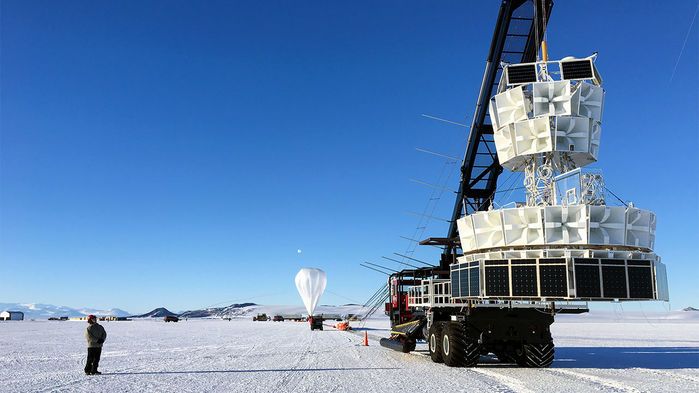
ANITA did not discover a particle traveling through the Earth. It discovered something more frustrating: radio pulses whose reconstructed direction and waveform looked like they came from an upward-going particle shower, from a geometry in which the simplest known explanation should not work.
That distinction matters. The Antarctic Impulsive Transient Antenna was built to search for the radio signatures of extraordinarily energetic cosmic particles, including neutrinos, from a balloon tens of kilometers above Antarctica. In its first and third flights, in 2006 and 2014, ANITA recorded two unusual events that appeared to originate from below the horizon at steep angles. If interpreted as upward-going air showers produced by tau leptons emerging from the ice, the parent neutrinos would have had to cross thousands of kilometers of Earth at energies where the Standard Model predicts severe attenuation. The result was not a discovery of new physics. It was an experimental anomaly: a measurement for which the most obvious physical interpretation creates a serious problem.
And the problem became harder to ignore when other experiments looked for the expected companions and found none. IceCube searched years of neutrino data for counterparts to the ANITA events. Later work used the Pierre Auger Observatory to search for the upward-going showers that a persistent astrophysical interpretation would imply. Neither produced the corroborating population that the simplest neutrino picture requires. At the same time, alternative explanations involving Antarctic ice, unusual radio propagation, detector backgrounds, and physics beyond the Standard Model have all been investigated. One of the most exotic possibilities, a CPT-symmetric universe with a mirror anti-universe, really is published theoretical physics, but it remains a hypothesis, not a solution demonstrated by the data.
The Signals That Started the Problem
ANITA is an unusual observatory because it does not sit underground waiting for particles to collide inside a tank. Its antennas hang beneath a balloon flying roughly 30–40 kilometers above Antarctica, scanning an enormous area of ice for brief radio pulses produced by ultrahigh-energy cosmic-ray air showers and, potentially, neutrino-induced cascades. Ordinary cosmic-ray showers arrive from above and can reflect from the Antarctic surface before reaching the balloon. That reflection normally reverses the polarity of the radio waveform, giving researchers an important clue about what kind of event they are seeing.
The two famous ANITA events were different. They had the characteristics of cosmic-ray-like air showers, but their reconstructed trajectories pointed upward at steep angles rather than downward from the sky. The ANITA collaboration reported the first unusual event from ANITA-I in 2016 and a second, similar event from ANITA-III in 2018. The latter paper explicitly noted that an upward-propagating tau lepton produced by a tau neutrino could in principle generate such a signal, but that the steep emergence angle creates serious tension with the Standard Model neutrino cross section. The events were therefore interesting precisely because the data appeared to sit between categories: they looked like something the instrument knew how to recognize, but appeared to arrive from a direction that made the conventional source difficult to explain.
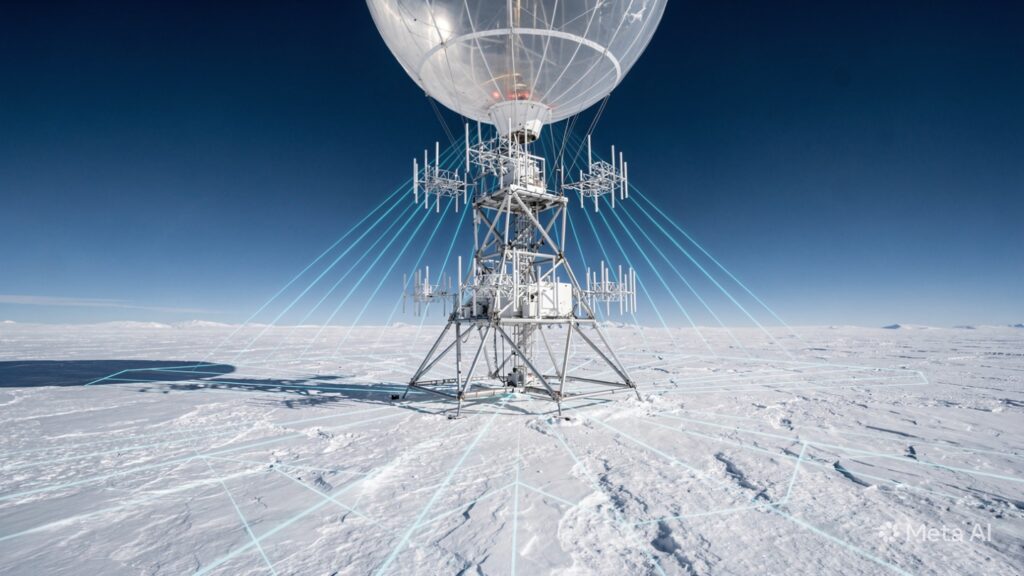
The crucial phrase is therefore not “particles came through the Earth.” That is an interpretation of the observed geometry, not a directly observed trajectory. The radio antennas measured a pulse. From its timing, polarization, waveform and direction, physicists reconstructed the most likely type and direction of the underlying shower. If the shower really originated beneath the ice at the inferred angle, its parent particle would have had to survive an extraordinary journey through the planet. That is where the Standard Model problem begins.
Why the Earth Becomes a Wall at These Energies
Neutrinos are famous for passing through ordinary matter almost effortlessly, but that reputation becomes misleading at the energies relevant to ANITA. At sufficiently high energies, neutrinos interact more readily, and a long enough path through Earth becomes an enormous filter, the same physical threshold examined in claims about the Big Bang being a fourteen-billion-year cosmic fraud. The ANITA geometry implies a chord through the planet of roughly 6,000–7,000 kilometers for the steep events. At energies around a fraction of an exaelectronvolt and above, that corresponds to many interaction lengths, meaning that a conventional neutrino flux capable of producing the observed upward-going showers should be heavily suppressed before reaching the Antarctic surface. The 2025 Pierre Auger analysis describes the problem explicitly: an interpretation in terms of ordinary upward-going showers would require a flux that should have produced many more events in other observatories.
This is why the anomaly became interesting to particle physicists. If the events really were tau-neutrino-induced showers emerging from deep below the ice, either the interaction physics at extreme energies would have to behave differently from the Standard Model expectation, or the source would have to be extraordinarily unusual. Neither possibility is impossible merely because it is uncomfortable. But neither can be declared established simply because ANITA saw two pulses.
Then IceCube Looked for the Missing Neutrinos
IceCube provides a particularly important reality check because it is looking for neutrinos by an entirely different method. Buried deep beneath the South Pole, its thousands of optical sensors watch for the faint flashes produced when neutrinos interact in Antarctic ice. It is therefore not simply another version of ANITA. It samples a different part of the particle’s interaction history with a different detector architecture.
Researchers used seven to eight years of IceCube data to search for neutrino counterparts associated with the directions and possible source scenarios of the ANITA candidates. The searches did not find the expected correlated events. IceCube’s own account of the analysis explains the basic logic: if an intense astrophysical neutrino source were responsible for the ANITA signals, the same source should generally produce detectable neutrinos in IceCube as well. The absence of those counterparts placed strong constraints on ordinary astrophysical explanations. Subsequent work went further, showing that even tau-neutrino regeneration through Earth cannot easily rescue the standard astrophysical interpretation.
But “IceCube found nothing” is not the same statement as “IceCube proved the ANITA events were impossible.” A non-detection constrains models. It does not identify the true cause of the original pulses. It tells us that certain explanations require too many accompanying events, too much flux, or the wrong energy distribution. That is enormously useful scientifically, but it is not itself a new-particle detection.
The Anomaly Got More Complicated in ANITA-IV
There is an important piece of the story that gets lost whenever the ANITA anomaly is presented as two identical impossible signals. ANITA’s fourth long-duration flight, in 2016, produced four additional cosmic-ray-like events with anomalous non-inverted polarity. They were statistically unusual, but they were not steep upward-going events like the famous ANITA-I and ANITA-III pair. All four occurred close to the horizon, and the collaboration explicitly noted that ANITA-IV did not reproduce the earlier steeply upward-going geometry.

That matters because it weakens the temptation to treat every anomalous ANITA pulse as evidence of one exotic particle. The four ANITA-IV events may have a different origin from the two steep events. In fact, ANITA researchers have discussed the possibility that the different classes of anomalies represent different physical or instrumental phenomena. The word “anomaly” therefore describes a family of observations, not necessarily one undiscovered object or one undiscovered particle.
Could the Antarctic Ice Be Fooling the Detector?
One of the most important alternatives has nothing to do with parallel universes. It concerns the Antarctic itself. Radio waves do not encounter the ice as a perfectly uniform optical surface. Density changes, internal layers, firn structure and other glaciological boundaries can alter how radio signals propagate and reflect, a real complication in reading Antarctic ice worth comparing to more speculative claims about what ancient ice cores actually tell us about civilizations that weren’t ours. Researchers have proposed that a conventional cosmic-ray shower could produce a radio pulse that interacted with subsurface ice structures in an unusual way, potentially mimicking the polarity and direction that made the famous events appear to be upward-going.
A 2020 study argued that subsurface layers and firn-density inversions could plausibly produce reflections without the polarity inversion normally expected from a surface reflection. That was a serious physical proposal, not an internet invention. But it did not become a consensus solution. A later experimental analysis using ANITA and HiCal data found the proposed subsurface-reflection scenarios disfavored, while noting that the problem could not simply be reduced to one clean mechanism. In other words, “it’s the ice” remains part of the scientific discussion, but it is not a settled answer either.
This is exactly why the anomaly remains useful. A strange signal can be valuable even if the final explanation turns out to be mundane. If an overlooked property of Antarctic ice can imitate the signature of an exotic particle, that is itself an important experimental lesson for future radio-based cosmic-particle searches.
The Anti-Universe Is Real Physics. It Is Not an ANITA Discovery.
Among the explanations attached to ANITA, none sounds more dramatic than the idea that the signal came from a universe on the other side of the Big Bang. The underlying theory is real. In 2018, Latham Boyle, Kieran Finn and Neil Turok published CPT-Symmetric Universe in Physical Review Letters. Their proposal imposes CPT symmetry, the combined symmetry involving charge, parity and time, on the cosmological state and describes the post-Big-Bang universe as the CPT image of a corresponding pre-Big-Bang epoch. The model also offered a possible explanation for the cosmological matter-antimatter asymmetry and a dark-matter candidate within its framework.
That makes the phrase “anti-universe hypothesis” legitimate. What is not legitimate is silently upgrading the theory into an explanation that ANITA has confirmed. The published CPT-symmetric model was a cosmological theory with several testable predictions. It was not an experimental paper announcing that ANITA had detected particles from the mirror universe. The connection between the two ideas became prominent because the unusual ANITA geometry seemed to invite exactly the sort of exotic interpretation that a mirror cosmology could inspire.
That distinction is the difference between physics and mythology. A peer-reviewed theory can be mathematically serious, physically motivated and worth testing while still being completely unconfirmed. The existence of a published hypothesis proves that scientists have proposed it. It does not prove that nature selected it.
Dark Matter Is Another Possibility, But Not a Detection
Other researchers have explored models in which a new, long-lived particle could traverse large portions of Earth before producing an observable shower near the Antarctic surface. Some of these proposals invoke dark-matter-like particles or other physics beyond the Standard Model. This is plausible territory for theoretical particle physics because the identity of dark matter remains unknown even though its gravitational effects are extraordinarily well established.
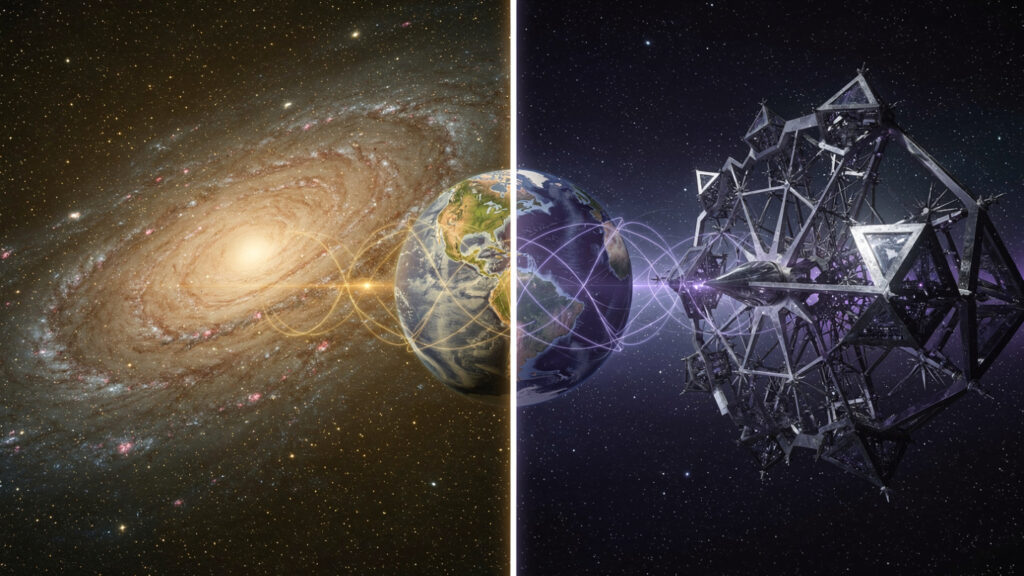
But this is another place where wording matters. Dark matter is not a single confirmed particle waiting to be identified. Its existence is inferred from gravitational phenomena across galaxies, galaxy clusters and the large-scale universe, while its microscopic identity remains unknown. An ANITA explanation that introduces a hypothetical particle with unusual interaction strength and lifetime would therefore be a proposal for new physics, not the first direct detection of dark matter. The distinction is enormous.
The same standard applies to every exotic interpretation. If a new particle explains ANITA, it should eventually do more than explain ANITA. It should make predictions that other experiments can test. A convincing discovery would leave traces in multiple datasets, survive competing explanations, and ideally produce a reproducible signal in a detector designed to find it.
Then Pierre Auger Added Another Constraint
The story did not stop with IceCube. In 2025, the Pierre Auger Collaboration published a dedicated search for upward-going air showers motivated specifically by the two famous ANITA events. Auger searched its fluorescence-detector data for showers arriving from below the horizon with energies above 0.1 exaelectronvolts. It found one candidate, but the event was consistent with the expected background of 0.27±0.12 events from misreconstructed cosmic rays. More importantly, if a persistent upward-going flux were normalized to reproduce the ANITA observations, Auger calculated that substantially more events should have appeared, more than 34 for one assumed spectrum and more than 8 even for a conservative spectrum.
This does not erase ANITA. It sharpens the contradiction. A particle population capable of producing the ANITA events cannot simply be invoked at whatever flux is necessary and then disappear everywhere else. IceCube constrains the accompanying neutrinos. Auger constrains upward-going air showers. ANITA itself supplies the original unusual pulses. Each experiment sees a different part of the possible explanation, and the combined picture is considerably harder to fit with a simple astrophysical neutrino source than it was when the anomaly first became famous.
So What Does ANITA Actually Prove?
It proves that ANITA recorded unusual radio events. It does not prove that a new particle crossed the Earth. It does not prove that an anti-universe exists. It does not prove that dark matter was detected. And it does not prove that the Standard Model has been experimentally overturned.
What the data do establish is more precise and, scientifically, more valuable: the two steep ANITA events are difficult to reconcile with a straightforward Standard Model interpretation as upward-going tau-neutrino-induced showers. Ordinary astrophysical explanations are strongly constrained by IceCube and other observations, independent searches have failed to reproduce the expected accompanying population, and several alternative mechanisms remain under investigation. The 2025 Pierre Auger result makes a simple persistent upward-going cosmic-ray interpretation particularly difficult, while the history of proposed subsurface-reflection mechanisms shows that even the apparent direction of a radio pulse is something physicists must interrogate rather than accept at face value.
The Difference Between an Anomaly and a Discovery
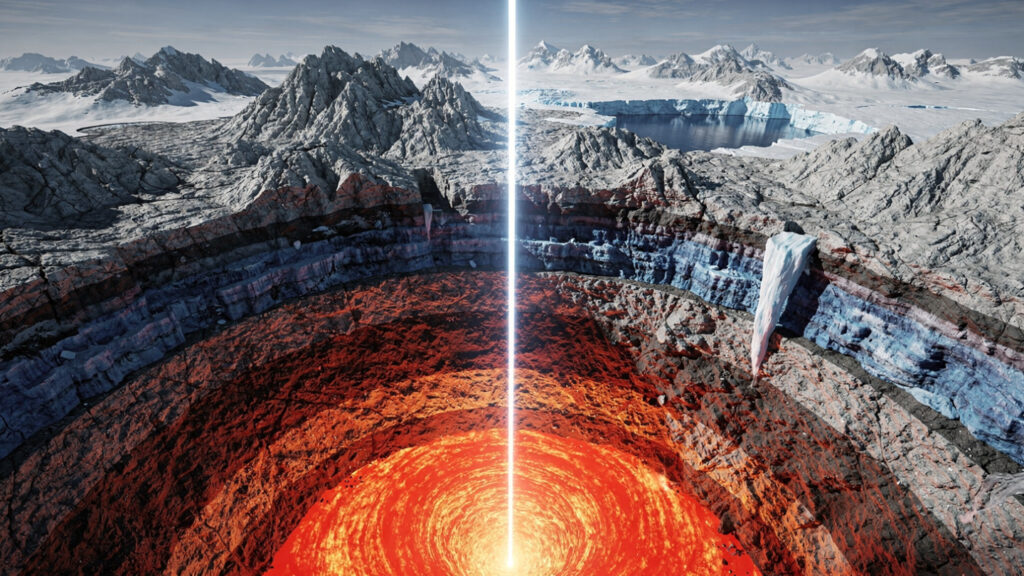
There is a temptation, whenever an experiment produces something genuinely strange, to choose the most spectacular explanation first. ANITA makes that temptation unusually powerful. The phrase “signals from beneath Antarctica” sounds like a portal, the same rhetorical leap examined in claims about the machinery beneath reality beginning to wake and worlds bleeding through each other. “Particles through Earth” sounds like new physics. “Anti-universe” sounds like confirmation of an alternate cosmos. But experimental physics works in the opposite direction. The more extraordinary the interpretation, the more independently reproducible evidence it must survive.
That is why the missing corroboration matters more than the headline. A single anomalous detector signature can be produced by an unknown physical process, an overlooked environmental effect, an instrumental subtlety, a statistical fluctuation, or some combination of factors. The job of the next experiment is not to make the anomaly more dramatic. It is to make the list of possible explanations smaller.
And that is exactly what has happened. IceCube made the standard astrophysical-neutrino story harder. Antarctic subsurface studies showed that the ice itself has to be treated as part of the detector system, while later experimental work challenged some specific reflection models. ANITA-IV showed that not all anomalous-looking events shared the same geometry. Pierre Auger added another independent constraint against interpreting the original events as an ordinary persistent population of upward-going showers. None of those results gives us the final answer, but together they make the scientific question considerably sharper.
The most honest description of ANITA is therefore not that it detected an anti-universe, a dark-matter particle, or something that “should be impossible.” It detected signals whose simplest interpretation creates a physical contradiction that has resisted a clean resolution.
That is not a failure of science.
That is what science looks like when the instrument gets interesting before the explanation does.