




MAVEN did not mysteriously fail when 3I/ATLAS passed through the Mars system. NASA now has a specific explanation for what happened: after emerging from behind Mars on December 6, 2025, the spacecraft was found to be rotating at an abnormally high rate. That rotation prevented its power system from operating normally, drained its batteries, and ultimately left the spacecraft unrecoverable. The connection to 3I/ATLAS was temporal, not causal. MAVEN had already observed the interstellar comet, remained operational afterward, and then suffered an internal spacecraft anomaly months before the comet’s closest approach to Earth.
That distinction matters because 3I/ATLAS generated an extraordinary amount of speculation during the same period. A faint image from Mars was interpreted by some as evidence of concealment. MAVEN’s loss of contact became a supposed technological attack. A stray point of light was promoted as a companion craft. Unusual chemistry became “engineered” chemistry. Radio interference became a possible message. Each individual observation was real enough to provide a foothold for speculation, but the conclusions built on top of them were not supported by the evidence.
The eventual MAVEN investigation is therefore useful precisely because it replaces coincidence with chronology and telemetry. The spacecraft did not vanish immediately after seeing 3I/ATLAS. It did not lose power while conducting the comet observations. It did not receive a documented external energy pulse. It emerged from Mars with an unexpected attitude state, rotated abnormally, exhausted its batteries, and stopped communicating. NASA’s anomaly review board, meeting through a formal investigation and confirmed at a June 3, 2026 telecon with officials including Mike Moreau, concluded that the spacecraft could not be recovered.

The “Low-Resolution” Image Wasn’t Evidence of a Cover-Up
The first piece of the story needs to be separated from the second. NASA’s Mars Reconnaissance Orbiter really did capture an unusually coarse-looking image of 3I/ATLAS on October 2, 2025. But the reason is visible in the technical circumstances of the observation. HiRISE was designed primarily to image the Martian surface at close range, not to photograph faint, fast-moving objects against a distant stellar background. The spacecraft had to rotate away from its normal imaging targets and point the instrument toward the comet roughly 30 million kilometres away, more than a hundred thousand times farther than its typical Mars-surface imaging distance.
NASA says the resulting image had a scale of about 19 miles, or 30 kilometres, per pixel. That sounds shocking until the geometry is understood. The “pixelated ball” was not a photograph of a solid object with a few missing details. It was the comet’s extended coma, a cloud of dust and ice surrounding the nucleus, seen from an instrument being used in an unusual way, with spacecraft jitter during the 3.2-second exposure smearing it further. The image was scientifically useful because it helped constrain the comet’s size and morphology, not because it was capable of resolving a spacecraft-sized object hidden inside the coma. No delay, bureaucratic or otherwise, changes that basic optical fact: at that distance, this instrument was never going to produce anything sharper.
There is also a revealing detail in the chronology. NASA did not simply produce one suspicious photograph and stop. MAVEN itself observed the comet in ultraviolet wavelengths, while Perseverance also detected it from the Martian surface. NASA subsequently published the observations and described what the different instruments were capable of measuring. The imperfect image was therefore not evidence that NASA could see something clearly and chose not to show it. It was an example of what happens when a scientific instrument is pointed at a target very different from the one it was designed to photograph.
MAVEN Actually Observed 3I/ATLAS
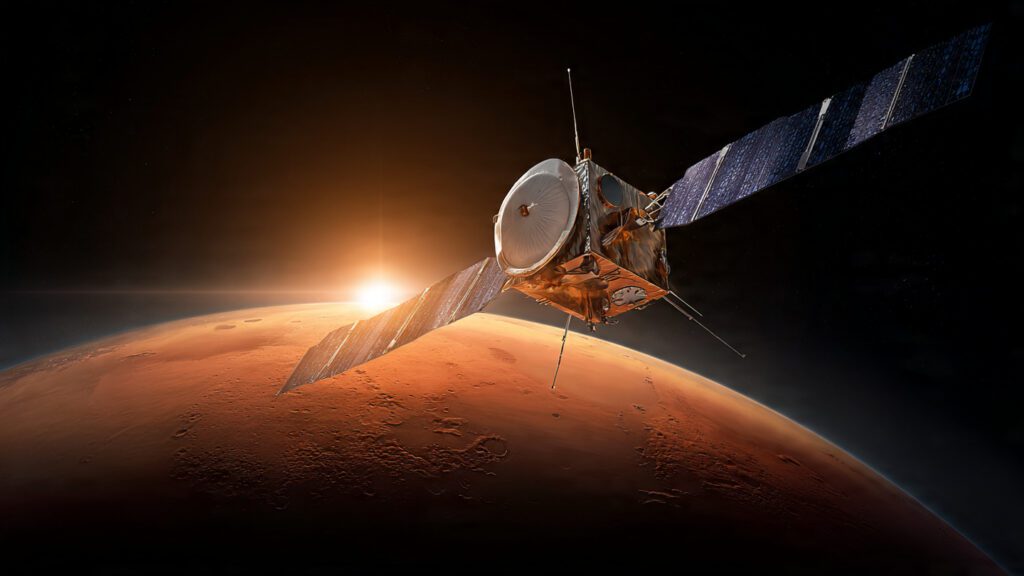
The most important fact is often lost in the conspiracy version of the story: MAVEN did successfully observe 3I/ATLAS. During late September and early October 2025, its Imaging Ultraviolet Spectrograph conducted observations over roughly ten days, capturing the comet in multiple ultraviolet wavelengths and examining hydrogen in its surrounding coma. NASA described those observations as valuable measurements of the comet’s composition and water production.
MAVEN’s observations were therefore not some failed attempt to approach or interrogate an unknown craft. They were ordinary scientific observations of a rare interstellar comet. The spacecraft performed the task for which it was being used, returned scientific information, and continued its mission.
This timeline becomes crucial later. If 3I/ATLAS had somehow disabled MAVEN during those observations, the spacecraft’s subsequent history should show the failure occurring at or immediately after the encounter. It does not.
MAVEN Survived the Encounter
NASA reported the loss of contact on December 6, 2025, more than two months after the October comet observations. Before MAVEN disappeared, its telemetry had shown its subsystems operating normally. NASA’s initial December investigation recovered a fragment of tracking data indicating that something unusual had happened while the spacecraft emerged from behind Mars: MAVEN was rotating in an unexpected manner, and its orbital trajectory appeared to have changed.
That was the beginning of the real mystery. NASA did not initially know exactly what had happened, and it did not pretend otherwise. Recovery efforts continued. Engineers analyzed tracking data. An anomaly review board was eventually convened in February 2026. The spacecraft was not immediately declared dead because the mission team had to determine whether the abnormal state could be reversed and whether communications could be restored.

Then NASA Found the Failure Mechanism
By June 2026, the picture had become much clearer. NASA’s anomaly review board concluded that MAVEN was in safe mode and rotating at an unusually high rate, roughly 2.7 rotations per minute, when it emerged from behind Mars. That abnormal rotation kept its solar panels from facing the Sun, causing the spacecraft’s batteries to drain. Once the batteries were depleted, the communications system lost power, and the spacecraft entered a state from which it could not be recovered.
This is a very different kind of explanation from “MAVEN was attacked.” It does not require an external object, an electromagnetic weapon, a plasma beam, a gravitational intervention or an intentional transmission. The evidence NASA recovered pointed to the spacecraft’s own attitude and power systems.
There is an important nuance, however. “NASA knows why MAVEN became unrecoverable” is not identical to “NASA knows the ultimate root cause of every step that produced the abnormal rotation.” The public NASA finding establishes the chain from abnormal rotation to battery depletion to loss of communications and unrecoverable status. It does not turn every unanswered engineering question about what initiated the abnormal state into a solved mystery. That distinction is worth preserving because genuine anomaly investigations often end with a known failure mechanism while some deeper initiating cause remains uncertain.
But an unresolved internal engineering question is not evidence for an external alien cause. If anything, it is precisely where the evidence stops. The correct conclusion is therefore narrower and stronger: MAVEN’s loss of mission capability was explained by an abnormal spacecraft state and subsequent battery depletion; no evidence links that failure to 3I/ATLAS.

The “Second Object” Was Never Established
Another claim built itself around apparent secondary points of light near 3I/ATLAS. Online discussions interpreted these as evidence that the comet was accompanied by another object, potentially a probe or formation-flying spacecraft. But an apparent point of light is not automatically an astronomical object, much less an artificial one.
Faint astronomical images contain background stars, detector artifacts, cosmic-ray events, optical effects and processing artifacts. A genuine companion would need to survive much more demanding tests: repeated observations, consistent motion, independent instruments and a trajectory demonstrating that the object remains physically associated with the comet rather than merely appearing nearby in a two-dimensional image.
No persistent artificial companion to 3I/ATLAS has been established through that process. That does not mean every unexplained pixel must have an immediate explanation. It means the evidentiary burden for turning a pixel into a spacecraft has not been met.

The “Engineered Chemistry” Problem
3I/ATLAS really did have unusual chemistry. That part should not be minimized. Astronomers observed a chemically rich coma containing water, carbon monoxide, carbon dioxide, methanol, hydrogen cyanide and other species, while later observations revealed abundance patterns unlike those of many familiar Solar System comets.
But unusual chemistry is precisely what astronomers expect to learn from an object that formed around another star. The comet is not required to reproduce the chemical history of our own Solar System. Its volatile inventory records the environment in which its parent body formed, the temperatures it experienced, the radiation it encountered and the subsequent evolution of its ices and dust.
The correct scientific question is therefore not “Why isn’t this comet chemically identical to our comets?” It is “What does the difference tell us about the planetary system that produced it?” That question is vastly more interesting because it can actually be investigated with spectroscopy.
The Radio Search Was the Direct Test
When the possibility of technology is raised, there is at least one way to test a specific version of the claim: look for a technological signal. Breakthrough Listen did exactly that. On December 18, 2025, the program used the 100-metre Green Bank Telescope to search 3I/ATLAS across 1-12 GHz for narrowband technosignatures.
The result was a nondetection. The published analysis reported no candidate signals down to its stated sensitivity threshold. That does not prove that no conceivable technology could ever be associated with 3I/ATLAS; a radio search can only exclude signals within the frequencies, sensitivities and signal characteristics it actually examined. But it does mean that the dedicated search found no credible narrowband technosignature.
This is how the artificial-origin question should be handled: formulate a prediction, observe the object, and see whether nature cooperates. A search that finds nothing does not create a conspiracy. It narrows the possibilities.
What About the Alleged “Signals”?
Claims of mysterious radio signals associated with 3I/ATLAS also need to be separated from the actual SETI record. Candidate events can occur during radio observations for many reasons, especially in a radio environment saturated with human transmissions. A candidate signal is not equivalent to a confirmed technosignature. It has to survive interference checks, repeat observations and independent analysis before it can be treated as evidence of an extraterrestrial transmitter.
That standard was not met by the signals circulated online as evidence of communication from 3I/ATLAS. The dedicated Green Bank search instead produced a nondetection of credible narrowband technosignatures. In other words, the actual SETI experiment did not confirm the extraordinary interpretation that social media had already attached to the earlier reports.
The Minority View Deserves Accuracy Too
There is no reason to pretend that every scientist has reached precisely the same philosophical conclusion about 3I/ATLAS. Harvard astronomer Avi Loeb has argued that certain features of the object deserve consideration under an artificial-origin hypothesis. That minority position is part of the public scientific discussion and should be represented honestly.
But even acknowledging a minority hypothesis does not connect 3I/ATLAS to MAVEN’s failure. A hypothesis about the nature of the comet is one question. A hypothesis about the cause of a spacecraft anomaly is another. There is no demonstrated evidentiary bridge between them.
This is where much of the online narrative quietly changes the subject. “Could 3I/ATLAS be unusual?” becomes “Could 3I/ATLAS be artificial?” becomes “Did an artificial object disable MAVEN?” Each step sounds like a continuation of the previous question. Scientifically, however, each step requires new evidence. None can be smuggled into existence by proximity.
MAVEN Was Already an Extraordinary Mission
There is another reason the mundane explanation should not be treated as an anticlimax. MAVEN launched in November 2013 and entered Mars orbit in September 2014. Its primary mission was designed around roughly one year of operations. Instead, the spacecraft continued for more than eleven years, studying Mars’ upper atmosphere, ionosphere and interactions with the Sun and solar wind while also serving as a communications relay for surface missions.
By the time contact was lost in December 2025, MAVEN had already operated for more than a decade beyond its original one-year mission. NASA ultimately declared the spacecraft unrecoverable on June 3, 2026. That is not a story about a mysteriously silenced spacecraft whose extraordinary life was interrupted at the exact moment an alien object arrived. It is the story of an aging planetary spacecraft that delivered more than a decade of science beyond its original mission and eventually suffered a serious attitude-and-power anomaly.
The Timeline Leaves Very Little Room for the 3I/ATLAS Theory
Put the dates beside one another and the supposed connection begins to collapse.
3I/ATLAS was discovered on July 1, 2025. MAVEN observed it repeatedly during late September and early October. NASA continued operating the spacecraft afterward. The comet continued on its predicted trajectory. MAVEN was last heard from on December 6. It had emerged from behind Mars in an abnormal rotational state. The spacecraft’s batteries subsequently drained. NASA’s review board concluded that MAVEN was unrecoverable. 3I/ATLAS did not cause a spacecraft to disappear while it was observing the comet; the spacecraft failed more than two months after its primary 3I/ATLAS observations.
The coincidence is real. The causal link is not established.
What the Evidence Actually Says
3I/ATLAS was real. Its interstellar origin was real. MAVEN’s observations were real. The low-resolution MRO image was real. The spacecraft’s December 6 loss of contact was real. The abnormal rotation was real. The battery depletion was real. The anomaly review was real. The Green Bank technosignature search was real.
What the evidence does not establish is an external attack, a directed-energy pulse, an artificial companion, engineered chemistry, or a causal relationship between 3I/ATLAS and MAVEN’s failure.
And that distinction is more important than it first appears. Science does not require every mystery to be replaced by a dramatic answer. Sometimes the investigation ends with a narrower conclusion: we know what happened, but not every detail of why the first step happened. That is not failure. That is what an honest anomaly investigation looks like.
The temptation is to look at two extraordinary events occurring within the same season and connect them with a line. But chronology is not causation, proximity is not mechanism, and an unexplained engineering anomaly is not evidence of extraterrestrial technology.
MAVEN did not need to be attacked for its final chapter to be remarkable.
It survived eleven years at Mars. It watched an interstellar comet pass through the neighbourhood. It transmitted scientific observations back to Earth. And then, after emerging from behind another world, its own unexpected motion drained the power that kept it alive.
The mystery was never that MAVEN went silent when 3I/ATLAS was nearby. The real mystery was what happened inside MAVEN during those final hours, and NASA’s investigation has now taken us much closer to the answer.
That answer is considerably less cinematic than an alien weapon. It is also supported by the evidence.